
- Release Year: 2003
- Platforms: Arcade, Blacknut, PlayStation 2, PSP, Windows, Xbox 360, Xbox
- Publisher: Arc System Works Co., Ltd., Blue Moon Red Owl, Funbox Media Ltd., H2 Interactive Co., Ltd., Kingstill International Software Services Ltd., Majesco Sales, Inc., MediaKite Distribution Inc., Noviy Disk, Sammy Corporation, SEGA Corporation, ZOO Digital Publishing Ltd.
- Developer: Arc System Works Co., Ltd., Sammy Corporation
- Genre: Action, Fighting
- Perspective: Side-view
- Game Mode: Online PVP, Single-player
- Gameplay: Combos, Fighting, Mission Mode, Story mode
- Setting: Anime, Fantasy, Manga
- Average Score: 87/100
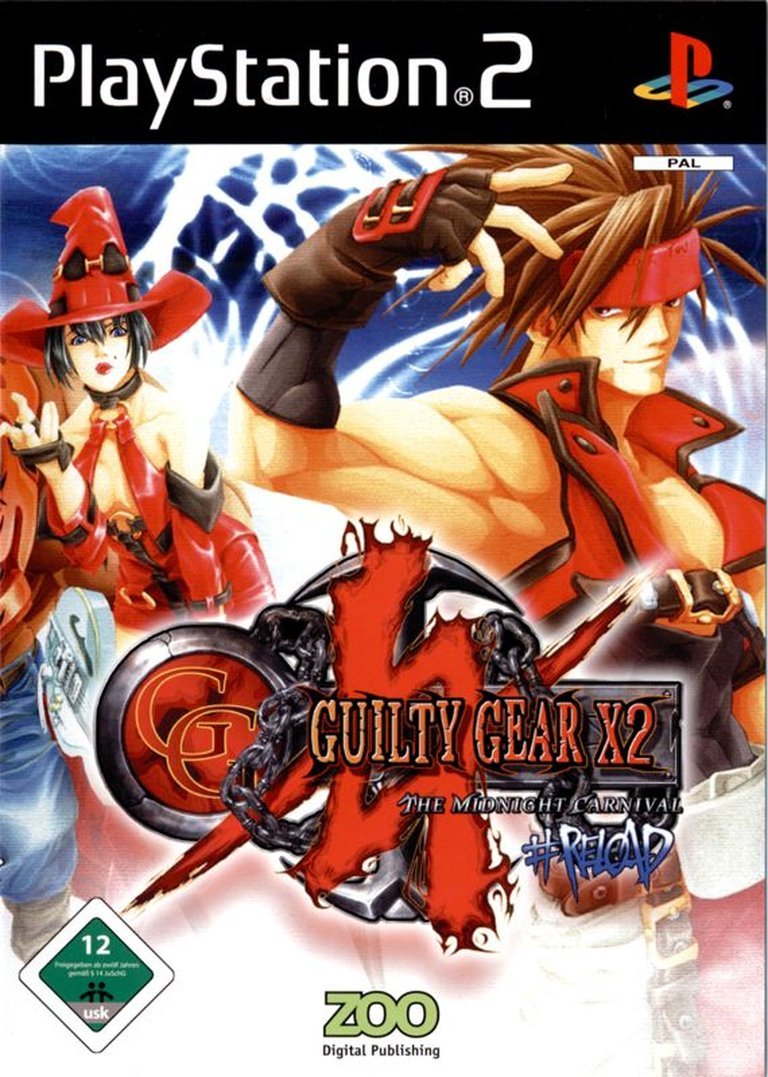
Description
Guilty Gear X2: The Midnight Carnival #Reload is an enhanced update to the original Guilty Gear XX, featuring balanced gameplay, refined moves, and new playable characters. Set in a vibrant, anime-inspired world, the game follows a diverse cast of fighters—including Holy Knights, assassins, and bounty hunters—as they battle in a side-scrolling 2D fighting arena. With unlockable extras, evolving storylines, and online multiplayer on select platforms, it delivers fast-paced combat and deep mechanics for competitive and casual players alike.
Gameplay Videos
Guilty Gear X2: The Midnight Carnival #Reload Reviews & Reception
myabandonware.com (89/100): This game IS abandonware. This version of it, anyway.
mobygames.com (85/100): Average score: 85%
Guilty Gear X2: The Midnight Carnival #Reload: A Masterclass in 2D Fighting Evolution
Introduction
In the pantheon of 2D fighting games, few titles have left as indelible a mark as Guilty Gear X2: The Midnight Carnival #Reload. Released in 2003 as an update to Guilty Gear XX, this iteration refined the series’ signature blend of high-speed combat, intricate mechanics, and gothic-punk aesthetics into a near-perfect fighting experience. Developed by Arc System Works, #Reload stands as a testament to the studio’s commitment to balancing depth with accessibility, all while pushing the boundaries of what a 2D fighter could achieve in the early 2000s. This review will dissect the game’s development, narrative, gameplay, and legacy, arguing that #Reload is not just a high-water mark for the Guilty Gear series, but a cornerstone of the fighting game genre as a whole.
Development History & Context
The Studio and Vision
Arc System Works, founded in 1988, had already established itself as a formidable force in the fighting game genre with the original Guilty Gear (1998) and its sequel, Guilty Gear X (2000). The studio’s founder, Daisuke Ishiwatari, served as the creative linchpin for the series, contributing not only as a director and designer but also as a composer and voice actor. His vision for Guilty Gear was ambitious: a fighting game that merged the technical depth of Street Fighter with the stylistic flair of anime and heavy metal. By the time Guilty Gear X2 (2002) rolled around, Arc System Works had honed its craft, delivering a game that was both a critical and commercial success.
#Reload emerged as an iterative update to Guilty Gear X2, a practice common in the fighting game community to refine balance, add content, and extend the lifespan of a title. Released in arcades in March 2003 and later ported to the PlayStation 2, Xbox, Windows, and PSP, #Reload was designed to address the imbalances and oversights of its predecessor while introducing new mechanics and content to keep the competitive scene engaged.
Technological Constraints and Innovations
The early 2000s were a transitional period for fighting games. While 3D fighters like Tekken and Virtua Fighter dominated the arcade scene, 2D fighters were increasingly seen as a niche genre. Arc System Works, however, remained committed to the 2D format, leveraging the Sega NAOMI arcade hardware to push the visual and technical boundaries of sprite-based combat.
One of the most significant innovations in #Reload was the introduction of the Burst Gauge, a new resource that allowed players to perform Psyche Bursts—a defensive mechanic that could interrupt an opponent’s combo. This addition was a game-changer, as it provided a way for players to escape pressure and turn the tide of a match. The Burst Gauge also introduced a risk-reward dynamic, as using a burst at the wrong time could leave a player vulnerable.
Another key feature was the Force Roman Cancel (FRC), a technique that allowed players to cancel certain moves into others at the cost of 25% of their tension gauge. This mechanic deepened the combo system, enabling more creative and devastating sequences. The inclusion of FRCs was a testament to Arc System Works’ commitment to rewarding mastery and skill expression.
The Gaming Landscape
At the time of #Reload‘s release, the fighting game community was in a state of flux. The arcade scene, once the lifeblood of the genre, was in decline, particularly in the West. Home consoles were becoming the primary platform for fighting games, and online play was still in its infancy. #Reload was one of the first fighting games to embrace online multiplayer, with its Xbox version featuring Xbox Live support. This was a bold move, as online play in fighting games was fraught with technical challenges, particularly in maintaining the precise timing and input responsiveness that the genre demanded.
Despite these challenges, #Reload thrived. Its release on multiple platforms ensured a broad audience, and its deep mechanics and balanced roster made it a favorite among competitive players. The game’s success was a testament to Arc System Works’ ability to adapt to the changing landscape while staying true to the core principles of the Guilty Gear series.
Narrative & Thematic Deep Dive
Plot and Characters
Guilty Gear X2: The Midnight Carnival #Reload continues the story of the Guilty Gear series, set in a post-apocalyptic world where humanity is recovering from a devastating war against the Gears—biological weapons created by the enigmatic “That Man.” The narrative is fragmented, with each character’s story mode offering a unique perspective on the overarching conflict.
The game’s roster is a diverse and eclectic mix of fighters, each with their own motivations and backstories. Sol Badguy, the series’ protagonist, is a rogue Gear seeking redemption. Ky Kiske, the Holy Knight, is tasked with hunting down Gears and maintaining order. May, a cheerful pirate, searches for her friend Dizzy, while Faust, a deranged doctor, seeks to “heal” the world through violence. The cast is rounded out by a host of unique characters, including Bridget, a bounty hunter with a complex gender identity, and I-No, a mysterious woman with ties to “That Man.”
The narrative in #Reload is delivered through a combination of in-game dialogue and illustrated cutscenes. While the story is not the primary draw of the game, it provides a rich backdrop for the combat, giving players a reason to invest in the characters and their struggles. The writing is often melodramatic and over-the-top, befitting the game’s anime-inspired aesthetic, but it also touches on deeper themes of identity, redemption, and the consequences of war.
Themes and Symbolism
At its core, Guilty Gear is a story about the cyclical nature of violence and the struggle for redemption. The Gears, created as weapons of war, are both victims and perpetrators of the conflict that has ravaged the world. Characters like Sol and Ky grapple with their past actions, seeking to atone for the sins they have committed. This theme is reflected in the game’s mechanics, where players must constantly adapt and evolve their strategies to overcome their opponents.
The game’s gothic-punk aesthetic also plays a significant role in its thematic depth. The world of Guilty Gear is a dark and oppressive place, filled with ruins and remnants of a once-great civilization. The characters, with their elaborate costumes and exaggerated designs, are a visual representation of the game’s themes of rebellion and individuality. The heavy metal soundtrack, composed by Daisuke Ishiwatari, further reinforces this aesthetic, with its driving rhythms and aggressive guitar riffs serving as a sonic backdrop to the on-screen chaos.
Dialogue and Localization
One of the standout features of #Reload is its fully voiced dialogue, a rarity in fighting games at the time. The voice acting is a mix of Japanese and English, with the latter often criticized for its stiff and unnatural delivery. However, the Japanese voice acting is top-notch, with veteran voice actors like Norio Wakamoto (Johnny) and Kikuko Inoue (I-No) bringing their characters to life with nuance and emotion.
The localization of #Reload is another area where the game shines. The English script, while not without its flaws, does an admirable job of capturing the game’s unique tone and style. The dialogue is often humorous and self-aware, with characters breaking the fourth wall and poking fun at the absurdity of their situations. This playful approach to storytelling helps to balance the game’s darker themes, making the narrative more accessible and engaging.
Gameplay Mechanics & Systems
Core Gameplay Loop
At its heart, Guilty Gear X2: The Midnight Carnival #Reload is a 2D fighting game that emphasizes speed, precision, and creativity. The core gameplay loop revolves around mastering a character’s move set, learning matchups, and executing combos with surgical precision. The game’s controls are tight and responsive, with a five-button layout that includes Punch, Kick, Slash, Heavy Slash, and Dust—a unique attack that launches opponents into the air.
The Tension Gauge is a central mechanic in #Reload, filling as the player lands hits or takes damage. This gauge is used to power Overdrive Attacks (super moves) and Roman Cancels, a technique that allows players to cancel the recovery frames of certain moves into others. The introduction of the Burst Gauge in #Reload added another layer of strategy, as players could now use Psyche Bursts to escape combos or interrupt opponent’s attacks.
Combat and Character Progression
#Reload features a roster of 23 playable characters, each with their own unique playstyle and move set. The game’s balance is exceptional, with no single character dominating the meta. This diversity encourages players to experiment with different fighters, each offering a distinct approach to combat.
The game’s Mission Mode is a standout feature, offering 100 challenges that test the player’s mastery of each character’s move set. These missions range from simple combo trials to complex scenarios that require precise execution and strategic thinking. Completing these missions unlocks new content, including alternate costumes and artwork, providing a tangible sense of progression.
UI and Innovative Systems
The user interface in #Reload is clean and intuitive, with health bars, tension gauges, and burst meters clearly displayed. The game’s Training Mode is particularly robust, offering a range of options for practicing combos and matchups. Players can adjust the AI’s behavior, set up specific scenarios, and even record and playback their inputs to analyze their performance.
One of the most innovative features in #Reload is the COUNTER option in Training Mode, which allows players to practice attacks on an opponent as counterhits. This is a crucial tool for mastering the game’s advanced mechanics, as counterhits often lead to more damaging combos and different properties.
Flaws and Criticisms
While #Reload is widely regarded as a masterpiece, it is not without its flaws. The game’s steep learning curve can be daunting for newcomers, with its complex mechanics and precise execution requirements. The lack of a comprehensive tutorial mode means that players must rely on external resources, such as guides and community forums, to fully grasp the game’s systems.
Another criticism leveled at #Reload is its online play, which, while groundbreaking for its time, was not without issues. The Xbox Live implementation, in particular, suffered from lag and connectivity problems, which could be frustrating for competitive players. However, these issues were largely mitigated in later iterations of the game, such as Guilty Gear XX Accent Core Plus R, which introduced rollback netcode.
World-Building, Art & Sound
Setting and Atmosphere
The world of Guilty Gear is a dark and oppressive one, filled with the remnants of a once-great civilization. The game’s stages are a visual feast, ranging from the rain-soaked streets of London to the fiery depths of Hell. Each stage is meticulously detailed, with layered parallax scrolling and dynamic lighting effects that bring the world to life.
The game’s gothic-punk aesthetic is a defining feature, blending elements of cyberpunk, steampunk, and gothic horror. The character designs are equally striking, with elaborate costumes and exaggerated proportions that reflect the game’s anime-inspired roots. From Sol Badguy’s leather-clad rebel look to I-No’s gothic Lolita attire, each character is a visual representation of their personality and backstory.
Visual Direction
#Reload is a technical marvel, pushing the limits of 2D sprite-based animation. The character sprites are highly detailed, with fluid animations that convey a sense of weight and impact. The game’s use of color is particularly impressive, with vibrant hues and bold contrasts that make each character stand out against the detailed backgrounds.
The visual effects in #Reload are equally impressive, with explosive impacts, flashing lights, and dynamic camera angles that heighten the intensity of the combat. The game’s Roman Cancel mechanic is a visual spectacle, with the screen freezing momentarily as the player cancels one move into another. This not only serves as a gameplay mechanic but also as a stylistic flourish, reinforcing the game’s emphasis on speed and precision.
Sound Design and Music
The sound design in #Reload is top-notch, with crisp sound effects that convey the weight and impact of each attack. The voice acting, while not universally praised, is a key part of the game’s personality, with each character’s lines reflecting their unique personality and backstory.
However, the true star of the game’s audio presentation is its soundtrack, composed by Daisuke Ishiwatari. The music is a blend of heavy metal, rock, and electronic influences, with driving rhythms and aggressive guitar riffs that perfectly complement the on-screen action. Tracks like “Holy Orders (Be Just or Be Dead)” and “Ride the Fire!” are iconic within the fighting game community, and the soundtrack as a whole is widely regarded as one of the best in the genre.
The game’s Korean exclusive soundtrack, composed by Shin Hae Chul, is another standout feature. This alternate soundtrack retains the heavy metal and rock influences of the original but adds a unique Korean flavor, with synth-heavy arrangements and electronic beats. While not as widely known as the original soundtrack, it is a fascinating alternate take on the game’s audio identity.
Reception & Legacy
Critical and Commercial Reception
Guilty Gear X2: The Midnight Carnival #Reload was met with widespread critical acclaim upon its release. Reviewers praised the game’s deep mechanics, balanced roster, and stunning visuals, with many hailing it as one of the best fighting games of its generation. The game’s Xbox version, in particular, was lauded for its online play, which was a rarity in fighting games at the time.
Critics also praised the game’s soundtrack and voice acting, with the heavy metal-inspired music receiving particular acclaim. The game’s Mission Mode was another highlight, offering a wealth of content for players to sink their teeth into. However, some reviewers noted the game’s steep learning curve and lack of a comprehensive tutorial, which could be off-putting for newcomers.
Commercially, #Reload was a success, selling well across multiple platforms. The game’s PlayStation 2 version sold over 90,000 copies in Japan, while the Xbox version found a dedicated audience in the West. The game’s PC version, released on Steam in 2014, introduced a new generation of players to the Guilty Gear series, further cementing its legacy.
Influence and Evolution
#Reload had a profound impact on the fighting game genre, influencing subsequent titles in the Guilty Gear series and beyond. The game’s Burst Gauge and Force Roman Cancel mechanics became staples of the series, appearing in later iterations like Guilty Gear XX Accent Core and Guilty Gear Xrd. The game’s online play also set a precedent for future fighting games, with titles like Street Fighter IV and Mortal Kombat following in its footsteps.
The game’s visual style and soundtrack have also left a lasting impression on the genre. The gothic-punk aesthetic of Guilty Gear has become a defining feature of the series, inspiring countless imitators and homages. The game’s heavy metal soundtrack has similarly become iconic, with tracks like “Holy Orders (Be Just or Be Dead)” and “Ride the Fire!” remaining fan favorites to this day.
Competitive Scene and Community
#Reload has maintained a dedicated competitive scene since its release, with tournaments and events held around the world. The game’s deep mechanics and balanced roster make it a favorite among competitive players, and its online play has helped to keep the community alive and thriving.
The game’s community is another key part of its legacy. Fans of Guilty Gear are known for their passion and dedication, with forums, Discord servers, and social media groups dedicated to discussing and analyzing the game. The game’s modding community is also active, with players creating custom stages, characters, and even entirely new game modes.
Conclusion
Guilty Gear X2: The Midnight Carnival #Reload is a masterclass in 2D fighting game design. Its deep mechanics, balanced roster, and stunning visuals set a new standard for the genre, while its innovative features like the Burst Gauge and Force Roman Cancel added layers of strategy and creativity. The game’s gothic-punk aesthetic and heavy metal soundtrack further cemented its identity, creating a unique and immersive world that has captivated players for over two decades.
While the game is not without its flaws—its steep learning curve and online play issues chief among them—its strengths far outweigh its weaknesses. #Reload is a testament to Arc System Works’ commitment to pushing the boundaries of the fighting game genre, and its influence can be seen in countless titles that followed in its wake.
For fans of fighting games, Guilty Gear X2: The Midnight Carnival #Reload is an essential experience. Its deep mechanics, rich lore, and stunning presentation make it a standout title in a genre known for its innovation and creativity. Whether you’re a seasoned veteran or a newcomer looking to dive into the world of Guilty Gear, #Reload is a game that demands to be played, studied, and celebrated.
Final Verdict: 9.5/10 – A Timeless Masterpiece
Guilty Gear X2: The Midnight Carnival #Reload is not just one of the best fighting games of its generation—it’s one of the best fighting games of all time. Its influence on the genre is undeniable, and its legacy continues to inspire and challenge players to this day. If you have even a passing interest in fighting games, #Reload is a must-play experience that will leave a lasting impression.