
- Release Year: 1999
- Platforms: Windows
- Publisher: Active Media Group AB
- Developer: Young IQ
- Genre: Action, Puzzle
- Perspective: Side view
- Game Mode: Hotseat, Single-player
- Gameplay: Arcade, Gambling elements, Mini-games, Paddle, Pinball, Platform, Pong, Shooter, Tile matching puzzle
- Setting: Europe, Futuristic, Sci-fi
- Average Score: 95/100
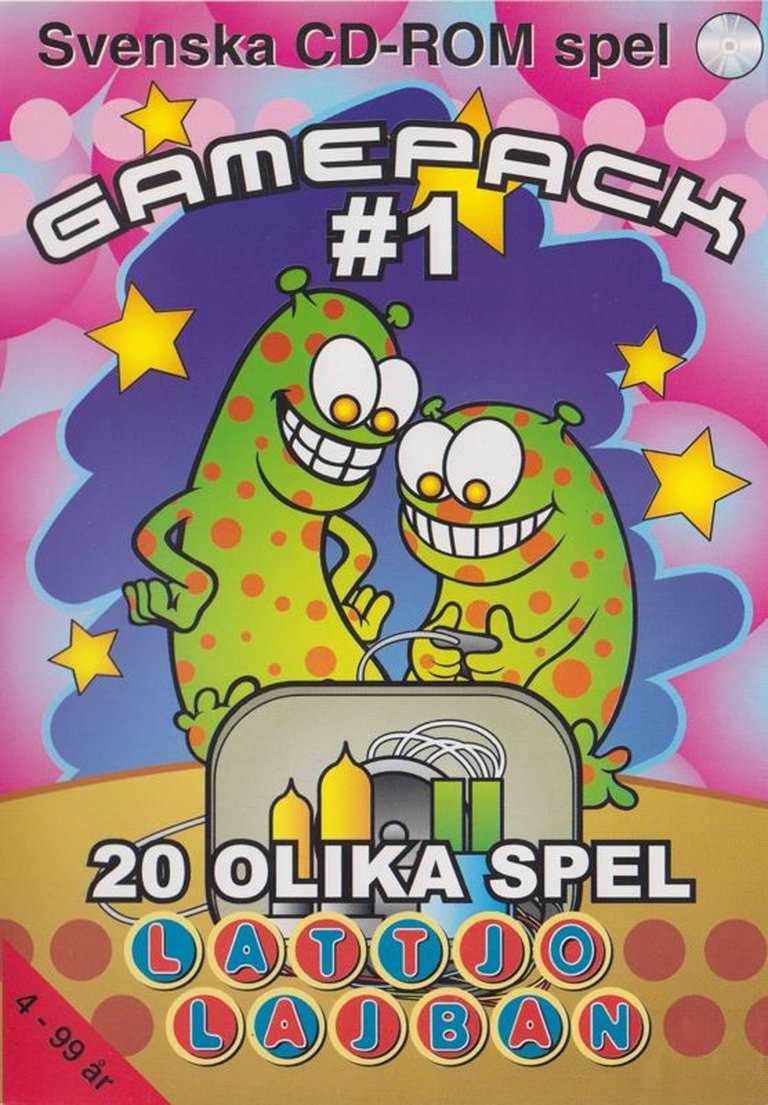
Description
Gamepack #1 is a 1999 Windows collection of 20 diverse mini-games spanning genres like arcade, puzzle, and memory, all created using Click&Create. The games are accessed via a grid interface and include a mix of single-player and two-player experiences, such as memory games with international photos, a superhero sidescroller, a space battle shooter, and quirky challenges like an ice cream-making simulator and a medieval anachronism puzzle. While scores are not saved, the variety offers quick, casual entertainment with themes ranging from sci-fi to European settings.
Gamepack #1 Reviews & Reception
metacritic.com (98/100): The greatest weapons-based fighter returns, this time on Sega Dreamcast.
metacritic.com (93/100): Homeworld boasts amazing ship graphics and gorgeous deep-space vistas, a unique command and navigation interface and white-knuckle real-time strategy.
Gamepack #1 Cheats & Codes
PlayStation (PSX)
| Code | Effect |
|---|---|
| Triangle, Circle, Square | Pitfall 3D demo |
| Circle, Square, Triangle | Mechwarrior 2 information |
| Circle(2), Triangle | NBA Shoot Out ’97 information |
| Square, Triangle, Square | Peak Performance information |
| X or Start simultaneously on controllers one and two | Puzzle Fighter 2 Turbo two player mode |
| Square, Triangle, Circle | View Ogre Battle FMV sequence |
| Circle, Square, Circle | View Steel Reign FMV sequence |
| Square, Circle, Triangle | View Underground CD Volume 2 FMV sequence |
| Triangle(2), Square | View credits |
Gamepack #1: A Forgotten Gem of the Late ’90s Mini-Game Compilation Era
Introduction
In the shadow of 1999’s titanic releases—System Shock 2, Planescape: Torment, and Soulcalibur—lies Gamepack #1, a modest yet fascinating artifact of late-’90s gaming culture. Developed by Young IQ and published by Active Media Group AB, this CD-ROM compilation of 20 mini-games is a snapshot of an era when “game creation tools” like Click&Create democratized development, and publishers scrambled to capitalize on the burgeoning casual and educational gaming markets. While it lacks the polish or ambition of its contemporaries, Gamepack #1 offers a unique lens into the experimental, often overlooked corners of the industry—a time when games were as much about novelty as they were about depth.
This review will dissect Gamepack #1 in exhaustive detail, exploring its development context, gameplay mechanics, and the curious legacy of a title that, despite its obscurity, reflects the playful, unrefined spirit of its time.
Development History & Context
The Studio and the Tool
Gamepack #1 was developed by Young IQ, a studio with a focus on educational and family-friendly software. Their work often targeted younger audiences or casual gamers, a niche that aligned perfectly with the rise of “edutainment” in the late ’90s. The game was built using Click&Create, a user-friendly game development tool released in 1994 by Europress Software. Click&Create allowed aspiring developers to assemble games without extensive programming knowledge, using a drag-and-drop interface and pre-built templates. This tool was part of a broader movement—alongside The Games Factory and Klik & Play—that lowered the barrier to entry for game creation, fostering a wave of indie and amateur projects.
For Gamepack #1, Click&Create’s limitations were both a blessing and a curse. The tool’s simplicity enabled rapid prototyping and iteration, but it also constrained the game’s technical ambition. The result is a compilation that feels simultaneously charming and crude, a testament to the era’s “good enough” ethos.
The Gaming Landscape of 1999
1999 was a year of seismic shifts in the gaming industry. The Dreamcast had just launched in North America, promising a new era of online gaming and 3D graphics. Meanwhile, the PlayStation and Nintendo 64 were in their twilight years, churning out late-cycle masterpieces like Final Fantasy VIII and Donkey Kong 64. The PC gaming scene was equally vibrant, with Half-Life, Unreal Tournament, and EverQuest redefining multiplayer and immersive storytelling.
Amidst this backdrop, Gamepack #1 occupied a niche that was rapidly fading: the mini-game compilation. These collections, often bundled with magazines or sold as budget titles, were a staple of the ’90s, offering bite-sized experiences for players with limited time or attention spans. However, by 1999, the market was shifting toward more polished, narrative-driven experiences. Gamepack #1’s existence is a reminder of this transitional period, where older forms of gaming coexisted uneasily with the industry’s future.
Technological Constraints
The game’s technical specifications reveal its modest ambitions:
– Platform: Windows (CD-ROM)
– Visual Style: Fixed/flip-screen, side-view, and top-down perspectives
– Gameplay: A mix of real-time and turn-based mechanics
– Multiplayer: Local same-screen only (1-2 players)
The lack of high-score saving—a staple of arcade and score-chasing games—is particularly telling. Scores were stored only in memory during play sessions, a limitation likely imposed by Click&Create’s engine. This design choice underscores the game’s ephemeral nature: it was meant to be played in short bursts, not as a competitive or long-term experience.
Narrative & Thematic Deep Dive
The Absence of Narrative
Gamepack #1 is, at its core, a narrative-free experience. There is no overarching story, no characters to speak of, and no dialogue beyond the occasional on-screen prompt. Instead, the game relies on pure gameplay mechanics to engage players, a stark contrast to the story-driven epics of 1999.
This absence of narrative is not a flaw but a deliberate design choice. The game’s appeal lies in its variety and immediacy. Each mini-game is a self-contained challenge, designed to be picked up and played without context. This approach aligns with the era’s casual gaming trends, where titles like Microsoft Entertainment Pack and The Playroom thrived on simplicity and accessibility.
Themes: Education and Play
While Gamepack #1 lacks a traditional narrative, it is not without thematic underpinnings. Many of the mini-games subtly incorporate educational elements, reflecting Young IQ’s focus on learning through play. For example:
– Geography Puzzle: Players must correctly place Sweden’s regions on a map, a task that blends puzzle-solving with basic geography.
– Math Shooter: A space-themed game where players solve simple addition problems to target enemies, combining arithmetic with arcade action.
– Medieval Anachronism: A game where players remove out-of-place objects from a medieval scene, teaching historical awareness through interaction.
These elements are not overtly didactic but instead integrated into the gameplay, making learning feel like a natural part of the experience. This approach was common in late-’90s edutainment, where games like The Oregon Trail and Where in the World Is Carmen Sandiego? proved that education and entertainment could coexist.
Cultural Representation
Several mini-games in Gamepack #1 feature cultural and geographical themes, particularly in the memory games. Three of the tile-matching games use photographs from:
– The Netherlands
– France
– Around the world
These games serve as virtual postcards, offering players a glimpse into different cultures through imagery. While the representation is superficial—limited to static images—it reflects a broader trend in ’90s gaming, where titles like Europa spelet (another Young IQ game) used similar mechanics to teach geography and cultural awareness.
Gameplay Mechanics & Systems
The Mini-Game Grid
Gamepack #1 presents its 20 mini-games in a 5×4 grid of numbered buttons, each leading to a different experience. The lack of descriptions or previews adds an element of mystery and discovery, encouraging players to explore each game blindly. This design choice harkens back to the arcade cabinets of the ’80s, where players would drop a quarter into an unfamiliar machine, unsure of what to expect.
The grid’s randomness is both a strength and a weakness. On one hand, it fosters curiosity and replayability—players might return to the grid to try a game they previously overlooked. On the other, it lacks the curated experience of modern compilations like Nintendo Switch Online’s NES/SNES libraries, where games are organized by genre or difficulty.
Core Gameplay Loops
The mini-games in Gamepack #1 span a wide range of genres, each with its own mechanics. Below is a breakdown of the most notable entries:
-
Memory Games (3 variants)
- Mechanics: Classic tile-matching, where players flip tiles to find pairs.
- Twist: Each variant uses different imagery (Netherlands, France, world landmarks), adding a cultural layer.
- Analysis: These games are simple but effective, relying on a tried-and-true mechanic. The lack of a timer in some variants makes them accessible to younger players.
-
Superhero Sidescroller
- Mechanics: A time-limited sidescrolling shooter where players control a flying hero, hitting targets for points.
- Analysis: This game is a barebones Gradius or R-Type clone, lacking the depth or visual flair of its inspirations. The time limit adds urgency but also frustration, as players may feel rushed.
-
Shell Game
- Mechanics: A classic “three cups and a ball” game, where players must track a coin as cups shuffle.
- Twist: Distracting objects move across the screen, increasing difficulty.
- Analysis: This game is a test of focus and pattern recognition, a rare example of a mini-game that feels like a cognitive exercise rather than pure entertainment.
-
Space Battle
- Mechanics: A top-down shooter where players defend their ships from waves of enemies in an asteroid field.
- Analysis: A simplified Asteroids or Galaga experience, with basic controls and repetitive gameplay. The lack of power-ups or progression makes it feel shallow compared to contemporaries like R-Type Delta.
-
Medieval Anachronism
- Mechanics: Players remove modern objects from a medieval scene.
- Analysis: This game is more puzzle than action, requiring players to identify historical inconsistencies. It’s a clever way to teach history but may feel too slow for players seeking fast-paced fun.
-
Ice Cream Machine
- Mechanics: A time-management game where players fulfill ice cream orders.
- Analysis: A proto-Diner Dash, this game tasks players with quick decision-making. The lack of a scoring system beyond points makes it feel incomplete, but the core idea is sound.
-
Breakout Clone
- Mechanics: A single-level Breakout variant.
- Analysis: This is the most straightforward of the mini-games, offering little beyond the original Breakout formula. The fixed layout limits replayability.
-
Missile Defense
- Mechanics: Players control a cannon to shoot down missiles targeting a village.
- Analysis: A simplified Missile Command, this game is tense but repetitive. The lack of varying missile patterns or power-ups makes it feel stale after a few plays.
-
Oil Drop Catcher
- Mechanics: Players catch falling oil drops in a drum balanced on a see-saw.
- Analysis: This game is frustratingly imprecise, with the see-saw mechanics making it difficult to position the drum accurately. It’s a rare misstep in an otherwise solid compilation.
-
Pinball (Space Theme)
- Mechanics: A space-themed pinball game where Earth is the ball.
- Analysis: This is one of the most polished mini-games, with a unique premise and satisfying physics. The lack of multiple tables limits its depth, but it’s a standout.
-
Shooting Gallery
- Mechanics: A light-gun-style game with pop-up targets.
- Analysis: A serviceable Duck Hunt clone, this game suffers from imprecise controls (likely due to mouse input) but offers quick, satisfying gameplay.
-
Sweden Geography Puzzle
- Mechanics: Players place Sweden’s regions on a map using a wind turbine to rotate pieces.
- Analysis: This game is educational but clunky, with the wind turbine mechanic feeling unnecessarily gimmicky. The puzzle itself is well-designed, but the controls hinder enjoyment.
-
Math Shooter
- Mechanics: Players solve addition problems to target enemies.
- Analysis: A clever blend of math and action, this game makes learning feel interactive and rewarding. The space theme adds a layer of fun, but the difficulty ramps up quickly.
-
Picture Straightening Puzzle
- Mechanics: Players straighten tilted pictures on a wall, with each adjustment affecting others.
- Analysis: This game is deceptively complex, requiring players to think ahead. It’s one of the most unique mini-games in the compilation, though the controls can be fiddly.
-
Maniac Racers (2-Player Racing)
- Mechanics: A top-down racing game for two players.
- Analysis: This is the only multiplayer-exclusive game in the compilation, offering chaotic, competitive fun. The controls are simple but responsive, making it a highlight for local play.
-
Crab Sound Effects
- Mechanics: Players interact with crabs on a beach, triggering sound effects.
- Analysis: This is the most bizarre mini-game, offering no clear objective beyond experimentation. It’s more of a toy than a game, but its weirdness makes it memorable.
-
Platformer (Jewel Hunt)
- Mechanics: A sidescrolling platformer where players avoid pumpkins to reach a jewel.
- Analysis: A basic Super Mario Bros. clone, this game lacks the polish or level design of its inspiration. The pumpkin enemies are poorly telegraphed, leading to cheap deaths.
-
Platformer (Castle Infiltration)
- Mechanics: A platformer where players rescue a horse/pegasus from a castle.
- Analysis: This is the most ambitious of the platformers, with keys, guards, and multiple paths. However, the controls are stiff, and the level design is unforgiving, making it frustrating.
Innovative or Flawed Systems?
Gamepack #1’s mechanics are largely derivative, borrowing heavily from established genres. However, a few systems stand out as either innovative or flawed:
- Educational Integration: The seamless blending of learning and gameplay in games like Math Shooter and Sweden Geography Puzzle is ahead of its time, foreshadowing modern “gamified” education tools.
- Multiplayer Focus: Games like Maniac Racers and the memory games prioritize local multiplayer, a rarity in an era increasingly dominated by single-player experiences.
- Lack of Progression: The absence of high scores or unlockables makes the game feel disposable. While this aligns with its casual roots, it also limits long-term engagement.
UI and Controls
The game’s user interface (UI) is minimalist to a fault. The grid of numbered buttons offers no hints or previews, forcing players to rely on trial and error. The controls vary by mini-game but are generally mouse-driven, with some games supporting keyboard inputs. The lack of customization options (e.g., rebinding keys) reflects the game’s budget origins.
World-Building, Art & Sound
Setting and Atmosphere
Gamepack #1 lacks a unified setting, instead offering a patchwork of themes ranging from medieval Europe to outer space. This eclecticism is part of its charm, as each mini-game feels like a self-contained diorama. However, the lack of cohesion also makes the compilation feel scattered, with no overarching identity.
The art style is functional but unremarkable, with simple sprites and backgrounds that reflect the limitations of Click&Create. Some games, like the pinball and space battle, feature more detailed visuals, while others, like the memory games, rely on static photographs. The result is a visually inconsistent experience, though one that occasionally surprises with its creativity.
Sound Design
The game’s sound design is equally minimalist. Most mini-games feature basic sound effects (e.g., blasts in the space battle, flipping tiles in the memory games), but there is no music to speak of. The crab sound effects game is the sole exception, offering a playful audio sandbox that stands out for its weirdness.
The absence of music is a missed opportunity, as even simple chiptune tracks could have elevated the experience. Instead, the game relies on ambient silence, which makes the experience feel sterile at times.
Reception & Legacy
Critical and Commercial Reception
Gamepack #1 received little to no critical attention upon release, a fate shared by many budget compilations of the era. Its commercial performance is equally obscure, though its presence on MobyGames suggests it found at least a small audience among casual gamers.
The game’s Moby Score is listed as “n/a,” indicating it was never formally reviewed by major outlets. This obscurity is not surprising—Gamepack #1 was not designed to compete with the blockbuster titles of 1999 but rather to fill a niche for younger or less demanding players.
Evolution of Its Reputation
In the years since its release, Gamepack #1 has faded into obscurity, remembered only by those who encountered it in their youth or through retro gaming circles. Its legacy is not one of innovation or influence but rather as a time capsule of late-’90s gaming culture.
The game’s most enduring contribution may be its use of Click&Create, a tool that empowered amateur developers. While Gamepack #1 itself is forgettable, it represents a larger movement toward accessible game development, one that would later evolve into modern indie gaming.
Influence on Subsequent Games
Gamepack #1 did not directly influence later titles, but its compilation format lived on in games like:
– WarioWare, Inc. (2003), which refined the mini-game concept with microgames and rapid-fire gameplay.
– The Playroom (2013), a PS4 launch title that used mini-games to showcase the console’s features.
– Nintendo Switch Online’s classic game libraries, which curate retro titles in a similar grid-based interface.
The game’s educational elements also foreshadowed later titles like Brain Age and Big Brain Academy, which blended learning with gameplay in more polished ways.
Conclusion: A Modest Footnote in Gaming History
Gamepack #1 is not a great game by any stretch of the imagination. It lacks the polish, depth, and ambition of its 1999 contemporaries, and its reliance on derivative mechanics makes it feel unremarkable in hindsight. Yet, it is not without charm or historical significance.
As a product of its time, Gamepack #1 reflects the late-’90s gaming landscape—a period of transition and experimentation, where older forms of play coexisted with the industry’s future. Its use of Click&Create highlights the democratization of game development, while its educational elements showcase the era’s fascination with “edutainment.” Most importantly, it serves as a reminder of gaming’s playful, unrefined roots, a time when games could be simple, weird, and unapologetically fun.
Final Verdict: Gamepack #1 is a curiosity rather than a classic, best appreciated by retro gaming enthusiasts or those interested in the history of casual and educational games. It is not a must-play, but it is a worthwhile artifact—a modest footnote in a year defined by giants.
Score: 5/10 – A flawed but fascinating relic of its era.