
- Release Year: 2019
- Platforms: Windows
- Publisher: Moon Bear
- Developer: Moon Bear
- Genre: Action, Puzzle
- Perspective: 1st-person
- Game Mode: Single-player
- Gameplay: Puzzle elements, Shooter
- Setting: Futuristic, Sci-fi
- Average Score: 85/100
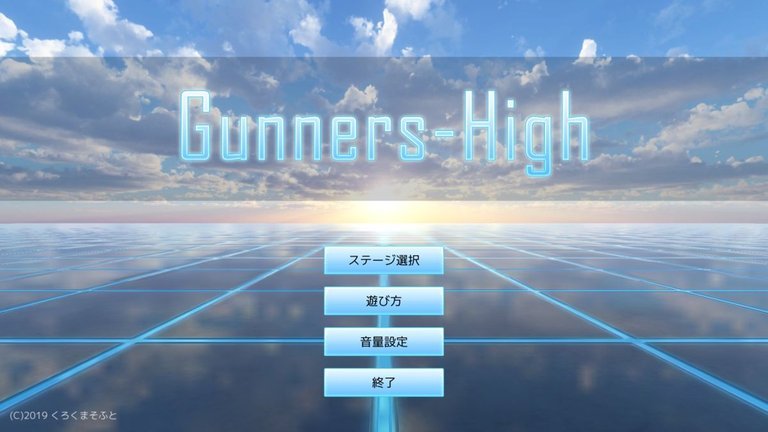
Description
Gunners-High is a fast-paced puzzle-shooter game set in a futuristic, high-altitude environment where players must destroy all targets on elevated platforms within a strict time limit and with limited ammunition. The game challenges players with precision aiming, strategic use of different guns, and navigating traps across nine unique levels, blending action and puzzle elements in a sci-fi setting.
Gunners-High Mods
Gunners-High Reviews & Reception
ign.com (85/100): There’s nothing damning about spending time in Afterparty’s version of Hell.
gameinformer.com (85/100): Dreams’ robust design and sharing tools offer endless possibilities to creators and a growing tidal wave of fun, hilarious, and moving gameplay experiences for players.
Gunners-High Cheats & Codes
PlayStation
Wait until the opening demo completes. Then when the title screen appears, hold L1 + L2 + R1 + R2 and press Select. If you entered the code correctly, the ‘Push Start’ text will change to ‘Secret Code’. There will now be two letters behind the ‘Secret Code’ text. Press Up or Down to change the left letter. Press Triangle or X to change the right letter. Then, enter one of the following codes to enable the corresponding cheat effect:
| Code | Effect |
|---|---|
| MA | Start at Stage 2 |
| UT | Start at Stage 3 |
| RH | Start at Stage 4 |
| MK | Start at Stage 5 |
| HT | Start at Stage 6 |
| CM | Small character (does not alter hit check size) |
| QB | Large character (does not alter hit check size) |
| MV | Press X, Square, O, Circle on controller two for smaller windows on screen |
| YI | Start with nine bombs |
| TY | Axel or Ruka can kill with one hit |
| SS | Weapon power-up time starts at 999 seconds |
PlayStation (Debug Mode)
Enable the ‘Cheat mode’ code. Then, set the code to ‘MA’, press Select, change code to ‘SV’, and press Start. Now press one of the following buttons on controller two to enable the corresponding cheat effect:
| Code | Effect |
|---|---|
| Up | Boosts weapon power to maximum for ten seconds |
| Down | Toggle voice mode |
| Left | Change Gunlock type |
| Right | Skips area and disengages Invincibility |
| Triangle | Toggles Invincibility (falling will still cause damage) |
| Circle | Increases number of bombs |
| Square | Switches selected weapon type between Axel and Ruka |
| X | Increases weapon power up time in 30 second increments |
Gunners-High: A Forgotten Gem in the Puzzle-Shooter Hybrid Genre
Introduction: The Overlooked Experiment
In the vast, ever-expanding universe of video games, where blockbuster franchises dominate headlines and indie darlings capture hearts, Gunners-High (2019) remains a curious footnote—a game that slipped through the cracks of mainstream attention despite its ambitious fusion of genres. Developed and published by the obscure studio Moon Bear, Gunners-High is a first-person puzzle-shooter that challenges players to destroy targets across nine precarious, platform-based levels, all while managing limited ammunition and strict time constraints. It is a game of precision, patience, and perseverance, blending the methodical planning of a puzzle game with the twitch reflexes of a shooter.
Yet, for all its mechanical ingenuity, Gunners-High arrived with little fanfare and departed just as quietly. There are no critic reviews on MobyGames, no player testimonials, no cultural footprint. It exists in a liminal space—neither a commercial success nor a critical disaster, but rather a quiet experiment in game design that raises intriguing questions about the intersection of puzzle-solving and shooting mechanics. This review seeks to resurrect Gunners-High from obscurity, dissecting its design, context, and legacy to determine whether it is a hidden masterpiece, a flawed curiosity, or simply a game that arrived at the wrong time.
Development History & Context: The Mystery of Moon Bear
The Studio Behind the Game
Moon Bear is an enigma in the gaming industry. With no notable prior releases and no subsequent projects, the studio’s existence is defined almost entirely by Gunners-High. The lack of information about the developers—their backgrounds, inspirations, or even their location—adds an air of mystery to the game. Were they a small, passionate team experimenting with a niche concept? A group of students testing the waters of commercial game development? Or perhaps a side project from industry veterans working under a pseudonym? Without interviews, postmortems, or even a website, we are left to speculate.
What we do know is that Gunners-High was released on September 3, 2019, exclusively for Windows. The timing of its launch is noteworthy: 2019 was a year dominated by high-profile releases like Sekiro: Shadows Die Twice, Resident Evil 2 Remake, and The Outer Worlds. In such a crowded marketplace, a small, unmarketed puzzle-shooter from an unknown studio would have struggled to gain traction, regardless of its quality. The game’s lack of promotional material, trailers, or even a Steam page with substantial metadata suggests a minimalist, perhaps even amateur, approach to distribution.
Technological and Design Constraints
Gunners-High is a game of modest ambitions, both technically and artistically. The levels are constructed from simple geometric platforms suspended in a void, evoking the aesthetic of a tech demo or an early 2000s indie title. The visuals are functional rather than flashy, prioritizing clarity and precision over immersion or spectacle. This minimalism may have been a deliberate design choice—stripping away distractions to focus on the core mechanics—or a limitation imposed by the team’s resources and expertise.
The game’s mechanics are similarly straightforward but deceptively deep. Players must navigate each level, destroying all targets while conserving ammunition and beating the clock. The addition of traps—such as moving obstacles or environmental hazards—adds a layer of complexity, requiring players to plan their routes and shots carefully. The fusion of puzzle and shooter elements is not entirely novel (games like Portal and The Talos Principle have explored similar territory), but Gunners-High distinguishes itself by emphasizing speed and accuracy over narrative or environmental storytelling.
The Gaming Landscape in 2019
The late 2010s were a period of experimentation and hybridization in game design. The success of titles like Baba Is You (2019), which redefined puzzle mechanics, and Apex Legends (2019), which revolutionized the battle royale genre, demonstrated that players were hungry for fresh ideas. However, the market was also increasingly saturated, with indie developers competing not only with AAA studios but also with an ever-growing backlog of games on platforms like Steam and itch.io.
Gunners-High’s release into this environment was ill-timed. Without a strong marketing push, a recognizable brand, or a unique hook to differentiate it from the hundreds of other indie games vying for attention, it was doomed to obscurity. Its lack of multiplayer or replayable content—features that had become almost mandatory for shooters by 2019—further limited its appeal. In hindsight, Gunners-High feels like a relic of an earlier era, a game that might have thrived in the late 2000s or early 2010s, when the indie scene was less crowded and players were more forgiving of rough edges.
Narrative & Thematic Deep Dive: The Silence of the Void
The Absence of Story
Gunners-High is a game that defies conventional narrative analysis because it has no narrative to speak of. There are no characters, no dialogue, no lore, no cutscenes—just nine levels, a gun, and a timer. The game’s setting is a series of abstract, floating platforms, devoid of context or explanation. Why are these targets here? Who placed them? What is the player’s motivation for destroying them? The game offers no answers, leaving players to project their own meanings onto the experience.
This narrative vacuum is both a strength and a weakness. On one hand, the lack of story allows the gameplay to take center stage, unencumbered by exposition or distractions. Players are free to focus entirely on the mechanics, honing their skills without the pressure of following a plot. On the other hand, the absence of any thematic or emotional anchor makes Gunners-High feel hollow. In an era where even the most mechanical games (e.g., Tetris Effect, Thumper) often incorporate narrative or atmospheric elements to enhance immersion, Gunners-High’s sterility feels like a missed opportunity.
Themes of Precision and Constraint
If Gunners-High has a “story,” it is one told through its mechanics. The game is a meditation on precision, constraint, and the tension between speed and accuracy. Every level is a test of the player’s ability to optimize their actions, balancing the need to destroy targets quickly with the necessity of conserving ammunition. The time limits and traps introduce an element of pressure, forcing players to think on their feet and adapt to unforeseen challenges.
In this sense, Gunners-High can be read as a metaphor for modern life—a series of high-stakes challenges where resources are limited, time is scarce, and failure is punishing. The game’s abstract setting reinforces this interpretation, stripping away the trappings of realism to focus on the raw, unadorned struggle of the player against the system. It is a game about mastery, about overcoming obstacles through skill and perseverance, and about the satisfaction of solving a puzzle under duress.
The Unspoken Influence of Classic Arcade Games
While Gunners-High lacks a explicit narrative, its design philosophy is deeply rooted in the traditions of classic arcade and puzzle games. The game’s emphasis on high scores, time limits, and repetitive play evokes the golden age of arcade gaming, where titles like Space Invaders and Pac-Man challenged players to achieve perfection within rigid constraints. Similarly, the puzzle elements recall the logic-based challenges of games like Lemmings or The Incredible Machine, where success hinged on careful planning and execution.
This retro-inspired design is both a homage and a limitation. For players who grew up with these classics, Gunners-High may feel like a nostalgic throwback, a reminder of a time when games were simpler but no less demanding. For younger players, however, the lack of modern amenities—such as checkpoints, save systems, or dynamic difficulty adjustment—may make the game feel punishing and outdated.
Gameplay Mechanics & Systems: The Core Loop of Destruction
The Fusion of Puzzle and Shooter
At its heart, Gunners-High is a game about destruction. The core loop is simple: enter a level, identify all targets, eliminate them within the time limit, and move on to the next challenge. The twist is that ammunition is limited, forcing players to prioritize their shots and plan their routes carefully. This fusion of puzzle and shooter mechanics is the game’s defining feature, and it is executed with a surprising degree of sophistication.
The puzzle elements manifest in the level design. Each stage is a carefully constructed obstacle course, with targets placed in locations that require precise aiming, creative use of the environment, or strategic sequencing. Some targets may be hidden behind obstacles, requiring players to find the right angle or use ricochet shots. Others may be moving, demanding quick reflexes and anticipation. The addition of traps—such as turrets, collapsing platforms, or environmental hazards—further complicates the puzzle, introducing an element of risk and reward.
The shooter mechanics, meanwhile, are straightforward but effective. The game offers several different guns, each with unique properties (e.g., rate of fire, accuracy, damage). Players must choose the right tool for the job, balancing the need for speed with the constraints of ammunition. The first-person perspective enhances the immersion, making each shot feel weighty and deliberate.
The Role of Time and Ammunition
Time and ammunition are the twin pillars of Gunners-High’s challenge. The time limits are tight but fair, forcing players to act quickly without rushing recklessly. The ammunition constraints, meanwhile, introduce a layer of strategy, as players must decide which targets to prioritize and which to leave for later. This dual pressure creates a tense, high-stakes atmosphere where every decision matters.
The game’s difficulty curve is well-paced, with early levels serving as tutorials for the core mechanics and later stages introducing more complex puzzles and traps. However, the lack of a checkpoint system means that failure can be frustrating, especially in the later levels where a single mistake can force players to restart from the beginning. This design choice is in keeping with the game’s arcade-inspired philosophy, but it may alienate players accustomed to more forgiving modern games.
The User Interface: Minimalism at Its Best (and Worst)
Gunners-High’s UI is a study in minimalism. The HUD is sparse, displaying only the essential information: ammunition count, time remaining, and target status. This clean presentation ensures that the player’s focus remains on the action, but it also means that critical information—such as the location of remaining targets—can be easy to overlook. The lack of a map or radar system forces players to rely on memory and spatial awareness, which can be challenging in the more complex levels.
The menu system is equally barebones, with no options for customization or accessibility. There are no difficulty settings, no control remapping, no visual or audio adjustments. This lack of flexibility is a significant drawback, especially for players with disabilities or those who prefer a more tailored experience.
World-Building, Art & Sound: The Aesthetics of Abstraction
The Abstract Setting: A Void of Meaning
Gunners-High’s world is a series of floating platforms suspended in an endless void. There is no sky, no horizon, no landmarks—just geometric shapes and targets. This abstract setting serves a functional purpose, ensuring that the player’s attention is directed entirely toward the gameplay. However, it also robs the game of any sense of place or atmosphere.
The visual design is utilitarian, with simple textures and basic lighting. The platforms are uniformly colored, and the targets are clearly marked, making them easy to identify even in the heat of action. This clarity is essential for a game that demands precision, but it also makes the world feel sterile and uninspired. There is no environmental storytelling, no hidden details, no sense of discovery—just a series of challenges to be overcome.
The Sound of Silence
The audio design in Gunners-High is equally minimalist. The game features no music, relying instead on ambient sounds and weapon effects to create its atmosphere. The silence is oppressive, reinforcing the game’s isolating, high-pressure environment. The sound of gunfire is sharp and punchy, emphasizing the weight of each shot, while the ambient noises—such as the hum of machinery or the creaking of platforms—add a subtle layer of tension.
However, the lack of music is a missed opportunity. A dynamic soundtrack could have enhanced the game’s emotional impact, building tension during critical moments and providing a sense of relief upon completion. As it stands, the silence makes Gunners-High feel more like a tech demo than a fully realized experience.
Reception & Legacy: The Game That Wasn’t
Critical and Commercial Obscurity
Gunners-High’s reception—or lack thereof—is one of the most striking aspects of its legacy. The game has no critic reviews on MobyGames, no player reviews, no Metascore, no Steam user ratings. It is as if the game was released into a vacuum, with no one to notice or care. This obscurity is not necessarily a reflection of the game’s quality but rather a symptom of its lack of visibility.
The reasons for this invisibility are manifold. The game’s minimalist marketing, obscure developer, and lack of a unique hook all contributed to its failure to gain traction. Additionally, the puzzle-shooter hybrid genre is a niche one, with few standout examples to draw comparisons. Without a built-in audience or a clear selling point, Gunners-High was doomed to fade into obscurity.
The Influence of Gunners-High: A Ghost in the Machine
Despite its lack of commercial success, Gunners-High is not without merit. Its fusion of puzzle and shooter mechanics is a bold experiment, and its emphasis on precision and constraint offers a refreshing challenge in an era of hand-holding and open-world bloat. However, its influence on subsequent games is negligible. There are no sequels, no spiritual successors, no indie developers citing it as an inspiration.
This lack of legacy is unfortunate, as Gunners-High’s core mechanics have the potential to inspire future games. The idea of a shooter where ammunition and time are scarce resources, forcing players to think strategically rather than rely on brute force, is a compelling one. With more polish, better presentation, and a stronger narrative or thematic hook, Gunners-High could have been a cult classic. As it stands, it remains a forgotten experiment—a game that dared to be different but failed to find an audience.
Conclusion: A Flawed Gem Worth Rediscovering
Gunners-High is a game of contradictions. It is mechanically innovative but visually uninspired, challenging but frustrating, ambitious but obscure. It is a game that defies easy categorization, blending genres in a way that feels both fresh and familiar. Yet, for all its flaws, it is also a game that deserves to be remembered—not as a masterpiece, but as a bold experiment that pushed the boundaries of what a puzzle-shooter could be.
In the grand tapestry of video game history, Gunners-High is a minor thread, easily overlooked amidst the larger, more vibrant patterns. But for those willing to seek it out, it offers a unique and rewarding experience—a test of skill, patience, and precision that stands apart from the crowd. It is a game that asks more of its players than most, and in doing so, it achieves a rare kind of purity. There are no distractions, no hand-holding, no shortcuts—just the player, the gun, and the targets.
Ultimately, Gunners-High is a game that will resonate most with a specific type of player: those who crave challenge, who appreciate minimalism, and who are willing to overlook rough edges in pursuit of mechanical depth. It is not a game for everyone, nor is it a game that will be remembered by history. But for those who discover it, it is a hidden gem—a quiet masterpiece of precision and constraint.
Final Verdict: 7/10 – A flawed but fascinating experiment that deserves a second look.