
- Release Year: 1995
- Platforms: Windows
- Publisher: P.S. Neeley
- Developer: P.S. Neeley
- Genre: Strategy, Tactics
- Perspective: Top-down
- Game Mode: Single-player
- Gameplay: Board game, Turn-based
- Setting: Egypt (Ancient)
- Average Score: 52/100
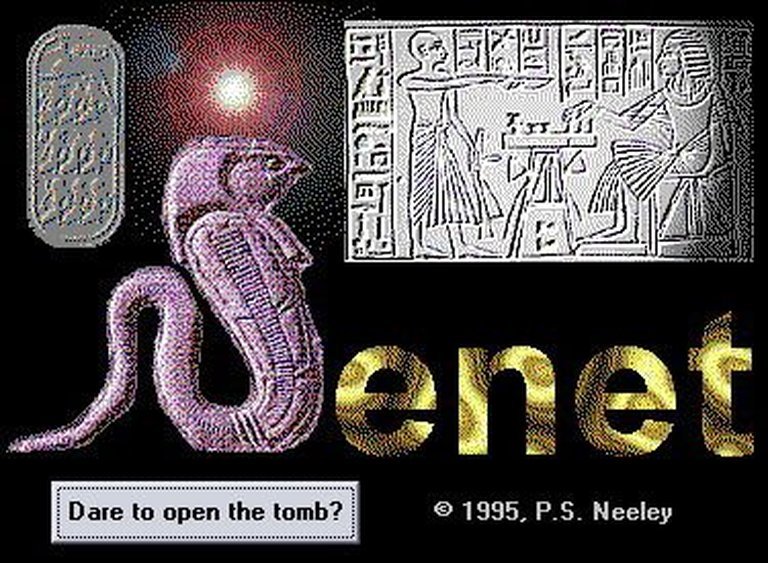
Description
Senet is a digital adaptation of one of the oldest known board games, originating from ancient Egypt. Played on a 30-square board with an S-shaped path, the game involves moving five tokens (cones or reels) from start to finish using casting sticks, similar to dice. Players must strategically navigate their tokens while avoiding opponents’ pieces, which can send them back to the start. Special squares add unique challenges and advantages, such as the ‘Power and Life’ square for protection, the ‘Good’ square for extra throws, and the ‘Water’ square that resets progress. The game also features educational ‘Mummy Facts’ about ancient Egypt and includes a tutorial and help system to guide players through its historically inspired rules.
Where to Buy Senet
PC
Senet Free Download
PC
Senet Guides & Walkthroughs
Senet Reviews & Reception
mobygames.com (52/100): This is a shareware version of Senet (also known as the Game of Thirty Squares), an ancient Egyptian board game and one of the oldest known games of humanity.
Senet Cheats & Codes
PC
Click the ankh on the menu screen, and then start a new game.
| Code | Effect |
|---|---|
| Click the ankh on the menu screen | The pawns on the board will be random colors instead of blue and green. |
Senet: A Digital Resurrection of Ancient Egypt’s Game of the Dead
Few video games can claim to be a direct descendant of one of humanity’s oldest pastimes, but Senet—a 1995 shareware title by P.S. Neeley—does just that. This digital adaptation of the ancient Egyptian board game, known as the “Game of Thirty Squares,” is more than a mere historical curiosity; it is a bridge between modern gaming and the dawn of civilization. While its mechanics are simple by today’s standards, Senet offers a fascinating glimpse into how ancient games can be preserved, reinterpreted, and experienced in the digital age. Yet, its obscurity raises questions: Can a game so deeply rooted in history find relevance in a world dominated by high-definition graphics and complex narratives? Or is Senet destined to remain a niche artifact, appreciated only by historians and board game enthusiasts?
Development History & Context: A Scholar’s Labor of Love
The Creator: P.S. Neeley and the Shareware Era
Senet was developed by P.S. Neeley, a programmer with a passion for historical board games. Released in May 1995 for Windows, the game emerged during the shareware boom of the mid-1990s, a time when independent developers distributed their work freely, often relying on honor-system payments for full versions. Neeley’s Senet was no exception—it was a shareware title, meaning players could download and play it for free, with the option to register for additional features or support.
Neeley was not a commercial game studio but a solo developer with a clear mission: to digitize and preserve ancient games. His work extended beyond Senet; he also created digital versions of other historical board games, such as Royal Game of Ur and Mehen. His official website, P.S. Neeley Shareware, served as a hub for these projects, catering to a niche audience of history buffs and strategy gamers.
Technological Constraints and Design Choices
The mid-1990s were a transitional period for PC gaming. While 3D acceleration was on the horizon (with games like Quake pushing boundaries in 1996), Senet was a 2D, top-down, turn-based strategy game—a genre that thrived in the era of Civilization (1991) and Master of Orion (1993). The game’s minimalist design was a product of both its historical source material and the technical limitations of the time.
- Graphics: The game featured a simple, functional UI with a static board and basic token animations. The visuals were not meant to impress but to clarify gameplay, staying true to the abstract nature of ancient board games.
- Sound: Senet lacked elaborate sound design, relying instead on basic system sounds for moves and interactions. The absence of music or voice acting was typical for shareware strategy games of the era.
- Distribution: As a downloadable shareware title, Senet was distributed via BBS (Bulletin Board Systems) and early internet archives, a far cry from the digital storefronts of today.
The Gaming Landscape in 1995
1995 was a pivotal year for PC gaming, marked by the rise of CD-ROM-based games, real-time strategy (RTS), and 3D shooters. Titles like Command & Conquer, Warcraft II, and Doom II dominated the market, while adventure games like Myst and Phantasmagoria showcased the potential of multimedia storytelling.
In this context, Senet was an outlier—a turn-based, rule-based strategy game with no narrative, no characters, and no flashy presentation. It catered to a small but dedicated audience of strategy enthusiasts and history lovers, standing in stark contrast to the action-packed, visually rich games that defined the era.
The Challenge of Reconstructing an Ancient Game
The most significant hurdle in developing Senet was not technical but historical. The exact rules of Senet have been lost to time. While archaeological evidence—such as game boards, tokens, and tomb paintings—confirms its existence, no written rules survive. Neeley’s solution was to adopt a reconstructed ruleset proposed by Egyptologist John Tait, which framed Senet as a race game similar to Backgammon.
This academic approach set Senet apart from other digital board games of the time, which often prioritized accessibility over historical accuracy. Neeley’s commitment to authenticity—even in the face of ambiguity—made Senet a unique blend of game design and historical scholarship.
Narrative & Thematic Deep Dive: A Game of Life, Death, and the Afterlife
The Absence of Traditional Narrative
Senet is not a game with a story in the conventional sense. There are no characters, no dialogue, and no plot. Instead, its narrative is embedded in its mechanics and themes, drawing from the religious and cultural significance of the original game.
The Mythological and Religious Context of Senet
In ancient Egypt, Senet was more than a game—it was a spiritual journey. The board’s 30 squares were believed to represent the 30 days of the lunar month, and the game itself was a metaphor for the soul’s passage through the afterlife. Key squares on the board held special meanings:
- “The House of Rebirth” (Square 27): Symbolized the transition from life to death.
- “The House of Water” (Square 26): Represented chaos and danger, sending the player’s token back to the start.
- “The House of the Three Truths” (Square 28-30): The final stretch, where the soul was judged before entering the afterlife.
These themes are subtly integrated into Neeley’s digital adaptation. While the game does not explicitly narrate this journey, the structure of the board and the rules evoke the struggle of the soul to reach paradise.
“Mummy Facts”: Educational Storytelling
To compensate for the lack of traditional narrative, Senet includes “Mummy Facts”—a feature that displays historical trivia about ancient Egypt during gameplay. These snippets serve as environmental storytelling, immersing the player in the game’s cultural context. Examples include:
- Details about Egyptian burial practices.
- Explanations of hieroglyphs and symbols found on Senet boards.
- Insights into the role of games in Egyptian society.
This approach transforms Senet from a mere board game into an interactive history lesson, reinforcing its themes of life, death, and rebirth.
Themes: Luck, Strategy, and the Illusion of Control
At its core, Senet explores the tension between fate and free will—a central concern in ancient Egyptian theology. The game is heavily luck-based, with movement determined by casting sticks (ancient Egyptian dice). However, players can make tactical decisions, such as blocking opponents or sacrificing tokens, to influence the outcome.
This mirrors the Egyptian belief in Ma’at—the concept of cosmic order and balance. While the gods controlled destiny, individuals could still navigate their fate through wisdom and strategy. Senet embodies this philosophy, making it a philosophical experience as much as a competitive one.
Gameplay Mechanics & Systems: A Race Through the Afterlife
Core Gameplay Loop: A Simple Yet Strategic Race
Senet is a two-player turn-based strategy game where each player controls five tokens (cones or reels). The objective is to move all tokens from the starting square to the final square before the opponent. The gameplay loop is straightforward:
- Roll the Casting Sticks: Players use four binary sticks (each with a marked and unmarked side) to determine movement. The number of marked sides facing up dictates how many squares a token can move.
- Move a Token: Players choose which token to move, strategizing based on board position and opponent threats.
- Resolve Special Squares: Landing on certain squares triggers unique effects (e.g., extra turns, immunity, or penalties).
- Capture Opponent Tokens: If a token lands on a square occupied by an opponent’s token, the opponent’s token is sent back to the start.
- Win the Game: The first player to move all five tokens off the board wins.
Movement and Strategy: The Role of Luck and Tactics
While Senet is luck-dependent, it is not devoid of strategy. Key tactical considerations include:
- Blocking: Placing tokens on squares to prevent opponent advancement.
- Sacrificing Tokens: Deliberately exposing a token to capture to clear a path for others.
- Special Square Management: Prioritizing landing on beneficial squares (e.g., “House of Rebirth” for safety) while avoiding dangerous ones (e.g., “House of Water”).
The game’s S-shaped board creates bottlenecks, forcing players to compete for key squares and adding a layer of spatial strategy.
Special Squares: Mechanical Depth and Thematic Resonance
The three special squares introduce risk-reward mechanics and reinforce the game’s themes:
-
“Power and Life” (Square 15, the Center):
- Effect: Tokens on this square cannot be captured.
- Strategy: A safe haven for defensive play, but occupying it for too long can stall progress.
- Theme: Represents the heart of the afterlife journey, a moment of stability amid chaos.
-
“Good” (Square 26):
- Effect: Grants an extra turn.
- Strategy: A high-value square that can turn the tide of the game.
- Theme: Symbolizes divine favor, a rare moment of luck in the soul’s trial.
-
“Water” (Square 27):
- Effect: Sends the token back to the start.
- Strategy: A dangerous trap that players must avoid or use against opponents.
- Theme: Represents chaos and peril, a test of the soul’s resilience.
UI and Accessibility: A Product of Its Time
Senet’s user interface is functional but sparse, reflecting its shareware origins:
- Top-Down Board View: The entire board is visible, with tokens clearly marked.
- Turn Indicators: A simple text prompt informs players whose turn it is.
- Help System: A comprehensive tutorial explains the rules, catering to newcomers.
- “Mummy Facts” Display: Historical trivia appears in a small text box, adding context without disrupting gameplay.
While the UI lacks modern polish, it is effective for its purpose. However, the lack of visual feedback (e.g., animations for captures or special square effects) makes the game feel static compared to contemporary digital board games.
Flaws and Missed Opportunities
Despite its strengths, Senet suffers from several design limitations:
- Over-Reliance on Luck: The casting sticks introduce high variability, making skill less impactful than in games like Backgammon (which uses dice but allows for more strategic depth).
- Limited AI: The computer opponent follows basic logic but lacks adaptive strategy, making single-player matches predictable.
- No Multiplayer Options: In 1995, hotseat multiplayer was standard, but Senet missed an opportunity to include network play, which would have extended its lifespan.
- Repetitive Gameplay: Without variants or custom rules, matches can feel samey after multiple plays.
World-Building, Art & Sound: Minimalism in Service of History
Setting and Atmosphere: Ancient Egypt as a Backdrop
Senet’s world-building is abstract yet evocative. The game does not feature detailed environments or character designs, but its board layout, token shapes, and historical trivia create a strong sense of place. The S-shaped path mirrors the journey of the soul, while the hieroglyph-inspired symbols on the board reinforce the Egyptian aesthetic.
Visual Design: Functional Aesthetics
The game’s art style is minimalist, prioritizing clarity over beauty:
- Board Layout: The 30-square grid is rendered in earthy tones, evoking the papyrus and wood of ancient game boards.
- Tokens: Represented as simple cones and reels, staying true to archaeological findings.
- Special Squares: Highlighted with distinct symbols, making them easily identifiable.
While the visuals are not impressive by modern standards, they serve their purpose: to facilitate gameplay while honoring the game’s historical roots.
Sound Design: The Silence of the Tombs
Senet’s audio design is almost nonexistent, a common trait in shareware games of the era:
- No Music: The game lacks a soundtrack, which could have enhanced immersion (e.g., Egyptian-inspired melodies).
- Basic Sound Effects: Token movements and captures are accompanied by generic system sounds, offering no thematic reinforcement.
- Missed Opportunity: A subtle ambient soundscape (e.g., wind, distant chants) could have evoked the mysticism of the afterlife journey.
The absence of sound makes Senet feel clinical, detracting from its spiritual themes.
Reception & Legacy: A Forgotten Relic of Gaming History
Critical and Commercial Reception: Obscurity in a Crowded Market
Senet received little critical attention upon release. On MobyGames, it holds an average player score of 2.6/5 (based on only two ratings), suggesting mixed reception. Factors contributing to its obscurity include:
- Niche Appeal: The game catered to history enthusiasts and board game fans, a small audience compared to mainstream gamers.
- Shareware Limitations: Without marketing or distribution support, Senet struggled to find visibility.
- Lack of Innovation: While historically significant, the game did not push mechanical boundaries, making it easy to overlook in an era of rapidly evolving game design.
Evolution of Its Reputation: A Cult Following Among Historians
Despite its lack of commercial success, Senet has garnered a cult following in academic and historical gaming circles. It is frequently cited in:
- Discussions of ancient board games in digital media.
- Educational resources on Egyptian culture.
- Retrospective analyses of shareware strategy games.
Its historical accuracy and faithful adaptation have earned it respect among Egyptologists and game historians, even if it remains unknown to the broader gaming community.
Influence on Subsequent Games: The Rise of Digital Board Game Preservation
Senet was ahead of its time in digitizing ancient games, paving the way for later titles such as:
- The Royal Game of Ur (2003, 2017): Another Neeley adaptation, further refining the historical board game genre.
- Hnefatafl (2010s): Digital versions of the Viking strategy game, inspired by Senet’s approach.
- Board Game Arena (2010–present): Online platforms that preserve and digitize classic board games, including ancient ones.
While Senet itself did not spawn direct sequels, it contributed to a growing interest in historical board games, proving that ancient games could find new life in digital form.
Conclusion: A Digital Monument to an Ancient Pastime
Senet is not a great game by modern standards—its luck-heavy mechanics, minimalist presentation, and lack of depth prevent it from standing alongside contemporary strategy titles. Yet, its historical significance, educational value, and faithful adaptation of an ancient Egyptian ritual make it a fascinating artifact in gaming history.
Final Verdict: 6.5/10 – A Flawed but Fascinating Historical Experiment
- Strengths:
- Authentic adaptation of an ancient game.
- Educational value through “Mummy Facts.”
- Strategic depth in special square mechanics.
- Weaknesses:
- Over-reliance on luck diminishes skill-based play.
- Outdated UI and lack of sound make it feel sterile.
- No multiplayer or AI depth limits replayability.
Legacy: A Bridge Between Past and Present
Senet’s true importance lies in its role as a digital preservation effort. It demonstrates how video games can serve as interactive museums, allowing players to experience history rather than merely read about it. While it may never achieve mainstream recognition, Senet remains a testament to the enduring power of ancient games and the potential of digital media to revive them.
For history buffs, strategy enthusiasts, and curious gamers, Senet is worth experiencing—not for its gameplay alone, but for its connection to a civilization that played it over 5,000 years ago. In that sense, it is more than a game; it is a time machine.
Final Score: ★★★★★★☆☆☆☆ (6.5/10) – A Niche Masterpiece for History Lovers