
- Release Year: 1998
- Platforms: Windows
- Publisher: Empire Interactive Europe Ltd., JHC SoftWare
- Developer: JHC SoftWare
- Genre: Simulation, Sports
- Perspective: Top-down
- Game Mode: Single-player
- Gameplay: Mouse-controlled, Physics-based, Practice mode, Undo shot
- Setting: Snooker
- Average Score: 91/100
Description
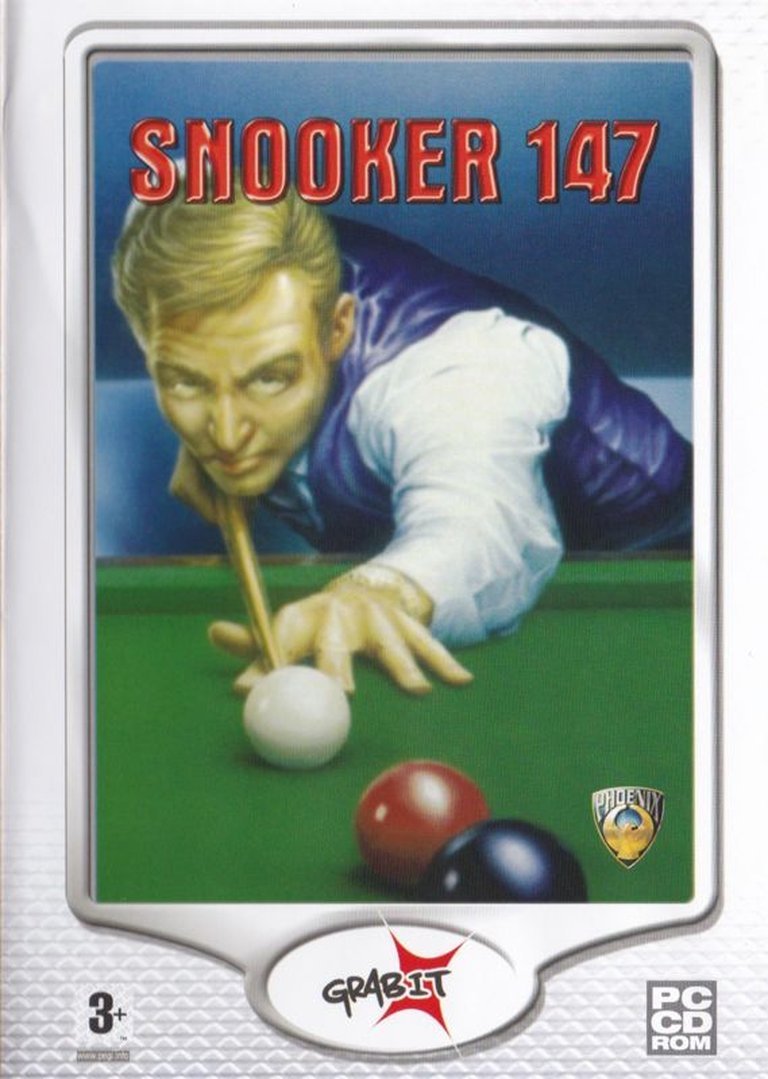
Snooker 147 is a single-player snooker simulation game released in 1998 for Windows, designed to accurately model the physics of snooker. The game features mouse-controlled mechanics for shot strength, spin, and aiming, with a top-down perspective and three AI difficulty levels. It includes in-game help, sound effects, and practice modes for trick shots, though it lacks high scores or player aids like sighting lines. Originally commercial, it is now available as freeware.
Gameplay Videos
Snooker 147 Free Download
Snooker 147 Reviews & Reception
myabandonware.com (91/100): So good and good relax
Snooker 147: A Masterclass in Minimalist Simulation
Introduction
In the vast, often bombastic landscape of late-1990s gaming, where polygons were proliferating and CD-ROMs were crammed with FMV cutscenes, Snooker 147 emerged as a quiet anomaly—a game so stripped-down, so unapologetically focused on its core mechanics, that it defied the era’s trends. Released in March 1998 by JHC Software and published by Empire Interactive, this top-down snooker simulation was not just a game; it was a statement. A statement about the beauty of precision, the elegance of physics, and the timeless appeal of a sport that, at its heart, is a battle of angles, spin, and psychological endurance.
Snooker 147 is not a game that will dazzle you with spectacle. There are no licensed players, no commentary, no dynamic lighting or crowd reactions. What it offers instead is something far rarer: a near-perfect digital recreation of the tactile, cerebral experience of playing snooker. It is a game that understands that the drama of snooker lies not in flashy presentation, but in the tension of a finely judged safety shot, the satisfaction of a perfectly executed screw-back, or the quiet despair of leaving your opponent a simple pot on the black.
This review will dissect Snooker 147 with the same meticulous care its players apply to the baize. We will explore its development, its mechanics, its place in gaming history, and why, over two decades later, it remains a cult classic among simulation enthusiasts.
Development History & Context
The Studio and the Vision
Snooker 147 was the brainchild of Dr. James H. Clark, a developer whose background in physics and software engineering is evident in every line of code. JHC Software, Clark’s one-man operation, was not a household name in gaming, but it was a studio with a clear philosophy: to create simulations that prioritized accuracy over aesthetics. This ethos was already evident in Poolster, the companion game to Snooker 147, which shared the same engine and physics model.
The late 1990s were a fascinating time for sports simulations. The industry was transitioning from 2D sprites to 3D polygons, with games like FIFA: Road to World Cup 98 and NBA Live 98 pushing the boundaries of visual fidelity. Yet, amidst this arms race for realism, Snooker 147 took a different path. It embraced a top-down perspective, eschewing the isometric or 3D views that were becoming standard in cue sports games (e.g., Virtual Pool 2, released the previous year). This was not a limitation of technology, but a deliberate choice. Clark understood that snooker is a game of geometry, and a top-down view is the most intuitive way to represent that geometry.
Technological Constraints and Innovations
The game was built for Windows 95/98, with minimal system requirements: a Pentium 120 (though it could run on a 486), 640×480 resolution, and a sound card for its sparse but effective audio. The constraints of the era—limited processing power, minimal RAM—forced Clark to optimize every aspect of the game. The result was a title that ran smoothly even on low-end machines, a rarity in an era where bloated installations were becoming the norm.
The most remarkable achievement of Snooker 147 is its physics engine. Clark devoted a significant portion of the game’s help documentation to explaining the physics model, a rarity in commercial games. The engine accounted for:
– Ball spin: Topspin, backspin, and side spin, all of which could be controlled with precision.
– Cushion reactions: The way balls rebound off the table’s rails, with accurate angles and speed loss.
– Friction and deceleration: How balls slow down based on the nap of the cloth.
– Collision physics: The transfer of momentum between balls, including the subtle effects of glancing blows.
This was not the first snooker game to attempt realistic physics—titles like Jimmy White’s ‘Whirlwind’ Snooker (1991) had tried—but it was arguably the first to do so with such transparency and accuracy. Clark’s background in physics allowed him to create a model that was both playable and educational. Players could not only feel the physics in action but understand why a shot behaved the way it did.
The Gaming Landscape of 1998
In 1998, the sports simulation genre was dominated by two trends:
1. The rise of 3D: Games like International Superstar Soccer Pro 98 and NHL 98 were leveraging 3D graphics to create more immersive experiences.
2. Licensing and realism: Developers were increasingly securing licenses for real players, teams, and leagues to add authenticity.
Snooker 147 bucked both trends. It was 2D, unlicensed, and devoid of the trappings of “realism” as defined by the industry. Yet, in its own way, it was more realistic than any of its contemporaries. While other games were chasing the appearance of realism, Snooker 147 was chasing the feel of it.
The game’s commercial release was modest. It was sold as shareware, with a trial version available for free and the full version requiring a small fee. This model was common in the late 1990s, particularly for niche or indie titles. However, Snooker 147’s legacy was secured when, years later, Clark released it as freeware, ensuring its preservation and continued playability.
Narrative & Thematic Deep Dive
The Absence of Narrative
Snooker 147 is a game that defies traditional narrative analysis because it has no narrative. There are no characters, no plot, no dialogue. The closest it comes to storytelling is the implicit narrative of improvement: the player’s journey from fumbling amateur to (hopefully) master of the baize.
This absence of narrative is not a flaw; it is a feature. Snooker, as a sport, is inherently narrative-free. It is a game of pure mechanics, where the drama emerges from the interplay of skill, strategy, and chance. Snooker 147 respects this by refusing to impose a story where none is needed.
Themes: Precision, Patience, and Perfection
If Snooker 147 has themes, they are the themes of snooker itself:
1. Precision: Every shot requires careful calculation. The game’s controls, while simple, demand exacting input. A millimeter’s difference in the cue’s contact point can mean the difference between a perfect pot and a missed opportunity.
2. Patience: Snooker is a game of incremental progress. Unlike pool, where the objective is often to clear the table in a single visit, snooker rewards cautious play, safety shots, and the slow accumulation of points.
3. Perfection: The holy grail of snooker is the maximum break—a 147, achieved by potting all reds with blacks, followed by all the colors in order. Snooker 147 does not track high scores or statistics, but the pursuit of this perfection is baked into its design.
The Digital Baize as a Meditative Space
There is something almost meditative about Snooker 147. The game’s minimalist presentation—its stark green table, its simple sound effects, its lack of distractions—creates a space where the player can focus entirely on the mechanics of the game. In an era where games were becoming increasingly noisy, Snooker 147 offered silence. It was a game that could be played in short bursts or long sessions, a digital equivalent of a quiet afternoon in a snooker hall.
Gameplay Mechanics & Systems
Core Gameplay Loop
The gameplay of Snooker 147 is deceptively simple:
1. Aim: Position the crosshair cursor to determine the direction of the shot.
2. Adjust spin: Use the cue ball representation in the bottom-right corner to apply side or backspin.
3. Set power: Drag the cue left or right to control the strength of the shot.
4. Execute: Click to strike the cue ball.
This three-step process is repeated ad infinitum, with the player alternating between potting reds and colors, accumulating points, and (ideally) outmaneuvering the AI opponent.
The Brilliance of the Control Scheme
The game’s control scheme is a masterclass in minimalist design. With just three mouse-operated inputs, Clark managed to capture the entirety of snooker’s complexity:
– Aiming: The crosshair cursor is intuitive, allowing for precise angle selection.
– Spin control: The cue ball representation lets players apply English (side spin) or screw (backspin) with a simple click-and-drag.
– Power adjustment: The left-right drag for shot strength is both tactile and easy to master.
What makes this system so brilliant is its accessibility. Unlike many sports games, which bury mechanics behind complex button combinations, Snooker 147 makes everything immediate. Yet, beneath this simplicity lies depth. Mastering the interplay of power, spin, and angle is a challenge that can take years to perfect.
AI and Difficulty
The game features three AI difficulty levels, though even the hardest setting is not particularly punishing by modern standards. The AI is competent but predictable, often falling into patterns that can be exploited with practice. This is not necessarily a flaw; the AI’s role is not to be a perfect opponent but to provide a consistent challenge that allows the player to improve.
Practice Mode and Undo Function
One of the game’s most underrated features is its practice mode, which allows players to position the balls manually and attempt trick shots. This is not just a fun diversion; it is a tool for mastery. Players can recreate real-world scenarios, experiment with spin, and refine their technique.
The undo function is equally valuable. It allows players to rewind a shot, correcting mistakes and learning from them. This is a rare feature in sports games, which typically emphasize consequences over experimentation. In Snooker 147, the undo function is a nod to the game’s educational aspirations.
The Absence of Hand-Holding
Snooker 147 is notable for what it doesn’t include:
– No sighting lines: Many snooker games provide visual aids to help players aim. Snooker 147 offers none. The player must rely on their own judgment.
– No statistics: There is no record of high scores, no breakdown of performance metrics. The game is purely about the moment.
– No tutorials: Beyond the help text, there is no guided instruction. Players learn by doing.
This lack of hand-holding is refreshing. It treats the player as an intelligent participant, not a passive consumer. It is a design philosophy that trusts the player to engage with the game on its own terms.
World-Building, Art & Sound
The Digital Snooker Hall
Snooker 147’s world is a single, unchanging space: the snooker table. There are no other environments, no crowds, no referees. The table is rendered in a top-down perspective, with a simple green baize, wooden rails, and pockets. The balls are color-coded according to standard snooker rules, and the cue is represented as a thin line.
This minimalism is not a limitation; it is a strength. The game’s art direction is functional, prioritizing clarity and precision over aesthetic flair. Every element on the screen serves a purpose. The crosshair cursor is unobtrusive but visible. The spin controls are intuitive. The table’s layout is instantly readable.
Sound Design: The Symphony of the Baize
The game’s sound design is equally sparse but effective. The clack of balls colliding, the thud of a ball dropping into a pocket, the swish of the cue striking the ball—these sounds are simple but satisfying. They provide the necessary auditory feedback to make the game feel tactile.
There is no music, no commentary, no ambient noise. The silence is intentional. It allows the player to focus entirely on the mechanics, to hear the subtle differences between a well-struck shot and a miscue.
Atmosphere: The Loneliness of the Long-Distance Potting
Snooker 147 is a lonely game. There are no spectators, no opponents beyond the AI, no distractions. It is just you, the table, and the balls. This loneliness is not a bug; it is a feature. Snooker, at its core, is a solitary pursuit. Even in a crowded hall, the player is alone with their thoughts, their strategy, their mistakes.
The game’s atmosphere captures this solitude perfectly. It is a digital meditation on focus, a test of patience and precision. In this sense, Snooker 147 is not just a simulation of snooker; it is a simulation of the experience of snooker.
Reception & Legacy
Critical Reception: The Silent Appreciation
Snooker 147 was not a commercial blockbuster, nor was it widely reviewed in mainstream gaming publications. Its reception was quiet, confined mostly to niche communities of simulation enthusiasts and snooker fans. On platforms like MobyGames and My Abandonware, player reviews are uniformly positive, with comments like:
– “So good and good relax” (tiger11, My Abandonware)
– “Nice experience & lovely time spanned” (joyanta kumar sarker, My Abandonware)
– “It is a favorite game for me” (Yourpey, My Abandonware)
These reviews are not eloquent, but they are telling. They speak to the game’s ability to provide a relaxing, engaging experience, even decades after its release.
Commercial Performance and Longevity
The game’s commercial performance was modest. It was sold as shareware, a model that limited its reach. However, its transition to freeware in the 2000s ensured its longevity. Today, it remains available on abandonware sites and the developer’s own website, a testament to its enduring appeal.
Influence on Subsequent Games
Snooker 147’s influence is subtle but significant. It proved that a sports simulation could succeed without licensing, without 3D graphics, without all the trappings of “realism.” It demonstrated that mechanical depth and physics accuracy could be more important than visual fidelity.
Later snooker games, such as Snooker 19 (2019), would adopt more modern presentation styles, but none have matched Snooker 147’s purity of design. It remains a benchmark for what a simulation can achieve when it focuses on the essence of the sport.
The Cult Following
Snooker 147 has developed a cult following over the years. It is beloved by:
– Simulation purists, who appreciate its accurate physics.
– Snooker fans, who see it as a digital extension of their passion.
– Retro gamers, who admire its minimalist design and historical significance.
This following is small but devoted. The game is frequently discussed in forums dedicated to retro gaming and sports simulations, where it is praised for its timeless gameplay and educational value.
Conclusion: A Masterpiece of Minimalism
Snooker 147 is not a game for everyone. It does not dazzle with graphics, thrill with narrative, or excite with multiplayer modes. What it offers is something far rarer: a perfectly distilled digital representation of snooker. It is a game that understands the sport’s essence—its geometry, its physics, its psychological tension—and translates that essence into a playable experience.
In an industry obsessed with spectacle, Snooker 147 is a quiet rebellion. It is a reminder that games do not need to be loud to be meaningful, that simplicity is not a limitation but a strength. It is a game that rewards patience, precision, and practice, and in doing so, it becomes more than just a simulation. It becomes a meditation, a challenge, a test of skill.
Over two decades after its release, Snooker 147 remains a cult classic, a hidden gem in the annals of gaming history. It is a game that deserves to be remembered not just for what it was, but for what it represented: a vision of gaming where mechanics matter more than marketing, where depth is more important than dazzle, and where the pursuit of perfection is its own reward.
Final Verdict: 9/10 – A timeless simulation that captures the soul of snooker with unparalleled precision.
Post-Script: Why Snooker 147 Still Matters
In the years since Snooker 147’s release, the gaming industry has changed dramatically. Graphics have become photorealistic, games have become cinematic, and sports simulations have become bloated with licenses, commentary, and unnecessary features. Yet, Snooker 147 endures because it is uncompromising. It does not apologize for its simplicity. It does not chase trends. It is, in every sense, a pure game.
For those willing to engage with it, Snooker 147 offers a rare experience: the chance to master a skill, to understand a physics model, to lose yourself in the quiet rhythm of the baize. It is a game that does not just simulate snooker—it honors it.
And in a world where games are increasingly designed to be consumed and discarded, Snooker 147 stands as a testament to the enduring power of timeless design.