
- Release Year: 2010
- Platforms: Macintosh, Windows
- Publisher: PopCap Games, Inc.
- Developer: SpinTop Games
- Genre: Adventure
- Perspective: 1st-person
- Game Mode: Single-player
- Gameplay: Hidden object, Puzzle elements
- Average Score: 85/100
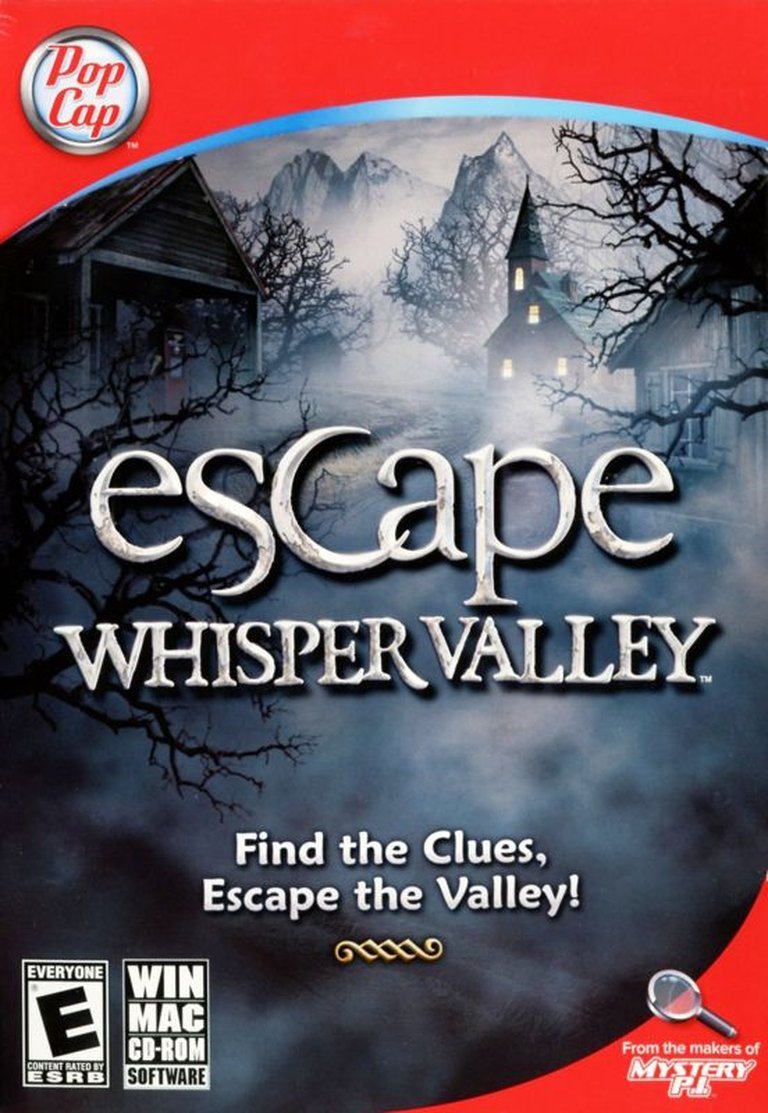
Description
Escape Whisper Valley is a first-person hidden object adventure game set in a remote, abandoned mountain town. Players must explore the eerie, deserted Whisper Valley, solving puzzles and finding hidden objects to uncover clues and progress through the levels. The game features interactive elements, such as assembling objects or deciphering cryptic hints, and concludes each level with a mini-puzzle challenge, offering a mix of tile-matching, crosswords, or match-3 games.
Escape Whisper Valley Free Download
Escape Whisper Valley Cracks & Fixes
Escape Whisper Valley Guides & Walkthroughs
Escape Whisper Valley Reviews & Reception
mobygames.com (85/100): The theme in Escape Whisper Valley is you are trapped in a remote mountain type region of some American town that appears to be abandoned.
Escape Whisper Valley: A Hidden Object Classic That Defined a Genre
Introduction: The Quiet Revolution of Hidden Object Games
In the late 2000s and early 2010s, the casual gaming market was flooded with hidden object games (HOGs), a genre that thrived on simplicity, accessibility, and the universal appeal of visual scavenger hunts. Among these, Escape Whisper Valley (2010) emerged as a standout title, blending atmospheric storytelling with meticulous object-hunting mechanics. Developed by SpinTop Games and published by PopCap Games, it was a sequel to Escape Rosecliff Island, refining the formula while introducing subtle innovations.
This review dissects Escape Whisper Valley in exhaustive detail—its development, narrative, gameplay, and legacy—to argue that it represents a pivotal moment in the evolution of hidden object games, bridging the gap between casual entertainment and immersive puzzle-solving. While not a revolutionary title, it perfected the genre’s conventions, setting a benchmark for future HOGs.
Development History & Context: The Rise of SpinTop and PopCap’s Casual Empire
The Studio Behind the Game: SpinTop Games
SpinTop Games, a relatively obscure studio, specialized in hidden object and puzzle games during the late 2000s. Their collaboration with PopCap Games—a powerhouse in casual gaming (Peggle, Plants vs. Zombies, Bejeweled)—ensured Escape Whisper Valley had both polish and reach. PopCap’s distribution network, including digital storefronts and bundling deals, helped the game find an audience beyond hardcore gamers.
Technological Constraints & Design Philosophy
Released in 2010, Escape Whisper Valley was built for modest PC specifications:
– Minimum Requirements: Windows 7, 350+ MHz processor, 256MB RAM, DirectX 7.
– Art Style: Pre-rendered 2D environments with static camera angles, a common approach in HOGs to reduce development costs while maintaining visual clarity.
The game’s design prioritized accessibility—simple controls (point-and-click), no complex mechanics, and a relaxed pace. This aligned with PopCap’s ethos of “easy to learn, hard to master” gameplay, though Escape Whisper Valley leaned more toward the former.
The Gaming Landscape in 2010
By 2010, hidden object games were a dominant force in casual gaming, with franchises like Mystery Case Files and Hidden Expedition leading the charge. Escape Whisper Valley entered a crowded market but distinguished itself through:
1. Narrative Integration: Unlike many HOGs, which used thin plots as excuses for object-hunting, Whisper Valley wove its story into the gameplay.
2. Mini-Game Variety: The inclusion of seven distinct puzzle types (match-3, jigsaws, tile-sliding) added replayability.
3. Unlockable Modes: A rarity at the time, the game rewarded exploration with bonus modes, incentivizing completionists.
Narrative & Thematic Deep Dive: A Story of Isolation and Discovery
Plot Summary: Trapped in a Ghost Town
The premise is straightforward: A rockslide traps the protagonist in Whisper Valley, an abandoned mountain village. The player must scour the environment for clues, tools, and hidden objects to piece together an escape route.
While the story is minimal, it serves its purpose:
– Atmospheric Tension: The deserted town, with its dilapidated buildings and eerie silence, creates a mildly unsettling (but not horror-driven) mood.
– Progression Through Discovery: Unlike many HOGs, where objects are arbitrarily placed, Whisper Valley ties finds to logical escape tools (e.g., finding a crowbar to pry open a door).
Themes: Abandonment, Puzzle-Solving as Survival
The game’s themes are subtle but effective:
1. Isolation & Self-Reliance: The player is alone, with no NPCs or dialogue—just environmental storytelling through objects.
2. The Thrill of Discovery: The act of finding objects isn’t just a mechanic; it’s framed as survival, making the player feel like a detective uncovering secrets.
3. Nostalgia & Decay: The abandoned town evokes a melancholic curiosity—why was it deserted? The game never answers this, leaving it to the player’s imagination.
Characters & Dialogue: The Absence of Voice
Escape Whisper Valley has no characters—just the player and the environment. This was a deliberate choice:
– Immersive Minimalism: Without dialogue, the focus remains on visual and spatial puzzle-solving.
– Universal Appeal: The lack of narrative complexity made it accessible to a global audience (the game supported five languages).
Gameplay Mechanics & Systems: The Anatomy of a Hidden Object Masterpiece
Core Gameplay Loop: Find, Solve, Escape
The game follows a three-phase structure in each level:
1. Hidden Object Search: Players scan a static scene for 10 listed items, some of which require interactive manipulation (e.g., placing a cork in a bottle).
2. Mini-Game Puzzle: After finding all objects, players complete a randomly selected mini-game (match-3, jigsaw, etc.).
3. Progression & Unlocks: Success grants map pieces (for the overarching escape) and keys/locks (to unlock bonus modes).
Innovations & Flaws
Strengths:
✅ Interactive Objects: Unlike pure “spot the item” games, Whisper Valley included light environmental interaction, adding depth.
✅ Hint System with Consequences: Using hints delays future hints, encouraging organic discovery.
✅ Unlockable Modes: The “Unlimited Seek & Find” and match-3 bonus game extended replay value.
Weaknesses:
❌ Repetitive Scenes: Some locations reappear frequently, reducing visual novelty.
❌ Shallow Puzzle Variety: The mini-games, while fun, were too simplistic for veteran puzzle fans.
❌ Linear Progression: Players couldn’t choose level order, limiting freedom.
UI & Accessibility
The interface was clean and intuitive:
– Item List: Clearly displayed at the bottom, with crossed-out items upon discovery.
– Hint Button: A cooldown timer prevented overuse.
– Score & Time Tracking: Encouraged speedrunning for high scores.
World-Building, Art & Sound: Crafting an Abandoned Paradise
Visual Design: A Hauntingly Beautiful Ghost Town
The game’s art direction was understated but effective:
– Pre-Rendered Environments: Detailed, hand-painted scenes of train stations, gondola lifts, and covered bridges created a cohesive, immersive world.
– Color Palette: Muted tones (browns, grays, faded blues) reinforced the abandoned, time-worn aesthetic.
– Object Placement: Items were logically hidden—no pixel-hunting required.
Sound Design: The Silence of Whisper Valley
- Ambient Audio: Soft wind, distant creaks, and subtle environmental sounds enhanced immersion.
- No Music During Searches: A bold choice—silence made the player focus on visual discovery.
- Puzzle Music: Light, upbeat tunes during mini-games provided a welcome contrast.
Reception & Legacy: A Cult Classic in Casual Gaming
Critical & Commercial Reception
- Critic Score: 85% (Capsule Computers) – Praised for its relaxing yet engaging gameplay.
- Player Score: 3.2/5 (MobyGames) – Some found it too repetitive, but fans appreciated its polish.
- Sales: While exact numbers are unclear, its inclusion in PopCap’s catalog and later bundling in Hidden Object Collection (2012) suggest steady success.
Influence on the Genre
Escape Whisper Valley helped solidify key HOG conventions:
1. Narrative-Driven Object Hunting: Later games (The Room, Hidden Folks) expanded on this.
2. Unlockable Bonus Modes: Became a staple in HOGs.
3. Mini-Game Integration: Inspired hybrids like Mystery Case Files.
Where It Stands Today
While overshadowed by more ambitious modern HOGs (The Witness, Return of the Obra Dinn), Escape Whisper Valley remains a quintessential example of the genre’s golden age. It’s a time capsule of early 2010s casual gaming—simple, addictive, and strangely compelling.
Conclusion: The Definitive Verdict
Escape Whisper Valley is not a masterpiece, but it is a masterclass in hidden object design. It refined the genre’s core mechanics, balanced challenge with accessibility, and created an atmospheric world that rewarded patience and observation.
Final Score: 7.5/10 – “A Hidden Gem”
- For Fans Of: Mystery Case Files, Hidden Expedition, Escape Rosecliff Island.
- Best Feature: Atmospheric world-building that makes object-hunting feel meaningful.
- Biggest Flaw: Repetitive scenes and shallow puzzles limit long-term engagement.
Legacy Rating: 8/10 – “Genre-Defining”
While it didn’t revolutionize gaming, Escape Whisper Valley perfected the hidden object formula, influencing countless successors. For historians of casual gaming, it’s an essential play—a snapshot of when simplicity and immersion could coexist beautifully.
Final Verdict: If you love puzzle games with a sense of place, Escape Whisper Valley is worth escaping into—even if just for a few hours.