
- Release Year: 2001
- Platforms: Windows
- Publisher: 1C Company, Fishtank Interactive, JoWooD Productions Software AG, Stormregion Szoftverfejlesztő Kft.
- Developer: Stormregion Szoftverfejlesztő Kft.
- Genre: Strategy, Tactics
- Perspective: Diagonal-down
- Game Mode: LAN, Online PVP, Single-player
- Gameplay: No base building, Point and select, Real-time, Unit control, Unit repair
- Setting: Futuristic, Sci-fi
- Average Score: 74/100
Description
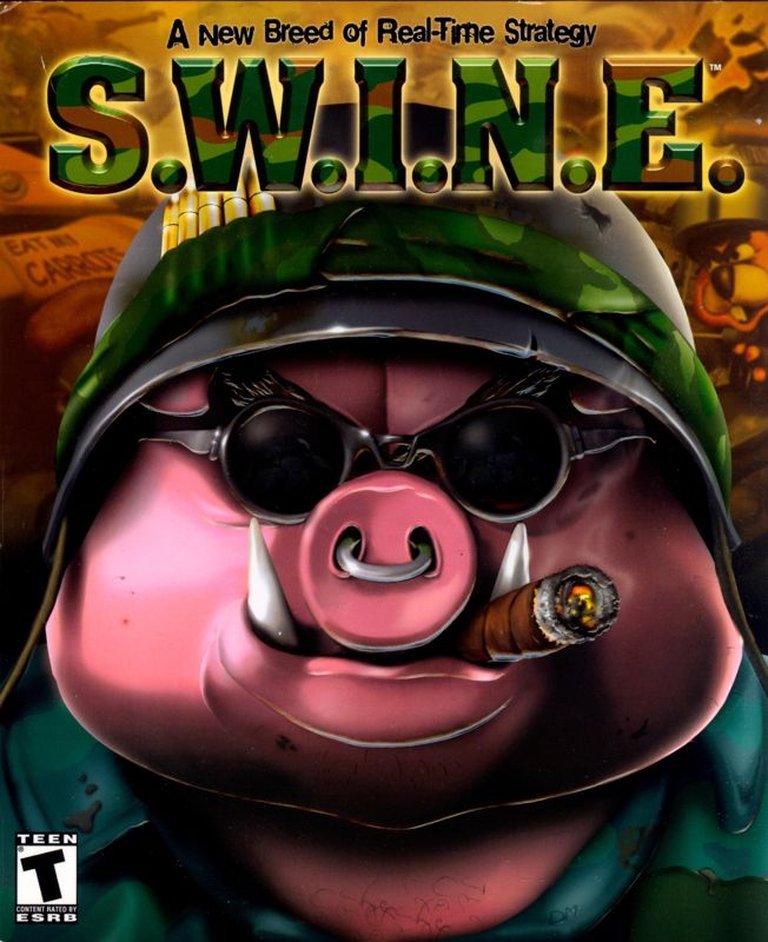
S.W.I.N.E. is a real-time strategy game set in a whimsical, animal-themed world where the Swine National Army invades CarrotLand, the home of the Rabbit nation. Players command either the underdog Rabbit forces or the dominant Swine army in a series of missions, with no on-field construction—units are pre-selected before battles. The game features humorous dialogue, colorful explosions, and a unique repair system to revive damaged units. With two campaigns, multiplayer support, and a lighthearted tone, it blends tactical depth with playful charm.
Gameplay Videos
Where to Buy S.W.I.N.E.
S.W.I.N.E. Free Download
S.W.I.N.E. Patches & Updates
S.W.I.N.E. Mods
S.W.I.N.E. Reviews & Reception
metacritic.com (65/100): A solid real-time strategy game with plenty of humor, all wrapped up in a beautiful shell.
mobygames.com (72/100): A real-time strategy game in a 3D environment, similar to Emperor: Battle for Dune but with a humorous twist.
oldpcgaming.net : The humor is almost invisible in SWINE when you’re actually playing it, which is an entirely conventional real-time strategy game.
metacritic.com (85/100): The only downsides to this game are the slightly unimaginative campaigns, and the oh-so-annoying voice-overs, which feature the worst “foreign” accents I’ve heard in a while.
S.W.I.N.E. Cheats & Codes
PC
Press [SHIFT] + [ENTER] to open the console, then type:
| Code | Effect |
|---|---|
| smarten | Increase Ranking of Selected Unit |
| instant delivery | Get Units Fast |
| mo money | Additional 1000 Credits |
| quicker than death | Kill Enemy Units with One Shot |
| blitzkrieg | Skip Level |
| show fps | Show Framerate |
S.W.I.N.E.: A Strategic Masterpiece in a Nifty Environment
Introduction
In the early 2000s, the real-time strategy (RTS) genre was dominated by titans like Command & Conquer and StarCraft. Amidst this landscape, a quirky, underrated gem emerged: S.W.I.N.E. (Strategic Warfare In a Nifty Environment). Developed by the Hungarian studio StormRegion and published by Fishtank Interactive, S.W.I.N.E. dared to be different. It eschewed the conventional tropes of resource-gathering and base-building, instead offering a streamlined, tactics-focused experience wrapped in a whimsical, anthropomorphic war between pigs and rabbits.
S.W.I.N.E. is a game that defies easy categorization. It is both a parody and a serious tactical simulator, a lighthearted romp and a punishing challenge. Its unique blend of humor, innovation, and depth has earned it a cult following, even as it remains overlooked by the broader gaming community. This review will delve deep into the game’s development, narrative, gameplay, and legacy, exploring why S.W.I.N.E. stands as a fascinating anomaly in the RTS genre.
Development History & Context
The Studio and Vision
StormRegion, a small Hungarian studio founded in 1997, was the creative force behind S.W.I.N.E. The team, led by Attila Bánki-Horváth (credited as “Maci”) and Péter Bajusz (“Hyp-X”), sought to carve out a niche in the crowded RTS market. Their vision was clear: create a game that emphasized tactical depth over economic micromanagement, all while infusing it with a sense of humor and charm.
The choice of pigs and rabbits as the warring factions was deliberate. The pigs, with their German accents and militaristic demeanor, were a clear nod to the Axis powers of World War II, while the rabbits, with their French accents and guerrilla tactics, evoked the spirit of the French Resistance. This satirical framing allowed the game to explore themes of war and conflict without taking itself too seriously.
Technological Constraints and Innovations
Developed in the late 1990s and early 2000s, S.W.I.N.E. faced the technological limitations of its time. The game was built on the Gepard 3D engine, which allowed for dynamic camera angles and detailed unit models but was constrained by the hardware of the era. The team had to optimize the game to run on systems with as little as a Pentium II 466 MHz processor and 96 MB of RAM, a far cry from today’s standards.
Despite these constraints, S.W.I.N.E. introduced several innovations. One of the most notable was the visual representation of unit firing ranges. Dotted lines surrounding each unit displayed their minimum (red) and maximum (yellow) firing ranges, a feature that was groundbreaking for real-time tactics games. This innovation would later become a staple in StormRegion’s Codename: Panzers series.
The Gaming Landscape of 2001
When S.W.I.N.E. launched in late 2001, the RTS genre was in a state of flux. StarCraft had set the standard for competitive play, while Command & Conquer: Red Alert 2 and Emperor: Battle for Dune dominated the casual market. S.W.I.N.E. arrived as a breath of fresh air, offering a tactical experience that was both accessible and deep.
However, the game’s release was not without challenges. The humor, which relied heavily on stereotypes and puns, did not always translate well across cultures. Reviews were mixed, with critics praising the game’s innovation and charm but criticizing its repetitive missions and technical issues. Despite this, S.W.I.N.E. found a dedicated fanbase, particularly in Europe, where its satirical take on war resonated more strongly.
Narrative & Thematic Deep Dive
Plot Overview
S.W.I.N.E. presents a dual-campaign structure, allowing players to experience the conflict from both the pigs’ and rabbits’ perspectives. The pig campaign follows General Iron Tusk, a thinly veiled expy of Adolf Hitler, as he overthrows the Pig Republic and launches an invasion of Carrotland. The rabbit campaign, meanwhile, focuses on the survivors of the initial invasion as they organize a guerrilla resistance to reclaim their homeland.
The narrative is delivered through a series of comic-style cutscenes and mission briefings, all infused with the game’s signature humor. The pigs are portrayed as bumbling yet ruthless invaders, while the rabbits are depicted as clever underdogs fighting against overwhelming odds. The story is lighthearted but not without its darker moments, particularly in the pig campaign, where the player is tasked with crushing rebel forces and securing strategic objectives.
Characters and Dialogue
The game’s characters are broadly drawn but memorable. General Iron Tusk is the quintessential villain, a megalomaniacal dictator with a penchant for dramatic speeches. The rabbit leaders, by contrast, are more understated, relying on cunning and guile to outmaneuver their porcine foes.
The dialogue is a highlight of S.W.I.N.E., with over 6,000 voice lines recorded for the game. The pigs speak in gruff, German-accented English, while the rabbits affect a French lilt. The writing is filled with puns and one-liners, from the pigs’ “That’s all, folks!” tank to the rabbits’ “Carrotpult” artillery. While the humor can be hit-or-miss, it adds a layer of personality to the game that sets it apart from its more serious contemporaries.
Themes and Satire
At its core, S.W.I.N.E. is a satire of war and militarism. The game lampoons the absurdity of conflict, particularly the idea of anthropomorphic animals waging war with advanced military hardware. The pigs’ invasion of Carrotland is a clear allegory for historical acts of aggression, while the rabbits’ resistance mirrors the struggles of occupied nations.
The game also explores themes of resource scarcity and territorial expansion. The pigs’ invasion is justified by the need for fertile land to feed their growing population, a nod to the real-world motivations behind many historical conflicts. The rabbits, meanwhile, are fighting for their very survival, a struggle that resonates with audiences on a visceral level.
Gameplay Mechanics & Systems
Core Gameplay Loop
S.W.I.N.E. is a real-time tactics game, meaning it focuses on the tactical deployment of pre-selected units rather than the economic management of resources. Players begin each mission with a set number of Strategic Points (SPs), which can be used to purchase new units or activate special abilities. Unlike traditional RTS games, there is no base-building or resource-gathering; instead, the focus is on positioning, maneuvering, and exploiting the strengths and weaknesses of each unit.
The game’s missions are varied, ranging from straightforward assaults to complex defensive operations. Players must carefully manage their units’ ammunition, fuel, and health, using supply trailers to keep their forces operational. The lack of a traditional economy means that every unit lost is a significant setback, adding a layer of tension to the gameplay.
Unit Types and Specializations
S.W.I.N.E. features a diverse roster of units, each with its own strengths and weaknesses. The pigs and rabbits share many of the same unit types, but there are key differences that reflect their respective playstyles.
- Scouts: Fast, lightly armored units ideal for reconnaissance and hit-and-run tactics. They are the only units capable of traversing water.
- Tanks: Versatile units with balanced offense and defense. They can dig in to increase their armor but become immobile in the process.
- Heavy Tanks (Pigs Only): Slow but heavily armored units capable of plowing through obstacles. They are the pigs’ answer to the rabbits’ mobility.
- Artillery: Long-range units that excel at bombarding entrenched enemies. They must deploy to fire, making them vulnerable to fast-moving units.
- Rocket Launchers: Mid-range units that can fire salvos of rockets for area denial. They are effective against groups of enemies but struggle against heavily armored targets.
- Tank Killers (Rabbits Only): Fast, anti-armor units equipped with homing missiles. They are the rabbits’ counter to the pigs’ heavy tanks.
- Mortars: Short-range, high-damage units that fire in a high arc, making them effective against units in cover. They can retract their barrels to increase their armor at the cost of firepower.
- Moving Fortresses: Super-heavy units with massive firepower and health. They are slow and expensive but can turn the tide of battle.
- Command Vehicles: Support units that can call in airstrikes or other special abilities.
- Minelayers: Units that can lay mines to deny enemy movement. They are unarmed but can be equipped with mine detectors to clear enemy mines.
- Tow Trucks: Unarmed units that tow supply trailers or disabled units to safety.
The game’s unit interactions follow a rock-paper-scissors dynamic. For example, tank killers excel against heavy tanks but are vulnerable to scouts, while artillery dominates static defenses but struggles against mobile units. This balance ensures that no single unit type is overpowered, forcing players to adapt their strategies to the mission at hand.
Combat and Tactics
Combat in S.W.I.N.E. is a delicate dance of positioning and timing. The game’s real-time nature means that players must constantly monitor their units’ status and adjust their tactics on the fly. The lack of a traditional economy means that every unit lost is a significant setback, adding a layer of tension to the gameplay.
One of the game’s most innovative features is the visual representation of unit firing ranges. Dotted lines surrounding each unit display their minimum and maximum firing ranges, allowing players to quickly assess the effectiveness of their positioning. This feature, combined with the game’s dynamic camera system, gives players unprecedented control over their units.
The game also features a robust damage model, with units taking different amounts of damage depending on where they are hit. For example, artillery shells that hit a unit’s top armor will deal more damage than those that hit the front. This level of detail adds a layer of realism to the gameplay, rewarding players who take the time to learn the intricacies of each unit.
Character Progression and Veterancy
Units in S.W.I.N.E. gain experience through combat, becoming more effective as they survive more battles. Veteran units gain improved stats, including increased health, damage, and armor. They also receive visual upgrades, such as additional armor plates or kill markings, making them stand out on the battlefield.
The veterancy system adds a layer of strategy to the game, as players must decide whether to risk their experienced units in dangerous situations or hold them back to preserve their strength. The loss of a veteran unit can be a significant setback, particularly in the later stages of a campaign.
UI and Controls
The game’s user interface is functional but unremarkable. Players control their units using a point-and-click system, with commands issued through a context-sensitive menu. The game’s camera can be rotated and zoomed, allowing players to get a better view of the battlefield.
One of the game’s most useful features is the active pause system, which allows players to pause the game and issue commands to their units. This feature is particularly helpful in the later stages of a mission, where the chaos of battle can make it difficult to keep track of individual units.
World-Building, Art & Sound
Setting and Atmosphere
S.W.I.N.E. is set in a whimsical, anthropomorphic world where pigs and rabbits wage war with advanced military hardware. The game’s setting is a mix of pastoral farmlands and industrial strongholds, with the pigs’ territory characterized by fortified cities and the rabbits’ homeland featuring rolling fields and underground warrens.
The game’s art style is cartoonish but detailed, with units and environments rendered in a way that emphasizes their comedic nature. The pigs’ tanks are adorned with snouts and tusks, while the rabbits’ vehicles feature carrot-themed designs. This visual humor extends to the game’s explosions, which are colorful and non-violent, reinforcing the game’s lighthearted tone.
Visual Direction
The game’s visual direction is a key part of its charm. The units are designed to be both functional and humorous, with exaggerated features that emphasize their anthropomorphic nature. The pigs’ units are blocky and industrial, reflecting their militaristic culture, while the rabbits’ vehicles are sleek and agile, reflecting their guerrilla tactics.
The game’s environments are equally detailed, with varied terrain that affects unit movement and visibility. Forests, hills, and rivers all play a role in the gameplay, forcing players to adapt their strategies to the landscape.
Sound Design and Voice Acting
The game’s sound design is a standout feature, with over 6,000 voice lines recorded for the game. The pigs speak in gruff, German-accented English, while the rabbits affect a French lilt. The voice acting is hammy but effective, adding a layer of personality to the game’s units.
The game’s soundtrack is similarly impressive, with a mix of orchestral and electronic tracks that set the tone for each mission. The music is dynamic, changing to reflect the intensity of the battle, and adds to the game’s immersive atmosphere.
Reception & Legacy
Critical Reception
S.W.I.N.E. received mixed reviews upon its release in 2001. Critics praised the game’s innovative mechanics and humor but criticized its repetitive missions and technical issues. The game’s Metacritic score of 65/100 reflects this divide, with some reviewers hailing it as a breath of fresh air in the RTS genre and others dismissing it as a gimmicky novelty.
One of the game’s most common criticisms was its humor, which relied heavily on stereotypes and puns. While some reviewers found the game’s satirical take on war to be clever and amusing, others found it to be cringe-worthy and unfunny. The game’s voice acting, in particular, was a point of contention, with some critics praising the hammy performances and others finding them to be grating.
Despite these criticisms, S.W.I.N.E. found a dedicated fanbase, particularly in Europe, where its satirical take on war resonated more strongly. The game’s unique blend of tactics and humor set it apart from its contemporaries, and its innovations, such as the visual representation of firing ranges, would go on to influence later games in the genre.
Commercial Performance and Freeware Release
S.W.I.N.E. was not a commercial success, but it developed a cult following in the years after its release. In 2005, StormRegion released the game as freeware, updating it to version 1.9 for compatibility with Windows XP. This move helped to sustain the game’s community and introduced it to a new generation of players.
The freeware release also paved the way for the game’s HD Remaster, which was developed by Kite Games and released in 2019. The remaster featured updated graphics, improved UI, and official multiplayer support, bringing the game to modern platforms like Steam and GOG.
Influence and Legacy
S.W.I.N.E.‘s influence can be seen in later games in the real-time tactics genre, particularly StormRegion’s Codename: Panzers series. The game’s emphasis on tactical depth over economic micromanagement, as well as its innovations in unit design and combat mechanics, have left a lasting impact on the genre.
The game’s legacy is also evident in its enduring fanbase. Despite its mixed reception, S.W.I.N.E. has remained a beloved cult classic, with players continuing to mod and play the game more than two decades after its release. The game’s HD Remaster has introduced it to a new generation of players, ensuring that its unique blend of humor and tactics will continue to be appreciated for years to come.
Conclusion
S.W.I.N.E. is a game that defies easy categorization. It is both a parody and a serious tactical simulator, a lighthearted romp and a punishing challenge. Its unique blend of humor, innovation, and depth has earned it a cult following, even as it remains overlooked by the broader gaming community.
The game’s emphasis on tactical depth over economic micromanagement, combined with its satirical take on war, sets it apart from its contemporaries. Its innovations, such as the visual representation of firing ranges and the veterancy system, have left a lasting impact on the real-time tactics genre.
While S.W.I.N.E. may not be a perfect game, it is a fascinating anomaly in the RTS landscape. Its charm, humor, and tactical depth make it a game worth experiencing, particularly for fans of the genre looking for something a little different. In the pantheon of RTS games, S.W.I.N.E. stands as a testament to the power of innovation and the enduring appeal of a well-crafted tactical experience.
Final Verdict: 8/10 – A cult classic that deserves a place in the history of real-time tactics games.