
- Release Year: 2004
- Platforms: Windows
- Publisher: unitygames
- Developer: beetle tec, studio.311
- Genre: Action, Puzzle
- Perspective: 3rd-person
- Game Mode: Single-player
- Gameplay: Destruction, Hacking, Key card usage, Non-lethal combat, Stealth
- Setting: Corporate, Office
- Average Score: 8/100
Description
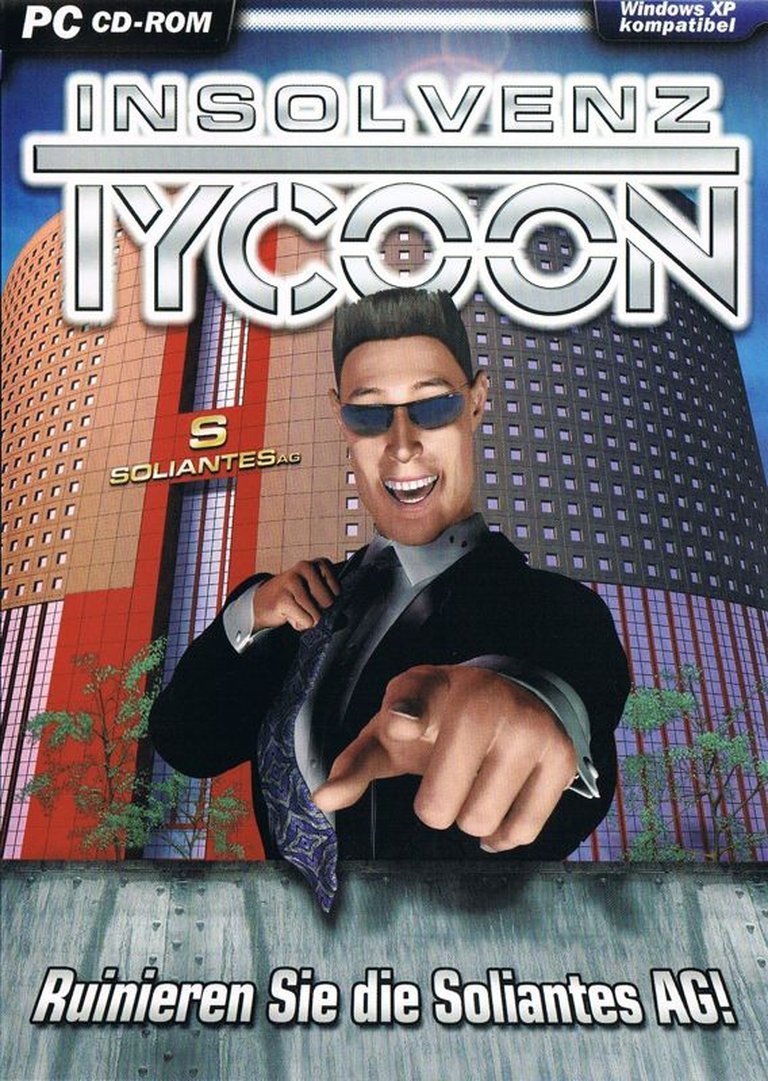
Insolvenz Tycoon is a chaotic action-puzzle game where players take on the role of a saboteur tasked with ruining the Soliantes AG corporation. Navigate through 20 levels, each representing a different company, as you hack computer systems, steal or destroy documents, and wreak havoc using stolen key cards and a non-lethal ‘horror kill gun’ to neutralize guards. The game blends third-person exploration with real-time destruction, challenging players to cause as much mayhem as possible before ultimately bankrupting the target company.
Insolvenz Tycoon Reviews & Reception
mobygames.com (8/100): Average score: 8% (based on 1 ratings)
mobygames.com (8/100): Average score: 8% (based on 1 ratings)
Insolvenz Tycoon: A Bizarre, Forgotten Relic of Early 2000s Gaming
Introduction: The Tycoon Game That Defied Convention
In the vast, often predictable landscape of business simulation games, Insolvenz Tycoon (2004) stands as a glaring anomaly—a game that dared to ask: What if, instead of building an empire, you destroyed one? Developed by the obscure German studios beetle tec and studio.311, and published by unitygames, this title subverted the very essence of the “tycoon” genre. While contemporaries like RollerCoaster Tycoon and Zoo Tycoon tasked players with construction and management, Insolvenz Tycoon handed them a sledgehammer and said, “Break everything.”
At its core, the game is a third-person action-puzzle hybrid disguised as a corporate sabotage simulator. Players control a nameless operative tasked with infiltrating offices, hacking systems, stealing documents, and wreaking havoc—all while evading guards and security cameras. The goal? To bankrupt Soliantes AG and other fictional companies across 20 levels, each representing a different corporate entity. The premise is as absurd as it is intriguing: a reverse-tycoon experience where success is measured in chaos rather than profit.
Yet, despite its audacious concept, Insolvenz Tycoon remains one of the most critically reviled games of its era, earning a dismal 8% score from PC Action Germany—a review so scathing it suggested the developers might have gone bankrupt themselves during production. This review seeks to unpack the enigma of Insolvenz Tycoon: its origins, its mechanics, its failures, and its strange, fleeting legacy in gaming history.
Development History & Context: A Game Born in Obscurity
The Studios Behind the Madness
Insolvenz Tycoon was the brainchild of two little-known German developers:
– beetle tec – A studio with no other notable releases, leaving their broader portfolio a mystery.
– studio.311 – Similarly obscure, though they contributed to the game’s design and possibly its isometric 2D art style.
The game was published by unitygames, a now-defunct German publisher, and distributed by rondomedia Marketing & Vertriebs GmbH. The lack of recognizable names in its development suggests it was a low-budget, niche project, likely targeting a German audience given its USK 12 rating and German-language release.
The Gaming Landscape of 2004: Tycoon Games at Their Peak
The early 2000s were the golden age of tycoon games. Franchises like:
– RollerCoaster Tycoon (1999–2004)
– Zoo Tycoon (2001–2004)
– Railroad Tycoon 3 (2003)
– The Movies (2005)
dominated the simulation genre, offering players creative sandboxes where they could build, manage, and optimize. Even unconventional tycoon games like Pizza Tycoon (1994) and Casino Tycoon (2001) thrived by blending business mechanics with lighthearted themes.
Insolvenz Tycoon, however, inverted the formula. Instead of constructing, players deconstructed. Instead of growth, they engineered collapse. This was not a game about capitalism’s triumphs, but its self-destruction—a darkly humorous critique disguised as a low-budget action game.
Technological Constraints & Design Choices
Released exclusively for Windows in 2004, Insolvenz Tycoon was built with minimal system requirements:
– CPU: Intel Pentium
– OS: Windows 98
– RAM: 256 MB
– DirectX: 9.0
The game’s isometric 2D perspective (as noted by OGDB) was a throwback to earlier tycoon games like Theme Hospital (1997), but its real-time action mechanics set it apart. The developers likely faced budgetary and technical limitations, resulting in:
– Clunky controls (keyboard-only movement)
– Repetitive level design (20 near-identical office layouts)
– A lack of polish in animations and sound
Given the scathing critical reception, it’s possible the game was rushed to market, with little playtesting or refinement.
Narrative & Thematic Deep Dive: Corporate Sabotage as Satire
Plot: A One-Man Wrecking Crew
Insolvenz Tycoon offers no traditional story. There is no protagonist with a backstory, no villain with motives—just a faceless operative (referred to in-game as “your little guy”) tasked with bankrupting corporations. The premise is delivered with minimal exposition:
– You are a corporate saboteur.
– Your mission: infiltrate, steal, destroy, repeat.
– The endgame? Total financial ruin for your targets.
The lack of narrative depth is both a weakness and a strength. On one hand, it makes the game feel hollow and repetitive. On the other, it amplifies the absurdity—players are not saving the world or avenging a wrong; they are mindlessly dismantling capitalism, one printer at a time.
Themes: A Dark Comedy of Corporate Collapse
While Insolvenz Tycoon lacks overt political messaging, its core mechanic—corporate sabotage—invites interpretation:
1. Anti-Capitalist Satire?
– The game rewards destruction over creation, mocking the tycoon genre’s usual celebration of entrepreneurship.
– The title itself—“Insolvenz” (German for bankruptcy)—suggests a critique of unchecked corporate power.
-
A Commentary on Workplace Alienation?
- The player’s character is a faceless drone, much like the office workers whose livelihoods they destroy.
- The repetitive, mundane tasks (hacking computers, stealing keycards) mirror the monotony of corporate life.
-
Pure Absurdist Humor?
- The game’s over-the-top violence (a “non-lethal horror kill gun”) and cartoonish destruction suggest it was meant as a parody rather than a serious simulation.
Characters & Dialogue: The Silence of the Saboteur
- The Player Character: A mute, generic office worker with no personality.
- Guards & NPCs: Faceless obstacles with no dialogue or individuality.
- The “Horror Kill Gun”: A weapon described as “totally safe non-lethal”—a darkly comedic touch that underscores the game’s tongue-in-cheek tone.
The absence of meaningful interaction reinforces the game’s mechanical nature—this is not a story-driven experience, but a purely systemic one.
Gameplay Mechanics & Systems: Chaos by Design
Core Gameplay Loop: Infiltrate, Sabotage, Escape
Insolvenz Tycoon structures its gameplay around five key actions:
1. Movement & Stealth – Navigate offices using keyboard controls (no mouse support).
2. Hacking – Use computers to disable security systems or steal data.
3. Theft & Destruction – Steal documents, smash equipment, or burn files.
4. Combat – Use the “horror kill gun” to incapacitate guards (non-lethally, of course).
5. Progression – Unlock new offices by collecting keycards and completing sabotage objectives.
Level Design: 20 Flavors of the Same Office
Each of the 20 levels represents a different company, but in practice, they are variations of the same office layout:
– Desks, computers, safes, and security cameras are placed in slightly different configurations.
– Guards patrol predictable routes, making stealth easy to exploit.
– Objectives repeat: Hack this terminal, steal that document, destroy this printer.
The lack of variety makes the game feel repetitive quickly, a flaw exacerbated by the clunky controls and absence of a save system (players must complete levels in one sitting).
Combat & Stealth: A Broken System
- The “Horror Kill Gun” – A one-hit incapacitation tool that makes guards temporarily vanish.
- Problem: Guards respawn infinitely, making combat tedious rather than strategic.
- Security Cameras – Can be destroyed, but their placement is often arbitrary and unfair.
- Stealth Mechanics – Nonexistent. The game does not penalize detection meaningfully, removing any tension.
UI & Controls: A Relic of the Early 2000s
- Keyboard-Only Controls – No mouse support, making navigation awkward.
- Minimal HUD – Players must memorize key bindings (e.g., which key hacks vs. which key shoots).
- No Tutorial – The game throws players into the action with no guidance, leading to frustration.
Innovation vs. Flaws: A Game of Missed Potential
| Innovative Aspects | Flawed Execution |
|---|---|
| Reverse-Tycoon Concept – A fresh twist on the genre. | Repetitive Level Design – 20 offices that feel identical. |
| Dark Humor & Satire – A rare critique of corporate culture in gaming. | Clunky Controls – Keyboard-only movement feels outdated. |
| Destruction as Gameplay – Unusual for its time. | No Real Consequences – Guards respawn, cameras are easily destroyed. |
| Minimalist Storytelling – Lets players project their own narrative. | No Progression System – No upgrades, no character growth. |
Verdict: Insolvenz Tycoon had a brilliant premise but failed in execution, suffering from poor design choices, lack of polish, and repetitive gameplay.
World-Building, Art & Sound: The Aesthetic of Corporate Dystopia
Visual Design: A Dull Office Nightmare
- Isometric 2D Graphics – A retro choice that harkens back to Theme Hospital or Syndicate.
- Bland Office Aesthetic – Beige walls, gray cubicles, generic furniture—the game visually embodies corporate monotony.
- Limited Animation – Characters move stiffly, and interactions lack fluidity.
The art direction reinforces the game’s themes—players are trapped in a soulless corporate hellscape, and the visuals ensure they feel every second of it.
Sound Design: The Silence of the Cubicle
- Ambient Office Noises – Printers humming, keyboards clacking—subtle but effective in creating atmosphere.
- No Voice Acting – The game is completely silent outside of basic sound effects.
- Repetitive Soundtrack – If one exists, it’s forgettable.
The lack of audio polish mirrors the game’s overall unfinished feel.
Atmosphere: A Satirical Dystopia
Insolvenz Tycoon does not aim for realism—it’s a caricature of corporate life, where:
– Offices are mazes of bureaucracy.
– Guards are mindless obstacles.
– Destruction is the only meaningful interaction.
The game’s world feels intentionally oppressive, reinforcing its satirical edge.
Reception & Legacy: The Game That Flopped Into Obscurity
Critical Reception: A Universal Panning
The only known professional review comes from PC Action Germany (June 2004), which awarded it a devastating 8/100. The reviewer’s scathing remarks include:
“Vermutlich rauschte die Entwickler-Schmiede von Insolvenz Tycoon während der Master-Phase selbst in die Pleite. Anders kann ich mir dieses nervtötende Etwas einfach nicht erklären.”
(“Presumably, the developers of Insolvenz Tycoon themselves went bankrupt during the mastering phase. Otherwise, I can’t explain this nerve-grating thing.”)
The review lambasts the game’s:
– Repetitive, boring gameplay
– Lack of innovation
– Poor controls and design
No other major outlets reviewed it, and Metacritic has no recorded scores, suggesting it fell into immediate obscurity.
Commercial Performance: A Game No One Bought
- No sales figures exist, but its lack of presence in gaming databases suggests minimal commercial impact.
- eBay listings show it selling for under $10, indicating it was not a collector’s item.
- Only 2 players have logged it on MobyGames, reinforcing its cult obscurity.
Legacy: A Footnote in Tycoon Game History
Insolvenz Tycoon did not inspire imitators, nor did it leave a lasting mark on the genre. However, its concept of “reverse tycoon” gameplay has seen occasional revivals in indie games like:
– Job Simulator (2016) – A VR game where players mock corporate jobs.
– Not For Broadcast (2022) – A darkly comedic media sabotage simulator.
– Teardown (2020) – A destruction-focused heist game with physics-based chaos.
While Insolvenz Tycoon itself is forgotten, its core idea—subverting expectations in simulation games—lives on in more refined forms.
Conclusion: A Flawed Experiment Worth Remembering
Insolvenz Tycoon is not a good game by any conventional metric. Its controls are clunky, its levels are repetitive, and its design is unpolished. Yet, it remains fascinating for one reason: it dared to be different.
In an era where tycoon games celebrated capitalism, Insolvenz Tycoon mocked it. Where others built, it destroyed. Where others rewarded efficiency, it rewarded chaos. It was ahead of its time in concept but behind in execution, a cautionary tale of what happens when ambition outpaces resources.
Final Verdict: 4/10 – A Noble Failure
-
✅ Pros:
- Unique, subversive premise (reverse-tycoon gameplay).
- Darkly comedic tone that critiques corporate culture.
- Short, bizarre experience that stands out in gaming history.
-
❌ Cons:
- Repetitive, uninspired level design.
- Clunky controls and lack of polish.
- No meaningful progression or depth.
Insolvenz Tycoon is not a game to play for fun, but a game to study—a curiosity of early 2000s gaming, a failed experiment that nonetheless challenged genre conventions. It deserves recognition not for its quality, but for its audacity.
For historians and oddity seekers, it’s a fascinating relic. For everyone else? A cautionary tale.
Final Score: 4/10 – “A Bold Idea Buried Under Bad Execution”
Would you like a follow-up analysis on similar “anti-tycoon” games that succeeded where Insolvenz Tycoon failed? Let me know!