
- Release Year: 2000
- Platforms: Windows
- Publisher: The Code Zone
- Developer: The Code Zone
- Genre: Strategy, Tactics
- Perspective: Top-down
- Game Mode: Single-player
- Gameplay: Board game, Turn-based
- Average Score: 97/100
Description
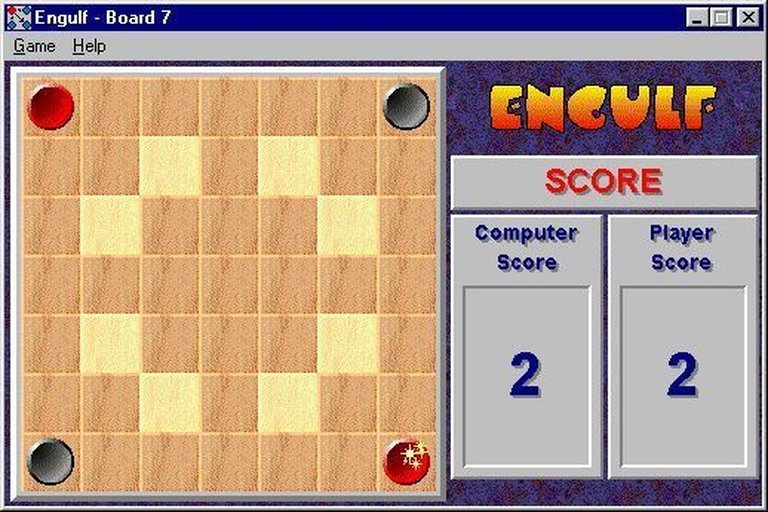
Engulf is a single-player, turn-based strategy game set on a 7×7 grid where the player competes against the computer to dominate the board with the most pieces. Starting with two pieces in opposing corners, players can move one square to replicate their piece or jump two squares without replication. Capturing occurs when a piece is moved adjacent to an opponent’s piece, and the game ends when a player has no pieces or legal moves left. The game features 35 unique boards, four difficulty levels, customizable visuals, and helpful in-game animations to guide movement.
Engulf Reviews & Reception
metacritic.com (97/100): Step into the Dark… As Carrington Institute’s most promising new Agent, Joanna Dark must uncover the truth behind the dataDyne Corporation’s recent technological breakthroughs – breakthroughs which could have serious consequences for mankind.
verticalslicegames.com (98/100): Reviews express overwhelmingly positive sentiment towards Clair Obscur: Expedition 33, frequently hailing it as a masterpiece and a landmark achievement, especially for a debut studio.
Engulf: A Forgotten Gem of Turn-Based Strategy
Introduction
In the vast ocean of video games, some titles are destined to be remembered as classics, while others fade into obscurity. Engulf, a turn-based strategy game released in 2000 by The Code Zone, falls into the latter category. Despite its modest ambitions and limited scope, Engulf offers a unique and engaging experience that deserves a closer look. This review aims to shed light on this overlooked title, exploring its development history, gameplay mechanics, and the context in which it was released.
Development History & Context
Engulf was developed by The Code Zone, a studio that produced a package of games used in various combinations across around twenty different game compilation packages. The game was released in 2000, a time when the gaming landscape was dominated by titles like The Sims, Baldur’s Gate II: Shadows of Amn, and The Legend of Zelda: Majora’s Mask. In this competitive environment, Engulf stood out as a simple yet strategic game that offered a refreshing change of pace.
The game was created using StarView by Star Division Corporation, with some graphics sourced from SpriteLib and MIDI files courtesy of Microsoft Corporation. The development team, led by John Hattan (credited as John ‘FlyMan’ Hattan), included Shelley Hattan for help files and a group of quality control folks who ensured the game’s polish.
Narrative & Thematic Deep Dive
Engulf is a single-player strategy game played against the computer. The objective is to end the game with the most pieces on the board. The game is played on a 7×7 grid, with each player starting with two pieces placed in opposing corners. The narrative is minimal, focusing on the strategic gameplay rather than a complex story.
The game features thirty-five different boards, each with a unique arrangement of squares that players can or cannot move into. This variety ensures that each game feels fresh and challenging. The thematic elements are straightforward, emphasizing strategy and tactical thinking over elaborate storytelling.
Gameplay Mechanics & Systems
The core gameplay loop of Engulf revolves around two primary moves: moving a piece one square, which replicates that piece, and moving a piece two squares, which is a jump and does not replicate the player’s piece. The game ends when a player has no pieces remaining or no legal moves left, with the player having the most pieces at that time declared the winner.
The game is entirely mouse-controlled and played in a window that cannot be resized. It features sound, four levels of difficulty, in-game help screens, and a choice of playing piece, color, and screen background. The help facility is particularly noteworthy, as it displays an animation when a piece is being dragged to a new position, indicating squares that can legally be moved to.
World-Building, Art & Sound
Engulf is set in a simple, abstract world represented by a 7×7 grid. The visual direction is minimalistic, focusing on clarity and functionality rather than elaborate graphics. The sound design is similarly understated, with MIDI files providing a subtle backdrop to the gameplay.
The game’s atmosphere is one of strategic contemplation, with the abstract nature of the grid and pieces allowing players to focus on the tactical aspects of the game. The choice of playing piece, color, and screen background adds a touch of personalization, enhancing the overall experience.
Reception & Legacy
Upon its release, Engulf received little critical attention, and its commercial reception was similarly modest. The game’s legacy is one of obscurity, with few players remembering it today. However, for those who did play it, Engulf offered a unique and engaging strategic experience that stood out in a crowded market.
The game’s influence on subsequent titles is minimal, but its simple yet effective gameplay mechanics serve as a reminder of the enduring appeal of turn-based strategy games. Engulf may not have left a significant mark on the industry, but it remains a fascinating artifact of its time.
Conclusion
Engulf is a forgotten gem of turn-based strategy, offering a unique and engaging experience that deserves recognition. While it may not have the elaborate storytelling or complex mechanics of more prominent titles, its simplicity and strategic depth make it a worthwhile addition to any strategy game enthusiast’s library. In the grand tapestry of video game history, Engulf may be a small thread, but it is one that adds a touch of elegance and sophistication to the overall picture.