
- Release Year: 1998
- Platforms: Macintosh, Windows
- Publisher: Sound Source Interactive, Inc.
- Developer: Digital Media International
- Genre: Educational
- Perspective: 3rd-person
- Game Mode: Single-player
- Gameplay: Mini-games, Reading, writing
- Setting: Fantasy
- Average Score: 94/100
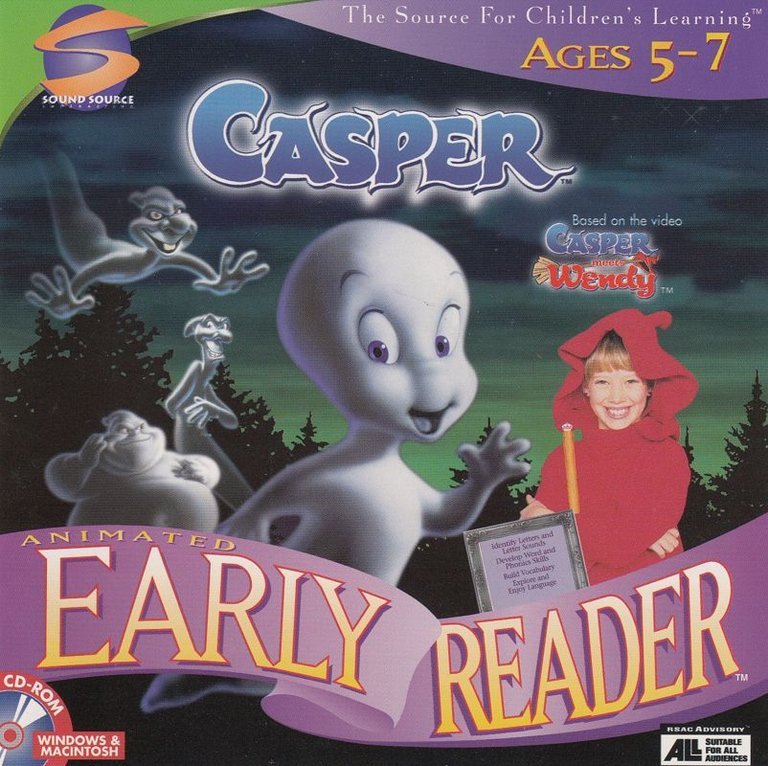
Description
Casper: Animated Early Reader is an educational computer game designed for children ages 5 to 7, based on the direct-to-video film Casper meets Wendy. Players join Casper, his ghostly friends Fatso, Stinky, and Stretch, along with Wendy the Little Witch, in a series of reading-focused games and activities. As they complete challenges, players earn Casper Coins, which can be redeemed to unlock video clips from the film, blending learning with interactive fun in a fantasy setting.
Gameplay Videos
Casper: Animated Early Reader Free Download
Casper: Animated Early Reader Reviews & Reception
mobygames.com (94/100): A triumphant return to form for the series.
Casper: Animated Early Reader Cheats & Codes
PlayStation (NTSC-U)
Enter codes at the main menu or during gameplay as specified.
| Code | Effect |
|---|---|
| L2, L1, R1, R1, Triangle, Triangle, then hold X | Displays various cheat options |
| Hold Up/Left + L1 + R1 + Start, release Up/Left + L1, press Down/Right + Triangle while holding R1 + Start | Enables free movement mode |
| Hold Triangle and press X, R1(3) | Faster movement |
| Hold Triangle and press X, L1(3) | Slow motion |
PlayStation (GameShark/Pro Action Replay)
Enter these codes using a GameShark or Pro Action Replay device.
| Code | Effect |
|---|---|
| 8007EA28 0001 | Brass Key |
| 8007EA2C 0001 | Iron Key |
| 8007EA30 FFFF | Infinite Fools Gold |
| 3007EDE4 00FF | No Height Limit |
| 8007F01C 0064 8007F02C 0064 800FBD80 0064 |
Infinite Health |
Casper: Animated Early Reader – A Hauntingly Delightful Educational Experiment
Introduction: The Ghostly Gateway to Literacy
In the late 1990s, the edutainment genre was a booming frontier, where developers sought to blend learning with the allure of beloved franchises. Casper: Animated Early Reader (1998), developed by Digital Media International and published by Sound Source Interactive, emerged as a charming yet overlooked entry in this space. Tied to the direct-to-video film Casper Meets Wendy, this CD-ROM title targeted children aged 5 to 7, promising to teach reading skills through the whimsical lens of Harvey Comics’ friendly ghost and his supernatural companions.
At its core, Casper: Animated Early Reader is a product of its time—a point-and-click adventure disguised as an interactive storybook, where mini-games and phonics exercises replace traditional gameplay. Yet, beneath its simple facade lies a fascinating case study in licensed educational software, reflecting both the strengths and limitations of late-’90s multimedia learning tools.
This review will dissect the game’s development, narrative structure, gameplay mechanics, and cultural impact, ultimately arguing that while Casper: Animated Early Reader may not have revolutionized edutainment, it remains a nostalgic artifact of an era when digital learning was still finding its spectral feet.
Development History & Context: The Rise of Licensed Edutainment
The Studio Behind the Specter
Digital Media International (DMI) was a key player in the 1990s educational software boom, specializing in licensed properties. Their portfolio included titles like The Land Before Time: Kindergarten Adventure and Maisy’s Playhouse, demonstrating a knack for transforming children’s media into interactive learning experiences. Casper: Animated Early Reader was part of a broader Casper multimedia push, capitalizing on the character’s resurgence following the 1995 live-action film and subsequent animated spin-offs.
Sound Source Interactive, the publisher, was no stranger to edutainment, having released titles like Reader Rabbit and JumpStart. Their collaboration with DMI ensured that Casper would follow the proven formula of blending brand recognition with structured learning.
Technological Constraints & Design Philosophy
Released in 1998, Casper: Animated Early Reader was built for the CD-ROM era, requiring Windows 95/98 or Mac OS 7.0–9. The game’s 257 MB footprint (a substantial size for the time) housed animated cutscenes, voice acting, and a modest array of mini-games. The technical limitations of the era meant that the game relied heavily on pre-rendered animations and static backgrounds, with interaction confined to point-and-click mechanics.
The development team, led by producer Andy Williams and executive producer Marco Pinter, aimed to create a “reading adventure” rather than a traditional game. Their approach mirrored contemporaries like Reader Rabbit and Mario’s Early Years, prioritizing educational outcomes over gameplay depth. The inclusion of Hilary Duff as the voice of Wendy (years before her Lizzie McGuire fame) and Jeremy Foley as Casper added star power, though the voice acting remains rudimentary by modern standards.
The Edutainment Landscape of 1998
By the late ’90s, the edutainment market was saturated with titles vying for parental approval. Casper entered a crowded field alongside heavyweights like The ClueFinders, JumpStart, and Disney’s Animated Storybook series. What set it apart was its tie-in to Casper Meets Wendy, a direct-to-video film that expanded the Casper universe with new characters like Wendy the Little Witch and the Ghostly Trio (Fatso, Stinky, and Stretch).
The game’s release coincided with the peak of CD-ROM-based learning software, a period when schools and households were increasingly adopting computers as educational tools. However, as the internet began its ascent, the shelf life of such titles was already waning. Casper: Animated Early Reader arrived at the tail end of this golden age, just before web-based learning platforms would render many CD-ROM edutainment titles obsolete.
Narrative & Thematic Deep Dive: A Spooky Storybook Adventure
Plot & Structure: Learning Through Play
Casper: Animated Early Reader eschews a traditional narrative in favor of a loose, activity-driven framework. The game is set at Camp Sunnybright, a whimsical summer camp where Casper, Wendy, and the Ghostly Trio host a series of reading-based challenges. Players navigate through different zones—each themed around a character’s domain (e.g., Wendy’s Haunted Maze, Stinkie’s Rancid Mansion)—completing mini-games that reinforce literacy skills.
The lack of a cohesive story is intentional; the game prioritizes modular learning over plot progression. Instead of a linear adventure, players are encouraged to explore at their own pace, selecting activities that align with their skill level. This design choice reflects the era’s educational philosophy, which favored self-directed learning over rigid storytelling.
Characters & Voice Acting: Familiar Faces, Limited Depth
The game’s cast is pulled directly from Casper Meets Wendy, ensuring instant recognition for young fans:
– Casper (voiced by Jeremy Foley) – The friendly ghost serves as the player’s guide, offering encouragement and explanations.
– Wendy the Little Witch (voiced by Hilary Duff) – A mischievous but well-meaning witch who adds a magical twist to the activities.
– The Ghostly Trio (Fatso, Stinky, Stretch) – The comedic relief, each hosting their own themed challenges.
While the voice acting is serviceable, it lacks the polish of later children’s media. Duff’s early performance as Wendy is notably high-pitched and exaggerated, fitting the era’s animation standards but feeling dated today. The narrator, Mark Davis, provides clear instructions, though his delivery is somewhat robotic—a common trait in edutainment titles of the time.
Themes: Friendship, Persistence, and the Joy of Reading
At its heart, Casper: Animated Early Reader promotes positive reinforcement and incremental learning. The game’s themes revolve around:
1. Collaboration – Casper and his friends work together to help the player, modeling teamwork.
2. Persistence – Activities are designed to be challenging but not frustrating, with hints available if needed.
3. The Magic of Reading – The game frames literacy as an adventure, using fantasy elements to make learning feel like play.
The underlying message is clear: reading is a gateway to fun, not a chore. This aligns with the broader edutainment movement’s goal of gamifying education, though Casper’s execution is more functional than inspirational.
Gameplay Mechanics & Systems: Mini-Games and Phonics Drills
Core Gameplay Loop: Earn Coins, Unlock Rewards
The game’s structure is straightforward:
1. Select an Activity – Players choose from a variety of mini-games, each focusing on a different literacy skill.
2. Complete the Challenge – Success earns Casper Coins, the game’s currency.
3. Unlock Rewards – Coins can be spent to watch clips from Casper Meets Wendy, serving as both incentive and break from learning.
This loop is simple but effective, leveraging operant conditioning to motivate young players. The promise of unlockable content—a staple of edutainment—keeps children engaged, even if the rewards are merely passive video clips.
Mini-Games: A Mixed Bag of Educational Value
The game features ten distinct activities, each targeting a specific reading skill:
| Mini-Game | Skill Focus | Description |
|---|---|---|
| Alphabet Soup | Letter Recognition | Match letters to their sounds in a soup-themed sorting game. |
| Word Match | Vocabulary Building | Pair words with corresponding images (e.g., “cat” with a picture of a cat). |
| Rhyming Riddles | Phonemic Awareness | Select words that rhyme with a given prompt. |
| Sentence Scramble | Grammar & Syntax | Rearrange words to form coherent sentences. |
| Casper’s Crossword | Spelling & Word Recall | Fill in a crossword puzzle with age-appropriate clues. |
| Wendy’s Haunted Maze | Reading Comprehension | Follow written directions to navigate a maze. |
| Stinkie’s Goop Machine | Letter Sounds | Identify the correct phonetic sound for a given letter. |
| Fatso’s Word Find | Sight Word Recognition | Locate hidden words in a grid (similar to a word search). |
| Stretch’s Train Ride | Alphabetical Order | Arrange words in ABC order to help Stretch’s train reach its destination. |
| Magic Potion Mixing | Creative Writing | Combine words to create silly sentences, reinforcing parts of speech. |
Strengths:
– Adaptive Difficulty – Many mini-games offer three skill levels, allowing the game to grow with the player.
– Variety – The mix of visual, auditory, and kinesthetic activities caters to different learning styles.
– Immediate Feedback – Correct answers are praised, while mistakes are gently corrected, reducing frustration.
Weaknesses:
– Repetition – Some activities, like Word Match, become tedious after multiple playthroughs.
– Limited Depth – The mini-games are shallow by design, offering little replay value beyond initial completion.
– Passive Rewards – Unlocking video clips is a weak incentive compared to more interactive rewards (e.g., customizable avatars or new gameplay modes).
UI & Navigation: Simple but Clunky
The game’s interface is child-friendly but dated:
– Point-and-Click Navigation – Players move Casper around Camp Sunnybright by clicking on locations.
– Large, Colorful Buttons – Designed for small hands and limited motor skills.
– Text-to-Speech Support – Instructions are read aloud, ensuring accessibility for early readers.
However, the UI suffers from late-’90s CD-ROM jank:
– Slow Loading Times – Transitioning between activities involves noticeable delays.
– Limited Save Functionality – Progress is tracked via Casper Coins, but there’s no traditional save system.
– No Customization – Unlike JumpStart or Reader Rabbit, there’s no avatar creation or personalization.
World-Building, Art & Sound: A Ghostly Aesthetic
Visual Design: Cartoonish Charm with Technical Limits
The game’s art style is a faithful adaptation of the Casper animated series, featuring:
– Bright, Pastel Colors – The camp setting is vibrant, with exaggerated character designs.
– Pre-Rendered Backgrounds – Locations like Wendy’s Haunted Maze and Stinkie’s Rancid Mansion are static but detailed.
– Limited Animation – Characters move stiffly, with most interactions confined to simple gestures.
While the visuals are functional, they lack the fluidity of later children’s games. The 3rd-person perspective is more of a narrative framing device than a gameplay mechanic, as players never directly control Casper’s movements beyond clicking.
Sound Design: Whimsical but Repetitive
The audio experience is minimalist but effective:
– Voice Acting – As mentioned, Hilary Duff and Jeremy Foley deliver performances that are enthusiastic but unrefined.
– Background Music – A light, cheerful score accompanies gameplay, though it loops incessantly.
– Sound Effects – Simple cues (e.g., coin jingles, ghostly whooshes) reinforce actions.
The sound design’s biggest flaw is its lack of variety. The same musical tracks play throughout, and voice lines repeat frequently, which may test the patience of both players and supervising adults.
Atmosphere: A Friendly Haunt
Despite its technical limitations, the game succeeds in creating a welcoming, non-threatening environment. The camp setting is designed to feel safe and inviting, with no scary elements despite the ghostly theme. This aligns with Casper’s brand identity as a friendly, child-appropriate ghost, ensuring that the game remains accessible to its target audience.
Reception & Legacy: A Forgotten Gem of Edutainment
Critical & Commercial Reception
Casper: Animated Early Reader received little formal criticism upon release, a common fate for licensed edutainment titles. The few available player reviews (such as the 4.7/5 average on MobyGames) suggest it was well-received by its intended audience, though it never achieved the mainstream success of Reader Rabbit or JumpStart.
Why It Didn’t Break Out:
1. Oversaturated Market – The late ’90s saw a glut of similar titles, making it hard for Casper to stand out.
2. Limited Marketing – Unlike Disney or Sesame Street titles, Casper lacked a major promotional push.
3. Short Shelf Life – As web-based learning grew, CD-ROM edutainment quickly became obsolete.
Legacy & Influence
While Casper: Animated Early Reader didn’t leave a lasting mark on the industry, it represents:
– A Snapshot of Late-’90s Edutainment – The game embodies the era’s focus on licensed properties + structured learning.
– Early Use of Incentive Systems – The Casper Coins mechanic predates modern gamification techniques.
– A Time Capsule of Voice Acting – Hilary Duff’s early role is a curiosity for fans of her later work.
The game’s obscurity today is partly due to abandonware status—it’s no longer commercially available, though it can be found on archives like MyAbandonware and the Internet Archive. Its preservation is a testament to the efforts of retro gaming enthusiasts, though it remains a niche interest.
Conclusion: A Spectral Footnote in Gaming History
Casper: Animated Early Reader is neither a masterpiece nor a disaster—it’s a competent, if unremarkable, edutainment title that fulfilled its mission of teaching reading skills through playful interaction. Its strengths lie in its accessible design, adaptive difficulty, and charming presentation, while its weaknesses—repetitive gameplay, limited depth, and technical constraints—are products of its era.
Final Verdict: 6.5/10 – A Friendly but Flawed Phantom
- For Educators & Parents (1998): A solid choice for early readers, though not the best in its class.
- For Retro Gamers (Today): A nostalgic curiosity, worth a brief playthrough for fans of ’90s edutainment.
- For Game Historians: A minor but interesting artifact of the CD-ROM learning software boom.
Casper: Animated Early Reader may not haunt the annals of gaming history, but it serves as a gentle reminder of a time when digital learning was still finding its voice—one friendly ghost at a time.
Where to Experience It Today:
– MyAbandonware
– Internet Archive
– Retrolorean
Would you dare to take a trip back to Camp Sunnybright? The ghosts are waiting—and they’ve got words to teach.