
- Release Year: 1998
- Platforms: Windows
- Publisher: Optimus Nexus, Optimus Pascal Multimedia
- Developer: Leryx-Longsoft
- Genre: Puzzle
- Perspective: Side view
- Game Mode: Single-player
- Gameplay: Physics-based, Puzzle-solving
- Setting: Wilderness
- Average Score: 76/100
Description
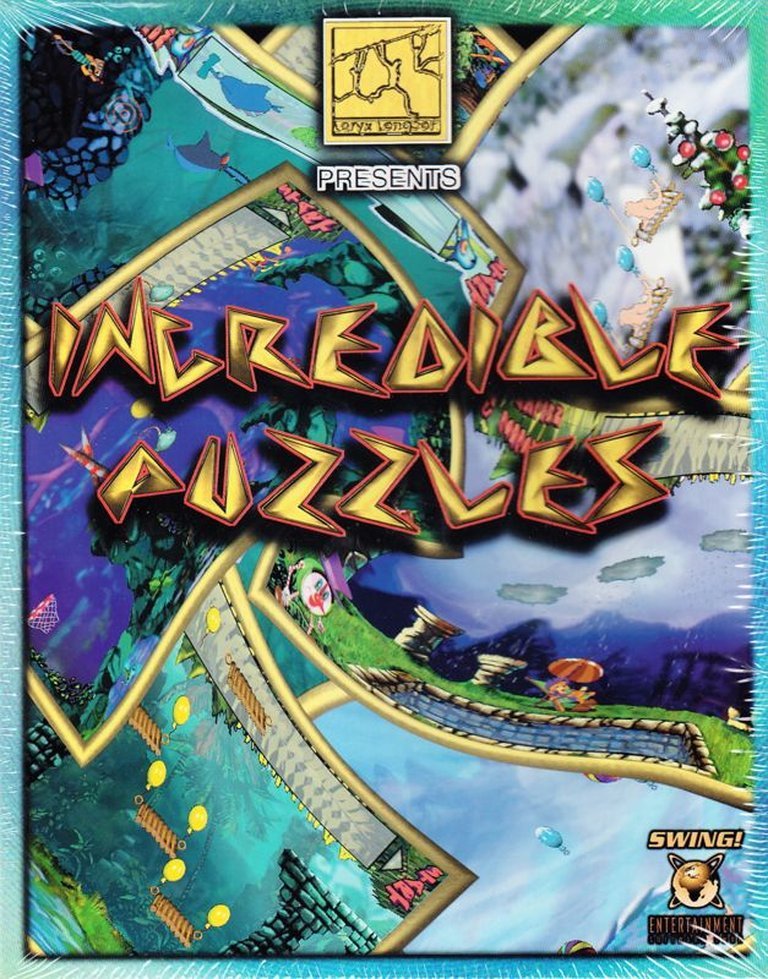
Leo the Lion’s Puzzles is a creative puzzle game where players arrange various elements like animals, balloons, and ropes into contraptions to solve wilderness-themed challenges, similar to Rube Goldberg machines. Set across multiple chapters with unique graphics, the game tasks players with achieving goals such as freeing trapped animals or activating mechanisms, all governed by physics and gravity. Hints are available if players struggle, and progress is automatically saved after each solved puzzle.
Gameplay Videos
Where to Buy Leo the Lion’s Puzzles
PC
Leo the Lion’s Puzzles Reviews & Reception
mobygames.com (76/100): A puzzle game with a concept similar to the Incredible Machine games.
Leo the Lion’s Puzzles: A Forgotten Gem of Physics-Based Puzzle Design
Introduction: The Lion’s Leap into Logic
In the late 1990s, the puzzle genre was undergoing a quiet revolution. While blockbusters like Tomb Raider and Half-Life dominated headlines, a small Polish studio, Leryx-Longsoft, was crafting something far more cerebral—and far more charming. Leo the Lion’s Puzzles (1998), known in its native Poland as Zagadki Lwa Leona, emerged as a delightful hybrid of The Incredible Machine’s Rube Goldberg mechanics and the whimsical world-building of children’s edutainment. Yet, unlike its Sierra-inspired predecessors, Leo the Lion’s Puzzles carved its own niche by blending physics-based problem-solving with a vibrant, animal-populated universe. This review explores why, despite its obscurity, the game remains a fascinating artifact of late-’90s puzzle design—a title that deserves reconsideration not just as a curiosity, but as a masterclass in accessible, creative gameplay.
Development History & Context: Poland’s Puzzle Renaissance
The Studio Behind the Lion
Leryx-Longsoft, a Polish developer with roots in the early 1990s, was no stranger to ambitious projects. Having previously released Leo the Lion (1996), a colorful platformer that introduced the titular feline hero, the studio sought to expand its universe into new genres. Leo the Lion’s Puzzles was conceived as a spiritual successor, shifting from action-platforming to logic-based challenges while retaining the character’s charm. The team, led by director Jarosław Modrzejewski (credited as Jarek Modrzejewski), consisted of 13 individuals—many of whom would later contribute to other notable Polish titles like Golem and Orle Gniazdo.
Technological Constraints and Creative Workarounds
Released in 1998 for Windows, the game was built within the limitations of late-’90s PC hardware. The minimum requirements—a Pentium 60 MHz processor, 16 MB of RAM, and DirectX 5.0 compatibility—reflect an era where developers had to optimize meticulously. The game’s physics engine, though rudimentary by modern standards, was a marvel of its time, simulating gravity, momentum, and object interactions with surprising fidelity. The fixed/flip-screen perspective and side-view presentation were practical choices, allowing for clear puzzle visualization without taxing the system.
The Gaming Landscape of 1998
The late ’90s were a golden age for puzzle games. The Incredible Machine series had already established the “Rube Goldberg” subgenre, while titles like Lemmings and Pipe Dream proved that logic games could captivate broad audiences. However, Leo the Lion’s Puzzles arrived at a crossroads: the industry was shifting toward 3D acceleration, and many developers were abandoning 2D puzzle mechanics in favor of more “immersive” experiences. In this context, Leryx-Longsoft’s decision to double down on a 2D, physics-driven puzzle game was both bold and risky.
Narrative & Thematic Deep Dive: A Jungle of Whimsy and Wit
Plot: The Lion’s Quest for Solutions
Leo the Lion’s Puzzles eschews a traditional narrative in favor of an episodic, environment-driven structure. The game is divided into three distinct chapters:
1. Secrets of the Jungle – A lush, vine-choked world where players interact with monkeys, parrots, and other tropical creatures.
2. Underwater World – A submerged realm featuring hammerhead fishes, jellyfish, and other aquatic oddities.
3. Secrets of the Pole – A frigid Arctic landscape populated by seals, penguins, and the occasional yeti.
Each chapter frames Leo as a benevolent problem-solver, assisting animals in need. Whether freeing a trapped bird, delivering a key to a locked cage, or constructing a bridge for a stranded seal, the game’s scenarios are simple yet effective in fostering empathy and curiosity.
Characters and Dialogue: Minimalism with Maximum Charm
Leo himself is a silent protagonist, but the game’s charm lies in its supporting cast. Animals communicate through expressive animations and occasional voiceovers (provided by Leszek Malec), adding personality without relying on text-heavy dialogue. The lack of spoken or written narrative is a deliberate choice—one that makes the game universally accessible, particularly to younger players.
Themes: Learning Through Play
At its core, Leo the Lion’s Puzzles is an educational game disguised as entertainment. The themes revolve around:
– Creativity and Experimentation – Players are encouraged to test wild combinations of objects, learning through trial and error.
– Physics as a Playground – Gravity, momentum, and cause-and-effect are not just mechanics but teaching tools.
– Environmental Awareness – The game subtly reinforces the interconnectedness of ecosystems, with each puzzle requiring harmony between animals and objects.
Gameplay Mechanics & Systems: The Art of the Contraption
Core Gameplay Loop: Build, Test, Refine
The gameplay follows a straightforward but endlessly engaging loop:
1. Objective Briefing – The player is given a goal (e.g., “Free the bird from the cage”).
2. Tool Selection – A limited set of objects (balloons, ropes, weights, animals) is provided.
3. Construction Phase – The player arranges these objects into a functional contraption.
4. Execution – The player hits “Start” and watches the physics unfold.
5. Iteration – If the solution fails, the player adjusts and retries.
This loop is reminiscent of The Incredible Machine, but Leo the Lion’s Puzzles distinguishes itself through its animal-assisted mechanics. For example:
– Monkeys can swing on ropes, altering momentum.
– Hammerhead fishes act as, well, hammers.
– Seals can bounce objects like trampolines.
Physics and Gravity: The Invisible Teacher
The game’s physics engine is its greatest strength. Every object obeys realistic (if exaggerated) laws of motion:
– Balloons provide lift but are susceptible to popping.
– Ropes stretch and sway, affecting trajectory.
– Weights anchor structures but can also trigger collapses.
This system is forgiving enough for children yet deep enough to challenge adults. The absence of a “undo” button forces players to think ahead, while the automatic save feature after each puzzle ensures frustration never becomes overwhelming.
Hint System: A Helping Paw
For players stuck on a puzzle, the game offers a sketch-style hint after a set time. These hints are not outright solutions but rather diagrammatic suggestions, preserving the satisfaction of discovery. This design choice reflects the game’s educational philosophy: guide, don’t solve.
UI and Controls: Simplicity as a Virtue
The interface is minimalist:
– Point-and-click object placement.
– A Start/Stop button to test contraptions.
– A Reset option to clear the board.
The mouse-driven controls are intuitive, though modern players might find the lack of keyboard shortcuts limiting. The fixed/flip-screen perspective ensures that puzzles are always visible in their entirety, eliminating camera-related frustrations.
World-Building, Art & Sound: A Feast for the Senses
Visual Design: Hand-Crafted Wonder
The game’s art direction is a standout feature. Backgrounds are hand-painted, blending prerendered elements with 2D sprites to create a storybook aesthetic. The jungle levels feature dense foliage and warm hues, while the Arctic stages employ cool blues and icy textures. The underwater sections are particularly impressive, with light refraction effects and bubbly animations adding depth.
Critics at the time praised the visuals. Reset magazine (1998) noted:
“The hand-drawn backgrounds with effectively blurred backgrounds really make an impression! The animated interludes between chapters—overseen by artists from Hanna-Barbera and the Łódź Film Studio—are equally impressive.”
Sound and Music: A Symphony of Whimsy
The soundtrack, composed by Adam Skorupa (credited as Scorpik) and Jan Blew, is a playful mix of upbeat melodies and ambient tones. Each environment has its own musical theme:
– Jungle – Lively, tribal-inspired rhythms.
– Underwater – Echoey, fluid compositions.
– Arctic – Crisp, windy soundscapes.
The sound effects are equally charming, from the boing of a bouncing seal to the splash of a fish hitting water. The voice acting, though sparse, adds personality—Leo’s occasional roars and the animals’ chirps and growls make the world feel alive.
Reception & Legacy: A Cult Classic in the Making
Critical Reception: Praise with Reservations
Upon release, Leo the Lion’s Puzzles received modest but positive reviews:
– Gambler (Poland, 1998) – 81/100: “A Polish developer can do it!” The review highlighted the game’s creativity and polish.
– Reset (Poland, 1998) – 7/10: Praised the graphics and animation but noted that the puzzle design, while clever, occasionally lacked depth.
The game’s MobyGames score (76% from critics, 3.8/5 from players) suggests a title that was well-received but not groundbreaking. Its niche appeal—targeting both children and puzzle enthusiasts—may have limited its mainstream success.
Commercial Performance and Obscurity
Sales figures for Leo the Lion’s Puzzles are unavailable, but its obscurity today suggests it was overshadowed by bigger releases. However, its cult following persists, particularly in Poland, where it remains a nostalgic favorite.
Influence and Legacy
While Leo the Lion’s Puzzles didn’t spawn a direct sequel, its DNA can be seen in later physics-based puzzle games:
– Crazy Machines (2004) – A spiritual successor to The Incredible Machine that shares Leo’s contraption-building ethos.
– World of Goo (2008) – Embraces similar physics-driven creativity.
– Besiege (2015) – Expands on the idea of building machines to solve problems.
The game’s educational potential has also been recognized retrospectively. Modern STEM-focused games like Kerbal Space Program and Human: Fall Flat owe a debt to Leo’s emphasis on learning through playful experimentation.
Conclusion: A Puzzle Game That Roars with Charm
Leo the Lion’s Puzzles is a game that defies easy categorization. It is at once a children’s edutainment title, a physics sandbox, and a love letter to creative problem-solving. Its greatest strength lies in its ability to make learning feel like play—a quality that many modern games strive for but few achieve with such elegance.
Final Verdict: 8.5/10 – A Hidden Masterpiece of Puzzle Design
While it may not have the name recognition of The Incredible Machine or Lemmings, Leo the Lion’s Puzzles stands as a testament to the power of simplicity, creativity, and heart in game design. Its blend of charming visuals, intuitive physics, and animal-assisted puzzles makes it a must-play for fans of the genre—and a title that deserves preservation in the annals of gaming history.
For those willing to dive into its jungle, ocean, and Arctic wonders, Leo the Lion’s Puzzles offers not just challenges, but a celebration of curiosity itself. And in an era where games often prioritize spectacle over substance, that’s a legacy worth remembering.
Where to Play Today:
– Available on GOG.com for $5.99 (includes modern compatibility fixes).
– Requires Windows 95 compatibility mode for the original release.
– Best experienced with a mouse and a sense of wonder.
Leo the Lion’s Puzzles may have been a quiet roar in 1998, but its echo continues to resonate.