
- Release Year: 2000
- Platforms: Windows
- Publisher: Swing! Entertainment Media AG
- Developer: Fakt GbR
- Genre: Action, Puzzle
- Perspective: Diagonal-down
- Game Mode: Single-player
- Gameplay: Collecting, Combat, Platforming, Puzzle solving, Time-based challenges
- Setting: Fantasy
- Average Score: 76/100
Description
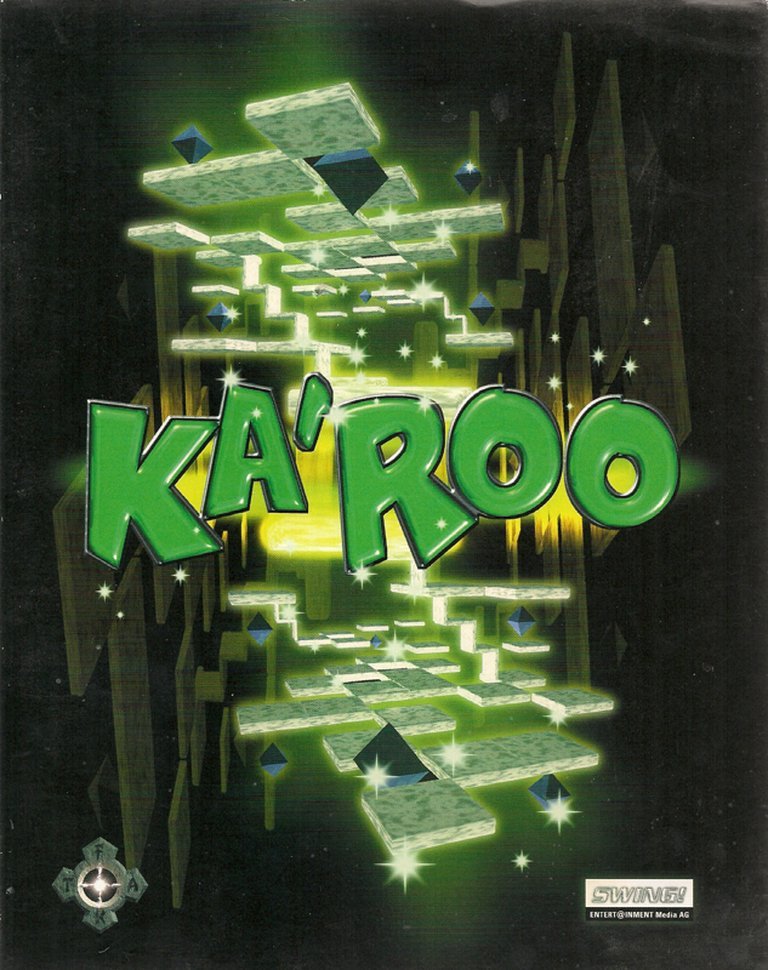
Ka’Roo is a puzzle-action game where players guide a boxing-gloved kangaroo through 80 3D platform levels set in diverse environments like Egypt and jungles. The goal is to collect energy crystals to unlock exits while battling enemies with boxing moves or power-ups, all within a time limit. The game blends action with puzzle-solving, featuring a radar for enemy detection and gradually increasing difficulty, making it accessible yet challenging for younger players.
Ka’Roo Free Download
Ka’Roo Cracks & Fixes
Ka’Roo Patches & Updates
Ka’Roo Reviews & Reception
mobygames.com (52/100): A little kangaroo wearing boxing gloves needs to be maneuvered through 80 levels.
myabandonware.com (100/100): No puedo hacerlo funcionar, ayuda por favor!
Ka’Roo Cheats & Codes
PC
Go to the Map menu and hold spacebar as you input the entire code.
| Code | Effect |
|---|---|
| Up – Up – Left – Down – Enter | Unlock next level |
| Up – Down – Right – Left – Up – L.Shift | Unlock all levels |
| Up – Right – Down – Left – Zero (must be numpad zero) | +1 Flag |
| Down – Right – Left – Down – Zero (must be numpad zero) | +1 Glove |
| Up – Right – Down – Right – Left – L.Ctrl | Infinite flags |
| Down – Right – Up – Right – Left – L.Alt | Infinite gloves |
| Down – R. | Infinite health |
Dreamcast
Enter the map screen while playing the game, then hold L + R and press the following sequences.
| Code | Effect |
|---|---|
| Up(2), Left, Down, X | Level skip |
| Up, Down, Right, Left, Up, X | Level select |
| Down, Left, B, Left, B(2) | Infinite lives |
| Down, B(2), A, Up, Left, Right | Infinite health |
| Up, Right, Down, Right, Left, A | Infinite checkpoints |
| Down, Right, Up, Right, Left, B | Infinite gloves |
| Down, A, Up, Left, A | Extra life |
| Up, Right, Down, Left, A | Extra checkpoint |
| Down, Right, Left, Down, A | Extra glove |
Ka’Roo: A Forgotten Gem of the Early 2000s Platformer Renaissance
Introduction
In the crowded landscape of early 2000s platformers, Ka’Roo (2000) emerges as a charming yet overlooked title that attempted to blend the burgeoning 3D platforming trend with puzzle-solving mechanics. Developed by the German studio Fakt GbR and published by Swing! Entertainment Media AG, this game stars a boxing-glove-wearing kangaroo navigating 80 levels across fantastical environments, from Egyptian tombs to lush jungles. While it never achieved the critical or commercial success of contemporaries like Banjo-Kazooie or Spyro the Dragon, Ka’Roo offers a fascinating case study in the evolution of the genre during a transitional era for PC gaming.
This review will dissect Ka’Roo’s development, gameplay, artistic direction, and legacy, arguing that while it may not have been a masterpiece, it was a competent and occasionally innovative title that deserved more attention than it received. Its blend of action and puzzle elements, coupled with its distinctive protagonist, makes it a noteworthy footnote in the history of 3D platformers.
Development History & Context
The Studio Behind the Game
Fakt GbR was a small German development studio that, despite its modest size, contributed to several notable projects in the late 1990s and early 2000s. The team behind Ka’Roo was led by Falk Möckel (gameplay programming and level design) and Andreas Lenk (lead programming, including the proprietary Darklight2 3D Engine). Other key figures included Marco Kalweit (particle systems, 3D sound, and controls) and Thomas Heinschke (3D modeling and textures). The studio’s portfolio included collaborations on games like Sky Surfer and Crazy Machines 2, but Ka’Roo was one of their most ambitious standalone projects.
Technological Constraints and Innovations
Released in 2000, Ka’Roo was developed during a period when 3D platformers were transitioning from the Nintendo 64’s dominance to the emerging power of PC hardware. The game utilized the Darklight2 3D Engine, a proprietary tool that allowed for diagonal-down isometric perspectives—a choice that set it apart from the fully 3D camera systems of contemporaries like Super Mario 64 or Crash Bandicoot. This perspective was likely a pragmatic decision, as it reduced the complexity of camera controls while still offering a sense of depth and exploration.
The engine supported:
– Dynamic lighting and particle effects (e.g., sandstorms in desert levels).
– A radar system for enemy detection, a feature that was relatively uncommon in platformers at the time.
– Zoomable camera mechanics, allowing players to adjust their view dynamically.
However, the engine’s limitations were evident in the game’s fixed camera angles, which occasionally led to frustrating moments of imprecise platforming—a common critique in reviews.
The Gaming Landscape of 2000
The year 2000 was a pivotal moment for platformers. The genre was at its peak on consoles, with titles like Banjo-Tooie, Spyro: Year of the Dragon, and Rayman 2 dominating the market. On PC, however, the platformer scene was more fragmented. While games like Deus Ex and The Sims were redefining PC gaming, 3D platformers struggled to find a foothold due to:
– Control scheme challenges: Keyboard-and-mouse setups were less intuitive for 3D movement than console controllers.
– Market saturation: Many PC gamers were shifting toward strategy, RPG, or FPS titles.
– Technical expectations: PC audiences demanded higher graphical fidelity, which smaller studios like Fakt GbR struggled to deliver.
Ka’Roo entered this competitive space as a budget-friendly, family-oriented title, aiming to appeal to younger players and casual gamers. Its USK 0 rating (suitable for all ages) and non-violent combat (boxing gloves instead of weapons) positioned it as a safe, accessible choice for parents.
Narrative & Thematic Deep Dive
Plot Overview
Ka’Roo’s narrative is minimal but serviceable. The game follows Joe, a plucky kangaroo, as he embarks on a quest to recover energy crystals stolen by a shadowy group of bandits. These crystals are vital to restoring power to his homeland, a premise that serves as a loose justification for the game’s 80 levels. The story is told through brief cutscenes and environmental storytelling, with each themed world (Egypt, Jungle, etc.) representing a different region Joe must traverse.
While the plot is hardly groundbreaking, it fulfills its purpose: providing a lighthearted, universally appealing framework for the gameplay. The lack of complex lore or character development is forgivable, given the game’s target audience.
Themes and Symbolism
Despite its simplicity, Ka’Roo subtly explores themes of:
1. Perseverance: Joe’s journey is one of endurance, with each level presenting increasingly difficult challenges.
2. Resourcefulness: The game emphasizes puzzle-solving over brute force, encouraging players to think strategically about crystal collection and enemy avoidance.
3. Environmental Diversity: The varied level themes (deserts, jungles, ruins) subtly celebrate global cultures, albeit through a fantastical lens.
The game’s boxing-glove mechanic is particularly interesting. Unlike typical platformer protagonists who rely on weapons or innate abilities, Joe’s gloves frame combat as playful rather than violent, aligning with the game’s family-friendly ethos.
Characters and Dialogue
Ka’Roo’s cast is limited but charming:
– Joe the Kangaroo: The silent protagonist, whose expressiveness is conveyed through animated hops, punches, and celebratory poses.
– Enemies: Ranging from skeletal warriors in Egypt to mischievous monkeys in the jungle, each foe is designed to fit its environment.
– The Bandits: The faceless antagonists, whose motives are never fully explained but serve as a simple “steal the crystals” MacGuffin.
The game features no spoken dialogue, relying instead on text prompts and sound effects (e.g., Joe’s grunts, enemy taunts). This minimalist approach keeps the focus on gameplay but also limits emotional engagement.
Gameplay Mechanics & Systems
Core Gameplay Loop
Ka’Roo’s structure is straightforward:
1. Navigate a level within a time limit.
2. Collect energy crystals (a set number is required to unlock the exit).
3. Defeat enemies using boxing gloves or power-ups.
4. Reach the exit before time runs out.
This loop is repeated across 80 levels, divided into six themed worlds. The gradual increase in difficulty is well-paced, with early levels focusing on basic platforming and later stages introducing:
– Moving platforms
– Hidden switches
– Multi-tiered arenas
– Enemy ambushes
Combat and Enemy AI
Combat is simple but effective:
– Basic Punch: A short-range attack with Joe’s gloves.
– Power-Ups: Temporary upgrades like faster punches or invincibility.
– Radar System: A mini-map that tracks enemy positions, adding a strategic layer to encounters.
Enemy AI is predictable but fair. Most foes follow set patrol routes, allowing players to plan their approach. However, the lack of advanced combat mechanics (e.g., combos, special moves) makes fights repetitive over time.
Puzzle-Solving and Exploration
While Ka’Roo is marketed as an action game, its puzzle elements are its strongest feature. Levels often require:
– Switch Activation: Pressing buttons to open doors or lower bridges.
– Crystal Sequencing: Collecting crystals in a specific order to progress.
– Environmental Manipulation: Using moving platforms or wind currents to reach hidden areas.
The radar system doubles as a puzzle-solving tool, helping players locate hidden crystals or switches. This mechanic was praised in reviews for adding depth to the gameplay.
Controls and Camera
The game’s biggest flaw is its clunky controls:
– Keyboard-Only Input: No controller support, which was a significant oversight for a 3D platformer.
– Limited Movement: Joe cannot sidestep or strafe, making precise jumps difficult.
– Camera Issues: The fixed isometric perspective sometimes obscures platforms or enemies, leading to cheap deaths.
These issues were frequently cited in reviews, with PC Zone calling the controls “träge” (sluggish) and PC Player noting that the game’s appeal was limited to children due to its simplistic mechanics.
Progression and Replayability
Ka’Roo offers linear progression, with levels unlocking sequentially. However, it includes:
– Time Trials: Players can replay levels to beat their best times.
– Crystal Hunting: Collecting all crystals in a level unlocks bonuses.
– Secret Areas: Hidden paths reward exploration with extra power-ups.
While not as deep as contemporaries like Banjo-Kazooie, these features add some replay value, though the lack of a save-anywhere system (players must complete levels to save) frustrates modern audiences.
World-Building, Art & Sound
Visual Design and Aesthetics
Ka’Roo’s art style is colorful and cartoonish, with a low-polygon 3D aesthetic that was standard for the era. The game’s six themed worlds each have distinct visual identities:
1. Egypt: Golden sands, hieroglyph-covered walls, and towering obelisks.
2. Jungle: Dense foliage, wooden bridges, and ancient ruins.
3. Ice World: Slippery surfaces, frozen lakes, and glacial caves.
4. Volcano: Lava pits, crumbling rock formations, and geysers.
5. Castle: Gothic architecture, drawbridges, and trap-filled halls.
6. Space Station: Futuristic corridors, zero-gravity sections, and robotic enemies.
The character models are simple but expressive. Joe’s animations—stretching before a jump, winding up for a punch—give him personality despite the lack of dialogue. Enemy designs are whimsical, with skeletons in bandit hats and robot scorpions adding variety.
Sound Design and Music
The audio in Ka’Roo is functional but unremarkable:
– Sound Effects: Punch impacts, crystal collection chimes, and enemy taunts are clear but lack depth.
– Music: Composed by Fredrik Sand, the soundtrack features upbeat, looped tracks that fit each world’s theme (e.g., tribal drums in the jungle, eerie synths in the castle). However, the music is repetitive, with only a few tracks per world.
PC Joker praised the game’s “niedliche Sounduntermalung” (cute sound accompaniment), but most reviews agreed that the audio was adequate rather than memorable.
Atmosphere and Immersion
Ka’Roo excels in creating a sense of place. The zoomable camera allows players to appreciate the level design, and environmental details (e.g., sandstorms in Egypt, falling leaves in the jungle) enhance immersion. However, the lack of ambient sound (e.g., no wind howling, no animal noises) weakens the atmosphere.
The game’s fantasy setting is its strongest suit, offering a whimsical escape that contrasts with the darker themes of other 2000s platformers like Psychonauts or Conker’s Bad Fur Day.
Reception & Legacy
Critical Reception
Ka’Roo received mixed reviews, with an average critic score of 52% on MobyGames. Praise was directed at:
– Charming visuals (PC Action: “niedliche, völlig gewaltfreie Spiel” – “cute, completely non-violent game”).
– Accessible gameplay (PC Games: “besonders für jüngere Spielefans einen Blick wert” – “especially worth a look for younger gaming fans”).
– Puzzle variety (Retro Replay: “brain-teasing puzzles” that add depth).
Criticisms focused on:
– Clunky controls (PC Zone: “simple Hüpfspiel” – “simple jumping game”).
– Repetitive music (Absolute Games: “кисловатого юмора” – “sour humor”).
– Short length (PC Joker: “alles in einem faulen Nachmittag” – “everything in a lazy afternoon”).
Commercial Performance
Ka’Roo was a budget title, and its sales reflected its niche appeal. It failed to compete with AAA platformers but found a small audience among younger players and casual gamers. Its lack of controller support and technical limitations likely hindered its commercial success.
Legacy and Influence
Ka’Roo is largely forgotten today, but it holds a minor place in platformer history as:
– An early example of a 3D isometric platformer on PC.
– A family-friendly alternative to more violent games of the era.
– A showcase of small-studio innovation in level design.
While it didn’t spawn sequels or imitators, its puzzle-platforming hybrid approach can be seen in later indie titles like Trine or Little Big Planet.
Conclusion: A Flawed but Charming Relic
Ka’Roo is not a lost masterpiece, but it is a competent, charming, and occasionally innovative platformer that deserves recognition for its ambitions. Its colorful worlds, clever puzzles, and non-violent combat make it a standout in the early 2000s PC platformer scene, even if its clunky controls and repetitive music hold it back.
Final Verdict: 6.5/10 – A flawed gem worth revisiting for platformer enthusiasts and retro gaming historians.
For modern players, Ka’Roo is best enjoyed as a curiosity—a snapshot of a time when 3D platformers were still finding their footing on PC. While it may not have aged gracefully, its heart and creativity shine through, making it a worthy addition to any retro gaming collection.
Where to Play Today:
– Abandonware sites (e.g., MyAbandonware, OldGamesDownload) offer free downloads.
– Patch 1.01 fixes some bugs, but hex edits (as documented by fans) are needed for full compatibility on modern systems.
– Emulation via DOSBox or PCem is recommended for the best experience.
Ka’Roo may not have been a classic, but it remains a testament to the creativity of small studios in an era dominated by giants. For that alone, it deserves to be remembered.