
- Release Year: 2020
- Platforms: Windows
- Publisher: S.A.D. Software Vertriebs- und Produktions GmbH
- Genre: Compilation
- Game Mode: Single-player
- Average Score: 80/100
Description
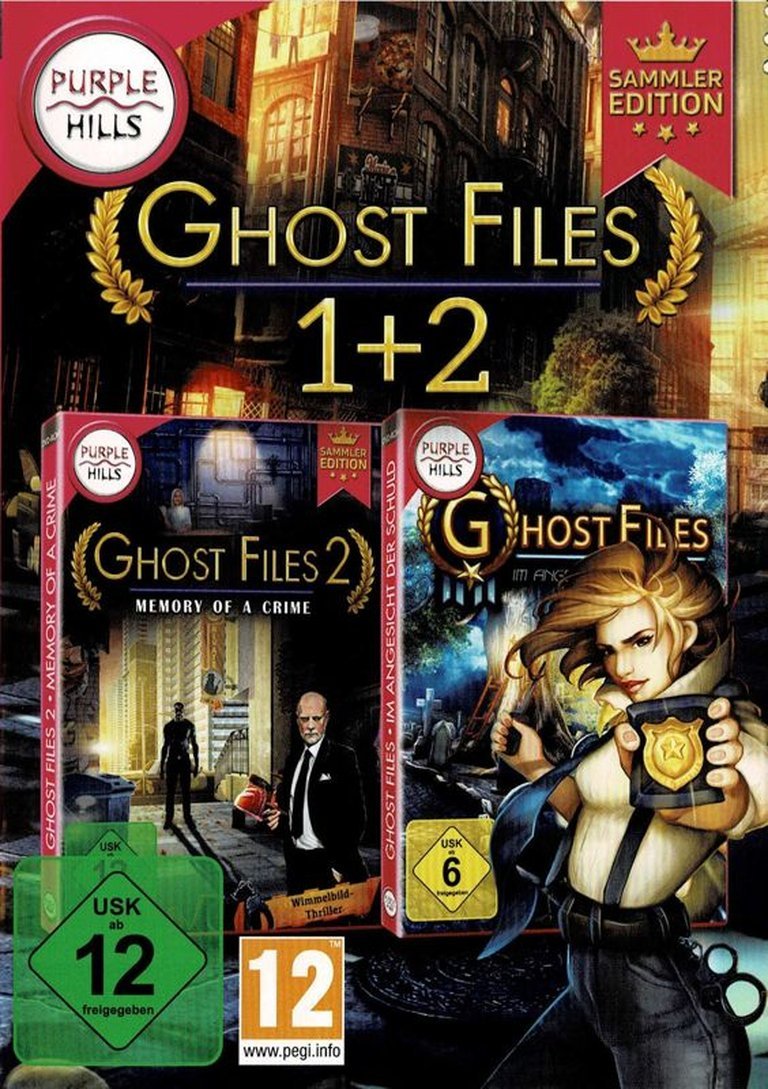
Ghost Files 1+2 (Sammler Edition) is a compilation of two mystery-adventure games: ‘Ghost Files: The Face of Guilt’ and ‘Ghost Files 2: Memory of a Crime’. Players dive into supernatural investigations, solving puzzles and uncovering eerie secrets in a dark, atmospheric setting. The games blend hidden-object challenges with narrative-driven gameplay, offering a chilling experience for fans of detective and horror genres.
Ghost Files 1+2 (Sammler Edition) Reviews & Reception
metacritic.com (80/100): Ghost Files: Memory of a Crime on Xbox One conjures up a very enjoyable narrative and gets the creepy serial killer character spot on.
rgamereview.com : Overall, this is was a relatively short detective game. It did have some good hidden object puzzles.
flyingomelette.com : Ghost Files: The Face of Guilt (Collector’s Edition) is a standard entry in the “Murder Mystery with Supernatural Elements” subgenre of hidden object games.
Ghost Files 1+2 (Sammler Edition): A Hauntingly Mediocre Hidden Object Compilation
Introduction: The Ghost of a Forgotten Genre
The Ghost Files series is a curious artifact of the hidden object puzzle adventure (HOPA) genre—a subcategory of gaming that once thrived in the mid-to-late 2010s but has since faded into obscurity. Published by Artifex Mundi and developed by Brave Giant Studio, Ghost Files 1+2 (Sammler Edition) bundles two detective-themed HOPA titles: Ghost Files: The Face of Guilt (2017) and Ghost Files 2: Memory of a Crime (2019). Marketed as a “Collector’s Edition,” this compilation promises an immersive blend of crime-solving, supernatural intrigue, and classic hidden object gameplay.
Yet, despite its ambitious premise, Ghost Files struggles to escape the shadows of its own mediocrity. It is a game that wants to be a gripping detective thriller with paranormal twists but instead delivers a formulaic, bug-riddled experience that feels more like a ghost of better HOPA games past. This review dissects the compilation’s strengths, flaws, and its place in the ever-shrinking HOPA landscape.
Development History & Context: The Rise and Fall of the HOPA Genre
The Artifex Mundi Machine
Artifex Mundi was once a powerhouse in the HOPA genre, churning out visually polished, narrative-driven hidden object games at a rapid pace. Founded in 2010, the Polish studio became synonymous with titles like Enigmatis, Grim Legends, and Nightmares from the Deep—games that blended mystery, fantasy, and puzzle-solving into digestible, casual-friendly experiences.
Ghost Files was developed in collaboration with Brave Giant Studio, a lesser-known developer that contributed to a handful of HOPA titles. The first game, The Face of Guilt, released in 2017, while Memory of a Crime followed in 2019. The Sammler Edition (Collector’s Edition) compilation, published by S.A.D. Software, arrived in 2020, bundling both games with minor extras (wallpapers, soundtracks, and bonus chapters).
Technological Constraints & Market Saturation
By the late 2010s, the HOPA genre was already in decline. The rise of mobile gaming, the oversaturation of the market, and the shift toward more interactive, narrative-driven experiences (e.g., The Room series, Return of the Obra Dinn) left traditional hidden object games struggling for relevance.
Ghost Files was built using Unity, a common engine for HOPA titles, allowing for cross-platform releases (PC, Mac, Linux, and later mobile). However, the games suffer from technical inconsistencies—bugs, awkward animations, and a disjointed art style that betrays their low-budget origins. The Sammler Edition does little to address these issues, serving as a mere repackaging rather than a definitive remaster.
The Gaming Landscape at Release
When Ghost Files 1+2 launched in 2020, the HOPA genre was already a niche within a niche. Big Fish Games, once the dominant distributor, had shifted focus, and Artifex Mundi’s output had slowed. The Ghost Files series arrived too late to capitalize on the genre’s heyday, instead appealing to a dwindling fanbase of casual gamers and hidden object enthusiasts.
Narrative & Thematic Deep Dive: A Detective Story Haunted by Its Own Inconsistencies
Plot Overview: From Police Procedural to Paranormal Nonsense
Ghost Files: The Face of Guilt (2017)
The first game follows Emily Meyer, a young detective in Boston’s police department, as she investigates a serial killer known as “The Guilty Man.” The premise is promising: a gritty, grounded detective story with forensic elements. Emily uses a portable lab kit to analyze fingerprints, blood samples, and bullet casings—a rare attempt at realism in the HOPA genre.
However, the game abruptly pivots into supernatural territory when Emily is shot and her soul is trapped in “Limbo,” a purgatorial realm where she must rely on a psychic to escape. The shift is jarring, undermining the initial police procedural tone. The killer’s true identity is revealed in a convoluted, nonsensical twist that feels more like a Scooby-Doo villain’s backstory than a serious crime thriller.
Ghost Files 2: Memory of a Crime (2019)
The sequel shifts focus to Arthur Christie, a private detective who wakes up in a basement with no memory of how he got there. The game leans harder into amnesia tropes, with Christie piecing together his past while uncovering a serial killer’s trail.
Unlike the first game, Memory of a Crime embraces its supernatural elements from the start, blending noir detective work with ghostly apparitions. The narrative is slightly more cohesive, but the writing remains weak, with stiff dialogue and underdeveloped characters.
Themes: Identity, Memory, and the Supernatural
Both games explore themes of memory loss, identity, and the blurred line between life and death. However, these themes are underutilized, serving more as plot devices than meaningful commentary.
- Memory as a Puzzle: The amnesia tropes in Memory of a Crime could have been a compelling narrative device, but the execution is clichéd and predictable.
- The Supernatural as a Crutch: The first game’s sudden shift into the paranormal feels unearned, as if the developers ran out of ideas for a grounded detective story.
- Detective Work vs. Ghost Hunting: The forensic elements in The Face of Guilt are the most interesting part, but they’re abandoned too quickly in favor of generic HOPA mechanics.
Characters & Voice Acting: A Mixed Bag
- Emily Meyer (The Face of Guilt) is a strong protagonist on paper—a skeptical detective who relies on logic over mysticism. However, her voice acting is inconsistent, ranging from convincing to downright cringeworthy.
- Arthur Christie (Memory of a Crime) is a generic noir detective, lacking the charm or depth of classic PIs like Sam Spade or Philip Marlowe.
- Supporting Cast: Most side characters are one-dimensional, existing only to deliver exposition or serve as red herrings.
The voice acting is a particular weak point. Some lines are delivered with over-the-top dramatic flair, while others sound like they were recorded in a single take with no direction. The accent work is especially rough, with some characters sounding like bad impressions of Bostonians.
Gameplay Mechanics & Systems: A Formulaic HOPA Experience
Core Gameplay Loop: Find, Click, Repeat
Like most HOPA games, Ghost Files follows a predictable structure:
1. Explore a location (e.g., a crime scene, a haunted mansion).
2. Find hidden objects (either via lists, silhouettes, or interactive scenes).
3. Solve a puzzle (e.g., matching symbols, rotating gears).
4. Progress the story via a brief cutscene or dialogue.
The games occasionally deviate from this formula with forensic mini-games (fingerprint analysis, blood matching) and supernatural mechanics (using a magical pyramid in Limbo). However, these moments are few and far between, making the experience feel repetitive.
Hidden Object Scenes: The Best (and Most Repetitive) Part
The hidden object scenes are the strongest aspect of Ghost Files. The developers experiment with different formats:
– Traditional lists (find all items on a checklist).
– Silhouette puzzles (match shapes to objects).
– Interactive HOPs (use one item to uncover another).
– Morphing objects (items that change over time).
However, the variety is undercut by repetition. Many scenes reuse assets, and some puzzles feel lifted from other HOPA games. The difficulty is inconsistent—some scenes are trivially easy, while others require pixel-hunting for tiny, poorly contrasted items.
Puzzles & Mini-Games: Derivative and Uninspired
The puzzle design is largely unoriginal, borrowing heavily from other HOPA titles:
– Piano key puzzles (play a melody by clicking notes).
– Light-switch logic puzzles (turn all lights on/off).
– Sliding tile puzzles (rearrange pieces to form an image).
– Cat’s Cradle puzzles (untangle strings).
Some puzzles are so simple they feel like filler, while others are frustrating due to unclear mechanics. The forensic mini-games (fingerprint matching, blood analysis) are the most unique and engaging, but they’re underutilized.
UI & Navigation: Functional but Flawed
- Map System: The fast-travel map is useful but basic, lacking the polish of later HOPA games.
- Inventory Management: Items are easy to miss due to poor highlighting.
- Hint System: The hint recharge is slow, leading to unnecessary frustration.
- Bugs & Glitches: Players have reported disappearing exits, unclickable objects, and progress-blocking softlocks.
Collector’s Edition Extras: Barely Worth the Name
The Sammler Edition includes:
– Bonus chapters (short, tacked-on extensions of the main story).
– Wallpapers & concept art (low-effort extras).
– Soundtrack (forgettable, generic mystery music).
– Achievements & collectibles (mostly filler).
These extras do not justify the “Collector’s Edition” label—they feel like afterthoughts rather than meaningful additions.
World-Building, Art & Sound: A Hauntingly Generic Aesthetic
Visual Design: A Clash of Styles
The Ghost Files games suffer from inconsistent art direction:
– 2D Characters vs. 3D Environments: Characters are hand-drawn 2D sprites, while backgrounds are low-poly 3D models. The clash is jarring, making cutscenes look uncanny and cheap.
– Reused Assets: Many locations look identical to other HOPA games, suggesting asset flipping.
– Limbo’s Supernatural Aesthetic: The best-looking sections are the Limbo sequences, which feature eerie, surreal environments. Unfortunately, these moments are too brief.
Atmosphere & Sound Design: A Missed Opportunity
- Music: The score is forgettable, relying on generic suspenseful strings and ambient noise. It fails to enhance the mood, instead blending into the background.
- Sound Effects: Footsteps, creaking doors, and ghostly whispers are competent but unremarkable.
- Voice Acting: As mentioned earlier, the delivery is uneven, with some lines sounding overly dramatic and others flat and lifeless.
The games attempt a noir detective atmosphere but lack the polish of titles like The Wolf Among Us or Disco Elysium. The supernatural elements feel tacked on, neither scary nor immersive.
Reception & Legacy: A Ghost in the HOPA Graveyard
Critical Reception: Mixed to Negative
- Metacritic (Memory of a Crime): 80/100 (Xbox One, TheXboxHub) – Praised for its narrative and puzzle variety, but criticized for technical issues.
- Player Reviews: Mostly lukewarm, with complaints about bugs, repetitive gameplay, and weak storytelling.
- Flying Omelette Review (2.5/5): Called it “forgettable” and “derivative,” noting that it fails to stand out in a crowded genre.
Commercial Performance: A Niche Within a Niche
The Ghost Files series did not make a significant impact in the HOPA market. By 2020, the genre was already in decline, and the games failed to attract a broad audience. The Sammler Edition was likely a last-ditch effort to squeeze revenue from existing assets.
Legacy: A Footnote in HOPA History
Ghost Files is not remembered as a classic—it’s a forgotten relic of a genre that has mostly faded away. Its biggest sin is being unremarkable: it does nothing new, fixes none of the genre’s flaws, and lacks the charm of better HOPA titles.
However, it does serve as a time capsule of the late-2010s HOPA boom, showcasing the formulaic design, technical limitations, and narrative shortcomings that led to the genre’s decline.
Conclusion: A Hauntingly Average Experience
Final Verdict: 5.5/10 – “For Diehard HOPA Fans Only”
Ghost Files 1+2 (Sammler Edition) is a competent but uninspired compilation that fails to rise above its genre’s limitations. It offers:
✅ Decent hidden object scenes with some variety.
✅ A few unique forensic mechanics that stand out.
✅ A serviceable detective narrative (despite its flaws).
However, it is dragged down by:
❌ Repetitive, derivative puzzles.
❌ Weak writing and voice acting.
❌ Technical bugs and inconsistent art style.
❌ A lack of innovation or memorability.
Who Should Play It?
- HOPA completists who want to experience every Artifex Mundi title.
- Casual gamers looking for a short, low-stakes mystery.
- Fans of detective stories who can overlook the supernatural nonsense.
Who Should Avoid It?
- Players seeking deep storytelling or immersive worlds.
- Those who dislike repetitive hidden object gameplay.
- Anyone expecting a polished, bug-free experience.
Final Thoughts: The Ghost of HOPA Past
Ghost Files 1+2 is not a bad game, but it’s not a good one either. It’s a ghost of a genre that has moved on, a relic of a time when hidden object games dominated casual gaming. If you’re nostalgic for the HOPA boom, it might be worth a discounted playthrough. But if you’re looking for a truly great detective experience, you’d be better off playing Disco Elysium, The Wolf Among Us, or even L.A. Noire.
In the end, Ghost Files is exactly what it sounds like—a file on a ghost, a fading memory of a genre that once thrived but now haunts the bargain bins of gaming history.
Score Breakdown:
– Narrative & Themes: 5/10
– Gameplay & Mechanics: 6/10
– Visuals & Sound: 5/10
– Replayability: 4/10
– Overall: 5.5/10 – “Mediocre”
Would I recommend it? Only if you’re a hardcore HOPA fan with nothing else to play. Otherwise, let this ghost rest in peace.