
- Release Year: 2014
- Platforms: Macintosh, Windows
- Publisher: Awesome Blade Software
- Developer: Awesome Blade Software
- Genre: Action, Platform
- Perspective: Side view
- Game Mode: Single-player
- Gameplay: 2D scrolling, Platform
- Setting: Fantasy
- Average Score: 69/100
Description
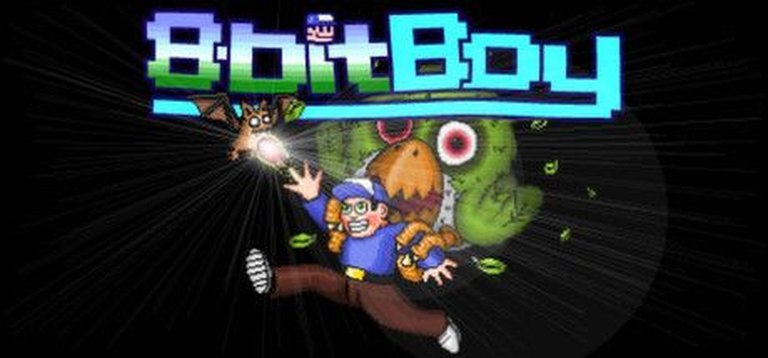
8BitBoy is a 2D platform game that transports players into an 8-bit world as an unemployed protagonist. Inspired by classics like Super Mario Bros., the game features 56 levels across five worlds, offering both a forgiving ‘kiddy mode’ with auto-saves and a challenging ‘retro mode’ requiring special coins to save progress. With side-scrolling action, fantasy settings, and nostalgic gameplay, it blends old-school mechanics with modern indie charm.
Gameplay Videos
Where to Buy 8BitBoy
PC
8BitBoy Guides & Walkthroughs
8BitBoy Reviews & Reception
metacritic.com (64/100): A fine tribute to 80’s platforming hits.
steambase.io (74/100): 8BitBoy™ has earned a Player Score of 74 / 100.
digitallydownloaded.net (70/100): 8BitBoy is a great throwback to the NES era of platform gaming where skill and mastery were required if you were to make it through to the end of the game.
goldplatedgames.com : It’s not even that bad on its own, but once the annoyances and inconsistencies start adding up, you’ll be wishing you were playing something from the 80s instead.
bigbossbattle.com : 8BitBoy is a homage to the traditional platformers of the 80s and early 90s.
8BitBoy Cheats & Codes
PC
Enter code while playing any level.
| Code | Effect |
|---|---|
| r+k+s | Instant World map access |
Macintosh
During gameplay press r + k + s
| Code | Effect |
|---|---|
| r+k+s | Instant World map access |
8BitBoy: A Nostalgic Homage with Flawed Execution
Introduction: A Love Letter to the Past, Marred by the Present
8BitBoy is a game that wears its heart on its sleeve. Developed by Rasmus Kønig Sørensen under the banner of AwesomeBlade Software, it is an unabashed love letter to the golden age of 8-bit and 16-bit platformers, particularly the Super Mario Bros. series. Released in 2014, the game attempts to recapture the magic of the NES era, blending retro aesthetics with modern indie sensibilities. However, while its intentions are noble, its execution is a mixed bag—one that has left critics and players divided.
At its core, 8BitBoy is a 2D side-scrolling platformer that follows the story of an unemployed, disillusioned man who stumbles upon a mysterious cartridge and is transported into an 8-bit world. The premise is charming, tapping into the universal nostalgia for simpler times when games were about precision, perseverance, and the sheer joy of overcoming challenges. Yet, despite its earnestness, 8BitBoy struggles to transcend its influences, often feeling more like a pastiche than a true evolution of the genre.
This review will dissect 8BitBoy in exhaustive detail, exploring its development history, narrative themes, gameplay mechanics, artistic direction, and legacy. By the end, we’ll determine whether it stands as a worthy tribute to the classics or merely a well-intentioned but flawed imitation.
Development History & Context: The Birth of a Retro Dream
The Studio and the Vision
8BitBoy is the brainchild of Rasmus Kønig Sørensen, a solo developer operating under the name AwesomeBlade Software. Sørensen’s vision was clear: to create the ultimate classic platformer, a game that would encapsulate the essence of the late ’80s and early ’90s platforming greats. In an era where indie developers were increasingly turning to retro aesthetics as a form of artistic expression, Sørensen sought to craft a game that wasn’t just inspired by the past but felt like it was plucked straight from it.
The game was developed using the Construct game engine, a tool known for its accessibility and suitability for 2D games. This choice allowed Sørensen to focus on design and gameplay rather than wrestling with complex coding. The result is a game that, at least visually and aurally, nails the retro aesthetic.
Technological Constraints and Design Choices
Despite its modern tools, 8BitBoy deliberately embraces the limitations of its inspirations. The game features:
– 2D side-scrolling gameplay with a fixed camera.
– Pixel art graphics that mimic the NES and early SNES eras.
– A chiptune soundtrack composed by Eric Skiff, whose Resistor Anthems album provides the game’s audio backbone.
Sørensen’s decision to restrict the game to these constraints was a double-edged sword. On one hand, it created an authentic retro experience; on the other, it limited the game’s ability to innovate. The absence of modern conveniences like mid-level checkpoints or a more forgiving difficulty curve would become points of contention among players.
The Gaming Landscape in 2014
8BitBoy arrived during a renaissance of retro-inspired indie games. Titles like Shovel Knight (2014), Super Meat Boy (2010), and Fez (2012) had already proven that nostalgia could be a powerful tool when paired with modern design sensibilities. However, 8BitBoy faced stiff competition. Unlike Shovel Knight, which iterated on classic mechanics with polished controls and inventive level design, 8BitBoy often felt like a direct emulation rather than an evolution.
The game’s Steam Greenlight origins also played a role in its reception. Greenlight was a platform that allowed indie developers to gauge community interest, but it also meant that many games, including 8BitBoy, were released in a somewhat unpolished state. This lack of refinement would later be cited as one of the game’s major drawbacks.
Narrative & Thematic Deep Dive: A Tale of Nostalgia and Escapism
Plot Summary
8BitBoy opens with a surprisingly melancholic premise. The protagonist, an unnamed and unemployed man, finds himself at a crossroads in life. Disillusioned and directionless, he retreats to his basement, where he discovers an old 8-bit console and a mysterious, unlabeled cartridge. Upon inserting it, he is transported into a vibrant but decaying 8-bit world, where he must platform his way through five distinct worlds to escape.
The narrative is minimalistic, with the bulk of the story confined to the opening cutscene. There is no dialogue, no character development, and no real resolution—just the implicit promise that completing the game will return the protagonist to his mundane reality, presumably with a renewed sense of purpose.
Themes: Nostalgia, Escapism, and the Search for Meaning
8BitBoy’s narrative, though sparse, is thematically rich. It explores:
1. Nostalgia as a Coping Mechanism: The protagonist’s retreat into the past is a direct commentary on how people use nostalgia to escape present-day struggles. The game’s world, while colorful and inviting, is also described as “decaying,” suggesting that the past, no matter how fondly remembered, is ultimately fleeting.
2. The Illusion of Control: The protagonist’s journey mirrors the player’s experience—both are navigating a world where success is determined by skill, perseverance, and a bit of luck. The game’s punishing difficulty reinforces the idea that life, like platforming, is a series of trials that require precision and resilience.
3. The Hero’s Journey: Though simplistic, the protagonist’s arc follows a classic hero’s journey—called to adventure, facing trials, and (presumably) returning transformed. The lack of a concrete ending, however, leaves this transformation ambiguous.
Characters and World-Building
The protagonist, referred to simply as “8BitBoy,” is a silent cipher, allowing players to project themselves onto him. The enemies, primarily birds and bird-like creatures, are generic but functional, serving as obstacles rather than characters. The bosses, all variations of a giant bird, reinforce the game’s lack of narrative depth but fit within its retro aesthetic.
The five worlds—each with its own art style and environmental theme—are the game’s strongest narrative element. From lush forests to fiery volcanoes, the worlds evoke the varied landscapes of Super Mario Bros. 3 and Donkey Kong Country, though they lack the same level of memorability.
Gameplay Mechanics & Systems: A Retro Experience with Modern Frustrations
Core Gameplay Loop
8BitBoy’s gameplay is a direct homage to Super Mario Bros. and other NES-era platformers. The core loop involves:
– Running and jumping through levels filled with enemies and obstacles.
– Defeating enemies by jumping on their heads or using power-ups.
– Collecting coins and power-ups to gain temporary abilities.
– Reaching the end of the level within a time limit.
The game features 56 levels spread across five worlds, each with its own visual theme and mechanics. Levels are designed to test the player’s platforming skills, with later stages introducing more complex challenges like moving platforms, conveyor belts, and precision jumps.
Power-Ups and Progression
8BitBoy includes a handful of power-ups that temporarily enhance the protagonist’s abilities:
– Shield: Absorbs one hit.
– Fireballs: Allows the player to shoot bouncing projectiles (single or dual).
– Time Extension: Adds extra seconds to the clock.
– 1-Up: Grants an extra life.
These power-ups are reminiscent of Super Mario Bros.’s mushrooms and fire flowers, though they lack the same level of impact. The fireballs, in particular, feel underwhelming, as their bouncing physics can be unpredictable.
Difficulty and Game Modes
The game offers two difficulty modes:
1. Kiddy Mode: Autosaves after each level and provides more time to complete stages.
2. Retro Mode: Requires players to collect a special coin in each level to save progress, mimicking the password or limited continue systems of old-school games.
Retro Mode is the more “authentic” experience, but it also highlights the game’s biggest flaw: the lack of mid-level checkpoints. Dying in a level sends the player back to the start, which can be frustrating in longer or more complex stages. This design choice, while faithful to the NES era, feels outdated in a modern context where games like Celeste and Shovel Knight have proven that retro-inspired games can be challenging without being punishing.
Controls and Physics
The controls in 8BitBoy are functional but imprecise. The protagonist’s jumps feel floaty, and his momentum can be difficult to control, leading to frequent accidental deaths. This is exacerbated by the game’s inconsistent hitboxes—some enemies and platforms behave unpredictably, making precision platforming a test of patience rather than skill.
The game supports both keyboard and gamepad controls, though neither feels entirely satisfactory. The use of the up arrow key for jumping (a nod to old DOS games) is particularly jarring and has been criticized by modern players accustomed to more intuitive layouts.
Boss Battles
Each world culminates in a boss battle, all of which are variations of a giant bird. These fights are simplistic, requiring players to jump on the boss’s head a set number of times while avoiding its attacks. While they fit the game’s retro aesthetic, they lack the creativity and memorability of bosses in games like Mega Man or Castlevania.
World-Building, Art & Sound: A Retro Aesthetic Done Right
Visual Design
8BitBoy’s art direction is its strongest asset. The game’s pixel art is vibrant and detailed, evoking the charm of NES and SNES classics. Each of the five worlds has a distinct visual identity:
1. Grassland: Lush greens and blue skies, reminiscent of Super Mario Bros.’s World 1.
2. Desert: Sandy dunes and pyramids, akin to Super Mario Bros. 3’s Desert Land.
3. Ice World: Slippery surfaces and frosty landscapes, similar to Donkey Kong Country’s icy stages.
4. Volcano: Fiery pits and lava flows, a staple of retro platformers.
5. Sky World: Floating platforms and cloudscapes, evoking Super Mario Bros. 3’s Sky Land.
The game’s color palette is bright and cheerful, though some critics have noted that it occasionally feels too polished, lacking the grit and imperfections of true 8-bit graphics.
Sound and Music
The soundtrack, composed by Eric Skiff, is a standout feature. Skiff’s chiptune compositions perfectly complement the game’s retro aesthetic, with upbeat melodies that evoke the golden age of gaming. The music is catchy and nostalgic, though it lacks the same level of memorability as iconic tracks from Super Mario Bros. or Mega Man.
Sound effects are minimal but effective, with familiar boings and coin chimes that further enhance the retro feel.
Atmosphere and Immersion
8BitBoy excels at creating a nostalgic atmosphere, transporting players back to the era of CRT televisions and cartridge-based gaming. The game’s world, while simple, is immersive, with each level feeling like a lovingly crafted homage to the past. However, the lack of narrative depth and the repetitive enemy designs prevent it from achieving the same level of immersion as modern retro-inspired games like Shovel Knight or Axiom Verge.
Reception & Legacy: A Divisive Tribute
Critical Reception
8BitBoy received mixed reviews upon release, with critics praising its nostalgia-inducing aesthetics but criticizing its flawed gameplay mechanics. Here’s a breakdown of the critical consensus:
| Publication | Score | Verdict |
|---|---|---|
| Indie Gamer Chick | 100% | “A lot of fun… but the controls are completely unacceptable.” |
| Mana Pool | 79% | “Excellent re-creation… but the gameplay physics need a tune-up.” |
| Digitally Downloaded | 70% | “A great throwback… reminds us that perseverance can be a reward.” |
| TechRaptor | 65% | “Delivers what is promised… doesn’t go above and beyond expectations.” |
| New Game Network | 63% | “Copies Super Mario Bros. so closely as to be embarrassing.” |
| Realm of Gaming | 60% | “A dull, albeit sometimes decent remembrance of Super Mario Bros.” |
| Calm Down Tom | 50% | “Enjoyed a very small part… frustrating platforming mechanics.” |
| Gold-Plated Games | 40% | “Crudely imitating… needs to build on its influences.” |
| LevelUp | 20% | “A martirio that amará el masoquista… an aberration.” |
Key Praises:
– Authentic retro aesthetic (graphics, music, level design).
– Challenging and rewarding for fans of old-school platformers.
– A labor of love with clear passion behind its creation.
Key Criticisms:
– Imprecise controls and floaty physics.
– Lack of innovation—too derivative of Super Mario Bros.
– Frustrating difficulty due to no mid-level checkpoints.
– Repetitive enemy and boss designs.
Player Reception
Player reviews on Steam and Metacritic are similarly divided. The game holds a Steambase Player Score of 74/100 (Mostly Positive) based on 1,941 reviews, with many players praising its nostalgia factor while others decry its flaws.
Common Player Sentiments:
– “Feels like a lost NES game” – Players who grew up with classic platformers often appreciate the game’s authenticity.
– “Controls are janky” – A frequent complaint, particularly regarding jump physics and hit detection.
– “Too hard for its own good” – The lack of checkpoints and punishing difficulty curve frustrate modern players.
– “Worth it on sale” – Many players feel the game is overpriced at $6.99 but recommend it during discounts.
Legacy and Influence
8BitBoy has not had a significant impact on the gaming industry. Unlike Shovel Knight, which spawned sequels and spin-offs, or Super Meat Boy, which became a benchmark for precision platforming, 8BitBoy remains a niche title. Its legacy is that of a flawed but earnest tribute—a game that succeeded in capturing the feel of retro platformers but failed to innovate or refine its mechanics.
That said, 8BitBoy is a testament to the power of nostalgia in indie game development. It proves that there is still an audience for unapologetically retro experiences, even if they don’t always meet modern standards of polish and design.
Conclusion: A Nostalgic Journey with Rough Edges
8BitBoy is a game that will resonate deeply with those who grew up playing Super Mario Bros. and its contemporaries. Its authentic retro aesthetic, catchy chiptune soundtrack, and challenging level design make it a compelling homage to the golden age of platformers. However, its imprecise controls, lack of innovation, and punishing difficulty prevent it from standing alongside modern classics like Shovel Knight or Celeste.
Final Verdict:
– For Retro Enthusiasts: A worthwhile experience, especially if you’re craving a dose of nostalgia. Play in Kiddy Mode to mitigate frustration.
– For Modern Platformer Fans: Approach with caution. The game’s flaws may outweigh its charms unless you’re particularly forgiving of retro quirks.
– For Casual Players: Likely too difficult and unforgiving to recommend.
Score: 6.5/10 – A Flawed but Charming Tribute
8BitBoy is not a bad game, but it is a missed opportunity. With tighter controls, more inventive level design, and a few modern concessions (like mid-level checkpoints), it could have been a standout indie platformer. As it stands, it remains a curio—a game that succeeds in capturing the spirit of the past but stumbles in its execution. For those willing to overlook its rough edges, it offers a brief but enjoyable trip down memory lane. For everyone else, it serves as a reminder that nostalgia, while powerful, is not always enough.
Post-Script: The Indelible Mark of Nostalgia
Games like 8BitBoy highlight the double-edged sword of nostalgia in game design. On one hand, they tap into a deep well of emotional resonance, offering players a chance to relive the magic of their youth. On the other, they risk becoming mere imitations, lacking the innovation and polish that define the best of modern gaming. 8BitBoy is a testament to the passion of indie developers who dare to dream of recapturing the past—but it also underscores the importance of learning from it rather than simply replicating it.
For those who do pick up 8BitBoy, the experience is likely to be a personal one. Some will see it as a love letter to a bygone era; others will view it as a relic best left in the past. Either way, it stands as a fascinating artifact—a game that, for all its flaws, reminds us why we fell in love with platformers in the first place.