
- Release Year: 1999
- Platforms: DOS, Windows
- Publisher: LucasArts Entertainment Company LLC
- Developer: LucasArts Entertainment Company LLC
- Genre: Adventure, Compilation
- Perspective: Third-person
- Game Mode: Single-player
- Gameplay: Point-and-click, Puzzle-solving
- Setting: Caribbean, Fantasy, Pirate
- Average Score: 89/100
Description
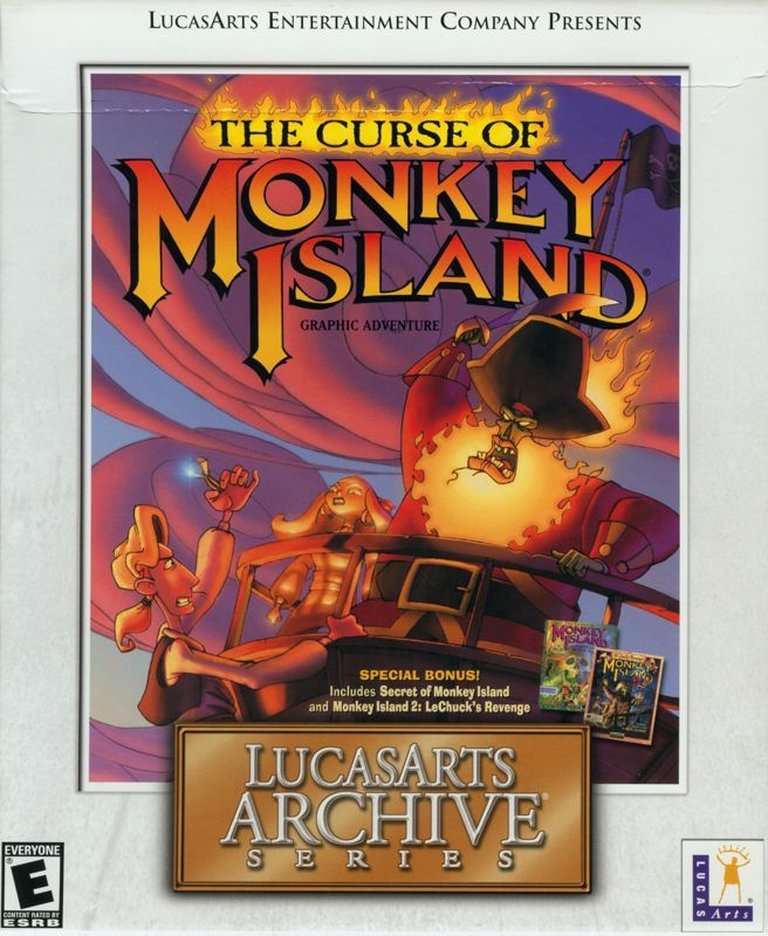
The Curse of Monkey Island is the third installment in the beloved Monkey Island series, following the adventures of the wannabe pirate Guybrush Threepwood as he battles the undead pirate LeChuck to rescue his love, Governor Elaine Marley. Set in a whimsical Caribbean world filled with humor, puzzles, and memorable characters, the game features voice-acting, vibrant graphics, and a legendary soundtrack, making it a classic point-and-click adventure.
Gameplay Videos
Where to Buy The Curse of Monkey Island
The Curse of Monkey Island Free Download
The Curse of Monkey Island Mods
The Curse of Monkey Island Guides & Walkthroughs
The Curse of Monkey Island Reviews & Reception
metacritic.com (89/100): A wonderful game that no adventure gamer should be without.
choicestgames.com : The Curse of Monkey Island is packed with memorable characters, like Murray the Demonic Skull.
christiananswers.net : This is the funniest game I’ve ever played. It’s hilarious!
mobygames.com (89/100): The new team did a good job filling those very large shoes, most noticeably as far as gameplay mechanics are concerned.
The Curse of Monkey Island Cheats & Codes
PC
Enter codes during gameplay.
| Code | Effect |
|---|---|
| [Shift] + V followed by X | Advance to chapter 4 during sea fights in chapter three |
| [Shift] + W | View ending sequence |
| [Shift] + J | Hear lightsaber sounds during ship-to-ship combat with Rottingham |
| Hold Shift + W | Instant win at any time (Steam Version) |
| LAPOSTAL | Unlimited cannonballs in 1st section (Steam Version) |
| [Shift] + V then Y | Win ship combat easily (Steam Version) |
| Hold Control + W | See end credits without beating the game |
| [Shift] + V | Skip ship-to-ship combat sequences |
The Curse of Monkey Island: A Masterclass in Adventure Gaming
Introduction
The Curse of Monkey Island (1997) stands as a pivotal entry in LucasArts’ legendary Monkey Island series, a franchise that redefined the adventure game genre with its razor-sharp wit, unforgettable characters, and ingenious puzzles. Released six years after Monkey Island 2: LeChuck’s Revenge, The Curse of Monkey Island arrived at a crossroads for adventure games, transitioning from the pixelated charm of the early ’90s to the CD-ROM era’s multimedia spectacle. This review will dissect the game’s development, narrative, gameplay, and legacy, arguing that while it may not surpass its predecessors in every aspect, it remains a triumph of storytelling, humor, and technical innovation—a game that both honors and evolves the Monkey Island legacy.
Development History & Context
The Changing of the Guard
The Curse of Monkey Island was developed under the leadership of Jonathan Ackley and Larry Ahern, who had previously worked on Full Throttle and Day of the Tentacle. Their vision for the game was shaped by the technological advancements of the mid-’90s, particularly the shift from floppy disks to CD-ROMs. This allowed for full voice acting, high-resolution graphics, and a dynamic musical score—features that were impossible in the earlier Monkey Island games.
The absence of Ron Gilbert, the series’ original creator, loomed large. Gilbert had envisioned Monkey Island as a trilogy with a definitive ending, but his departure after Monkey Island 2 left the narrative future of the series in flux. Ackley and Ahern faced the daunting task of continuing the story without Gilbert’s guiding vision, leading to a game that embraced the series’ humor and charm while sidestepping the deeper lore and meta-narrative hints of its predecessors.
Technological Leaps
The Curse of Monkey Island was the final game to use the SCUMM (Script Creation Utility for Maniac Mansion) engine, which had been the backbone of LucasArts’ adventure games since the late ’80s. The engine was heavily modified to support 640×480 resolution graphics, a significant upgrade from the 320×200 resolution of Monkey Island 2. The art style shifted to cel animation, giving the game a cartoon-like aesthetic that was both vibrant and expressive.
The game also introduced voice acting, with Dominic Armato as Guybrush Threepwood, Alexandra Boyd as Elaine Marley, and Earl Boen as LeChuck. The voice cast brought the characters to life in ways that text alone could not, adding layers of personality and humor to the dialogue.
The Adventure Game Landscape in 1997
By 1997, the adventure game genre was in decline. The rise of 3D graphics and action-oriented games like Quake and Tomb Raider had shifted player expectations. The Curse of Monkey Island was one of the last major 2D adventure games to achieve critical and commercial success, proving that the genre still had life left in it—if only for a little while longer.
Narrative & Thematic Deep Dive
Plot Summary
The Curse of Monkey Island picks up where Monkey Island 2 left off, with Guybrush Threepwood adrift at sea in a bumper car. He soon finds himself caught between his love, Governor Elaine Marley, and his nemesis, the undead pirate LeChuck. After defeating LeChuck (again), Guybrush proposes to Elaine using a cursed diamond ring, turning her into a gold statue. The rest of the game follows Guybrush’s quest to lift the curse by finding a non-cursed diamond ring of equal value on the mysterious Blood Island.
The story is divided into three chapters, each with its own distinct setting and challenges:
1. Plunder Island: Guybrush assembles a crew, recovers Elaine, and obtains a map to Blood Island.
2. Blood Island: Guybrush navigates a series of puzzles involving cannibals, a haunted hotel, and a ghostly debutante.
3. Monkey Island: The final confrontation with LeChuck takes place in his Carnival of the Damned, a twisted amusement park built over the ruins of Big Whoop.
Characters & Dialogue
The game’s strength lies in its characters, each of whom is brought to life through sharp writing and excellent voice acting:
– Guybrush Threepwood: The ever-optimistic, slightly dim-witted protagonist. His relentless determination and unintentional heroism make him endearing.
– Elaine Marley: A strong, independent governor who, unfortunately, spends much of the game as a gold statue or damsel in distress—a regression from her more active role in Monkey Island 2.
– LeChuck: The undead pirate returns as a demonic, fire-wreathed villain, more menacing than ever but still hilariously over-the-top.
– Murray the Talking Skull: A fan-favorite character who provides comic relief and unexpected depth.
– The Voodoo Lady: A recurring ally whose cryptic advice guides Guybrush through his quest.
The dialogue is packed with wit, wordplay, and pop culture references, maintaining the series’ tradition of humor while adding new layers of absurdity. The insult swordfighting returns, this time with rhyming insults, adding a musical dimension to the combat.
Themes
The Curse of Monkey Island explores several themes:
– Love and Sacrifice: Guybrush’s love for Elaine drives the entire plot, but his impulsive proposal leads to her curse, forcing him to undo his mistake.
– Identity and Transformation: LeChuck’s multiple forms (ghost, zombie, demon) reflect his inability to accept defeat, while Guybrush’s journey is one of self-discovery.
– The Nature of Curses: The game plays with the idea of curses as both literal and metaphorical, with Elaine’s golden form symbolizing the frozen, unchanging nature of obsession.
Criticisms of the Narrative
While the game’s humor and charm are undeniable, its narrative is not without flaws:
– Elaine’s Reduced Role: Unlike in Monkey Island 2, where Elaine was a proactive force, she is largely sidelined here, reducing her to a plot device.
– The Abrupt Ending: The game’s conclusion feels rushed, with LeChuck’s defeat lacking the satisfaction of the previous games’ climaxes.
– Lack of Narrative Depth: The game avoids the meta-narrative hints of Monkey Island 2, opting instead for a more straightforward adventure.
Gameplay Mechanics & Systems
Core Gameplay Loop
The Curse of Monkey Island is a point-and-click adventure game, where players guide Guybrush through a series of puzzles by interacting with the environment and other characters. The game’s interface is streamlined compared to its predecessors:
– Verb Coin: Instead of a verb menu at the bottom of the screen, players use a pop-up “verb coin” with three icons (hand, skull, parrot) representing actions, observations, and dialogue.
– Inventory Chest: The inventory is accessed via a chest that opens to reveal all collected items.
– Right-Click Shortcut: Right-clicking on an object performs the most obvious action, speeding up gameplay.
Puzzle Design
The puzzles in The Curse of Monkey Island are a mix of logical challenges and absurd humor:
– Logical Puzzles: Many puzzles require players to combine items or use them in creative ways (e.g., using a chisel to pry open a plank).
– Absurd Solutions: Some puzzles rely on adventure game logic, such as using a card to jimmy a lock or a hangover cure to fake death.
– Mini-Games: The game includes optional mini-games, such as ship-to-ship combat and insult swordfighting, which add variety but can feel out of place in an otherwise puzzle-driven game.
Combat & Progression
Combat is minimal, with insult swordfighting being the primary form of conflict. The game also features two difficulty modes:
– Normal Mode: A standard adventure game experience.
– Mega-Monkey Mode: Additional puzzles and challenges for veteran players.
UI & Accessibility
The UI is intuitive, with a cursor that changes color to indicate interactive objects. The voice acting and subtitles make the game accessible, though some puzzles rely on visual cues that may be missed.
World-Building, Art & Sound
Setting & Atmosphere
The Curse of Monkey Island takes place across three distinct islands, each with its own visual and thematic identity:
– Plunder Island: A bustling pirate haven with a barber shop, theater, and exclusive beach club.
– Blood Island: A volcanic, eerie island home to cannibals, a haunted hotel, and a ghostly debutante.
– Monkey Island: The climactic setting, featuring LeChuck’s Carnival of the Damned, a twisted amusement park.
The game’s art style is a cel-animated cartoon, with vibrant colors and exaggerated expressions that give it a Tim Burton-esque aesthetic. The backgrounds are hand-painted, adding depth and detail to the world.
Sound Design & Music
The sound design is immersive, with ambient noises, character voices, and a dynamic musical score composed by Michael Land. The music adapts to the player’s actions, creating a seamless audio experience. The voice acting is top-notch, with each character delivering memorable performances.
Reception & Legacy
Critical Reception
The Curse of Monkey Island was critically acclaimed, with praise for its humor, voice acting, and visuals. However, some critics noted its shorter length and lack of narrative depth compared to Monkey Island 2. The game holds an 89/100 on Metacritic and is often cited as one of the best adventure games of the ’90s.
Commercial Success
The game sold over 500,000 copies, making it one of LucasArts’ most successful adventure games. Its success was particularly strong in Germany, where it became a cultural phenomenon.
Influence & Legacy
The Curse of Monkey Island set the stage for future adventure games, proving that voice acting and high-resolution graphics could enhance the genre. It also inspired later entries in the Monkey Island series, including Escape from Monkey Island and Tales of Monkey Island.
Conclusion
The Curse of Monkey Island is a masterpiece of adventure gaming, blending humor, innovation, and technical prowess into a cohesive and unforgettable experience. While it may not reach the narrative depth of Monkey Island 2 or the meta-commentary of the original, it stands as a testament to LucasArts’ creativity and a high-water mark for the genre.
Final Verdict: The Curse of Monkey Island is a must-play for fans of adventure games and a landmark title in the history of video games. Its legacy endures, not just as a great game, but as a cultural touchstone that continues to inspire and entertain.
Score: 9.5/10 – A near-perfect adventure that captures the magic of Monkey Island while pushing the genre forward.