
- Release Year: 1997
- Platforms: Macintosh, Windows
- Publisher: Funware, Real World Multimedia Ltd
- Developer: Real World Multimedia Ltd
- Genre: Adventure
- Perspective: First-person
- Game Mode: Single-player
- Gameplay: Puzzle elements
- Setting: Contemporary
- Average Score: 86/100
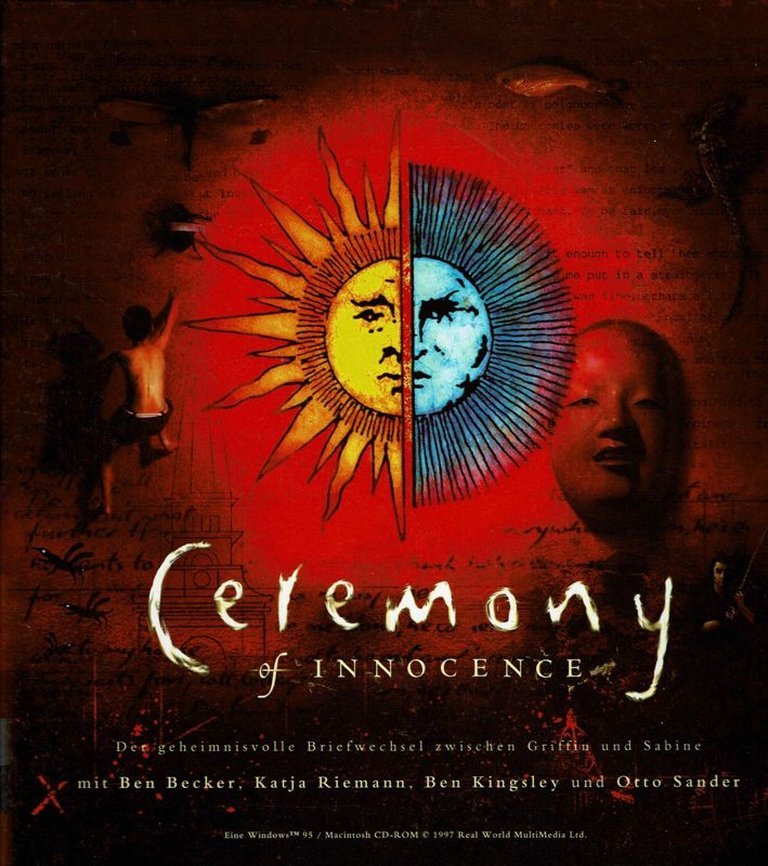
Description
Ceremony of Innocence is an adventure game based on Nick Bantock’s Griffin and Sabine book series, blending puzzle elements with a narrative-driven experience. The game follows Griffin Moss, a London postcard artist, as he begins a mysterious correspondence with Sabine Strohem, a woman from the remote Sicmons Islands. Their letters, exchanged across vast distances, unfold a deeply personal and enigmatic relationship, with each message accompanied by abstract puzzles derived from Griffin’s postcard designs. Players must solve these puzzles to progress, uncovering a story that bridges two contrasting worlds—one a bustling European metropolis, the other a secluded Pacific archipelago—while exploring themes of connection, art, and the unseen bonds between people.
Gameplay Videos
Ceremony of Innocence Free Download
Ceremony of Innocence Reviews & Reception
reddit.com : A simple yet intriguing story…Griffon creates unique postcards for his business Gryphon Cards, one day he receives a letter from a woman across the world claiming to know him quite personally and that she is able to see everything he draws…as he is drawing it.
mobygames.com (86/100): Ceremony of Innocence is based on a popular series of books about Griffin and Sabine by Nick Bantock, written in the early 90s.
Ceremony of Innocence: A Masterclass in Interactive Storytelling and Artistic Innovation
Introduction: The Epistolary Enigma
In the annals of video game history, few titles have dared to blend literature, art, and interactive media as seamlessly as Ceremony of Innocence (1997). Developed by Real World Multimedia under the creative stewardship of Peter Gabriel’s Real World label, this CD-ROM adventure transcends conventional gaming paradigms, offering instead a hauntingly beautiful, puzzle-laden epistolary romance. Based on Nick Bantock’s Griffin and Sabine trilogy, the game is not merely an adaptation but a reimagining—a multimedia love letter that challenges players to unravel its mysteries through tactile interaction and surrealist art.
At its core, Ceremony of Innocence is a story of two artists, Griffin Moss and Sabine Strohem, whose lives become inextricably linked through a series of postcards and letters. What begins as a curious correspondence evolves into a profound, almost telepathic connection, blurring the lines between reality and the supernatural. The game’s title, borrowed from W.B. Yeats’ The Second Coming (“The ceremony of innocence is drowned”), foreshadows the themes of lost purity, existential dread, and the fragility of human connection that permeate the narrative.
This review will dissect Ceremony of Innocence in exhaustive detail, exploring its development, narrative depth, gameplay mechanics, artistic achievements, and enduring legacy. It is a game that defies easy categorization—a hybrid of visual novel, puzzle adventure, and interactive art installation—yet its influence on storytelling in games is undeniable. For those who seek games that linger in the mind long after the credits roll, Ceremony of Innocence remains a singular, unforgettable experience.
Development History & Context: A Confluence of Art and Technology
The Birth of a Multimedia Masterpiece
Ceremony of Innocence emerged from the fertile creative ecosystem of Real World Multimedia, a division of Peter Gabriel’s Real World Studios. The project was helmed by producer Gerrie Villon and creative director Alex Mayhew, who assembled a dream team of over 100 artists, animators, and musicians. This collaborative effort was a testament to the era’s experimental spirit, where CD-ROM technology allowed for unprecedented fusion of text, voice, animation, and interactivity.
The game’s development was deeply intertwined with the artistic vision of Nick Bantock, whose Griffin and Sabine books were already critically acclaimed for their innovative format—physical letters tucked into envelopes embedded within the pages. Translating this tactile experience into a digital medium was no small feat. The team at Real World Multimedia, many of whom had previously worked on Gabriel’s EVE CD-ROM, leveraged a mix of 3D character models, clay animation, pastel paintings, and CGI to bring Bantock’s surreal postcards to life. Notable contributors included:
– Joan Ashworth and Ruth Lingford (animation)
– Jeff de Boer and Jonathan Hodgson (art direction)
– Alex Gifford (music)
– Andy Kennedy (sound design)
Technological Constraints and Innovations
Released in 1997, Ceremony of Innocence was designed for Windows 95/98 and Mac OS, with system requirements that reflected the era’s limitations:
– Windows 95, Pentium processor, 16 MB RAM, double-speed CD-ROM
– Mac System 7.1, PowerPC, 16 MB RAM
The game’s engine was built to handle its most distinctive feature: interactive postcard puzzles. Unlike traditional point-and-click adventures, these puzzles were not about inventory management or logic-based challenges but about manipulating the cursor in surreal, often abstract ways. For example, one early puzzle requires the player to guide a vulture to peck a seed, which then causes a tear in the postcard, revealing the letter beneath. These interactions were a technical marvel, requiring precise programming to ensure the cursor’s movements felt organic and responsive.
The Gaming Landscape of 1997
Ceremony of Innocence arrived at a pivotal moment in gaming history. The mid-90s saw the rise of narrative-driven adventures like Myst (1993) and The 7th Guest (1993), which emphasized atmosphere and puzzle-solving over action. However, Ceremony of Innocence distinguished itself by prioritizing emotional resonance and artistic expression over mechanical complexity. While Myst and its ilk often frustrated players with obtuse puzzles, Ceremony of Innocence’s challenges were intentionally intuitive yet whimsical, designed to immerse the player in the act of “opening” a letter rather than solving a riddle.
The game also benefited from the multimedia CD-ROM boom, a time when developers experimented with blending film, literature, and interactivity. Titles like Phantasmagoria (1995) and The Beast Within: A Gabriel Knight Mystery (1995) pushed the boundaries of full-motion video, but Ceremony of Innocence took a different approach, focusing on handcrafted art and voice acting to convey its story. The inclusion of Paul McGann (Griffin), Isabella Rossellini (Sabine), and Ben Kingsley (Victor Frolatti) lent the game a cinematic gravitas rare in the medium at the time.
Narrative & Thematic Deep Dive: A Love Story Wrapped in Mystery
Plot Summary: Letters Across the Void
The game begins with Griffin Moss, a reclusive London-based artist who designs postcards for a living, receiving an unexpected letter from Sabine Strohem, a woman living on the fictional Sicmon Islands in the South Pacific. Sabine claims to have seen Griffin’s unpublished postcards in her mind’s eye, suggesting a psychic or supernatural connection between them. What follows is a series of 75 letters and postcards, each more intimate and revealing than the last, as the two strangers explore their burgeoning relationship through written word and art.
The correspondence takes on an increasingly urgent and surreal tone as Sabine’s letters hint at darker forces at play. She speaks of a shadowy figure named Victor Frolatti, who seems to be manipulating their connection. The game’s narrative culminates in a climactic revelation that forces Griffin—and the player—to question the nature of reality, identity, and love.
Themes: Isolation, Connection, and the Fragility of Innocence
Ceremony of Innocence is a thematically rich experience, exploring ideas that resonate deeply with the human condition:
1. The Illusion of Distance: Griffin and Sabine are separated by thousands of miles, yet their emotional and artistic bond transcends physical space. The game suggests that true connection is not bound by geography but by shared creativity and vulnerability.
2. The Loss of Innocence: The title’s Yeatsian reference is no accident. As the correspondence deepens, both characters confront hidden truths about themselves and each other, leading to a shattering of their initial idealism.
3. Art as Communication: The postcards are not merely vessels for text but extensions of the characters’ souls. Griffin’s designs and Sabine’s interpretations of them become a language unto themselves, one that the player must decipher.
4. The Unreliable Narrator: The game plays with the idea of perception versus reality. Are Sabine’s visions genuine, or is she fabricating them? Is Griffin truly the passive recipient of her letters, or is he complicit in a larger deception?
Character Analysis: Voices in the Dark
The game’s strength lies in its characterization, brought to life by its stellar voice cast:
– Griffin Moss (Paul McGann): A man of quiet introspection, Griffin’s initial skepticism gives way to obsession as he becomes ensnared in Sabine’s world. McGann’s performance captures Griffin’s vulnerability and growing unease, making his journey compelling.
– Sabine Strohem (Isabella Rossellini): Sabine is enigmatic, passionate, and increasingly desperate. Rossellini’s voice imbues her with a haunting melancholy, making her feel both alluring and dangerous.
– Victor Frolatti (Ben Kingsley): The game’s antagonist is a master manipulator, his presence looming over the correspondence like a dark cloud. Kingsley’s chilling delivery ensures that Frolatti is as memorable as he is menacing.
Dialogue and Writing: Poetry in Motion
The script, adapted from Bantock’s novels, is lyrical and economical, with each letter conveying layers of meaning in just a few sentences. The writing avoids exposition, instead hinting at deeper truths that the player must piece together. For example:
“I saw your postcard before you sent it. The colors were wrong in my mind, but the shapes were exact. It was as if I were looking through a window into your soul.”
— Sabine to Griffin
Such lines are delivered with emotional weight, thanks to the voice actors’ nuanced performances. The game also incorporates excerpts from W.B. Yeats’ The Second Coming, reinforcing its themes of apocalypse and rebirth.
Gameplay Mechanics & Systems: Puzzles as Art
Core Gameplay Loop: The Act of Unfolding
Ceremony of Innocence eschews traditional adventure game mechanics in favor of a unique, letter-based structure:
1. Receive a Postcard: Each new letter arrives in Griffin’s mailbox, presented as a beautifully rendered postcard.
2. Solve the Puzzle: To “open” the letter, the player must interact with the postcard in a specific way. These puzzles are surreal and often abstract, requiring the player to experiment with the cursor.
– Example: In one puzzle, the player must rock a cradle by moving the mouse back and forth, causing a baby to cry and a hidden compartment to open.
– Another requires dragging a key across a lock in a specific pattern to unlock the letter.
3. Read the Letter: Once the puzzle is solved, the letter is revealed, and the corresponding voice actor reads it aloud.
4. Progress the Story: The contents of the letter advance the narrative, often introducing new mysteries or deepening the emotional stakes.
Puzzle Design: Intuitive Yet Enigmatic
The puzzles in Ceremony of Innocence are deliberately unconventional, designed to feel like interactive art rather than traditional challenges. Key characteristics include:
– No Inventory System: Unlike Myst or King’s Quest, there are no items to collect or combine. The puzzles are self-contained within each postcard.
– Cursor-Based Interaction: The mouse cursor is not just a tool but an extension of the player’s hand. It can be trapped, transformed, or used to manipulate objects in ways that feel tactile and immersive.
– Abstract Logic: Solutions often rely on visual metaphors rather than logical deduction. For instance, a puzzle might require the player to mimic the motion of waves to “open” a seashell-shaped envelope.
– Low Difficulty, High Engagement: While the puzzles are not overly challenging, they encourage close examination of the art, rewarding players who take the time to appreciate the details.
UI and Navigation: A Minimalist Approach
The game’s interface is sparse and elegant, designed to keep the focus on the postcards and letters:
– Mailbox Screen: The primary hub, where players select which letter to open next.
– Postcard View: A full-screen display of the current postcard, with no HUD elements to distract from the art.
– Menu Access: Pressing ‘M’ brings up a minimal menu for saving, loading, or adjusting settings.
The lack of intrusive UI elements enhances immersion, making the player feel as though they are truly handling Griffin’s mail.
Innovations and Flaws
Ceremony of Innocence’s gameplay is bold and experimental, but it is not without its flaws:
– Strengths:
– Seamless Integration of Story and Puzzle: The act of solving a puzzle feels like participating in the narrative, not just overcoming an obstacle.
– Artistic Puzzle Design: The puzzles are memorable and creative, often tied directly to the themes of the letters they unlock.
– Voice-Acted Narrative: The decision to have every letter read aloud adds emotional depth and makes the story more accessible.
– Weaknesses:
– Limited Replayability: Once the puzzles are solved, there is little incentive to replay the game, as the solutions do not change.
– Occasional Obscurity: A few puzzles rely on unintuitive interactions that may frustrate players unused to abstract thinking.
– Technical Limitations: The game’s fixed resolution and lack of widescreen support can make it difficult to play on modern systems without emulation.
World-Building, Art & Sound: A Feast for the Senses
Setting: Two Worlds, One Connection
Ceremony of Innocence juxtaposes two starkly different environments:
1. Griffin’s London: A gloomy, industrial cityscape, reflected in the muted tones of his postcards. His world is one of isolation and routine, where art is a solitary pursuit.
2. Sabine’s Sicmon Islands: A vibrant, almost mythical archipelago, depicted in lush, surreal colors. Her postcards evoke dreamlike landscapes, suggesting a world untouched by modernity.
The contrast between these settings reinforces the game’s central theme: that true connection can bridge even the most disparate worlds.
Visual Art: A Surrealist Masterpiece
The game’s art direction is nothing short of breathtaking, a testament to the talents of Nick Bantock and the Real World Multimedia team. Key aspects include:
– Handcrafted Postcards: Each of the 75 postcards is a unique work of art, blending collage, painting, photography, and digital manipulation. The styles range from whimsical to unsettling, mirroring the emotional arc of the story.
– Animation: The postcards often feature subtle animations—a flickering candle, a swaying tree—that bring them to life without overwhelming the player.
– Symbolism: The art is rich in metaphor, with recurring motifs like birds (freedom), cages (confinement), and mirrors (duality) reinforcing the game’s themes.
Sound Design: An Auditory Love Letter
The game’s audio is equally impressive, with a soundscapes that enhance the mood:
– Music (Alex Gifford): The score is ambient and atmospheric, using piano, strings, and electronic textures to evoke melancholy and wonder. It never overpowers the voice acting but instead complements the emotional beats.
– Voice Acting: The performances of McGann, Rossellini, and Kingsley are tour-de-force, imbuing the letters with authenticity and gravitas. Their deliveries make the characters feel real and relatable, despite the surreal nature of the story.
– Sound Effects (Andy Kennedy): Subtle effects—the rustle of paper, the sound of a stamp being placed, the distant cry of a bird—add layers of immersion, making the act of opening a letter feel tangible and intimate.
Reception & Legacy: A Cult Classic’s Enduring Influence
Critical Reception: Praise and Polarization
Ceremony of Innocence was lauded by critics upon release, earning an 86% average score on MobyGames and two BAFTA awards in 1998 (Best Moving Image and Best Sound). Reviewers praised its:
– Innovative storytelling (Tap-Repeatedly/Four Fat Chicks: “A magical, mysterious experience”)
– Artistic ambition (PC Soluces: “A poetic adaptation that seduces an discerning audience”)
– Voice acting (Feibel.de: “Tolle Sprecher [great voices]”)
However, the game was not a commercial blockbuster, in part due to its niche appeal and the declining CD-ROM market by the late 90s. Player scores on MobyGames average a disappointing 1.0/5, likely due to modern gamers’ frustration with its abstract puzzles and lack of traditional gameplay.
Awards and Accolades
- EUROPRIX 98 Overall Winner
- BAFTA Interactive Entertainment Awards (1998):
- Best Moving Image
- Best Sound
Influence on Later Games
While Ceremony of Innocence did not spawn direct sequels, its DNA can be seen in later narrative-driven experiences:
– Gone Home (2013): Like Ceremony of Innocence, Gone Home tells its story through environmental storytelling and found documents, emphasizing emotional resonance over gameplay.
– The Novelist (2013): This game also explores relationships through letters and personal artifacts, though with a more traditional puzzle structure.
– What Remains of Edith Finch (2017): The surreal, interactive storytelling of Edith Finch owes a debt to Ceremony of Innocence’s willingness to experiment with form and player agency.
Preservation and Modern Playability
Today, Ceremony of Innocence is a challenging game to experience natively, as it was designed for Windows 95/98. However, dedicated fans and preservationists have made it accessible through:
– Emulation (DOSBox, PCem): Sites like The Collection Chamber offer pre-configured emulation setups to run the game on modern systems.
– Abandonware Archives: My Abandonware and similar sites host the game’s ISO, though legal gray areas persist.
– YouTube Playthroughs: Longplays (such as this one) allow players to experience the story without solving puzzles.
Conclusion: A Timeless Ode to Art and Connection
Ceremony of Innocence is not a game for everyone. It defies convention, prioritizing emotional depth and artistic expression over traditional gameplay. Yet, for those willing to engage with its surreal puzzles and haunting narrative, it offers an unparalleled interactive experience—one that lingers in the memory like a half-remembered dream.
In the pantheon of narrative-driven games, Ceremony of Innocence stands as a bold experiment, a testament to the power of multimedia storytelling in the CD-ROM era. Its influence can be felt in modern titles that dare to blend literature, art, and interactivity, proving that its themes of connection, isolation, and the search for meaning are timeless.
Final Verdict: Ceremony of Innocence is a masterpiece of interactive fiction, a game that transcends its medium to become something closer to poetry than traditional gaming. While its puzzles may frustrate and its technical limitations may hinder modern playability, its artistic ambition and emotional resonance secure its place as one of the most unique and unforgettable experiences in video game history.
Score: 9.5/10 – A flawless execution of a daring vision, marred only by the limitations of its time.
For those who seek games that challenge, move, and inspire, Ceremony of Innocence is not just a game—it is an experience to be cherished.