
- Release Year: 2000
- Platforms: Windows
- Publisher: THQ Inc.
- Developer: Synetic GmbH
- Genre: Driving, Racing, Simulation
- Perspective: 1st-person, 3rd-person
- Game Mode: LAN, Online PVP, Single-player
- Gameplay: Championship Mode, Customizable race settings, Ghost truck, Qualifying races, Realistic damage, Replay editor, Time Trials, Unlimited speed mode
- Setting: Europe, Licensed race tracks, Weather effects
- Average Score: 81/100
Description
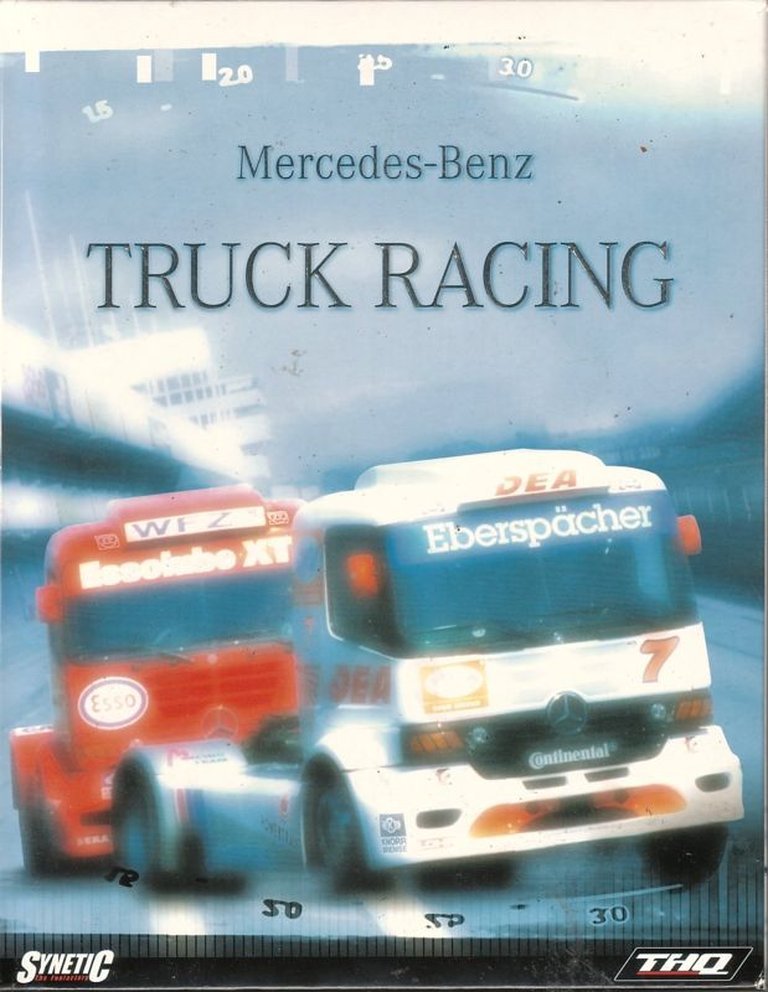
Mercedes-Benz Truck Racing is a licensed truck racing simulation game developed by Synetic GmbH and published by THQ Inc. in 2000. Players compete in high-speed races using souped-up Mercedes-Benz freightliners across licensed European tracks like Zolder, Misano, and the Nürburgring. The game offers both realistic and arcade-style gameplay, featuring authentic damage modeling, customizable race settings, and support for various steering devices. With options for single races, full seasons, and multiplayer modes (LAN/Internet), it balances realism and accessibility, allowing players to tweak vehicle mechanics or adjust AI difficulty to suit their preferences.
Gameplay Videos
Mercedes-Benz Truck Racing Free Download
Mercedes-Benz Truck Racing Cracks & Fixes
Mercedes-Benz Truck Racing Guides & Walkthroughs
Mercedes-Benz Truck Racing Reviews & Reception
en.wikipedia.org (79/100): The average score according to the MobyRank rating is 79% out of 100%.
oldpcgaming.net : It features real truck racing teams and drivers, realistic damage, a replay editor, and an optional unlimited speed mode which scratches the top speed you usually get with these trucks.
myabandonware.com (90/100): It’s every bit as barmy, madcap and fun as it sounds.
mobygames.com (76/100): A well balanced truck racing game that will appeal to all racing/driving gamers.
gamepressure.com (79/100): Mercedes Benz Truck Racing is a racing game under official Daimler Chrysler and Mercedes licenses.
Mercedes-Benz Truck Racing Cheats & Codes
PC
Type the following during the game:
| Code | Effect |
|---|---|
| BUGGYGIRL | Enable Cheats |
| MOGLI | Always Win |
| ALLOFF | Disable Cheats |
| U | Helicopter view |
| I | Special view 1 |
| D | Special view 2 |
| J | Change graphics mode |
| F | Display framerate |
| F12 | Screenshot |
Mercedes-Benz Truck Racing: A Deep Dive into the Overlooked Gem of Early 2000s Racing Simulators
Introduction: The Unlikely Hero of Racing Games
In the pantheon of early 2000s racing games, Mercedes-Benz Truck Racing (MBTR) stands as a fascinating anomaly—a title that defied conventions by focusing on the niche world of truck racing, a motorsport that, at the time, was largely overshadowed by the glamour of Formula 1 and the raw appeal of rally racing. Released in 2000 by German developer Synetic GmbH and published by THQ, MBTR was a bold experiment that sought to carve out a unique space in the racing genre. This review aims to explore the game’s development, its gameplay mechanics, its reception, and its lasting legacy, arguing that MBTR was not just a novelty act but a pioneering title that deserves recognition for its ambition and execution.
Development History & Context: A German Engineer’s Dream
The Studio Behind the Wheel
Synetic GmbH, the studio behind MBTR, was a relatively small but ambitious German developer known for its work on simulation and strategy games. Prior to MBTR, Synetic had developed BreakNeck, a motorcycle racing game that laid the groundwork for the physics engine used in MBTR. The studio’s collaboration with DaimlerChrysler AG (now Daimler AG) was a significant coup, granting them access to official Mercedes-Benz licensing, real-world truck racing teams, and technical data that would prove invaluable in crafting an authentic experience.
The development team, led by figures like Renate Langenkämper, André Kröker, and Jürgen Kersting, was a mix of designers, programmers, and artists who shared a passion for motorsport and simulation. Their vision was clear: to create a racing game that was not just about speed but about the unique challenges of piloting a five-tonne, 1,360-horsepower beast around a track. This was not a game about finesse; it was about brute force, momentum, and the sheer spectacle of watching (and feeling) these massive machines defy physics.
Technological Constraints and Innovations
MBTR was built on Synetic’s proprietary 3D Landscape Engine, a technology that allowed for detailed track rendering and dynamic weather effects. However, the engine was not without its limitations. The game’s system requirements were steep for the time—recommending a Pentium II 333 MHz processor and 64 MB of RAM—reflecting the computational demands of simulating the physics of such heavy vehicles. The team had to strike a balance between realism and playability, ensuring that the game remained accessible to players who might not have high-end rigs.
One of the most notable technical achievements was the game’s damage model. Unlike many racing games of the era, which treated damage as a superficial visual effect, MBTR’s damage system was deeply integrated into the physics. Collisions could affect everything from engine performance to steering responsiveness, and the game even simulated the effects of overheating engines and brake failures. This level of detail was unprecedented in a truck racing game and set MBTR apart from its contemporaries.
The Gaming Landscape of 2000
The late 1990s and early 2000s were a golden age for racing games. Titles like Gran Turismo 2 (1999), Need for Speed: Porsche Unleashed (2000), and Colin McRae Rally 2.0 (2000) dominated the market, each offering a different flavor of racing experience. MBTR entered this crowded field as an underdog, targeting a niche audience that was largely untapped. While truck racing was a real-world motorsport with a dedicated following in Europe, it had never been the subject of a major video game. Synetic’s gamble was that the novelty of racing trucks, combined with the game’s simulation depth, would attract both hardcore racing fans and casual players looking for something different.
Narrative & Thematic Deep Dive: The Story of the Unsung Titans
Plot and Structure: A Season in the Life
MBTR does not feature a traditional narrative in the sense of a story-driven campaign. Instead, it offers a structured career mode that mirrors the real-world European Truck Racing Championship. Players begin by selecting a team and a truck, each with its own performance characteristics, and then progress through a series of races across iconic European circuits like the Nürburgring, Zolder, and Misano. The career mode is divided into seasons, with each season consisting of multiple race weekends. A race weekend in MBTR is a multi-stage affair, featuring:
1. Warm-up sessions: Free practice to familiarize yourself with the track.
2. Time trials: Qualifying sessions to determine your starting position.
3. Qualifying races: Short races that award championship points and set the grid for the main event.
4. Cup races: The feature race, where the bulk of the points are awarded.
This structure is faithful to the real-world format of truck racing, and it adds a layer of strategic depth to the game. Players must manage their trucks’ condition across multiple races, balancing aggression with caution to avoid costly damage that could derail their championship hopes.
Characters and Teams: The Real Deal
One of MBTR’s strongest selling points was its authenticity. The game featured real truck racing teams and drivers, complete with accurate liveries and sponsor logos. This attention to detail extended to the trucks themselves, which were meticulously modeled after their real-world counterparts. The inclusion of real teams and drivers was not just a marketing gimmick; it lent the game a sense of legitimacy that was rare in racing games at the time.
However, the game’s focus on Mercedes-Benz trucks was a double-edged sword. While the licensing deal with DaimlerChrysler ensured a high level of authenticity, it also meant that the game was limited to a single manufacturer. This was a point of criticism for some players, who felt that the lack of variety in truck models detracted from the experience. In reality, truck racing in Europe was (and still is) dominated by a handful of manufacturers, with Mercedes-Benz being one of the most prominent. The game’s decision to focus exclusively on Mercedes trucks was thus a reflection of the sport’s real-world dynamics, even if it limited the game’s appeal to those seeking a broader range of vehicles.
Themes: The Beauty of the Beast
At its core, MBTR is a celebration of the underdog. Truck racing, as a sport, has always existed in the shadow of more glamorous motorsports. The trucks themselves are not sleek, aerodynamic machines but hulking, industrial beasts that seem almost comically out of place on a racetrack. Yet, there is a raw, unfiltered beauty to the spectacle of these vehicles hurtling around a circuit at speeds of up to 160 km/h, their engines roaring like thunder.
The game captures this dichotomy perfectly. On one hand, it is a technical simulation that demands precision and strategy. On the other, it is a chaotic, adrenaline-fueled experience where the laws of physics seem to bend under the sheer power of the trucks. The theme of defying expectations is woven into every aspect of the game, from the way the trucks handle to the way the AI opponents race. In MBTR, brute force often triumphs over finesse, and the player is constantly reminded that they are not driving a car but a monster that must be tamed.
Gameplay Mechanics & Systems: The Art of Controlling a Beast
Core Gameplay Loop: A Dance with Physics
The heart of MBTR lies in its gameplay, which is a masterclass in simulation design. The game’s physics engine is tuned to reflect the unique challenges of driving a racing truck. Unlike cars, which are designed for agility and responsiveness, trucks are heavy, unwieldy, and prone to understeer. The weight distribution—with most of the mass concentrated at the front—means that braking and cornering require a completely different approach than in traditional racing games.
One of the most striking aspects of MBTR’s gameplay is the emphasis on braking. In most racing games, braking is a secondary concern; the focus is on acceleration and cornering. In MBTR, however, braking is everything. The trucks’ massive weight means that they cannot stop on a dime, and misjudging a braking point can send you careening off the track. The game forces players to think several steps ahead, planning their braking and cornering well in advance of the actual turn. This is not a game where you can rely on reflexes alone; it demands foresight and patience.
Combat on Wheels: The Art of the Nudge
Truck racing is not a gentleman’s sport, and MBTR reflects this in its AI behavior. The game’s AI opponents are aggressive, often resorting to “nudging” and shunting to gain an advantage. This is not a bug but a feature; in real-world truck racing, contact between vehicles is common and even encouraged to a certain extent. The game’s damage model ensures that these collisions have consequences, however. A poorly timed nudge can send you spinning into a wall, while a well-executed shunt can give you the edge you need to overtake a rival.
The AI in MBTR is also remarkably intelligent. Opponents will make mistakes, especially when under pressure, and they are susceptible to the same mechanical failures as the player. This creates a dynamic racing experience where no two races are alike. The AI’s behavior is not scripted but reactive, meaning that it adapts to the player’s actions. If you are overly aggressive, the AI will respond in kind, leading to chaotic, multi-truck pileups. If you are more cautious, the AI will exploit your hesitation, squeezing past you in tight corners.
Character Progression and Customization: Tinkering Under the Hood
MBTR offers a deep customization system that allows players to fine-tune their trucks to suit their driving style. The game’s garage mode is a haven for simulation enthusiasts, offering options to adjust everything from suspension settings to gear ratios. These adjustments are not just cosmetic; they have a tangible impact on the truck’s performance. For example, tweaking the suspension can improve cornering stability, while adjusting the gear ratios can optimize acceleration out of tight turns.
The game also features a progression system that unlocks new trucks and teams as the player advances through the career mode. This system is tied to the championship structure, with better-performing teams and trucks becoming available as the player earns points and moves up the rankings. The progression is not just about unlocking faster trucks but about mastering the nuances of each vehicle. Some trucks are better suited to certain tracks, and the player must learn to adapt their driving style to the strengths and weaknesses of their chosen machine.
UI and Accessibility: A Game for Everyone
One of MBTR’s most underrated features is its accessibility. The game offers a range of difficulty settings and driving aids that make it approachable for casual players while still providing a challenge for hardcore simulation fans. For example, players can toggle options like automatic braking, traction control, and damage realism to tailor the experience to their skill level. The game also includes a “ghost truck” feature, which allows players to race against a recorded version of their best lap, providing a useful benchmark for improvement.
The user interface is clean and intuitive, with all the necessary information—speed, RPM, damage status—displayed in a way that is easy to read without being intrusive. The game’s menus are well-organized, and the options for customizing the racing experience are extensive. Players can adjust everything from the length of the races to the weather conditions, ensuring that no two playthroughs are the same.
Innovative Systems: The Replay Editor
MBTR includes a replay editor that was ahead of its time. This feature allowed players to record their races and then edit the replays to create highlight reels or analyze their performance. The editor was surprisingly flexible, offering tools to adjust camera angles, playback speed, and even the weather conditions of the replay. This was a rare feature in racing games of the era, and it added a layer of depth to the game that extended beyond the racing itself.
World-Building, Art & Sound: Crafting an Immersive Experience
Setting and Atmosphere: The Tracks Come Alive
MBTR’s tracks are one of its strongest assets. The game features a selection of real-world circuits, each faithfully recreated with attention to detail. The Nürburgring, with its infamous “Green Hell” section, is a standout, as is the tight and technical Zolder circuit in Belgium. The tracks are not just static environments but dynamic spaces that change with the weather. Rain turns the tarmac into a slippery nightmare, while fog reduces visibility to near-zero, forcing players to rely on their instincts and the faint glow of brake lights ahead.
The game’s atmosphere is further enhanced by its day-night cycle and dynamic lighting. Races can take place under the scorching midday sun or the cold glow of floodlights, each condition affecting the handling of the trucks in subtle ways. The attention to detail in the track design extends to the surroundings, with spectators, pit crews, and even abandoned trucks (in the case of foggy conditions) adding to the immersion.
Visual Direction: A Feast for the Eyes
For a game released in 2000, MBTR’s graphics were impressive. The trucks are rendered with a high level of detail, with accurate liveries, realistic damage modeling, and even visible drivers in the cockpits. The tracks are equally well-rendered, with textures that hold up surprisingly well even by modern standards. The game’s use of lighting and shadows is particularly noteworthy, with dynamic effects that change based on the time of day and weather conditions.
The game offers multiple camera views, including a first-person cockpit view that places the player directly in the driver’s seat. This view is particularly immersive, with a fully modeled interior that includes functional gauges and a steering wheel that moves in sync with the player’s inputs. The third-person views are equally well-executed, offering a cinematic perspective that highlights the sheer size and power of the trucks.
Sound Design: The Roar of the Engines
The sound design in MBTR is a mixed bag. The engine sounds are deep and resonant, capturing the raw power of the trucks’ 12-liter turbocharged engines. The roar of the engines, the screech of tires, and the crunch of metal during collisions all contribute to the game’s immersive atmosphere. However, the sound design is not without its flaws. The engine notes can sometimes feel repetitive, and the lack of variation in the sound effects for different trucks is noticeable. Additionally, the in-game radio chatter, while a nice touch, is limited in scope and can become repetitive over time.
Despite these minor shortcomings, the sound design in MBTR is effective in conveying the visceral experience of truck racing. The game’s audio cues—such as the growl of an opponent’s engine closing in from behind—are crucial for competitive play, providing players with the information they need to make split-second decisions.
Reception & Legacy: A Cult Classic in the Making
Critical Reception: Praise and Criticism
MBTR was met with generally positive reviews upon its release. German gaming publications, in particular, praised the game for its authenticity and depth. GameStar awarded it an 86%, calling it “absolute first-league material” and commending its graphics and physics. PC Joker gave it an 87%, highlighting the game’s challenging but rewarding gameplay. French publications like Jeuxvideo.com and JeuxVideoPC.com were similarly impressed, with both awarding the game a 75% and praising its innovative take on the racing genre.
However, not all reviews were glowing. Gamekult gave the game a 60%, criticizing its steep learning curve and the lack of variety in truck models. Computer and Video Games (CVG) was even more dismissive, awarding it a 58% and calling it “by no means a throwaway arcade affair,” implying that its simulation-heavy approach might alienate casual players. These criticisms were not unfounded; MBTR is a game that demands patience and practice, and its uncompromising realism is not for everyone.
Commercial Performance: A Niche Success
Commercially, MBTR was a modest success. It found a dedicated audience among simulation enthusiasts and truck racing fans, but it never achieved the mainstream appeal of titles like Gran Turismo or Need for Speed. The game’s niche focus and steep system requirements likely limited its reach, but it nevertheless carved out a loyal following that continues to celebrate the game to this day.
Evolution of Reputation: From Obscurity to Cult Status
In the years since its release, MBTR has gained a reputation as a cult classic. Its unique blend of realism and accessibility, combined with its faithful recreation of a niche motorsport, has earned it a place in the hearts of racing game aficionados. The game’s legacy is evident in the way it is still discussed in online forums and retro gaming communities, where it is often cited as one of the most underrated racing games of its era.
MBTR’s influence can also be seen in later racing games that attempted to capture the same blend of simulation depth and accessibility. Titles like Euro Truck Simulator 2 (2012) and F1 2010 (2010) owe a debt to MBTR’s pioneering approach to vehicle physics and customization. While these games are not direct descendants of MBTR, they share its philosophy of balancing realism with playability.
Influence on the Industry: A Blueprint for Niche Racing Games
MBTR’s most significant contribution to the racing game genre was its proof that niche motorsports could be the basis for compelling video games. Before MBTR, truck racing was largely ignored by game developers, who focused on more mainstream disciplines like Formula 1 and rally racing. MBTR demonstrated that there was an audience for games that explored the less glamorous but no less exciting aspects of motorsport.
The game’s success also highlighted the importance of authenticity in racing simulations. By working closely with DaimlerChrysler and real-world truck racing teams, Synetic was able to create a game that felt genuine, from the handling of the trucks to the structure of the championship. This commitment to authenticity set a new standard for licensed racing games and influenced the development of later titles like iRacing (2008) and Assetto Corsa (2014).
Conclusion: A Masterpiece of Niche Simulation
Mercedes-Benz Truck Racing is a game that defies easy categorization. It is neither a pure simulation nor a pure arcade racer but a hybrid that borrows the best elements of both. Its uncompromising physics engine and deep customization options make it a dream for simulation enthusiasts, while its accessible difficulty settings and driving aids ensure that it remains enjoyable for casual players. The game’s faithful recreation of the European Truck Racing Championship, complete with real teams, drivers, and tracks, lends it an authenticity that is rare in racing games.
Yet, for all its strengths, MBTR is not without its flaws. The lack of variety in truck models, the occasionally repetitive sound design, and the steep learning curve are all valid criticisms. However, these flaws do not detract from the game’s overall achievement. MBTR is a testament to the power of niche gaming, a title that dared to explore an overlooked corner of motorsport and, in doing so, created something truly unique.
In the annals of racing game history, Mercedes-Benz Truck Racing deserves a place among the greats. It is a game that challenged conventions, pushed the boundaries of simulation design, and proved that even the most unlikely subjects could be the basis for a compelling video game. For those willing to put in the time to master its nuances, MBTR offers an experience that is as rewarding as it is exhilarating—a true hidden gem of the early 2000s.
Final Verdict: 8.5/10 – A bold, ambitious, and ultimately successful experiment in niche racing simulation.