
- Release Year: 1996
- Platforms: Windows
- Publisher: Microforum International, Microforum Italia S.p.A.
- Developer: Microforum International
- Genre: Action
- Perspective: Behind view
- Game Mode: Single-player
- Gameplay: Platform, Shooter
- Average Score: 59/100
Description
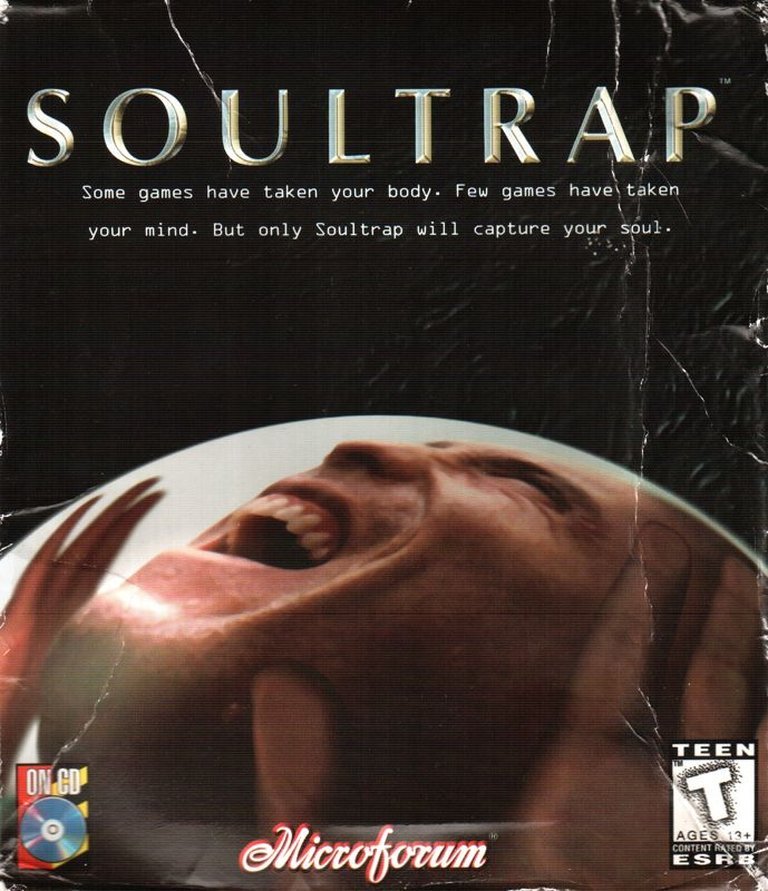
SoulTrap is a 3D platform game set within the mind of its protagonist, Malcolm West, where his fears and anxieties manifest as surreal, floating platforms and hostile enemies. Players navigate through 11 themed levels, battling phobia-based foes with weapons like a magical axe and grenade launcher, while solving puzzles and avoiding obstacles. The game features both first-person and third-person perspectives, offering a unique blend of action and psychological exploration.
Gameplay Videos
SoulTrap Free Download
PC
SoulTrap Reviews & Reception
en.wikipedia.org (60/100): With suitably spooky music, a dark tone, a nice assortment of weaponry and a nightmarishly intriguing idea, SoulTrap could’ve been more. As it is, it’s an initially inspirational but repetitive and only marginally entertaining exercise
mobygames.com (59/100): SoulTrap is a 3D platform game that takes place inside the mind of the main character of the game: Malcolm West. The fears and anxieties of Malcolm West are represented by strange often moving platform structures high in the sky.
squakenet.com : This is a really bold and ambitious game which tries to combine several genres into one, and while it doesn’t quite pull it off, it gets pretty close and is certainly work more than a cursory look.
SoulTrap Cheats & Codes
PC
Create the ‘Any level, any time’ registry entry under HKEY_CURRENT_USER\Software\Microforum\SoulTrap\.
| Code | Effect |
|---|---|
| “Any level, any time”=dword:00000001 | Unlocks all levels in the game. |
SoulTrap: A Nightmare of Ambition and Flawed Execution
Introduction
In the mid-1990s, the gaming industry was in the throes of a 3D revolution. Developers were experimenting with new technologies, pushing the boundaries of what was possible in interactive entertainment. Amid this era of innovation, SoulTrap emerged—a game that dared to explore the surreal landscapes of the human psyche. Developed by Microforum International and released in 1996, SoulTrap was an ambitious attempt to blend platforming, shooting, and psychological horror into a cohesive experience. Yet, despite its bold vision, the game ultimately stumbled under the weight of its own aspirations. This review delves deep into SoulTrap‘s development, narrative, gameplay, and legacy, offering a comprehensive analysis of a game that remains a fascinating, if flawed, artifact of its time.
Development History & Context
The Studio and the Vision
Microforum International, the studio behind SoulTrap, was a relatively small player in the mid-90s gaming scene. Known for titles like Huygen’s Disclosure and Gooch Grundy’s X-Decathlon, the studio had a reputation for experimenting with unconventional ideas. SoulTrap was no exception. The game was conceived as a psychological journey through the nightmares of its protagonist, Malcolm West, blending platforming mechanics with shooter elements and a dark, surreal aesthetic.
The game’s executive producer, Claudio Baiocchi, envisioned SoulTrap as a groundbreaking experience—one that would set a “new standard for 3D games,” as touted in its marketing materials. The team aimed to create a game that was not just technically impressive but also thematically rich, exploring the depths of human fear and anxiety.
Technological Constraints
Developing SoulTrap in 1996 was no small feat. The gaming industry was still grappling with the transition from 2D to 3D, and the tools available to developers were primitive by today’s standards. The game was built for Windows 95, a platform that was still in its infancy, and the team had to work within the limitations of the hardware of the time.
One of the most significant challenges was the game’s 3D engine. Unlike more polished 3D games of the era, such as Tomb Raider or Super Mario 64, SoulTrap’s engine was rudimentary, leading to clunky controls and inconsistent physics. The game’s use of both first-person and third-person perspectives was innovative but ultimately highlighted the engine’s limitations, as switching between views often felt jarring rather than seamless.
The Gaming Landscape of 1996
The mid-90s were a golden age for experimentation in gaming. Titles like Quake, Resident Evil, and Crash Bandicoot were redefining their respective genres, while lesser-known games like SoulTrap were pushing boundaries in their own ways. However, the market was also becoming increasingly competitive, with players expecting higher levels of polish and innovation.
SoulTrap entered this landscape as an underdog. It lacked the marketing muscle of bigger titles and struggled to stand out in a crowded field. Despite its unique premise, the game’s technical shortcomings and repetitive gameplay made it difficult to compete with more refined experiences.
Narrative & Thematic Deep Dive
Plot Overview
SoulTrap follows the story of Malcolm West, an executive director plagued by nightmares since childhood. These nightmares have resurfaced with a vengeance, and the only way for Malcolm to conquer his fears is to journey into his own subconscious. The game’s premise is intriguing: Malcolm must navigate a series of surreal, dreamlike levels, each representing a different facet of his psyche. From gothic castles to carnival-themed nightmares, the game’s environments are designed to reflect Malcolm’s deepest anxieties.
The narrative is minimalistic, with little in the way of exposition or character development. Instead, the story is conveyed through the game’s environments and the enemies Malcolm encounters—manifestations of his phobias. While this approach has the potential to be deeply immersive, SoulTrap fails to fully capitalize on its premise. The lack of a strong narrative thread leaves the game feeling disjointed, with little to tie the various levels together beyond their shared surrealism.
Characters and Dialogue
Malcolm West is the game’s sole playable character, and his journey is a solitary one. There are no NPCs to interact with, no allies to aid him, and no villains to confront beyond the abstract representations of his fears. This isolation could have been a powerful narrative device, emphasizing Malcolm’s internal struggle, but the game does little to develop his character beyond his role as a vessel for the player.
The absence of dialogue is another missed opportunity. While the game’s surreal aesthetic lends itself to a more abstract storytelling approach, the lack of any meaningful interaction or exposition leaves the narrative feeling hollow. Players are left to interpret the game’s themes on their own, but without enough context, these interpretations often feel shallow.
Themes: Fear, Anxiety, and the Subconscious
At its core, SoulTrap is an exploration of fear and anxiety. The game’s levels are designed to evoke a sense of unease, with floating platforms, bottomless pits, and grotesque enemies that seem to defy logic. The game’s surrealism is its greatest strength, as it effectively captures the irrational, dreamlike quality of nightmares.
However, the game’s themes are often overshadowed by its technical limitations. The abstract nature of the levels, while fitting for a dreamworld, can also feel arbitrary and confusing. The lack of a clear narrative or emotional throughline makes it difficult for players to fully engage with the game’s themes on a deeper level.
Gameplay Mechanics & Systems
Core Gameplay Loop
SoulTrap is, at its heart, a 3D platformer with shooter elements. Players must navigate a series of floating platforms, jumping from one to another while avoiding obstacles and defeating enemies. The game’s 11 levels each have their own unique themes, ranging from gothic castles to breakfast-themed nightmares, but the core gameplay remains largely the same throughout.
The game’s platforming mechanics are its biggest weakness. Malcolm’s movement is controlled via a “Jetboard,” a hoverboard-like device that allows him to glide through the air. However, the Jetboard’s physics are poorly implemented, making precise jumps and landings frustratingly difficult. The controls are sluggish, and the game’s camera angles often make it hard to judge distances, leading to frequent falls and cheap deaths.
Combat and Weapons
Combat in SoulTrap is a mixed bag. Players have access to a variety of weapons, including a magical axe, a .45 automatic, and a grenade launcher. While the arsenal is diverse, the combat itself is simplistic and repetitive. Enemies are largely static, offering little challenge beyond their sheer numbers, and the lack of tactical depth makes combat feel like a chore rather than an engaging part of the experience.
The game’s first-person and third-person perspectives can be toggled with the press of a button, but this feature is more of a gimmick than a meaningful gameplay mechanic. The first-person view is often disorienting, while the third-person view suffers from a fixed camera that can make navigation difficult.
Character Progression and Power-Ups
SoulTrap includes a basic progression system, with power-ups scattered throughout the levels that replenish health and ammunition. However, there is little in the way of meaningful character growth. Malcolm’s abilities remain static throughout the game, and there are no upgrades or new skills to unlock. This lack of progression makes the game feel stagnant, especially as the levels grow increasingly repetitive.
UI and Quirks
The game’s user interface is functional but unremarkable. The HUD is minimalistic, displaying only the most essential information, such as health and ammunition. While this keeps the screen uncluttered, it also feels underdeveloped, lacking the polish of more contemporary games.
One of the game’s few innovative features is its quicksave system, which allows players to save their progress at any point. This is a welcome addition, given the game’s punishing difficulty, but it does little to address the deeper issues with the gameplay.
World-Building, Art & Sound
Setting and Atmosphere
SoulTrap’s greatest strength lies in its surreal, dreamlike world. The game’s levels are designed to feel like fragments of Malcolm’s subconscious, with floating platforms, shifting geometries, and eerie, otherworldly landscapes. The gothic castle level, for example, is a striking representation of a nightmare, with its looming stone structures and bottomless pits.
However, the game’s abstract design often works against it. The levels can feel disjointed and confusing, with little to guide the player beyond trial and error. The lack of a clear visual language makes navigation a chore, and the game’s surrealism occasionally crosses the line into outright incoherence.
Visual Direction
The game’s visuals are a product of their time, with blocky 3D models and simple textures. While the art direction is ambitious, the execution is often lacking. The game’s environments are creative but suffer from a lack of detail, and the character models are stiff and unexpressive.
That said, SoulTrap does have a certain charm to its visuals. The game’s surreal aesthetic is unique, and the levels are often striking in their weirdness. The breakfast-themed level, for example, is a bizarre but memorable highlight, with its giant milk cartons and oversized breakfast foods.
Sound Design and Music
The game’s sound design is another area where SoulTrap shines. The eerie, atmospheric soundtrack, composed by Martin Dolgener, effectively enhances the game’s surreal tone. The music is haunting and immersive, perfectly complementing the game’s nightmare themes.
The sound effects, while simple, are effective in creating a sense of unease. The clanking of Malcolm’s Jetboard, the distant echoes of unseen enemies, and the ambient noises of the dreamworld all contribute to the game’s oppressive atmosphere.
Reception & Legacy
Critical Reception
Upon its release in 1996, SoulTrap received mixed reviews. Critics praised the game’s ambitious premise and surreal visuals but were largely unimpressed by its clunky gameplay and technical limitations.
- Coming Soon Magazine gave the game an 84%, calling it “truly captivating” and praising its graphics and soundtrack.
- PC Player (Germany) awarded it a 60%, noting that the game could have been a highlight if not for its imprecise controls and lack of clarity.
- The Adrenaline Vault also gave it a 60%, describing it as “an interesting game with gameplay that is much more aggravating than it is fun.”
- CD-Action scored it 50%, acknowledging its good graphics but criticizing its repetitive gameplay.
- Computer Games Magazine was the harshest, giving it a 40% and calling it “an initially inspirational but repetitive and only marginally entertaining exercise.”
Player reception was even less favorable, with an average score of 1.4 out of 5 on MobyGames. Many players found the game frustrating and unenjoyable, citing its poor controls and lack of polish.
Commercial Performance
SoulTrap was not a commercial success. The game’s niche appeal and technical shortcomings made it difficult to compete with more polished titles of the era. While it found a small audience among fans of surreal and experimental games, it ultimately faded into obscurity.
Evolution of Reputation
In the years since its release, SoulTrap has gained a cult following among retro gaming enthusiasts. Its surreal aesthetic and ambitious premise have made it a curiosity for those interested in the history of 3D gaming. However, it remains a divisive title, with some praising its creativity and others dismissing it as a flawed experiment.
Influence on Subsequent Games
While SoulTrap did not have a significant impact on the gaming industry, its surreal, dreamlike levels can be seen as a precursor to later psychological horror games like Silent Hill and Alan Wake. Its use of abstract, shifting environments also foreshadowed the design of games like Antichamber and The Stanley Parable, which play with perception and reality in similar ways.
Conclusion
SoulTrap is a game of contradictions—a bold, ambitious experiment that ultimately falls short of its potential. Its surreal, dreamlike world and haunting soundtrack are undeniably compelling, but its clunky controls, repetitive gameplay, and lack of narrative depth make it a frustrating experience. While it may not be a masterpiece, SoulTrap is a fascinating artifact of its time, offering a glimpse into the creative risks and technical limitations of mid-90s gaming.
For those interested in the history of 3D platformers or psychological horror, SoulTrap is worth a look, if only as a curiosity. However, players seeking a polished, engaging experience would be better served by more refined titles of the era. In the end, SoulTrap is a game that dared to dream big but ultimately found itself trapped in the nightmares of its own ambition.
Final Verdict: 6/10 – A flawed but fascinating experiment in surreal gaming.