
- Release Year: 2006
- Platforms: Windows
- Publisher: astragon Software GmbH
- Developer: FourX Development
- Genre: Action
- Perspective: 1st-person
- Game Mode: Single-player
- Gameplay: Shooter
- Setting: Office
- Average Score: 14/100
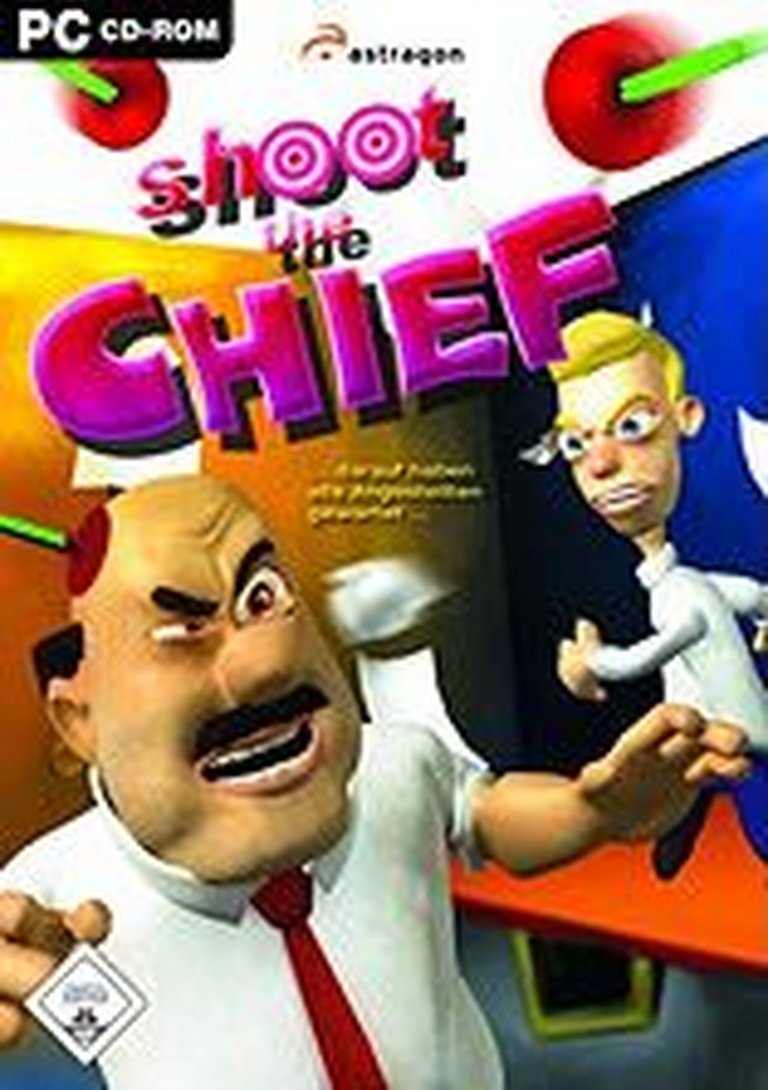
Description
In ‘Shoot the Chief’, the player takes on the role of a disgruntled employee seeking revenge on their boss by throwing paper pellets at them in a first-person office setting. The game features three levels where the boss moves and hides, and the player must hit them to earn points within a limited time. Additional items and employees in the office can also be targeted for positive or negative points, adding a layer of strategy to the gameplay.
Shoot the Chief Reviews & Reception
retro-replay.com : Shoot the Chief turns your everyday work frustrations into a thrilling paper-pellet showdown.
mobygames.com (14/100): Average score: 14% (based on 2 ratings)
Shoot the Chief Cheats & Codes
PC
Press ~ during game play to display the console window, then type sv_cheats 1 to enable cheat mode. Then, enter one of the following codes at the console window.
| Code | Effect |
|---|---|
| impulse 102 | Brain target practice |
| sv_gravity 2 | High jumps |
| buddha | Invincibility |
| impulse 101 | More weapons |
| noclip | No clipping mode |
| give_weapon Smg | Guns |
| give_weapon Smg | Gun cheats |
| give_weapon slam | Gun cheats |
| give_weapon crowbar | Gun cheats |
| give_weapon stunstick | Gun cheats |
| give_weapon shotgun | Gun cheats |
| give_weapon M60 | Gun cheats |
| give_weapon dragunovsvd | Gun cheats |
| give_weapon crossbow | Gun cheats |
Shoot the Chief: A Cathartic Office Revenge Fantasy or a Forgotten Relic?
Introduction: The Game That Let You Pelt Your Boss with Paper
In the vast, often serious landscape of first-person shooters, Shoot the Chief (2006) stands as a bizarre, almost surreal anomaly—a game that dared to ask: What if your office job was a high-score chase? Developed by FourX Development and published by astragon Software, this quirky arcade-style shooter tasks players with the simple yet deeply satisfying mission of pelting their tyrannical boss with crumpled paper balls. It’s a premise so absurdly specific that it borders on genius, tapping into the universal fantasy of workplace rebellion.
Yet, despite its novel concept, Shoot the Chief was met with near-universal disdain from critics, earning a dismal 14% average score from professional reviews. Players weren’t much kinder, with a 0.6/5 rating on MobyGames. So, what went wrong? Was this game a misunderstood gem, a lazy cash-in, or simply a product of its time?
This review will dissect Shoot the Chief in exhaustive detail—its development, its gameplay, its narrative (or lack thereof), and its legacy—to determine whether it deserves its place in the bargain bin of gaming history or if it holds some hidden value as a cultural artifact.
Development History & Context: A Game Born from Office Frustration
The Studio Behind the Paper Pellets
FourX Development, the studio behind Shoot the Chief, remains an obscure entity in gaming history. Little is known about the team, but their portfolio suggests a focus on casual, arcade-style experiences. The game was published by astragon Software GmbH, a German company known for simulation and strategy titles (Bus Simulator, Construction Simulator). The collaboration between a niche developer and a publisher specializing in simulations is odd, but it hints at Shoot the Chief’s intended audience: casual gamers looking for a quick, humorous distraction.
The Gaming Landscape of 2006: A Year of Titans
2006 was a monumental year for gaming, dominated by:
– Gears of War (Epic Games) – A cover-based shooter that redefined third-person action.
– The Elder Scrolls IV: Oblivion – A sprawling RPG that set new standards for open-world design.
– Call of Duty 3 – The continuation of a franchise that would soon dominate the FPS genre.
– The Legend of Zelda: Twilight Princess – A masterpiece of adventure gaming.
In this environment, Shoot the Chief was a tiny, almost insignificant blip—a game that didn’t compete with the graphical fidelity, narrative depth, or mechanical complexity of its contemporaries. Instead, it embraced minimalism, offering a five-minute experience that could be played in a coffee break.
Technological Constraints & Design Philosophy
Given its 2006 release, Shoot the Chief was not pushing any technical boundaries. The game runs on what appears to be a simple 2D/3D hybrid engine, with:
– Fixed camera angles (only slight left/right scrolling).
– Basic physics (paper balls arc predictably, no ragdoll effects).
– Cartoonish, low-poly visuals (intentionally stylized, not realistic).
The developers clearly prioritized accessibility and humor over innovation. The game was likely designed to be:
– Easy to pick up (mouse-only controls).
– Short and replayable (three levels, high-score chasing).
– A novelty item (capitalizing on the universal dislike of bad bosses).
In many ways, Shoot the Chief feels like a digital equivalent of a desk toy—something to fiddle with when bored at work rather than a game meant for deep engagement.
Narrative & Thematic Deep Dive: The Office as a Battleground
The Premise: A Revenge Fantasy for the Cubicle-Dweller
The game’s story is deliberately minimal:
– You are an unnamed, overworked employee.
– Your boss is a smug, evasive tyrant who dodges your paper projectiles.
– Your goal is to pelt him with enough paper balls to force him out of the office.
There is no dialogue, no cutscenes, and no character development. The narrative is conveyed through:
– Environmental storytelling (passive-aggressive emails popping up on-screen).
– Level design (each stage represents a different office environment).
– Humor (exaggerated animations, like the boss hiding under desks).
Themes: Workplace Frustration & Catharsis
Despite its simplicity, Shoot the Chief taps into universal workplace themes:
1. Power Imbalance – The boss is untouchable in real life, but in the game, he’s a target.
2. Petty Revenge – The act of throwing paper balls is juvenile, mirroring the childishness of office politics.
3. Time Pressure – The ticking clock reflects the stress of deadlines and performance metrics.
4. Collateral Damage – Hitting coworkers or office equipment results in penalties, reinforcing the idea that rebellion has consequences.
Comparison to Other “Office” Games
While Shoot the Chief is unique in its paper-throwing mechanic, it shares DNA with other workplace-themed games:
– Job Simulator (2016) – A VR comedy about mundane office tasks.
– The Sims (2000) – Where players can micromanage office dynamics.
– Dilbert: The Ultimate Cubicle Escape (1996) – A point-and-click adventure satirizing corporate culture.
However, unlike these games, Shoot the Chief doesn’t satirize or explore office life—it weaponizes it. The boss isn’t a character; he’s a moving target, and the office isn’t a setting; it’s a shooting gallery.
The Absence of Story: A Strength or a Weakness?
Critics like Ian Bogost (The Atlantic) have argued that video games don’t need stories—that their strength lies in interactivity and mechanics. Shoot the Chief embodies this philosophy. It doesn’t try to be Half-Life or BioShock; it’s pure gameplay, unburdened by lore or cutscenes.
But does this make it shallow? Or does it make it honest?
-
Pros of Minimal Narrative:
- No unnecessary fluff; the game gets straight to the action.
- The lack of story makes it timeless—office frustration is universal.
- Players project their own workplace grievances onto the game.
-
Cons of Minimal Narrative:
- Without any emotional investment, the game feels disposable.
- The boss is a faceless antagonist, making the revenge fantasy less satisfying.
- No progression or payoff—just a high score.
Gameplay Mechanics & Systems: The Art of Paper Warfare
Core Gameplay Loop: Point, Click, Pelt
Shoot the Chief is deceptively simple:
1. Aim with the mouse.
2. Scroll left/right to track the boss.
3. Click to throw a paper ball.
4. Hit the boss for points.
5. Avoid hitting coworkers/equipment (penalties).
The game is structured like an arcade shooter, with:
– Three levels (each with increasing difficulty).
– A time limit (five minutes per level).
– A high-score system (encouraging replayability).
Combat & Progression: The Boss as a Moving Target
The boss is not a passive target—he:
– Dodges behind obstacles (filing cabinets, desks).
– Hides in corners.
– Moves unpredictably (sometimes sprinting, sometimes crouching).
This forces the player to:
– Lead their shots (accounting for paper ball arc).
– Prioritize targets (boss vs. bonus items).
– Manage risk/reward (hitting a coworker costs points).
Scoring & Strategy: More Than Just Mindless Clicking
The game introduces nuanced scoring:
– Headshots (bonus points).
– Hitting office equipment (penalties).
– Hitting coworkers (penalties).
– Special items (pencil crossbow, etc.).
This adds a layer of strategy:
– Do you go for the high-risk boss shot or clear obstacles first?
– Do you chase bonus items or focus on the main target?
– How do you balance speed and accuracy before time runs out?
UI & Controls: Simplicity at Its Finest (or Most Limiting?)
The UI is barebones:
– Score display (top of the screen).
– Timer (counting down).
– No health bar, no ammo counter (paper balls are infinite).
Controls are mouse-only:
– Left-click = throw.
– Mouse movement = aim.
– Scroll wheel = pan left/right.
This minimalist approach makes the game easy to learn but limiting in depth. There’s no skill progression, no unlocks, and no variety beyond the three levels.
Innovation vs. Flaws: What Works and What Doesn’t
| Innovative Aspects | Flawed Aspects |
|---|---|
| Unique premise (office revenge fantasy) | Extremely short (can be beaten in 15 minutes) |
| Simple, addictive gameplay | No replay value beyond high scores |
| Humor and charm (exaggerated animations) | Repetitive (only three levels) |
| Accessible controls (mouse-only) | No difficulty settings (too easy for some, too hard for others) |
| Tactical scoring system | No narrative payoff (boss just disappears) |
Comparison to Moorhuhn (Crazy Chicken)
Critics frequently compared Shoot the Chief to Moorhuhn (1999), a German arcade shooter where players hunt chickens. Both games share:
– First-person perspective.
– Simple point-and-click mechanics.
– High-score chasing.
However, Moorhuhn had:
– More variety (different weapons, environments).
– Better pacing (gradual difficulty increase).
– Cultural impact (became a meme in Germany).
Shoot the Chief feels like a lesser imitation, lacking the polish and charm of its predecessor.
World-Building, Art & Sound: The Office as a Playground
Visual Design: Cartoonish Minimalism
The game’s art style is deliberately simple:
– Bright, exaggerated colors (boss in a red tie, coworkers in pastels).
– Low-poly 3D models (no realistic textures).
– Static backgrounds (office cubicles, filing cabinets).
This stylized approach serves two purposes:
1. Clarity – The boss stands out against the drab office.
2. Humor – The exaggerated animations (boss sliding under desks) enhance the comedy.
Sound Design: The Silence of the Office
The game’s audio is equally minimal:
– No voice acting.
– Basic sound effects (paper crumpling, thuds on impact).
– No background music (just ambient office noises).
This lack of audio polish makes the game feel incomplete. A funny soundtrack (elevator music, boss taunts) could have elevated the experience.
Atmosphere: Does It Capture the Office Vibe?
The game attempts to create an office atmosphere through:
– Cubicle mazes.
– Passive-aggressive emails (pop-up notifications).
– Coworker reactions (ducking, spilling coffee).
But it fails to immerse the player because:
– The office feels empty and lifeless.
– There’s no interaction beyond shooting.
– The boss is more of a target than a character.
Reception & Legacy: The Game Critics Loved to Hate
Critical Reception: A Near-Unanimous Pan
Shoot the Chief was savaged by critics:
– GameStar (Germany) – 16/100
“After five minutes, you’ve seen everything. The game is as shallow as a puddle.”
– PC Games (Germany) – 11/100
“A boring, repetitive experience with no depth.”
Common criticisms:
✔ Too short (beatable in minutes).
✔ No replay value.
✔ Lack of innovation.
✔ Weak presentation.
Player Reception: A Cult Following?
Players were equally harsh, with a 0.6/5 rating on MobyGames. However, some niche audiences appreciated it:
– Office workers who enjoyed the cathartic premise.
– Casual gamers looking for a quick time-waster.
– Speedrunners (though the game is too short for serious competition).
Legacy: A Footnote in Gaming History
Shoot the Chief had no lasting impact on the industry. It didn’t inspire clones, sequels, or even memes. It remains a curiosity—a game that could have been fun but was too half-baked to leave a mark.
Why Did It Fail?
- Lack of Depth – No progression, no variety.
- Poor Marketing – Released in a year dominated by AAA titles.
- Weak Execution – The humor and premise weren’t enough to carry the gameplay.
Conclusion: A Flawed but Fascinating Experiment
Shoot the Chief is not a good game by traditional standards. It’s short, repetitive, and lacking in polish. Yet, it’s not without merit.
The Good:
✅ Unique premise (office revenge fantasy).
✅ Simple, accessible gameplay.
✅ Humor and charm (exaggerated animations).
The Bad:
❌ Extremely short (no replay value).
❌ No narrative or character depth.
❌ Repetitive and shallow.
Final Verdict: 4/10 – A Novelty, Not a Masterpiece
Shoot the Chief is the video game equivalent of a desk toy—fun for a few minutes, but ultimately forgettable. It’s a missed opportunity; with more levels, better sound design, and a bit more polish, it could have been a cult classic. Instead, it’s a footnote, a game that dared to be silly in a year of serious blockbusters.
Should you play it?
– Yes, if you’re curious about obscure 2000s games.
– No, if you expect depth, challenge, or lasting entertainment.
In the grand tapestry of gaming history, Shoot the Chief is a tiny, crumpled paper ball—easily thrown away, but occasionally fun to flick at the wall.