
- Release Year: 2006
- Platforms: Windows
- Publisher: Global Software Publishing Ltd.
- Developer: Sarbakan, Inc.
- Genre: Adventure, Educational
- Perspective: Third-person
- Game Mode: Single-player
- Gameplay: Educational, Puzzle elements
- Setting: China, France, Russia, Tanzania
- Average Score: 94/100
Description
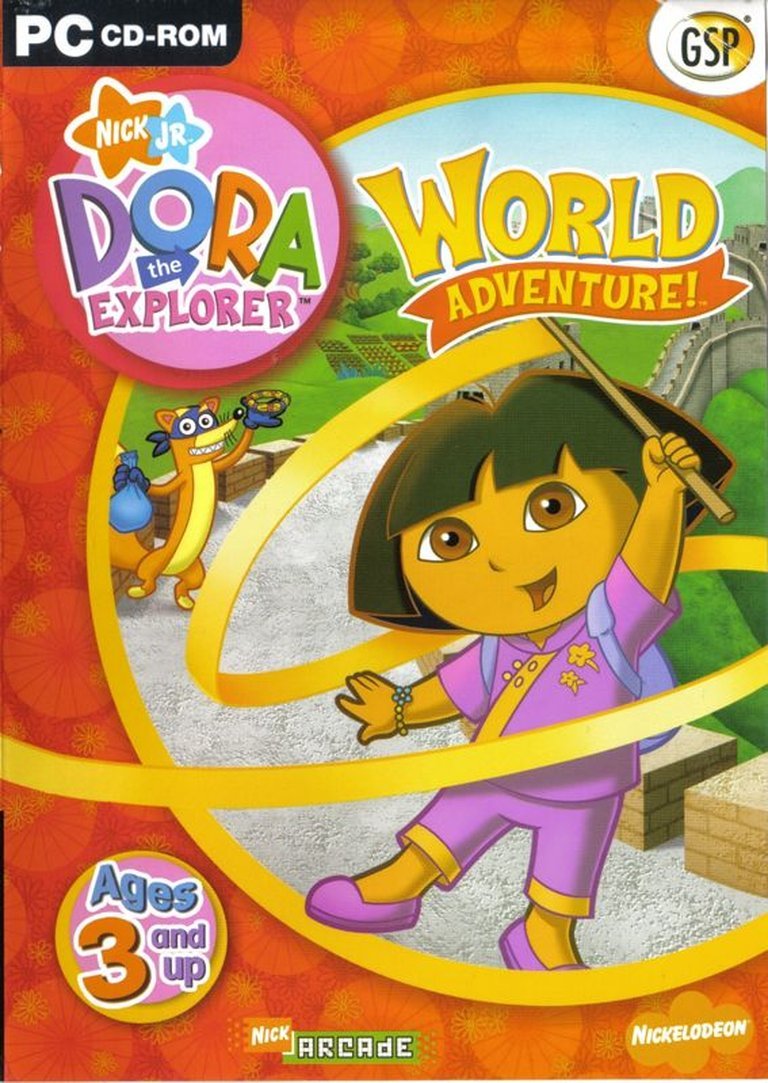
In ‘Dora the Explorer: World Adventure!’, young players join Dora on a global quest to recover friendship bracelets mistakenly taken by Swiper before World Friendship Day. The game takes players to four countries—France, Tanzania, Russia, and China—where they solve puzzles, collect stickers, and learn about geography, cultures, languages, and problem-solving. Designed for preschoolers, the game blends adventure with educational elements, teaching motor skills, pattern recognition, and the value of friendship, all while incorporating light Spanish vocabulary.
Gameplay Videos
Where to Buy Dora the Explorer: World Adventure!
PC
Dora the Explorer: World Adventure! Free Download
Dora the Explorer: World Adventure! Guides & Walkthroughs
Dora the Explorer: World Adventure! Reviews & Reception
commonsensemedia.org : Dora takes kids on first-rate global romp.
familyfriendlygaming.com (88/100): I really enjoy finding good, wholesome, and fun children’s video games to recommend to all ya’ll.
mobygames.com (100/100): Dora the Explorer: World Adventure! (2006) – MobyGames
Dora the Explorer: World Adventure!: A Comprehensive Retrospective
Introduction: The Legacy of a Preschool Pioneer
In the mid-2000s, the landscape of children’s edutainment software was dominated by a handful of franchises that sought to blend learning with playful interactivity. Among these, Dora the Explorer: World Adventure! (2006) stands as a quintessential example of how a licensed property could transcend its television origins to create a meaningful, globally conscious gaming experience for preschoolers. Developed by Sarbakan, Inc. and published by Global Software Publishing Ltd., this title emerged during a period when the Dora the Explorer franchise was at its cultural zenith, leveraging its pedagogical strengths to introduce young players to concepts of geography, language, and multiculturalism.
This review aims to dissect World Adventure! with the rigor it deserves, exploring its development context, narrative design, gameplay mechanics, and lasting influence. Far from being a mere cash-in on a popular IP, the game represents a thoughtful synthesis of educational theory and interactive design, tailored specifically for children aged 3–6. By examining its strengths and limitations, we can better understand its place in the broader history of edutainment software and the Dora franchise itself.
Development History & Context: Crafting a Global Classroom
The Studio and the Vision
Sarbakan, Inc., a Canadian developer with a portfolio heavily skewed toward children’s and educational software, was tasked with adapting Dora the Explorer into an interactive global adventure. The studio’s prior work included titles like The Backyardigans: Mission to Mars and Go, Diego, Go! Wolf Pup Rescue, indicating a specialization in translating Nickelodeon properties into engaging digital experiences. For World Adventure!, the team was led by Karen Poulin, who served as both director and lead game designer, ensuring a cohesive vision that aligned with the show’s educational ethos.
The game’s development coincided with the height of Dora the Explorer’s popularity. The television series, which premiered in 2000, had already redefined children’s programming by incorporating bilingual education (English and Spanish) and interactive elements that broke the fourth wall. By 2006, the franchise was a merchandising juggernaut, with retail sales exceeding $13 billion. The challenge for Sarbakan was to create a game that felt authentic to the show while expanding its educational scope to include global cultures—a ambitious goal for a title aimed at preschoolers.
Technological Constraints and Design Philosophy
Released exclusively for Windows PCs, World Adventure! was constrained by the hardware limitations of its era. The game ran on CD-ROM, a medium that, while ubiquitous in the mid-2000s, imposed strict limits on asset size and complexity. The development team prioritized accessibility and simplicity, ensuring that the game could run smoothly on the modest specifications of family computers. This necessitated a focus on 2D artwork, minimal animation, and intuitive mouse-based controls—design choices that, while limiting in terms of graphical fidelity, were perfectly suited to the target audience.
The game’s UI design was another critical consideration. Given that many players would be experiencing their first computer game, the interface had to be uncluttered, with large, easily clickable elements and voice-guided instructions (provided by Dora herself). The decision to include a sticker and postcard book as a progress-tracking mechanism was a stroke of genius, tapping into the tactile joy of collection while reinforcing a sense of achievement.
The Edutainment Landscape of 2006
The mid-2000s were a transitional period for edutainment software. The market was saturated with titles that often prioritized branding over educational value, leading to a glut of low-effort licensed games. However, a few standout titles—such as JumpStart’s various iterations and Reader Rabbit—continued to set the standard for meaningful learning experiences.
World Adventure! distinguished itself by tying its educational content directly to its narrative. Rather than presenting geography and language as abstract lessons, the game embedded them within a globetrotting adventure, making learning feel like a natural part of the journey. This approach was in line with the constructivist theory of education, which posits that children learn best through active, context-rich experiences.
Narrative & Thematic Deep Dive: A Tale of Friendship and Discovery
Plot Overview
The game’s premise is deceptively simple: World Friendship Day is approaching, and the mischievous fox Swiper has accidentally stolen friendship bracelets from four countries—France, Tanzania, Russia, and China. Dora, ever the problem-solver, enlists the player’s help to retrieve the bracelets and restore harmony. The narrative unfolds across these four locales, with each country offering a distinct cultural lens through which the player engages with the world.
What makes this premise effective is its universal appeal. Friendship is a concept that resonates deeply with young children, and the idea of traveling the world to help others is both exciting and morally instructive. The inclusion of Swiper as a reluctant ally (rather than a pure antagonist) adds nuance, teaching children about redemption and teamwork.
Characterization and Dialogue
Dora’s characterization in World Adventure! is faithful to her television counterpart. She is cheerful, encouraging, and patient, serving as both a guide and a peer to the player. Her dialogue is peppered with Spanish phrases (e.g., “¿Puedes ayudarme?”—“Can you help me?”), reinforcing the franchise’s bilingual mission. The game also introduces Boots the Monkey, Dora’s loyal companion, who provides comic relief and additional guidance.
Swiper’s role is particularly noteworthy. In the television series, Swiper is often a source of conflict, but here, his mistake becomes the catalyst for the adventure, and his subsequent cooperation with Dora models accountability and collaboration. This subtle shift in his characterization aligns with the game’s themes of friendship and global unity.
Themes: Multiculturalism and Early Global Awareness
World Adventure! is, at its core, a celebration of cultural diversity. Each country visited is rendered with authentic visual and auditory cues:
– France: The Eiffel Tower looms in the background, accordion music plays, and Dora teaches the player to say “Bonjour!”
– Tanzania: The savanna landscape is dotted with wildlife, and the player learns “Jambo!” (Swahili for “hello”).
– Russia: The Winter Palace and matryoshka dolls feature prominently, with Dora introducing “Privet!”
– China: The Great Wall serves as a backdrop, and the player is taught “Nǐ hǎo!”
These elements are not merely superficial. The game actively engages children in cultural practices, such as dressing Dora in traditional attire or participating in local customs. This immersion fosters early global awareness, a rare and commendable goal for a preschool title.
Educational Objectives
The game’s packaging outlines an ambitious list of learning objectives, including:
– World Geography and Cultures
– Foreign Languages (basic greetings in French, Swahili, Russian, and Mandarin)
– Motor Skills (mouse control and hand-eye coordination)
– Cognitive Skills (matching, sorting, patterning, problem-solving)
– Social-Emotional Learning (the value of friendship, teamwork, and helping others)
What sets World Adventure! apart is its integration of these objectives into gameplay. For example:
– Language learning is contextualized within each country’s segment, with Dora modeling phrases and encouraging the player to repeat them.
– Geography is taught through visual exploration, as players navigate iconic landmarks.
– Cognitive skills are honed through puzzles and mini-games, such as matching shapes or identifying patterns in local artifacts.
Gameplay Mechanics & Systems: Learning Through Play
Core Gameplay Loop
World Adventure! follows a linear but flexible structure. The player selects a country from a world map, then engages in a series of two to three activities per location. These activities are designed to be short, repeatable, and progressively challenging, ensuring that young players remain engaged without becoming frustrated.
The game’s difficulty scaling is handled elegantly. Players can choose from three levels:
1. Easy (for ages 3–4)
2. Medium (for ages 4–5)
3. Hard (for ages 5–6)
This tiered approach ensures that the game grows with the child, a feature that enhances its replayability and educational value.
Mini-Games and Activities
The bulk of World Adventure! consists of mini-games, each tailored to reinforce specific skills:
1. Transportation Challenges: Players help Dora travel to each country via different modes of transport (e.g., a hot air balloon to France, a safari jeep in Tanzania). These segments focus on hand-eye coordination and following directions.
2. Cultural Dress-Up: Dora must be outfitted in traditional clothing for each country. This activity teaches visual discrimination and cultural awareness.
3. Puzzle Solving: Tasks include matching shapes, sorting objects by color or pattern, and navigating simple mazes. These puzzles are designed to be intuitive, with Dora providing verbal hints if the player struggles.
4. Friendship Bracelet Recovery: In each country, the player must find and return the stolen bracelets, often by identifying hidden objects or completing a sequence of tasks.
Progress Tracking and Rewards
A standout feature of World Adventure! is its sticker and postcard book. As players complete activities, they earn stickers (depicting landmarks, animals, or cultural items) and postcards (featuring messages from Dora). This system serves multiple purposes:
– Motivation: The act of collecting stickers provides immediate gratification, encouraging players to persist.
– Reinforcement: The stickers and postcards visually recap what the player has learned, serving as a memory aid.
– Parental Involvement: The book can be printed, allowing parents to discuss the adventure with their child and extend the learning experience beyond the screen.
UI and Accessibility
The game’s user interface is a masterclass in preschool-friendly design:
– Large, colorful buttons ensure that even children with developing motor skills can navigate the game.
– Voice prompts guide the player through each activity, reducing reliance on text.
– Error forgiveness: The game does not penalize mistakes; instead, Dora offers encouragement and guidance, reinforcing a growth mindset.
One minor critique is the lack of save functionality. Given the game’s short play sessions (ideal for young attention spans), this omission is understandable, but it does limit long-term engagement.
World-Building, Art & Sound: Crafting a Vivid Global Journey
Visual Design: A Postcard from the World
World Adventure!’s art direction is bright, cheerful, and intentionally simplistic, reflecting both the technical constraints of the era and the needs of its audience. The game employs a 2D, cartoonish aesthetic that closely mirrors the television series, ensuring brand consistency and familiarity for young players.
Each country is rendered with distinct visual motifs:
– France is awash in pastel blues and pinks, with the Eiffel Tower and cobblestone streets evoking a storybook Paris.
– Tanzania features warm oranges and browns, with acacia trees and wildlife populating the savanna.
– Russia is depicted with cool blues and whites, emphasizing its wintry palette and architectural grandeur.
– China is vibrant, with red lanterns, pagoda roofs, and the Great Wall snaking across the landscape.
While the graphics are not technically impressive by modern standards, they are highly effective in conveying a sense of place and cultural identity.
Sound Design: A Symphony of Cultures
The game’s audio design is one of its strongest assets. Each country is accompanied by authentic musical themes:
– France: Accordion-led melodies evoke a Parisian café.
– Tanzania: Drum-heavy rhythms reflect traditional African music.
– Russia: Folk-inspired tunes with balalaika-like instrumentation.
– China: Pentatonic scales and string instruments create an East Asian ambiance.
These musical cues are subtle but immersive, reinforcing the game’s multicultural themes without overwhelming the player. Dora’s voice acting (provided by the same actress as the television series) is warm and engaging, while Swiper’s mischievous tones add a layer of playful tension.
Atmosphere and Immersion
World Adventure! excels in creating a welcoming, non-threatening atmosphere. The game’s world feels safe and inviting, with no elements that could frighten or confuse young players. The lack of failure states (players cannot “lose”; they can only try again) ensures that the experience remains positive and stress-free.
The game’s pacing is deliberate, allowing children to absorb information without feeling rushed. This unhurried approach is a hallmark of effective edutainment, prioritizing comprehension over completion.
Reception & Legacy: A Critical and Commercial Darling
Critical Reception
World Adventure! was met with universal acclaim from the limited number of critics who reviewed it. Common Sense Media, a trusted source for children’s media evaluations, awarded the game a perfect 5/5 score, praising its multicultural content, educational value, and accessibility. The review highlighted the game’s ability to introduce young children to global cultures in a way that was engaging and age-appropriate.
Parental feedback, while sparse, was overwhelmingly positive. Many praised the game for its lack of violence, educational depth, and alignment with the television series’ values. The sticker book feature was frequently cited as a standout element, with parents noting that it encouraged repeat play and facilitated discussions about the countries visited.
Commercial Performance
As a licensed title tied to one of the most successful children’s franchises of the 2000s, World Adventure! enjoyed strong sales, though exact figures are not publicly available. The game’s release coincided with the holiday season, a strategic move that capitalized on gift-giving trends. Its affordable price point (typical for edutainment software) and broad appeal made it a popular choice for parents of preschoolers.
Legacy and Influence
World Adventure!’s influence can be seen in subsequent Dora the Explorer games, many of which adopted its globally themed, puzzle-based structure. Titles like Dora’s Big Birthday Adventure (2010) and Dora Saves the Crystal Kingdom (2009) expanded on the formula, incorporating more interactive storytelling and diverse cultural settings.
Beyond the Dora franchise, the game contributed to a broader shift in edutainment design, proving that licensed properties could deliver meaningful educational experiences when developed with care. Its success helped pave the way for other culturally conscious children’s games, such as Little Pim’s language-learning series and National Geographic Kids’ adventure titles.
Cultural Impact
World Adventure! holds a unique place in the history of children’s software as one of the first titles to explicitly teach global awareness to preschoolers. In an era where diversity and inclusion are increasingly prioritized in education, the game’s multicultural curriculum feels ahead of its time. It remains a valuable artifact of how media can foster empathy and curiosity in young minds.
Conclusion: A Timeless Adventure for Young Explorers
Dora the Explorer: World Adventure! is more than just a licensed tie-in; it is a thoughtfully crafted educational tool that leverages the power of interactive media to broaden young horizons. By combining engaging gameplay, authentic cultural representation, and developmentally appropriate challenges, the game achieves what few titles in the genre have: it makes learning feel like an adventure.
While its graphics and mechanics may seem rudimentary by today’s standards, its educational philosophy and design principles remain relevant. The game’s emphasis on friendship, cooperation, and global understanding aligns with contemporary values, and its accessible, inclusive approach sets a benchmark for children’s software.
Final Verdict: Dora the Explorer: World Adventure! is a landmark title in edutainment, deserving of recognition not only as a commercial success but as a pioneering work in early childhood education. For parents and educators seeking a fun, meaningful, and culturally enriching experience for young children, it remains a timeless recommendation.
Score: 9/10 – A masterclass in preschool edutainment, marred only by its technical limitations and lack of save functionality.
Post-Script: As the Dora the Explorer franchise continues to evolve—with reboots, films, and new interactive experiences—World Adventure! stands as a testament to the power of simple, heartfelt design. It proves that even the youngest gamers deserve rich, respectful, and inspiring content, and that the world, no matter how vast, can be made accessible through the magic of play.