
- Release Year: 1987
- Platforms: Amstrad CPC, Antstream, Arcade, Commodore 64, Nintendo Switch, PlayStation 3, PlayStation 4, PS Vita, PSP, Windows, ZX Spectrum
- Publisher: Hamster Corporation, Imagine Software Ltd., SNK Corporation of America, SNK Corporation, SNK Playmore Corporation, SNK Playmore USA Corp.
- Developer: SNK Corporation
- Genre: Action
- Perspective: Side view
- Game Mode: Co-op, Single-player
- Gameplay: Platformer, Shooter
- Setting: Futuristic, Sci-fi
- Average Score: 69/100
Description
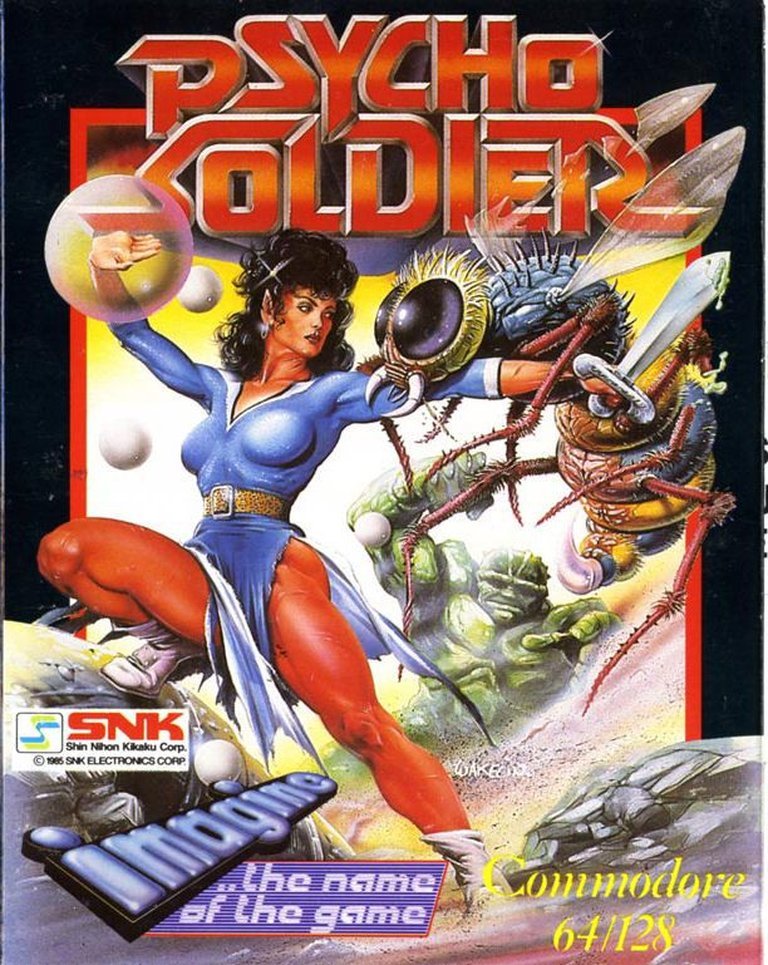
Psycho Soldier is a 2D side-scrolling action game set in a post-apocalyptic world, where Athena Asamiya, a descendant of the Greek goddess Athena, uses her psychic powers to battle mutant creatures. With the help of her friend Kensu, players navigate through a constantly scrolling environment, utilizing power-ups and psychic blasts in a unique blend of shooter and platformer gameplay. The game is notable for its anime/manga art style, cooperative two-player mode, and its pioneering use of a J-pop soundtrack with lyrics, which became iconic for Athena’s character in later SNK titles.
Gameplay Videos
Where to Buy Psycho Soldier
PC
Psycho Soldier Free Download
Psycho Soldier Cracks & Fixes
Psycho Soldier Guides & Walkthroughs
Psycho Soldier Reviews & Reception
mackerelphones.com : I love that Athena is a little chubby.
spectrumcomputing.co.uk (69/100): The ZX Spectrum version was published in 1987 by Imagine Software, and was converted by Ross Harris (as Source Software).
Psycho Soldier: A Pioneering Arcade Oddity and the Birth of an SNK Icon
Introduction
In the annals of arcade history, few games are as audacious, eccentric, and culturally significant as Psycho Soldier. Released in 1987 by SNK, this side-scrolling action game defied conventions with its blend of psychic powers, J-pop vocals, and anime-inspired aesthetics. It introduced Athena Asamiya, a character who would become a cornerstone of SNK’s The King of Fighters franchise, and pioneered the use of a full vocal soundtrack in video games. Psycho Soldier is a fascinating artifact of its era—a game that embraced the burgeoning otaku culture of 1980s Japan while simultaneously pushing the technical boundaries of arcade hardware. This review will dissect the game’s development, narrative, gameplay, and legacy, arguing that Psycho Soldier is not just a quirky relic but a bold experiment that laid the groundwork for SNK’s future successes.
Development History & Context
The Studio and the Vision
SNK, founded in 1978, was already a well-established name in the arcade scene by the mid-1980s, known for military-themed shooters like Ikari Warriors and Guerrilla War. However, Psycho Soldier represented a dramatic departure from the company’s usual fare. The game was developed as a spiritual sequel to Athena (1986), a fantasy platformer that starred a scantily clad warrior princess. While Athena leaned into mythological themes, Psycho Soldier embraced a more contemporary, sci-fi aesthetic, blending psychic powers with a post-apocalyptic setting.
The game’s development was spearheaded by a team that included Eikichi Kawasaki, who served as executive producer and lyricist, and Kaori Shimizu, a Japanese pop idol who provided the vocals for the game’s iconic theme song. The decision to incorporate a full vocal track was revolutionary. At the time, arcade games relied on synthesized music or simple sound effects. Psycho Soldier’s soundtrack required a custom JAMMA board consisting of three stacked PCBs, a technical marvel that allowed for the inclusion of digitized vocals alongside the game’s FM synthesis sound effects.
Technological Constraints and Innovations
The arcade hardware of 1987 was limited, but SNK pushed those limits to create Psycho Soldier. The game ran on a system with three Zilog Z80 processors, each clocked at 4 MHz. The sound system was particularly impressive, featuring a Yamaha YM3526 FM synthesis chip and a Y8950 chip, which added ADPCM decoding for digitized audio. This setup allowed for the game’s vocal track, a feature that was unprecedented in arcade games at the time.
The visuals, while not groundbreaking, were vibrant and colorful, with a resolution of 384×224 pixels and a palette of 1,024 colors. The game’s anime-inspired character designs, particularly Athena’s sailor fuku outfit, were a stark contrast to the more realistic or militaristic aesthetics of other arcade games of the era. This visual style, combined with the game’s upbeat J-pop soundtrack, gave Psycho Soldier a distinct identity that resonated with Japanese audiences.
The Gaming Landscape of 1987
The late 1980s were a golden age for arcade games, with titles like Double Dragon, Contra, and R-Type dominating the scene. Psycho Soldier arrived at a time when side-scrolling action games were evolving rapidly, incorporating more complex mechanics and narratives. However, few games dared to blend the genres as boldly as Psycho Soldier did. Its combination of platforming, shooting, and RPG-like power-ups set it apart from contemporaries like Wonder Momo (1987), which also featured a female protagonist but lacked the depth of Psycho Soldier’s gameplay systems.
The game’s release coincided with the rise of otaku culture in Japan, a subculture obsessed with anime, manga, and video games. Psycho Soldier’s anime-inspired visuals and J-pop soundtrack were tailor-made for this audience, making it one of the first arcade games to explicitly cater to this niche. This cultural context is crucial to understanding the game’s appeal and its lasting influence on SNK’s future titles.
Narrative & Thematic Deep Dive
Plot Overview
Psycho Soldier takes place in a post-apocalyptic world where ancient evil beings, known as the Shiguma, have been unleashed upon Earth. These creatures, once sealed away, now threaten humanity with their overwhelming power. The game’s protagonists, Athena Asamiya and Sie Kensou, are two teenagers with psychic abilities who rise to the challenge of defeating the Shiguma and saving the world.
Athena is a descendant of the original Athena from the 1986 game of the same name. In Psycho Soldier, she is reimagined as a high school student and aspiring pop idol, a far cry from her mythological predecessor. Kensou, her companion, is a martial artist with his own psychic powers. Together, they embark on a journey through ruined cities and subterranean landscapes, battling the Shiguma’s minions and ultimately confronting the monstrous final boss.
Characters and Dialogue
Athena and Kensou are the heart of Psycho Soldier’s narrative. Athena, in particular, is a fascinating character—a blend of innocence and power, embodying the “magical girl” archetype that would become a staple of anime and manga. Her design, with her purple hair and sailor fuku, is iconic, and her voice samples in the Japanese version of the game add a layer of personality that was rare for arcade games of the time.
Kensou, while less developed, serves as a capable foil to Athena. His design, with a Rambo-style headband, hints at SNK’s military shooter roots, but his psychic abilities and role as Athena’s partner give him a unique identity. The game’s dialogue, though minimal, is peppered with humorous and quirky voice samples, particularly in the Japanese version, where Athena’s reactions to obstacles and enemies add a layer of charm.
Themes
Psycho Soldier explores several themes that were ahead of its time. The most prominent is the idea of psychic powers as a force for good, a theme that would later be explored in depth in The King of Fighters series. The game also touches on the concept of destiny, with Athena and Kensou fulfilling an ancient prophecy to save humanity from the Shiguma.
The game’s post-apocalyptic setting is another key theme. The ruined cities and subterranean landscapes create a sense of urgency and desperation, contrasting with the upbeat tone of the game’s soundtrack. This juxtaposition of dark themes and lighthearted presentation is a hallmark of Psycho Soldier’s unique identity.
Finally, the game’s focus on Athena as a pop idol is a reflection of the idol culture that was booming in Japan at the time. Athena’s dual role as a warrior and a performer adds a layer of complexity to her character, making her one of the most memorable protagonists of the era.
Gameplay Mechanics & Systems
Core Gameplay Loop
Psycho Soldier is a side-scrolling action game with a strong emphasis on combat and power-ups. The game is an auto-scroller, meaning the screen constantly moves forward, forcing the player to keep up or risk falling behind. This design choice creates a sense of urgency and keeps the action fast-paced.
The player controls either Athena or Kensou, navigating through six stages filled with enemies and obstacles. The game’s controls are simple: a joystick for movement and two buttons for attacking and using special abilities. However, the depth of the gameplay comes from the game’s power-up system, which allows the player to customize their character’s abilities on the fly.
Combat and Power-Ups
The core of Psycho Soldier’s combat revolves around the use of “Psycho Energy” and “Psycho Balls.” Psycho Energy is a resource that powers the player’s abilities, measured by a bar on the left side of the screen. The player can use this energy to fire psychic blasts, create a shield of rotating spheres (Psycho Balls) around their character, or launch the spheres as powerful projectiles.
The Psycho Balls serve multiple purposes. They can absorb enemy projectiles, providing a defensive shield, and they can be launched at enemies for a powerful attack. The number and behavior of the Psycho Balls depend on the player’s Psycho Energy level. At maximum energy, the balls swirl rapidly around the character, absorbing most enemy fire and allowing for a screen-clearing attack.
The game features a wide variety of power-ups, each with a distinct effect:
– Lightning Bolt: Increases the power of the player’s psychic blasts.
– Blue Ball: Adds additional Psycho Balls to the player’s arsenal.
– Red Beam: Increases the player’s Psycho Energy.
– Skull: Drains the player’s Psycho Energy (to be avoided).
– Rainbow Block: Enhances the player’s jumping ability.
– Red Sword: Allows the player to break through walls with a single hit.
– Large Blue Ball: Transforms enemies into harmless balloons.
– Orange Ball with Blue Center: Increases the speed of the player’s attacks.
– Infinity Sign: Grants an unspecified ability boost.
– Arrow Up/Down: Upgrades or downgrades enemies.
– Large Red Skull: Removes all power-ups from the player.
– Large Red Ball with “F”: Instantly maxes out the player’s Psycho Energy.
– Green Egg: Transforms the player into a “Psycho Creature” (a phoenix for Athena, a dragon for Kensou) if the player’s energy is full.
The green egg is particularly notable, as it introduces a risk-reward mechanic. If the player’s energy is full, the egg will grant a powerful transformation, making the character invincible and granting a devastating fire breath attack. However, if the player’s energy is not full, the egg will release a swarm of deadly larvae, adding an element of chance to the gameplay.
Character Progression and UI
Psycho Soldier does not feature traditional character progression in the form of experience points or leveling up. Instead, the player’s power is determined by the power-ups they collect during each stage. This system encourages exploration and experimentation, as the player must decide which power-ups to prioritize and how to use them effectively.
The game’s UI is simple but effective. The player’s Psycho Energy and Psycho Balls are displayed prominently, along with their score and remaining lives. The auto-scrolling nature of the game means that the player must constantly monitor their position on the screen, adding to the game’s challenge.
Multiplayer and Cooperative Play
Psycho Soldier supports two-player cooperative play, with the second player controlling Kensou. This feature was relatively rare in arcade games of the time, and it adds a layer of strategy to the gameplay. Players can work together to defeat enemies, share power-ups, and cover each other’s weaknesses. The cooperative mode is one of the game’s strongest features, making it a standout title in the arcade scene of the late 1980s.
World-Building, Art & Sound
Setting and Atmosphere
Psycho Soldier’s world is a post-apocalyptic landscape, where ancient ruins and modern cities lie in ruins. The game’s stages take the player through a variety of environments, from crumbling cityscapes to subterranean caverns filled with organic horrors. The game’s art style is heavily influenced by anime and manga, with vibrant colors and exaggerated character designs.
The atmosphere of Psycho Soldier is a mix of urgency and whimsy. The auto-scrolling gameplay creates a sense of constant motion, while the game’s upbeat soundtrack and humorous voice samples add a layer of lightheartedness. This contrast between the dark setting and the cheerful presentation is one of the game’s most distinctive features.
Visual Direction
The visuals in Psycho Soldier are a product of their time, with a resolution of 384×224 pixels and a palette of 1,024 colors. The character sprites are detailed and expressive, particularly Athena, whose animations convey a sense of personality and charm. The enemy designs are equally impressive, with a mix of insectoid creatures, robotic foes, and monstrous bosses.
The game’s backgrounds are less detailed but serve their purpose well, providing a sense of depth and scale to the environments. The use of color is particularly effective, with bright hues for the player’s abilities and darker tones for the game’s more ominous settings.
Sound Design and Music
The sound design in Psycho Soldier is revolutionary for its time. The game’s soundtrack, composed by Kaori Shimizu, features a full vocal track, a first for arcade games. The theme song, “Psycho Soldier,” is an upbeat J-pop tune that plays during the game’s stages and credits. The song’s lyrics, sung in both Japanese and English depending on the version, add a layer of personality to the game and reinforce Athena’s role as a pop idol.
The game’s sound effects are equally impressive, with digitized voice samples for Athena and Kensou. These samples, while limited by the hardware of the time, add a layer of charm and personality to the characters. The game’s use of FM synthesis for its music and sound effects creates a rich audio experience that complements the visuals perfectly.
Reception & Legacy
Critical and Commercial Reception
Psycho Soldier received mixed reviews upon its release. The arcade version was praised for its innovative use of a vocal soundtrack and its unique blend of gameplay mechanics, but some critics found the game’s difficulty and repetitive stages to be off-putting. The home computer ports, particularly the ZX Spectrum and Commodore 64 versions, were met with similar reactions, with critics praising the game’s ambition but noting its technical limitations.
In Japan, Psycho Soldier was a moderate success, with Game Machine listing it as the seventh most-successful table arcade unit of the month in April 1987. The game’s theme song, “Psycho Soldier,” became a hit in its own right, further cementing Athena’s status as a pop culture icon.
Evolution of Reputation
Over time, Psycho Soldier has gained a cult following among retro gaming enthusiasts. Its unique blend of gameplay, music, and aesthetics has made it a standout title in SNK’s library, and its influence can be seen in later games like The King of Fighters series. The game’s theme song has been remixed and reused in numerous SNK titles, further solidifying its place in gaming history.
Influence on Subsequent Games
Psycho Soldier’s most significant legacy is its introduction of Athena Asamiya and Sie Kensou, who would go on to become key characters in The King of Fighters series. The game’s psychic powers mechanic also influenced later SNK titles, particularly the King of Fighters games, where Athena and Kensou’s abilities are central to their fighting styles.
The game’s use of a vocal soundtrack was also groundbreaking, paving the way for future games to incorporate full songs into their sound design. While Psycho Soldier was not the first game to feature vocals, it was one of the first to integrate them seamlessly into the gameplay experience.
Conclusion
Psycho Soldier is a game that defies easy categorization. It is a side-scrolling action game, a shooter, a platformer, and an RPG-like power-up collector all rolled into one. Its blend of psychic powers, J-pop vocals, and anime-inspired aesthetics makes it a unique and memorable title in the arcade canon. While it may not have been a commercial juggernaut, its influence on SNK’s future titles and its status as a cult classic are undeniable.
The game’s greatest strength is its ambition. Psycho Soldier dared to be different, embracing a mix of genres and styles that set it apart from its contemporaries. Its use of a full vocal soundtrack was revolutionary, and its introduction of Athena Asamiya as a pop idol warrior was a stroke of genius. While the game’s difficulty and repetitive stages may have limited its appeal at the time, its legacy as a pioneering title in the arcade scene is secure.
In the end, Psycho Soldier is a game that rewards curiosity and experimentation. Its power-up system, cooperative gameplay, and unique setting make it a standout title in SNK’s library, and its influence can still be felt in modern games. For fans of retro gaming, Psycho Soldier is a must-play—a bold experiment that helped shape the future of arcade gaming.