
- Release Year: 1989
- Platforms: Macintosh, Windows
- Publisher: Cyan, Inc., GameTap LLC
- Developer: Cyan, Inc.
- Genre: Adventure
- Perspective: 1st-person
- Game Mode: Single-player
- Gameplay: Open-ended exploration, Point-and-click, Puzzle elements
- Setting: Sci-fi, Space
- Average Score: 81/100
Description
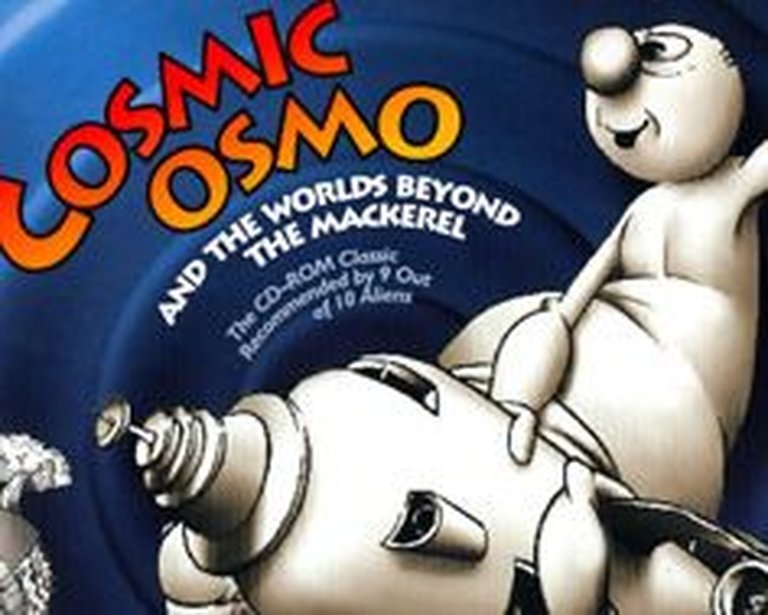
Cosmic Osmo and the Worlds Beyond the Mackerel is a whimsical, open-ended point-and-click adventure game designed for children, created by Cyan (the developers behind Myst). Players explore a vibrant, animated spaceship and traverse various surreal planets, interacting with objects and discovering hidden shortcuts like mouse holes or water drains. The game features no danger or failure states, encouraging freeform exploration and curiosity. Originally developed for Macintosh using HyperCard, it was later ported to Windows, offering a playful, sci-fi-themed journey filled with quirky characters and imaginative environments.
Gameplay Videos
Where to Buy Cosmic Osmo and the Worlds Beyond the Mackerel
PC
Cosmic Osmo and the Worlds Beyond the Mackerel Reviews & Reception
store.steampowered.com (78/100): A game about exploration and discovery, not winning or challenges.
mobygames.com (85/100): An open-ended exploring game where you can click on various elements on screen to trigger events.
medium.com : A sense of wonder I felt when a funky looking spaceship flew across the title screen.
Cosmic Osmo and the Worlds Beyond the Mackerel: A Forgotten Masterpiece of Exploration and Whimsy
Introduction: The Lost Gem of Cyan’s Early Oeuvre
In the pantheon of classic adventure games, few titles are as simultaneously beloved and overlooked as Cosmic Osmo and the Worlds Beyond the Mackerel. Released in 1989 by Cyan, Inc.—the studio that would later revolutionize the genre with Myst—this surreal, open-ended exploration game defies conventional categorization. It is neither a traditional adventure game nor a pure puzzle experience, but rather a digital playground of absurdity, creativity, and boundless curiosity. While Myst and Riven are celebrated for their atmospheric depth and narrative complexity, Cosmic Osmo remains a cult favorite, a game that eschews goals, conflict, and even failure in favor of unstructured discovery.
This review aims to resurrect Cosmic Osmo from the obscurity of gaming history, examining its development, design philosophy, and enduring charm. Through a deep dive into its mechanics, world-building, and cultural impact, we will argue that Cosmic Osmo is not merely a “kids’ game” or a curiosity from Cyan’s early days, but a radical experiment in interactive storytelling—a game that challenges the very notion of what a video game should be.
Development History & Context: The Birth of a Surreal Universe
The Miller Brothers and the HyperCard Revolution
Cosmic Osmo was the brainchild of brothers Rand and Robyn Miller, who founded Cyan, Inc. in 1987. Before Myst catapulted them to fame, the Millers were pioneers in the nascent field of multimedia storytelling, leveraging Apple’s HyperCard—a revolutionary software tool that combined database functionality with a graphical, user-modifiable interface. HyperCard allowed developers to create interactive “stacks” of cards, each containing text, images, and scripts, making it an ideal platform for experimental games.
The Millers’ first major project, The Manhole (1988), was a whimsical, non-linear adventure that invited players to explore a surreal house filled with odd characters and hidden interactions. Cosmic Osmo expanded on this foundation, taking the concept of open-ended exploration to cosmic proportions. The game was initially released in 1989 for the Macintosh, with a floppy disk version offering limited content and no background music. The following year, an enhanced CD-ROM version—titled Cosmic Osmo and the Worlds Beyond the Mackerel—debuted, featuring additional planets, digitized voices, and 18 original music tracks.
Technological Constraints and Innovations
The late 1980s were a period of rapid technological evolution in gaming, but also one of severe limitations. Cosmic Osmo pushed the boundaries of what was possible on the Macintosh platform:
- HyperCard as a Game Engine: The game’s entire structure was built within HyperCard, with animated sequences created using MacroMind VideoWorks (the precursor to Macromedia Director). An XCMD plug-in allowed VideoWorks sprites to be overlaid onto HyperCard’s graphical layer, enabling smooth animations and alpha-masked transparency effects.
- CD-ROM as a Medium: Cosmic Osmo was one of the first games to utilize CD-ROM technology, allowing for high-quality audio and larger asset storage. The CD-ROM version included CD-DA (Compact Disc Digital Audio) tracks, a rarity in games of the era.
- First-Person Perspective: Unlike most adventure games of the time, which used third-person or side-scrolling perspectives, Cosmic Osmo employed a first-person viewpoint, immersing players directly in its bizarre worlds.
The Gaming Landscape of 1989
The late 1980s were dominated by text adventures (e.g., Zork), graphic adventures (e.g., Maniac Mansion), and arcade-style action games. Cosmic Osmo stood apart by rejecting traditional gameplay mechanics:
- No Goals, No Failure: There were no puzzles to solve, no inventory to manage, and no way to “lose.” The game was purely about exploration.
- Non-Linear Design: Players could traverse between planets and microscopic environments at will, with no prescribed path.
- Audience Ambiguity: While often marketed as a “children’s game,” Cosmic Osmo’s humor, references (e.g., the parody band Swabs N’ Roses), and surrealism appealed to all ages.
The game’s lack of conventional structure made it a hard sell in an era where players expected clear objectives. Yet, its uniqueness earned it critical acclaim, including a 1990 MacUser Editors’ Choice Award for “Best Recreational Program.”
Narrative & Thematic Deep Dive: A Universe of Absurdity and Wonder
Plot? What Plot?
Cosmic Osmo defies traditional narrative structures. There is no overarching story, no protagonist with a mission, and no climax. Instead, the game presents itself as a cosmic travelogue, where the player assumes the role of an “Osmo”—a bizarre, amorphous creature—exploring a series of surreal planets.
The game begins with the player boarding a sentient spaceship, which serves as the hub for interplanetary travel. From there, they can visit seven distinct worlds, each with its own theme, inhabitants, and secrets:
- Osmo’s Planet: A microscopic world where the player can interact with a lazy Osmo, a talking dog, and a mouse that scurries through the environment.
- The Mackerel: A planet shaped like a giant fish, filled with aquatic oddities.
- The Clockwork Planet: A mechanical world with gears, cogs, and a ticking clock.
- The Jungle Planet: A lush, overgrown environment with hidden pathways.
- The Ice Planet: A frozen wasteland with slippery surfaces and icy caves.
- The Desert Planet: A barren landscape with hidden oases and underground tunnels.
- The Space Station: A futuristic outpost with alien technology.
Each planet is interconnected through shortcuts—tiny portals like mouse holes, water drains, or even the inside of a teapot—that allow for seamless transitions between macroscopic and microscopic scales.
Characters: The Inhabitants of the Cosmic Zoo
The game’s cast is a menagerie of eccentric, often nonsensical characters:
- Osmo: The titular creature, a sluggish, blob-like being who lounges around his planet, occasionally offering cryptic remarks.
- The Talking Dog: A jovial, anthropomorphic canine who enjoys belly rubs and bones.
- The Mouse: A tiny, fast-moving rodent that appears in various environments, often leading to hidden areas.
- The Clockwork Inhabitants: Mechanical beings that tinker with gears and machinery.
- The Space Station Aliens: Strange, otherworldly entities that communicate in beeps and boops.
What makes these characters compelling is their lack of utility. They do not provide quests, hints, or rewards. They exist purely for the player’s amusement, reinforcing the game’s philosophy of exploration for exploration’s sake.
Themes: Play, Curiosity, and the Joy of Discovery
Cosmic Osmo is a manifesto on the philosophy of play. Its themes include:
- The Beauty of the Unstructured: The game rejects the notion that interactive media must have objectives. It is a digital sandbox, where the only “goal” is to satisfy one’s curiosity.
- Scale and Perspective: The game’s ability to shift between macroscopic and microscopic views encourages players to see the world from multiple angles—a metaphor for intellectual curiosity.
- Humor and Whimsy: The game is filled with absurdist humor, from the Swabs N’ Roses album to the talking dog’s antics. It never takes itself seriously, inviting players to laugh at its oddities.
- Inclusivity: While often labeled a “children’s game,” Cosmic Osmo’s lack of reading requirements, simple controls, and universal themes make it accessible to all ages.
Dialogue and Sound: A Symphony of the Bizarre
The game’s digitized voice acting (a novelty in 1989) and original soundtrack (composed by Robyn Miller and Shep Lovick) are integral to its charm:
- Voice Characterization: Rand Miller provided the voices for most characters, imbuing them with a goofy, exaggerated tone that enhances the game’s surrealism.
- Music: The CD-ROM version’s soundtrack features jazz-infused tunes, with prominent saxophone performances by Kyle Stroud. The music shifts dynamically as the player explores, reinforcing the game’s dreamlike atmosphere.
Gameplay Mechanics & Systems: The Art of Doing Nothing
Core Gameplay Loop: Click, Explore, Repeat
Cosmic Osmo’s gameplay is deceptively simple:
- Point-and-Click Navigation: Players move by clicking on doors, edges of the screen, or interactive objects.
- Interactive Hotspots: Clicking on objects triggers animations, sound effects, or transitions to new areas.
- Planetary Travel: The spaceship serves as a hub, allowing players to jump between planets at will.
- Shortcuts: Hidden pathways (e.g., mouse holes, drains) enable non-linear exploration.
The Absence of Mechanics
What is most striking about Cosmic Osmo is what it lacks:
- No Inventory: Players cannot collect or use items.
- No Puzzles: There are no obstacles to overcome.
- No Failure States: The player cannot die, get stuck, or lose.
- No Score or Progress Tracking: The game provides no feedback on completion.
This minimalist design was radical in 1989 and remains so today. By stripping away traditional gameplay elements, Cosmic Osmo forces players to engage with the game on its own terms—to explore for the sake of exploration.
UI and Navigation: Intuitive but Limited
The game’s user interface is sparse:
- First-Person Perspective: The player sees the world through the Osmo’s eyes, with no on-screen HUD.
- Mouse-Driven Interaction: The cursor changes when hovering over interactive objects.
- No Map or Journal: Players must rely on memory to navigate.
While this simplicity enhances immersion, it can also lead to disorientation, especially in the game’s more labyrinthine areas.
Innovations and Flaws
Innovations:
– Non-Linear Exploration: The game’s interconnected worlds and shortcuts were ahead of their time.
– CD-ROM Utilization: The enhanced audio and music set a new standard for multimedia games.
– Accessibility: The lack of text and simple controls made it accessible to young children.
Flaws:
– Limited Feedback: The game provides no indication of progress, which can frustrate players accustomed to structured goals.
– Repetitive Interactions: Some animations and sound effects repeat frequently, leading to monotony.
– Technical Limitations: The floppy disk version’s lack of music and fewer planets made it a lesser experience.
World-Building, Art & Sound: A Surrealist’s Dream
Visual Design: Black-and-White Whimsy
Cosmic Osmo’s monochromatic aesthetic was a product of its time (Macintosh computers of the era had limited color capabilities), but it also contributed to the game’s timeless, storybook quality:
- Hand-Drawn Illustrations: Robyn Miller’s artwork has a sketch-like, cartoonish style, reminiscent of Dr. Seuss or Monty Python animations.
- Exaggerated Proportions: Characters and objects are often distorted for comedic effect, such as the oversized teapot or the tiny mouse.
- Detailed Environments: Each planet has a distinct visual identity, from the geometric precision of the Clockwork Planet to the organic chaos of the Jungle Planet.
Atmosphere: A Playground of the Absurd
The game’s atmosphere is one of unbridled creativity. It feels like stepping into a living cartoon, where the laws of physics and logic are bent to serve the game’s whimsical tone. The shift in scale—from planetary vistas to microscopic nooks—reinforces this sense of wonder.
Sound Design: Aural Whimsy
The game’s sound design is a masterclass in minimalist immersion:
- Digitized Voices: The characters’ voices are deliberately exaggerated, adding to the game’s comedic tone.
- Ambient Sounds: Each planet has unique sound effects, from the ticking of gears on the Clockwork Planet to the howling wind on the Ice Planet.
- Music: The jazz-infused soundtrack is playful and dynamic, shifting to match the player’s location.
Reception & Legacy: From Obscurity to Cult Classic
Critical Reception: A Game Ahead of Its Time
Cosmic Osmo received positive but niche acclaim upon release:
- All Game Guide (1998): Praised its surreal exploration and lack of constraints, calling it “Myst for kids stuck in a blender.”
- Techtite (1999): Highlighted its unique sci-fi theme and expansive worlds, noting its appeal to both children and adults.
- MacUser (1990): Awarded it the Editors’ Choice Award for “Best Recreational Program.”
However, its lack of traditional gameplay made it a polarizing experience. Some critics dismissed it as “too simple” or “lacking depth,” failing to recognize its philosophical boldness.
Commercial Performance: A Niche Success
Cosmic Osmo was never a blockbuster, but it found a dedicated audience among Macintosh users and educators. Its CD-ROM version was particularly notable for showcasing the potential of multimedia gaming.
Legacy: The DNA of Cyan’s Later Works
While Cosmic Osmo is often overshadowed by Myst, its influence on Cyan’s later games is undeniable:
- Exploration as a Core Mechanic: Myst and Riven inherited Cosmic Osmo’s emphasis on unstructured discovery.
- First-Person Perspective: The Millers’ preference for immersive viewpoints began with Cosmic Osmo.
- Surreal World-Building: The absurdity of Cosmic Osmo’s planets foreshadowed the dreamlike Ages of Myst.
Cultural Impact: A Game for Dreamers
Cosmic Osmo has left an indelible mark on players who experienced it in childhood. Many recall it as a gateway to imaginative play, a game that encouraged them to see the world differently. Its lack of rules made it a digital equivalent of a blank canvas, inviting players to project their own stories onto its worlds.
Modern Reappraisal: A Game Worth Preserving
In recent years, Cosmic Osmo has seen a resurgence of interest, thanks to:
- Steam Re-release (2010): The game became available on Steam as part of the Cyan Complete Pack, introducing it to a new generation.
- Nostalgia and Retro Gaming: Players who grew up with the game have advocated for its preservation, citing its unique place in gaming history.
- Educational Value: The game’s open-ended design has made it a subject of study in game design courses, particularly those focused on non-linear storytelling.
Conclusion: A Masterpiece of Unstructured Joy
Cosmic Osmo and the Worlds Beyond the Mackerel is a game out of time. Released in an era dominated by goal-oriented design, it dared to be something else entirely—a digital playground where the only rule is to explore, laugh, and wonder.
Its lack of conventional mechanics is not a flaw but a philosophical statement: a game does not need conflict, progression, or even a narrative to be meaningful. Cosmic Osmo is a celebration of curiosity, a testament to the idea that interactive media can be art—not just in its aesthetics, but in its very structure.
Final Verdict: A 10/10 for the Adventurous Soul
Rating: ★★★★★ (5/5) – A Timeless Oddity
Cosmic Osmo is not for everyone. Players who crave structure, challenge, or narrative will find it frustratingly empty. But for those willing to embrace its surrealism, it is a masterpiece of interactive whimsy—a game that rewards not skill, but imagination.
In the grand tapestry of video game history, Cosmic Osmo stands as a bold experiment, a reminder that games can be more than just challenges to overcome. It is a love letter to exploration, a digital dreamworld that invites players to lose themselves in its absurdity.
For these reasons, Cosmic Osmo and the Worlds Beyond the Mackerel is not just a forgotten relic—it is a vital piece of gaming’s artistic evolution, a game that dares to ask: What if a game’s only purpose is to make you smile?
Play it. Get lost in it. And remember what it feels like to explore without a map.