
- Release Year: 2012
- Platforms: Android, Browser, iPad, iPhone, Kindle Classic, Linux, Macintosh, Windows
- Publisher: Choice of Games LLC
- Developer: Choice of Games LLC
- Genre: Adventure, Role-playing (RPG)
- Perspective: 1st-person
- Game Mode: Single-player
- Gameplay: Interactive fiction, Text adventure
- Setting: Chinese
Description
Choice of Kung Fu is an interactive text-based RPG-adventure set in the Middle Kingdom, where players embark on a lifelong martial arts journey as a novice monk in the Order of the Peach Tree. Beginning with training under Abbot Bao and Master Shen, the game follows the protagonist’s rise through the ranks, facing challenges like bandit raids, rival students, and cultural clashes with foreign invaders. Along the way, players can master combat, magic, or esoteric arts, establish their own school, and ultimately vie for the honor of questioning the legendary Dragon Sage atop Xiaxue Mountain. The game blends martial arts lore, strategic decision-making, and narrative depth in a richly detailed Chinese setting.
Where to Buy Choice of Kung Fu
PC
Choice of Kung Fu Mods
Choice of Kung Fu Guides & Walkthroughs
Choice of Kung Fu Cheats & Codes
Choice Of Kung Fu (All Platforms)
Redeem codes in the game’s redemption section.
| Code | Effect |
|---|---|
| Vd4BFFMWRnGW | Redeemable rewards (effect varies) |
| eAu4tRkE2yvY | Redeemable rewards (effect varies) |
| 9oynPVQjaux2 | Redeemable rewards (effect varies) |
| ejCNWyy2KOfS | Redeemable rewards (effect varies) |
| YJBGeYaGcq4j | Redeemable rewards (effect varies) |
| eIiRlL707EB6 | Redeemable rewards (effect varies) |
| aDgq76MQmbJw | Redeemable rewards (effect varies) |
| WpR4qi797ahX | Redeemable rewards (effect varies) |
Choice of Kung Fu: A Masterful Blend of Martial Arts and Interactive Fiction
Introduction: The Path of the Digital Warrior
Choice of Kung Fu (2012) is not just a game—it is a meditation on discipline, honor, and the philosophical underpinnings of martial arts, wrapped in the elegant simplicity of interactive fiction. Developed by Choice of Games LLC, this text-based RPG transcends the limitations of its medium, offering players a deeply personal journey through the wuxia (martial hero) tradition of Chinese literature and folklore. Unlike the flashy, button-mashing kung fu games of the past, Choice of Kung Fu strips away the visual spectacle to focus on what truly matters: choice, consequence, and the evolution of a warrior’s spirit.
At its core, the game is a Bildungsroman—a coming-of-age story where the player’s decisions shape not just their character’s combat prowess, but their moral compass, relationships, and ultimate legacy. From the humble beginnings as a novice monk in the Order of the Peach Tree to the climactic confrontation with foreign invaders and the mystical encounter with the Dragon Sage, every decision resonates with weight. This is not a game about mindless combat; it is about the why behind the fight.
In an era dominated by open-world RPGs and cinematic action games, Choice of Kung Fu stands as a quiet revolution—a testament to the power of narrative-driven gameplay. It proves that immersion does not require cutting-edge graphics, but rather a masterfully crafted world where every word matters. This review will dissect the game’s development, narrative depth, mechanical innovations, and lasting impact, arguing that it is not only one of the finest interactive fiction titles ever made but also a vital bridge between Eastern martial arts philosophy and Western gaming traditions.
Development History & Context: The Rise of ChoiceScript and the Interactive Fiction Renaissance
The Studio Behind the Scroll: Choice of Games LLC
Choice of Games LLC, founded in 2009 by Dan Fabulich and Adam Strong-Morse, emerged during a pivotal moment in gaming history. The late 2000s and early 2010s saw a resurgence of interactive fiction, fueled by the accessibility of digital distribution and the growing appetite for narrative-driven experiences. Unlike traditional game studios, Choice of Games specialized in ChoiceScript—a proprietary engine designed to streamline the creation of branching-narrative games.
The studio’s mission was clear: to democratize game development by allowing writers—regardless of programming expertise—to craft deep, choice-driven stories. Choice of Kung Fu was one of their earliest and most ambitious projects, penned by Alana Joli Abbott, a writer with a background in fantasy and martial arts lore. Her collaboration with artist Sandy Jacobs-Tolle (who provided the game’s minimalist yet evocative cover art) and Fabulich (who refined the ChoiceScript language) resulted in a game that felt both authentic and innovative.
Technological Constraints and Creative Freedom
At the time of its release, Choice of Kung Fu was constrained by the limitations of mobile and browser-based platforms. Unlike AAA titles with sprawling 3D environments, the game relied entirely on text, requiring players to engage with their imagination. This was not a weakness, but a strength—ChoiceScript’s efficiency allowed for an astonishing depth of branching paths without the need for massive development budgets.
The engine’s simplicity also meant that Choice of Kung Fu could be ported across nearly every platform imaginable: iOS, Android, Kindle, Mac, Windows, Linux, and even web browsers. This cross-platform accessibility ensured that the game reached a wide audience, from hardcore RPG fans to casual readers seeking a literary experience.
The Gaming Landscape in 2012: A Shift Toward Narrative
The early 2010s were a transformative period for gaming. Indie developers were pushing boundaries with titles like The Walking Dead (Telltale, 2012) and Faster Than Light (2012), proving that storytelling and player agency could rival (and sometimes surpass) the spectacle of big-budget games. Meanwhile, mobile gaming was exploding, with Choice of Kung Fu arriving just as smartphones became viable platforms for deep, narrative-driven experiences.
In this context, Choice of Kung Fu was both a product of its time and a quiet rebel. It rejected the trend of “gamifying” everything in favor of a pure, unadulterated focus on choice and consequence. While other games used quick-time events or dialogue wheels to simulate agency, Choice of Kung Fu trusted its players to read, reflect, and decide—making it a spiritual successor to classic text adventures like Zork while carving out its own identity in the modern era.
Narrative & Thematic Deep Dive: The Soul of the Warrior
Plot Overview: A Journey from Novice to Legend
Choice of Kung Fu unfolds like a classical wuxia novel, blending historical drama, martial arts philosophy, and supernatural intrigue. The game’s structure is divided into distinct acts, each representing a phase in the protagonist’s life:
- The Novice Years (Monastery Life) – The player begins as a young monk under the tutelage of Abbot Bao and Master Shen at the Order of the Peach Tree. Early choices determine the protagonist’s foundational skills (e.g., brute strength vs. strategic cunning) and relationships (e.g., rivalry or camaraderie with fellow student Lu Jin).
- The Mission (Proving Oneself) – Sent to deal with the Blue Turban bandits, the player confronts the harsh realities of a kingdom in decline, where foreign occupiers exploit the land and the Emperor remains indifferent.
- Advanced Training (The Veiled Dragon’s Wisdom) – Under the enigmatic Master Miao Zhuge, the player refines their abilities, delving into magic, poetry, or esoteric martial techniques.
- Establishing a School (Legacy and Love) – In the provincial capital of Kuei Xian, the player founds their own school, faces challenges from rival warriors (like the youxia Sun An), and may pursue romance with characters like the fox spirit Feng.
- The Imperial Clash (Cultural Warfare) – The climax pits the player against George Gower’s foreign champions in a battle that is as much about ideology as it is about combat.
- The Dragon Sage’s Trial (Transcendence) – The final act determines whether the player is worthy to ascend Xiaxue Mountain and pose a question to the mythical Dragon Sage—a moment that encapsulates the game’s central theme: What does it mean to be a true master?
Themes: Honor, Colonialism, and the Burden of Mastery
Choice of Kung Fu is far more than a power fantasy—it is a philosophical exploration of martial arts as a way of life. Several key themes permeate the narrative:
- The Conflict Between Tradition and Modernity – The game’s antagonists are not just bandits or rival warriors, but foreign powers (embodied by George Gower) who represent cultural imperialism. The player’s struggle is not merely physical but ideological: Should the Middle Kingdom adapt to foreign ways, or resist at all costs?
- The Duality of Strength – The game constantly challenges the player to define what “strength” means. Is it raw power, strategic brilliance, or moral integrity? The path of the warrior is not linear; it demands balance.
- The Price of Mastery – Every major decision carries long-term consequences. Choosing to prioritize combat over diplomacy may win battles but lose allies. Pursuing romance might distract from training, yet it also humanizes the protagonist.
- The Illusion of Control – Despite the player’s agency, the game subtly reinforces the idea that some forces (fate, politics, the Emperor’s inaction) are beyond individual control. This mirrors the wuxia trope of the lone hero struggling against an indifferent world.
Characters: Archetypes with Depth
The cast of Choice of Kung Fu draws from classical Chinese literature, yet each character feels distinct and dynamic:
- Abbot Bao & Master Shen – The dual mentors represent the yin and yang of martial philosophy. Bao is the stern, traditionalist guide, while Shen is the more pragmatic (and occasionally mysterious) teacher who pushes the player toward greater challenges.
- Lu Jin – The rival student whose relationship with the protagonist can range from bitter enmity to reluctant respect. Their dynamic evolves based on early choices, making them one of the game’s most compelling figures.
- Feng (the Huli Jing) – A seven-tailed fox spirit who serves as both ally and potential love interest. Feng’s trickster nature adds levity and complexity, embodying the game’s blend of mythology and humanity.
- Sun An (the Youxia) – A wandering swordsman who challenges the player not out of malice, but to test their worth. His duel is one of the game’s most tense and thematically rich moments.
- George Gower – The Western diplomat whose champions represent a brutal, honorless form of combat. His presence forces the player to confront the cultural clash at the heart of the narrative.
Dialogue and Player Agency: The Power of Words
The writing in Choice of Kung Fu is sharp, evocative, and deeply aware of its literary roots. Abbott’s prose strikes a balance between lyrical descriptions (e.g., the mist-shrouded Xiaxue Mountain) and concise, impactful dialogue. The game’s choices are not merely binary “good vs. evil” options but nuanced decisions that reflect different philosophies:
- Combat vs. Diplomacy – Should you crush the Blue Turban bandits, or seek to understand their grievances?
- Tradition vs. Innovation – Do you adhere strictly to the Order’s teachings, or incorporate unconventional methods?
- Personal vs. Collective – Will you prioritize your own enlightenment, or dedicate yourself to protecting the kingdom?
The brilliance of the narrative lies in its reactivity. Unlike many RPGs where choices feel superficial, Choice of Kung Fu ensures that early decisions ripple across the entire story. A player who prioritizes poetry over combat will have entirely different dialogue options (and challenges) than a brute-force warrior.
Gameplay Mechanics & Systems: The Art of Choice
Core Gameplay Loop: A Life in Decisions
Choice of Kung Fu is, at its heart, a game about consequences. The gameplay can be broken down into three interconnected systems:
- Skill Development – Players allocate points into attributes like Strength, Speed, Wisdom, and Charisma, which unlock new dialogue options and combat techniques. The game subtly encourages specialization—jack-of-all-trades builds are possible but often less effective in critical moments.
- Branching Narrative – The story features dozens of major decision points, from choosing a weapon (sword, staff, fists) to deciding whether to spare or execute a defeated foe. Some paths are irreversible, adding tension to every choice.
- Combat & Strategy – Battles are resolved through text-based descriptions, with outcomes determined by stats and prior decisions. The lack of real-time input might disappoint action fans, but the tactical depth (e.g., exploiting an enemy’s weakness) keeps engagements engaging.
Character Progression: The Path to Mastery
Progression in Choice of Kung Fu is not about leveling up in a traditional sense, but about evolving as a person. Key milestones include:
- Graduating from the Monastery – Early choices determine whether the player is seen as a prodigy or a troublemaker.
- Mastering a Discipline – Players can focus on pure martial arts, magical techniques (qinggong, elemental attacks), or even non-combat skills like calligraphy and poetry.
- Founding a School – This mid-game phase tests the player’s leadership, as they must balance teaching, politics, and personal growth.
- The Imperial Tournament – The game’s climax is a gauntlet of fights where strategy matters more than brute force. A player who has neglected Wisdom may struggle against cunning opponents.
UI and Accessibility: Simplicity as a Virtue
The game’s interface is minimalist by design—a necessity for a text-based adventure, but also a strength. The ChoiceScript engine presents decisions clearly, with stats displayed unobtrusively. The lack of visuals means the game is accessible to players with visual impairments (via screen readers), and its lightweight design ensures smooth performance on even the most basic devices.
However, the absence of a map or journal system can be a minor frustration. Players must rely on memory to track relationships and past decisions, which, while immersive, may alienate those accustomed to more hand-holding in modern RPGs.
Innovations and Flaws
Innovations:
– True Branching Narrative – Unlike many “choice-based” games where decisions converge onto the same path, Choice of Kung Fu features multiple distinct endings, each reflecting the player’s journey.
– Moral Ambiguity – The game resists simplistic morality systems. “Good” choices can lead to weakness, while “ruthless” choices may be necessary for survival.
– Cultural Authenticity – The integration of wuxia tropes, Chinese mythology, and historical parallels (e.g., foreign occupation) gives the game a depth rarely seen in Western martial arts media.
Flaws:
– Limited Replay Incentives – While the branching paths encourage multiple playthroughs, the lack of visual or mechanical variety can make subsequent runs feel repetitive.
– Stat Opaqueness – Some players may find the attribute system unclear, as the impact of certain stats (e.g., Charisma vs. Wisdom) is not always intuitive.
– Pacing Issues – The early game is slow, with much of the first act dedicated to monastery life. While this builds atmosphere, it may test the patience of action-oriented players.
World-Building, Art & Sound: Painting with Words
Setting: A Living, Breathing Middle Kingdom
Choice of Kung Fu’s world is a masterclass in show, don’t tell. Through sparse but vivid descriptions, the game conjures:
- The Order of the Peach Tree Monastery – A place of discipline and serenity, where the scent of incense mingles with the sound of wooden practice swords.
- Kuei Xian – A bustling provincial capital where merchants, scholars, and warriors intersect, and where the player’s school becomes a beacon of hope or a target for rivals.
- Xiaxue Mountain – The mythical peak where the Dragon Sage awaits, described in almost dreamlike terms, reinforcing the game’s spiritual themes.
The world feels alive not because of detailed graphics, but because of the way it reacts to the player. NPCs remember past interactions, locations change based on decisions, and the political landscape shifts as the foreign threat grows.
Art Direction: The Power of Suggestion
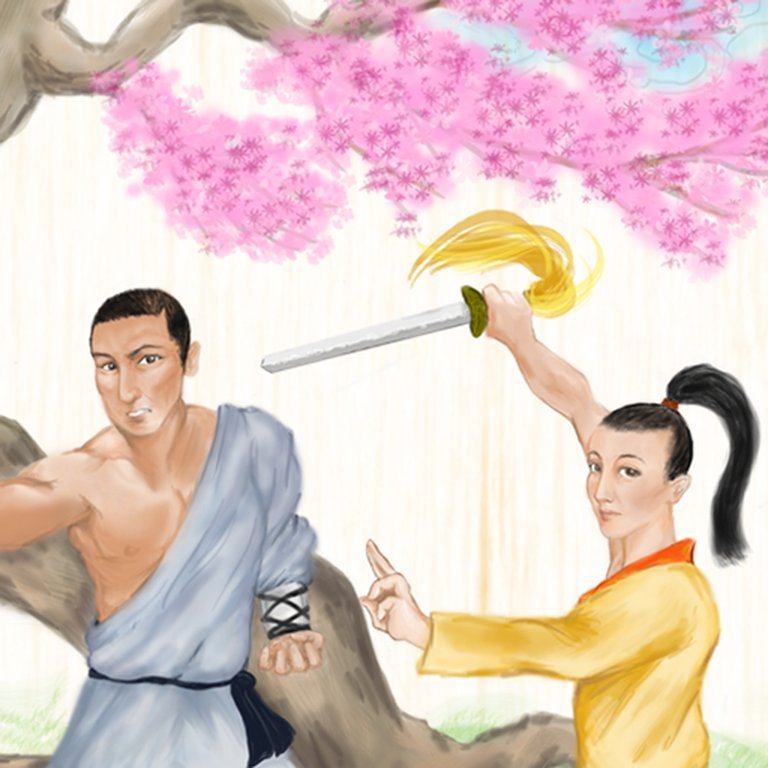
With no in-game visuals beyond the cover art, Choice of Kung Fu relies on the player’s imagination—a bold creative choice. Sandy Jacobs-Tolle’s cover illustration (depicting a warrior in mid-strike, surrounded by mist and cherry blossoms) sets the tone perfectly, evoking both the grace and ferocity of wuxia aesthetics.
This minimalist approach has a dual effect:
– Pros – It universalizes the experience, allowing each player to envision the world in their own way. It also keeps the focus squarely on the narrative.
– Cons – Players who crave visual feedback may find the experience lacking in immediacy.
Sound Design: The Silence of the Sword
Like its visuals, Choice of Kung Fu’s audio is nonexistent—a deliberate omission that reinforces its identity as a reading experience. However, the absence of sound is not a flaw; it is a testament to the game’s confidence in its writing. The “soundtrack” is the rhythm of the prose, the cadence of combat descriptions, and the weight of silence between choices.
Reception & Legacy: The Quiet Revolution of Interactive Fiction
Critical and Commercial Reception
Upon release, Choice of Kung Fu received modest attention, overshadowed by more visually flashy titles. However, within the interactive fiction community, it was praised for its depth and authenticity. On MobyGames, it holds a respectable 3.8/5 player score, with many highlighting its strong narrative and replay value.
Critics (where they existed) noted:
– Strengths – The game’s commitment to wuxia themes, its meaningful choices, and its respect for martial arts philosophy.
– Weaknesses – The slow start and lack of visual/audio polish limited its appeal to a niche audience.
Commercially, the game found its audience primarily on mobile platforms, where the “choice-based” genre was gaining traction. Its $4.99 price point (a premium for mobile at the time) reflected its quality, and its cross-platform availability ensured steady sales.
Evolution of Reputation: A Cult Classic
Over time, Choice of Kung Fu has gained a cult following among fans of interactive fiction and martial arts narratives. It is frequently cited in discussions about:
– The potential of text-based RPGs – Proving that deep storytelling can thrive without AAA budgets.
– Cultural representation in games – One of the few Western-developed games to engage seriously with Chinese martial arts philosophy.
– The legacy of ChoiceScript – Demonstrating how a simple engine can produce complex, emotionally resonant experiences.
Influence on Later Games
While Choice of Kung Fu did not spawn direct sequels, its DNA can be seen in later titles:
– Choice of Games’ later works – Titles like Choice of Robots and The Hero Unmasked refined the studio’s approach to branching narratives.
– Indie RPGs with deep choice systems – Games like Disco Elysium (2019) and Pentiment (2022) owe a debt to Choice of Kung Fu’s emphasis on player-driven storytelling.
– Martial arts games with narrative depth – Modern titles like Sifu (2022) and Ghost of Tsushima (2020) have embraced wuxia themes, though none have matched Choice of Kung Fu’s philosophical depth.
Conclusion: The Dragon Sage’s Verdict
Choice of Kung Fu is a game that defies easy categorization. It is at once a love letter to wuxia literature, a meditation on the meaning of mastery, and a pioneering work in interactive fiction. Its greatest strength—and occasional weakness—is its uncompromising focus on choice as both a mechanical and thematic core.
Final Verdict: A Masterpiece of Its Medium
Score: 9/10 (Exceptional, with minor flaws)
Why It Excels:
✅ Unparalleled narrative depth – Few games offer such a rich, reactive story where every decision feels meaningful.
✅ Authentic martial arts philosophy – It respects its source material without exoticizing or simplifying it.
✅ True player agency – The branching paths are not illusory; they fundamentally alter the experience.
✅ Accessible yet profound – Easy to pick up, but rewards deep engagement with its themes.
Where It Stumbles:
❌ Slow pacing in early acts – The monastery phase may test the patience of action-oriented players.
❌ Lack of visual/audio feedback – The text-only approach, while bold, limits its appeal.
❌ Some opaque mechanics – Stat interactions could be better explained.
Legacy: A Game That Asks the Right Questions
In the end, Choice of Kung Fu is not just about becoming the greatest warrior—it is about what you do with that power. Do you seek vengeance or justice? Do you cling to tradition or embrace change? Do you fight for glory, for your people, or for something greater?
The game’s final moment—the ascent to the Dragon Sage—is its most brilliant stroke. After decades of training, battles, and hard choices, the player is asked: What will you ask the sage? There is no “correct” question, just as there is no single path to mastery. Some players may ask for power, others for wisdom, and others for peace. The answer doesn’t matter. What matters is that the game forces you to think—and in an industry often obsessed with spectacle over substance, that is a rare and precious gift.
Choice of Kung Fu is not just a game. It is a journey. And like all great journeys, its true value lies not in the destination, but in the path you choose to walk.
Final Recommendation: Essential playing for fans of interactive fiction, martial arts lore, or narrative-driven RPGs. A landmark title that proves great storytelling needs no pixels—only purpose.