
- Release Year: 1999
- Platforms: Windows
- Publisher: Expert Software, Inc.
- Genre: Compilation
- Game Mode: Single-player
- Average Score: 93/100
Description
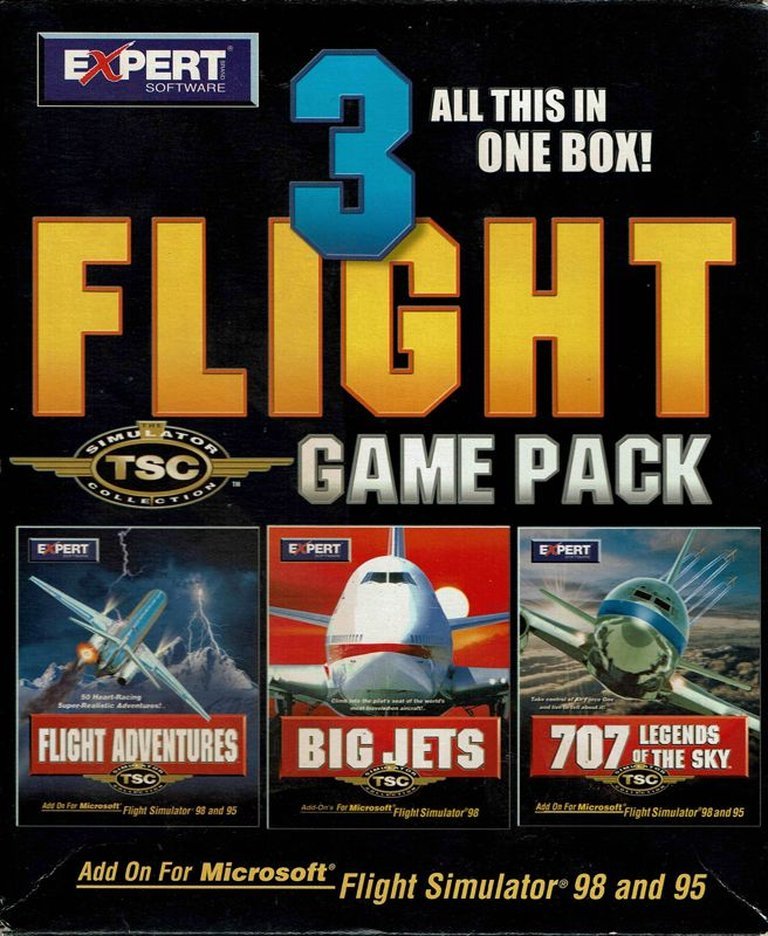
The 3 Flight Game Pack is a 1999 commercial compilation for Windows that bundles three add-ons for Microsoft Flight Simulator 95 and 98: ‘707: Legends of the Sky’, ‘Big Jets: The Simulator Collection’, and ‘Flight Adventures: The Simulator Collection’, offering enhanced flight simulation experiences.
3 Flight Game Pack Cracks & Fixes
3 Flight Game Pack Reviews & Reception
metacritic.com (93/100): Deported to a harsh desert world, exiles have struggled for three thousand years to regain the stars. Now it’s up to you to guide them home through a brutal empire bent on annihilation.
gamearchives.net : This pack isn’t just a budget relic—it’s a time capsule of PC flight simulation’s golden era, preserving mechanical depth and historical fidelity that modern sims often gloss over in favor of accessibility.
3 Flight Game Pack: Review
Introduction
In the twilight of the 20th century, as the gaming industry hurtled toward the next millennium with flashy 3D graphics and cinematic storytelling, a humble compilation quietly slipped onto store shelves. 3 Flight Game Pack, released in 1999 by Expert Software, Inc., offered PC enthusiasts a trio of Microsoft Flight Simulator expansions bundled onto a single CD-ROM. At first glance, it might seem like just another budget title lost in the shuffle of 1999’s gaming deluge—a year that gave us System Shock 2, Planescape: Torment, and Unreal Tournament. Yet, this unassuming collection represents something more profound: a preservation of flight simulation’s golden age at a pivotal technological crossroads. As we examine this compilation, we’ll discover how it encapsulates both the enduring appeal of flight simulation and the transitional period when PC gaming was about to undergo seismic changes.
Development History & Context
The story of 3 Flight Game Pack begins not with its own development, but with the legacy of Microsoft Flight Simulator itself. By 1999, Flight Simulator had evolved from Bruce Artwick’s pioneering 1979 Apple II wireframe biplane into a sophisticated platform that could model the entire planet in 1-kilometer blocks. The franchise had weathered corporate changes, technological revolutions, and shifting player expectations, yet remained the definitive flight simulation experience for PC gamers.
Expert Software, Inc. positioned itself as a purveyor of budget software compilations, targeting value-conscious consumers who wanted quality content without premium prices. The 1990s saw an explosion of such compilations—collections of older games, demos, or expansions repackaged for mass-market appeal. These often appeared in big-box retailers alongside chart-topping titles, offering accessible entry points to gaming genres that might otherwise seem intimidating.
The three expansions included in this pack—707: Legends of the Sky, Big Jets: The Simulator Collection, and Flight Adventures: The Simulator Collection—represented different facets of the flight simulation hobby. They catered to enthusiasts who craved specific aircraft types, scenarios, or challenges beyond what the base Flight Simulator packages offered. By bundling them together, Expert Software created an attractive value proposition: three specialized experiences for the price of one, all compatible with Microsoft Flight Simulator for Windows 95 and 98.
The timing was significant. 1999 marked the peak of PC gaming’s dominance before the console revolution of the early 2000s. Flight simulation, with its demanding hardware requirements and steep learning curve, was quintessentially PC-centric. This compilation arrived just as broadband internet was beginning to transform how gamers accessed content, making physical compilations like this one increasingly obsolete. It stands as a snapshot of an era when gaming knowledge was shared through magazines, demo discs, and retail shelves rather than online forums and digital distribution.
Narrative & Thematic Deep Dive
Unlike narrative-driven games that emerged in the late 1990s, flight simulation expansions don’t tell stories in the traditional sense. There are no cutscenes, no character arcs, no dramatic plot twists. Instead, 3 Flight Game Pack offers what might be called “experiential narratives”—stories that players create through their own actions and decisions within the simulation.
707: Legends of the Sky taps into the mythology of commercial aviation’s golden age. The Boeing 707, introduced in 1958, revolutionized air travel and became an icon of mid-20th century progress. Flying this aircraft in the simulation connects players to a narrative of technological optimism, global connectivity, and the romance of jet travel before it became mundane. Each flight becomes a chapter in the ongoing story of human mastery over distance and time.
Big Jets: The Simulator Collection expands this narrative scope to encompass the evolution of commercial aviation. From early jetliners to modern wide-body aircraft, this collection tells the story of how air travel transformed from an elite luxury to a mass transportation system. The thematic undercurrent explores humanity’s relationship with technology—how we’ve learned to trust our lives to machines that weigh hundreds of tons and travel at hundreds of miles per hour.
Flight Adventures: The Simulator Collection takes a different approach, focusing on the diversity of aviation experiences. This expansion might include everything from bush flying in remote wilderness to aerobatic performances, military training missions to historical recreations. The thematic thread here is the versatility of flight itself—how the same basic principles of aerodynamics can enable such wildly different experiences, from serene sightseeing to intense combat.
What emerges from these three components is a meditation on human ambition and ingenuity. Flight simulation, at its core, is about mastering complex systems and pushing the boundaries of what’s possible. The narratives aren’t scripted—they’re lived through each takeoff, each navigation challenge, each successful landing. In an era when many games were moving toward increasingly linear storytelling, 3 Flight Game Pack offered something more open-ended: the freedom to create your own stories within a meticulously crafted virtual world.
Gameplay Mechanics & Systems
The gameplay experience of 3 Flight Game Pack is fundamentally tied to the Microsoft Flight Simulator engine that powers it. This means players interact with a sophisticated flight model that simulates aerodynamics, weather effects, aircraft systems, and navigation with remarkable accuracy for its time.
The core gameplay loop follows a familiar pattern: pre-flight planning, aircraft preparation, takeoff, navigation, and landing. Each expansion adds new aircraft and scenarios that modify this loop in interesting ways. 707: Legends of the Sky introduces the challenges of managing large jetliners—complex systems management, long-distance navigation, and the intricacies of commercial flight operations. Players must master not just flying the aircraft but managing fuel, communicating with air traffic control, and adhering to flight plans.
Big Jets: The Simulator Collection likely expands the roster of commercial aircraft, each with unique flight characteristics and operational requirements. This creates a gameplay dynamic where players must adapt their skills to different aircraft types—learning the nuances of each model, from takeoff performance to landing speeds to system layouts. The collection might also introduce new airport environments, particularly those designed for larger aircraft, adding spatial awareness challenges to the mix.
Flight Adventures: The Simulator Collection probably offers the most varied gameplay experience. This could include short takeoff and landing (STOL) aircraft for bush flying, aerobatic planes for precision maneuvers, or specialized aircraft for specific missions. The gameplay here emphasizes adaptability and skill mastery across different flight regimes, from low and slow to high and fast, from calm conditions to challenging weather.
The simulation’s systems add layers of complexity and realism. Weather simulation affects aircraft performance and visibility. Navigation requires understanding VORs, NDBs, and eventually GPS systems. Aircraft systems—from engine management to electrical systems to hydraulic failures—must be monitored and maintained. These mechanics create a gameplay experience that rewards patience, attention to detail, and continuous learning.
However, the compilation’s strength is also its limitation. All three expansions share the same core interface and control scheme, which can be daunting for newcomers. The learning curve is steep, requiring players to invest significant time in understanding the simulation’s systems before they can fully enjoy the content. This reflects the era’s design philosophy, where depth and realism were prioritized over accessibility—a philosophy that would gradually shift in the following decade.
World-Building, Art & Sound
The world of 3 Flight Game Pack is fundamentally the world of Microsoft Flight Simulator—a virtual Earth rendered with satellite imagery and detailed terrain data. This creates an unprecedented sense of place and scale. Players can fly over their own neighborhoods, explore distant cities, or recreate famous flights. The world-building here is geographic and architectural rather than narrative—it’s about creating a believable, explorable planet.
Visual presentation in 1999 was impressive for its ambition, if not its polish by modern standards. Terrain textures, while limited by technology, provided enough detail to recognize landmarks and geographic features. Airports were modeled with appropriate precision, including runways, taxiways, and terminal buildings. The aircraft models, particularly for the specialized jets in these expansions, featured accurate liveries and functional cockpits with working instruments.
The art direction emphasizes authenticity over spectacle. There are no dramatic lighting effects, no particle systems, no advanced shaders. Instead, the visual design focuses on accurate representation—getting the proportions right, the colors accurate, the details faithful to the real aircraft. This commitment to realism creates an immersive experience that transcends graphical limitations.
Sound design plays a crucial role in building the simulation’s atmosphere. Engine sounds vary by aircraft type, from the distinctive whine of jet engines to the rumble of piston-powered planes. Wind noise, tire screech on landing, the click of switches in the cockpit—these audio details create a sensory experience that complements the visual simulation. Air traffic control communications, while repetitive, add to the authenticity of commercial flight operations.
The combination of visual and audio elements creates a cohesive world that feels lived-in and functional. This isn’t a game world designed for entertainment—it’s a simulation world designed for authenticity. The art and sound work together to create an environment where players can suspend disbelief and imagine themselves as real pilots, navigating real aircraft through real airspace.
Reception & Legacy
The reception of 3 Flight Game Pack is difficult to gauge through conventional metrics. MobyGames and Metacritic show no critic reviews and no user scores—a telling indicator of how budget compilations often flew under the radar of mainstream gaming press. This obscurity, however, doesn’t diminish the compilation’s significance within its niche.
For flight simulation enthusiasts, this compilation likely represented excellent value. The ability to expand one’s Flight Simulator experience with specialized aircraft and scenarios without purchasing multiple separate expansions would have been attractive. The compilation format also made these add-ons more accessible to casual simmers who might have been intimidated by purchasing individual expansions.
The legacy of 3 Flight Game Pack is tied to the broader legacy of Microsoft Flight Simulator itself. As one of the longest-running and most influential simulation franchises, Flight Simulator’s impact extends far beyond its sales numbers. It influenced the development of realistic physics engines, taught generations about aviation, and created a community of enthusiasts who pushed the boundaries of what PC hardware could achieve.
This compilation represents a specific moment in that legacy—the late 1990s, when Flight Simulator was at its commercial peak and PC gaming was about to undergo dramatic changes. The expansions included here showcase the breadth of experiences possible within the simulation framework, from commercial aviation to general aviation adventures. They demonstrate how Flight Simulator served as a platform for diverse aviation experiences, not just a single game.
In the broader context of gaming history, 3 Flight Game Pack exemplifies the budget software market of the late 1990s—a market that made gaming more accessible while also fragmenting the industry into mainstream hits and niche interests. As digital distribution and online communities began to transform how games were marketed and sold, compilations like this one became increasingly rare, making them valuable historical artifacts of a transitional period in gaming.
Conclusion
3 Flight Game Pack stands as a testament to an era when flight simulation represented the pinnacle of PC gaming’s technical ambitions and educational potential. While it may never achieve the recognition of the era’s narrative masterpieces or competitive multiplayer phenomena, its significance lies in what it represents: a commitment to authenticity, a celebration of human achievement in aviation, and a snapshot of gaming culture at a pivotal moment.
The compilation’s greatest strength is its focus on depth over accessibility, realism over entertainment, and education over escapism. It offers players not just games, but tools for understanding complex systems and experiencing the world from new perspectives. In an industry increasingly dominated by spectacle and simplification, 3 Flight Game Pack reminds us of gaming’s potential as a medium for serious simulation and experiential learning.
Its place in video game history is that of a quiet achiever—never a blockbuster, never a trendsetter, but always faithful to its purpose. For flight simulation enthusiasts, it represents excellent value and expanded possibilities. For gaming historians, it provides insight into the budget software market and the evolution of PC gaming distribution. And for anyone interested in the development of simulation as a gaming genre, it offers a preserved example of flight simulation at its late-1990s peak.
In the final analysis, 3 Flight Game Pack deserves recognition not for its innovation or influence, but for its unwavering dedication to simulation excellence. It may not have changed the industry, but it enriched the lives of those who experienced it, and that, ultimately, is the highest achievement any game can claim.