
- Release Year: 2001
- Platforms: Palm OS, Windows Mobile, Windows
- Publisher: Astraware Limited, Reflexive Entertainment Inc.
- Developer: Reflexive Entertainment Inc.
- Genre: Action
- Perspective: Side view
- Game Mode: Single-player
- Gameplay: Arcade, Paddle, Pong
- Setting: Futuristic, Sci-fi
- Average Score: 78/100
Description
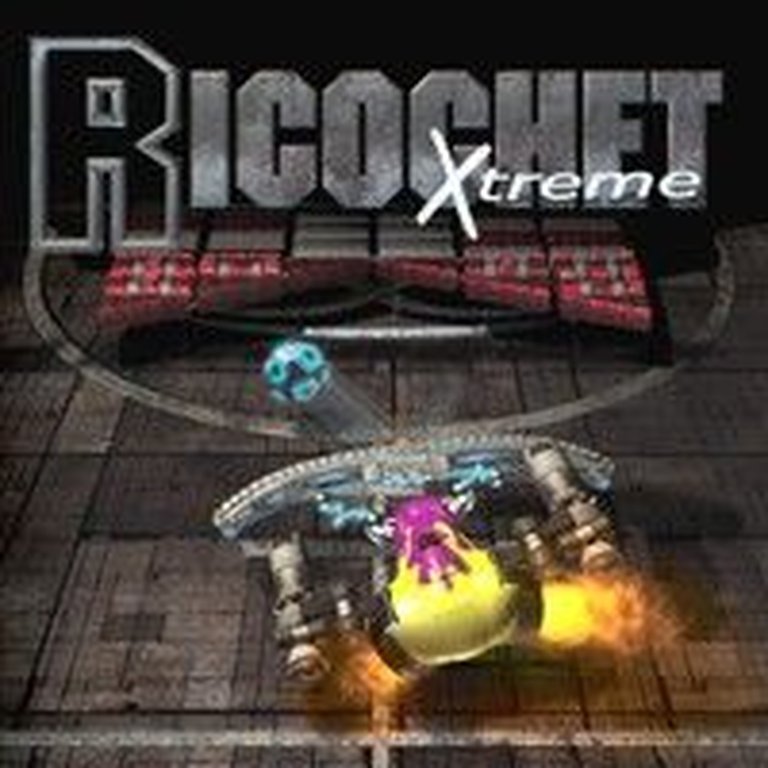
Ricochet is a shareware action game released in November 2001, inspired by the classic Arkanoid and Breakout formulas. Set in a sci-fi/futuristic universe, players control a paddle at the bottom of the screen to bounce a ball and destroy all bricks in each of the 170 levels across four difficulty settings. The game features enhanced graphics, sound effects, and power-ups such as extra balls, bombs, and fireballs to aid in clearing levels.
Gameplay Videos
Where to Buy Ricochet
Ricochet Free Download
PC
Ricochet Cracks & Fixes
Ricochet Mods
Ricochet Guides & Walkthroughs
Ricochet Reviews & Reception
reddit.com : Why is the game Ricochet so unpopular?
mobygames.com (78/100): A relax one-handed-game.
myabandonware.com (78/100): No, not just another Breakout clone, for this game by Reflexive Entertainment is one of the most original brick busting games yet.
Ricochet Cheats & Codes
Ricochet Lost Worlds: Recharged v1.1.29.1 [PC]
Start the game and enter codes when a Round has been loaded and you are in control of the paddle. Most codes also work in the Menu System but have little effect.
| Code | Effect |
|---|---|
| KillMeNow | Instant Kill |
| DebugGetRings | Earn Most Rings (gives golden rings for all Rounds of the selected/loaded level pack except for Rounds 1 & 2) |
| DebugUnlockLast | Unlocks Last Area (unlock access to most Round of the selected/loaded level pack. However, this will not unlock Rounds within the Final Starting Point) |
| DebugUnlockAll | Unlocks All Levels (unlock access to all Rounds of the selected/loaded level pack) |
| DebugSkip | Skip Current Level |
| flipad | Flips the advertisement in upper-right |
| Cheatzach | Crazy Score Display (point values higher than usual) |
| showMPH | Shows Ball Speed in Miles Per Hour |
| showFPS | Shows Frames Per Second |
| CheatReverse | Reversed Controls (as in: ‘Left goes Right’ & ‘Right goes Left’) |
Ricochet (2004) [PC]
Type GARGLUVSBIGBOTS at the main menu to enable cheat mode with unlimited lives. Press [Clr/Home] followed by one of the following keys.
| Code | Effect |
|---|---|
| [Inst/Del] | Add screen |
| [Plus] or [Minus] | Cycle through screens |
| [F7] | Delete screen from memory |
| Joystick | Move cursor |
| N | Name Screen |
| Fire | Place block |
| [F1] | Position angry yak |
| [Clr/Home] | Return to game |
| [Commodore] | View memory coordinates |
Ricochet Infinity [PC]
Enter one of the following codes during game play.
| Code | Effect |
|---|---|
| debug3way | 3 Way Ball Split |
| debug8way | 8 Way Ball Split |
| debugacid | Acidball |
| debugunlockall | All balls, ships and levels up to GMI rank |
| debugunlockplanets | All levels |
| lxylxy | All levels of current set |
| debugunlocklast | All levels of current set except the last one |
| debugcatch | Ball Catcher |
| debugballgen | Ballgenerator |
| debugbloss | Blossom |
| debugunlockset | Complete current set |
| debugoff | Disable debugging |
| blitx | Disable realtime scaling |
| pmon | Display statistics |
Ricochet Xtreme [PC]
Enter one of the codes during gameplay.
| Code | Effect |
|---|---|
| cheatmiss | Missiles |
| cheatgun | Guns |
| cheatnext | Level skip |
| cheatrail | Rail ball |
| cheatsmall | Small ball |
| cheatfire | Fire ball |
| cheatsplit | Multiple balls |
| cheatzach | Crazy score display |
| cheatreverse | Reverse mouse movement |
| cheatshrink | Shrink bat |
| cheatgrow or cheatexpand | Grow bat |
Ricochet [Acorn BBC A/B/B+/Master/Micro/Electron]
Use the provided level passwords to access specific levels.
| Code | Effect |
|---|---|
| ENIGMATIC | Level 2, Techlev |
| SPIRITUAL | Level 3, Derelict |
| SUPERNOVA | Level 4, UFO |
| CIRCUITRY | Level 5, Ancient |
Ricochet Lost Worlds [PC]
During gameplay, type in the following (Case Sensitive). Note that you must have a ball in play in order for these to work. Also, note that any code with ‘cheat’ or ‘debug’ in it doesn’t allow future level unlocks. However, it only affects the user’s profile. It is best to experiment these codes by creating a new profile.
| Code | Effect |
|---|---|
| Cheatzach | Crazy Score Display (point values higher than usual) |
| DebugGetRings | Earn Most Rings |
| flipad | Flips the advertisement in upper-right |
| KillMeNow | Instant Kill |
| debugleft | Moves Ball Left |
| debugright | Moves Ball Right |
| CheatReverse | Reversed Controls |
| showMPH | Shows Ball Speed in Miles Per Hour |
| showFPS | Shows Frames Per Second |
| DebugSkip | Skip Current Level |
| DebugUnlockAll | Unlocks All Levels |
| DebugUnlockLast | Unlocks Last Area |
Ricochet: A Deep Dive into Reflexive’s Breakout Revolution
In the early 2000s, as the gaming world hurtled toward the next console generation, a small shareware studio named Reflexive Entertainment quietly launched a game that would redefine a decades-old genre. Ricochet, released in November 2001, was not just another Breakout clone—it was a neon-soaked, intergalactic reimagining of brick-breaking that fused arcade nostalgia with futuristic flair. This is the story of how a simple paddle-and-ball concept evolved into a beloved franchise, and why Ricochet remains a cult classic in the annals of PC gaming.
Development History & Context
Reflexive Entertainment, founded in 1995, had already made a name for itself with titles like Zax: The Alien Hunter and Big Kahuna Reef. By 2001, the studio was riding the wave of the shareware boom, distributing games through platforms like RealArcade and later Steam. Ricochet was their boldest experiment yet—a sci-fi twist on Breakout that leveraged the Velocity game engine to deliver 3D graphics and smooth animations at a time when such features were rare in indie games.
The game’s development was spearheaded by James C. Smith, who served as producer, lead programmer, and even contributed to the background story. The team’s vision was clear: take the addictive simplicity of Breakout and inject it with enough visual and mechanical polish to stand out in a crowded market. The result was a game that felt both familiar and revolutionary, with 170 levels spread across four difficulty settings, each packed with moving bricks, power-ups, and chain-reaction triggers.
Narrative & Thematic Deep Dive
While Ricochet is not a narrative-heavy game, its thematic framing is worth exploring. The official description paints a picture of an “intergalactic competition” where players pilot ships with curved shields to clear space mines. This sci-fi veneer transforms the mundane act of brick-breaking into a high-stakes tournament, complete with pulsating electronic music and slick 3D environments. The game’s tagline, “The future of interstellar competition, today!” encapsulates this ethos, blending arcade excitement with a sense of cosmic grandeur.
Thematically, Ricochet taps into the era’s fascination with space and technology. Its levels span alien planets, underwater realms, and Mayan temples, creating a sense of exploration and wonder. The inclusion of a chihuahua-like alien mascot named Rico in later entries (like Ricochet Infinity) adds a touch of whimsy, grounding the game’s futuristic setting in playful charm.
Gameplay Mechanics & Systems
At its core, Ricochet is a Breakout game, but its mechanics are anything but basic. Players control a curved shield (the “bat”) at the bottom of the screen, deflecting an “ion sphere” to destroy bricks. The game’s innovation lies in its level design and power-ups. Bricks are arranged in intricate patterns, some of which move or trigger chain reactions when destroyed. This adds a layer of strategy, encouraging players to think beyond simple ball deflection.
The power-up system is another standout feature. Players can collect bonuses like extra balls, bombs, fireballs, and even a “Rail Ball” that cuts through bricks like butter. These power-ups are not just flashy—they fundamentally alter gameplay, offering new ways to tackle challenges. The game also introduces a rank system in Ricochet Infinity, unlocking new ships and ball skins as players progress, adding a sense of progression and customization.
World-Building, Art & Sound
Ricochet’s visual and auditory design is a major part of its appeal. The game’s 3D graphics were a significant leap forward for the genre, with vibrant colors, smooth animations, and detailed environments. Each level feels distinct, from the neon-lit corridors of space stations to the lush jungles of alien worlds. The art direction, led by Jeff McAteer and Chad Max, strikes a balance between futuristic sleekness and playful charm.
The sound design is equally impressive. The electronic soundtrack, composed by Zach Young, pulses with energy, syncing with the on-screen action to create a sense of urgency. Sound effects, from the satisfying “thwack” of the ball to the explosive boom of bombs, add to the game’s immersive quality. Reflexive even released a “Reactive Music” add-on, which dynamically adjusted the music’s intensity based on gameplay—a feature that was ahead of its time.
Reception & Legacy
Upon release, Ricochet received generally positive reviews, with critics praising its graphics, level design, and power-up system. PCMag.com awarded it 4 out of 5 stars, calling it a “jazzed-up” take on Breakout, while GameStar (Poland) lauded its “excellent graphics.” However, some critics, like VictoryGames.pl, felt the game lacked depth, awarding it a modest 60%.
Commercially, Ricochet was a success, spawning three sequels: Ricochet Lost Worlds (2004), Ricochet Lost Worlds Recharged (2004), and Ricochet Infinity (2007). The series expanded on the original’s formula with new environments, power-ups, and even a level editor, fostering a passionate community of modders. Reflexive’s acquisition by Amazon in 2008 marked the end of the series, but the games’ legacy lives on through fan sites like Ricochet Universe and the enduring popularity of Ricochet Infinity on Steam.
Conclusion
Ricochet is more than just a Breakout clone—it’s a testament to the creativity and innovation of indie game development in the early 2000s. By blending arcade nostalgia with futuristic aesthetics and strategic depth, Reflexive Entertainment created a game that still holds up today. Its influence can be seen in modern indie titles that reimagine classic genres, and its community-driven legacy ensures that Ricochet will continue to be celebrated by fans for years to come.
In the pantheon of PC gaming, Ricochet may not be a household name, but for those who’ve experienced its neon-lit brilliance, it’s a shining example of how a simple idea, executed with passion and polish, can leave a lasting impact. Whether you’re a retro gaming enthusiast or a curious newcomer, Ricochet is a journey worth taking—one brick at a time.