
- Release Year: 1996
- Platforms: DOS, Macintosh, Windows
- Publisher: Sierra On-Line, Inc.
- Developer: Papyrus Design Group, Inc.
- Genre: Driving, Racing, Simulation
- Perspective: 1st-person
- Game Mode: Single-player
- Gameplay: Car setup, Modding support, Pit crew interaction, Realistic simulation, Replay mode
- Setting: IndyCar racing, Real-world tracks
- Average Score: 82/100
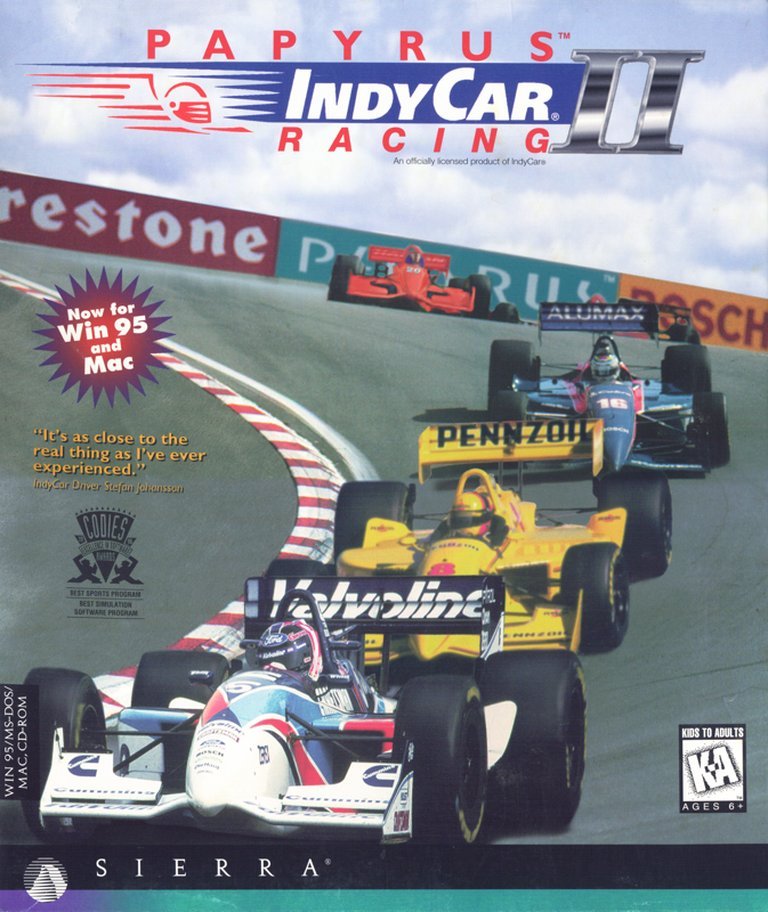
Description
IndyCar Racing II is a 1996 racing simulation game developed by Papyrus Design Group and published by Sierra On-Line, serving as the sequel to the 1993 IndyCar Racing. Featuring 15 tracks, SVGA graphics, realistic physics, and detailed car damage, the game offers an immersive open-wheel racing experience with various driving views and in-game car management.
Gameplay Videos
Where to Buy IndyCar Racing II
PC
IndyCar Racing II Free Download
IndyCar Racing II Patches & Updates
IndyCar Racing II Mods
IndyCar Racing II Guides & Walkthroughs
IndyCar Racing II Reviews & Reception
en.wikipedia.org (82/100): IndyCar Racing II received generally good ratings, such as 7.8 out of 10 by GameSpot, and 4 out of 5 by Computer Games Magazine.
mobygames.com (82/100): IndyCar Racing II received generally good ratings, such as 7.8 out of 10 by GameSpot, and 4 out of 5 by Computer Games Magazine.
IndyCar Racing II: Review
IndyCar Racing II stands as a monument to the golden age of PC racing simulations, a game that not only perfected the blueprint laid by its predecessor but also set a benchmark that few titles have surpassed. Released in 1996 by Papyrus Design Group, this sequel to the groundbreaking 1993 original was more than just an incremental update; it was a refinement of the racing genre itself, leveraging the technological advancements of the era to deliver an experience that was as close to real IndyCar racing as a home computer could provide. In this review, we’ll explore why IndyCar Racing II remains a touchstone for sim racing enthusiasts and a testament to the enduring appeal of meticulous, simulation-focused design.
Development History & Context
Papyrus Design Group, already renowned for their work on the original IndyCar Racing and the revolutionary NASCAR Racing, approached the sequel with a clear mandate: to evolve, not revolutionize. The gaming landscape of the mid-1990s was dominated by a growing appetite for realism, spurred on by advances in 3D graphics and processing power. Windows 95 had arrived, CD-ROMs were ubiquitous, and gamers expected more from their simulations than ever before.
The development team, led by David Kaemmer and Brian C. Mahony, drew heavily from the lessons learned during the creation of NASCAR Racing. This meant not only upgrading the graphics to crisp 640×480 SVGA but also refining the physics engine and artificial intelligence to create a more authentic racing experience. The inclusion of telemetry data, enhanced car damage models, and interactive pit communication (though speech recognition was limited to the Macintosh version) all pointed to a game designed for the hardcore racing fan.
However, the game’s release was not without its challenges. The CART series, which the game was based on, was undergoing significant changes, and licensing issues meant that certain tracks and drivers were absent. Despite these limitations, Papyrus managed to capture the essence of the 1995 IndyCar season, complete with accurate car models, liveries, and the distinctive characteristics of each circuit.
Narrative & Thematic Deep Dive
Unlike modern racing games, IndyCar Racing II does not present a traditional narrative or feature named characters. Instead, its story is one of immersion and authenticity. The game’s thematic core is the relentless pursuit of perfection on the track, a journey that mirrors the real-world challenges faced by professional drivers. Each race is a chapter in a larger saga of speed, strategy, and survival.
The absence of named drivers and crews might seem like a limitation, but it actually enhances the game’s universality. Every player becomes the protagonist, their car a blank slate onto which they project their own ambitions and frustrations. The numbered cars, the detailed telemetry, and the unforgiving physics all serve to reinforce the idea that this is not just a game, but a simulation of a demanding and dangerous sport.
Gameplay Mechanics & Systems
At its heart, IndyCar Racing II is a pure racing simulation, and its gameplay mechanics reflect this philosophy. The core loop is deceptively simple: qualify, race, and repeat. However, beneath this simplicity lies a wealth of complexity. The game offers a staggering array of customization options, from tire pressure and wing angles to fuel mixtures and gear ratios. Every adjustment has a tangible impact on performance, and mastering these settings is crucial for success.
The driving model is unforgiving, especially for newcomers. The cars are highly sensitive to setup changes, and even minor errors in throttle control or braking can send you spinning into the barriers. This realism is both the game’s greatest strength and its most significant barrier to entry. Novices will find themselves struggling to complete a single lap without incident, while veterans will relish the challenge of shaving milliseconds off their lap times.
The AI is another standout feature. Unlike many racing games of the era, the computer-controlled cars in IndyCar Racing II are aggressive and intelligent. They will defend their lines, capitalize on your mistakes, and even engage in strategic battles for position. This makes every race a dynamic and unpredictable experience, one that rewards both skill and strategy.
World-Building, Art & Sound
Visually, IndyCar Racing II was a significant leap forward from its predecessor. The SVGA graphics bring the tracks and cars to life with impressive clarity, and the attention to detail is evident in everything from the texture of the asphalt to the way the cars deform upon impact. The game includes fifteen accurately modeled circuits, each with its own unique challenges and character. From the high-speed ovals of Michigan and Texas to the technical road courses of Laguna Seca and Cleveland, every track demands a different approach and rewards mastery.
The sound design is equally impressive. The roar of the engines, the screech of tires, and the crunch of metal during a crash all contribute to a visceral sense of speed and danger. The absence of music during races is a deliberate choice, one that keeps the player focused on the task at hand and heightens the tension of each lap.
Reception & Legacy
Upon its release, IndyCar Racing II was met with widespread critical acclaim. Publications like Computer Gaming World and PC Gamer praised its realism, depth, and attention to detail, awarding it scores in the high 90s. The game was recognized as the best racing simulation of 1995 by Computer Games Strategy Plus and received the “Best Sports Game” award from Macworld in 1996.
Despite its critical success, the game’s sales were modest compared to its predecessor, NASCAR Racing. Only about 180,000 units were sold, a figure that paled in comparison to the million-plus copies moved by the NASCAR title. This relative commercial disappointment did not diminish the game’s influence, however. IndyCar Racing II set a new standard for racing simulations, one that would inspire future titles like Grand Prix Legends and iRacing.
The game’s legacy is also evident in its enduring modding community. Even decades after its release, fans continue to create new cars, tracks, and updates, ensuring that IndyCar Racing II remains a living, evolving experience.
Conclusion
IndyCar Racing II is more than just a game; it is a defining moment in the history of racing simulations. Its uncompromising commitment to realism, its deep and rewarding gameplay, and its lasting influence on the genre make it a classic that deserves to be remembered and celebrated. While it may be too demanding for casual players, those willing to invest the time and effort will find a racing experience that is as challenging as it is rewarding.
In the pantheon of PC racing games, IndyCar Racing II stands tall, a testament to the power of simulation and the enduring appeal of the open-wheel racing experience. For anyone interested in the evolution of the genre or simply seeking a true test of their driving skills, this game remains an essential part of any collection.