
- Release Year: 2003
- Platforms: Windows
- Publisher: Atari Europe S.A.S.U., Atari, Inc., Humongous Entertainment, Inc., Night Dive Studios, LLC
- Developer: Humongous Entertainment, Inc.
- Genre: Adventure, Driving, Educational, Racing
- Perspective: Side view
- Game Mode: Single-player
- Gameplay: Adventure, Driving, Educational, Racing
- Setting: Cartown
- Average Score: 68/100
Description
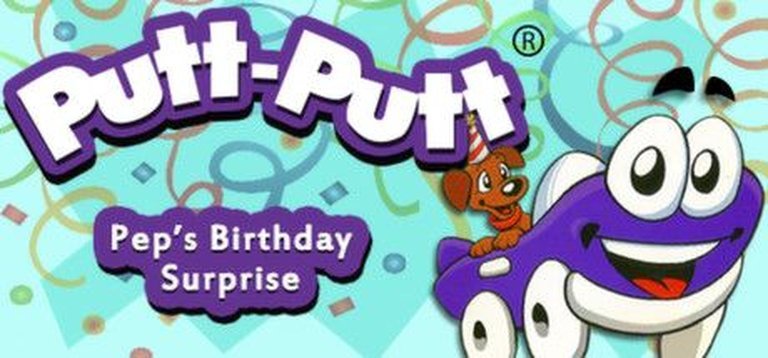
Putt-Putt: Pep’s Birthday Surprise is an educational adventure game where players help the lovable purple convertible, Putt-Putt, gather supplies for his friend Pep’s surprise birthday party in Cartown. The game features interactive elements, character interactions, and changing adventures each time it’s played, designed for preschool and toddler-aged children.
Gameplay Videos
Where to Buy Putt-Putt: Pep’s Birthday Surprise
Putt-Putt: Pep’s Birthday Surprise Free Download
Putt-Putt: Pep’s Birthday Surprise Guides & Walkthroughs
Putt-Putt: Pep’s Birthday Surprise Reviews & Reception
gamepressure.com (54/100): The game is characterized by excellent playability, entertaining children and at the same time teaches them logical, creative thinking and good manners and social behavior.
mobygames.com (83/100): Putt-Putt is a lovable little purple convertible with a go-getting attitude who always helps his friends!
gamesreviews2010.com : Putt-Putt: Pep’s Birthday Surprise is a delightful adventure game that’s perfect for young children. The puzzles are challenging but fair, and the game teaches valuable lessons about friendship, cooperation, and helping others.
Putt-Putt: Pep’s Birthday Surprise Cheats & Codes
PC
Create a new game file and name it CHEATER. All of the levels will be unlocked from the start.
| Code | Effect |
|---|---|
| CHEATER | Unlock All levels |
Putt-Putt: Pep’s Birthday Surprise: Review
In the pantheon of children’s adventure games, few series have achieved the enduring charm and educational value of Humongous Entertainment’s Putt-Putt. Released in 2003, Putt-Putt: Pep’s Birthday Surprise arrived at a pivotal moment in the studio’s history—a swan song for their beloved Junior Adventure series that would ultimately mark the end of an era. This review examines how this final installment both honors and struggles with its legacy, delivering a game that is simultaneously comforting in its familiarity and revealing in its departures.
Development History & Context
By the time Pep’s Birthday Surprise rolled into production, Humongous Entertainment was already showing signs of strain. The studio, which had been acquired by Infogrames (soon to rebrand as Atari), had just weathered significant layoffs in 2001, with over 40% of their staff let go. The creative team that had defined the series—including writer Laurie Bauman-Arnold, who penned every previous Putt-Putt adventure—was notably absent.
In their place came James “Kibo” Parry, an internet personality known for his subversive 90s presence and creation of the cryptic “Kiboism” religion. Parry’s script leans heavily on puns, chicken jokes, and sometimes awkward dialogue that, while maintaining the series’ playful tone, lacks the seamless charm of earlier entries. The development team was forced to work with the new YAGA engine—Atari’s proprietary system that replaced the beloved SCUMM engine that had powered all previous Humongous adventures.
This technological shift proved problematic. The YAGA engine struggled with compatibility on newer machines, even when it did run, often with performance issues. Unlike the SCUMM games that received ports and updates, Pep’s Birthday Surprise and its YAGA siblings have been largely left behind, unavailable on modern platforms beyond basic Steam releases that haven’t received meaningful support.
Narrative & Thematic Deep Dive
The plot centers on Putt-Putt planning a surprise birthday party for his loyal dog companion Pep—a celebration of the anniversary of Pep’s adoption. This narrative choice feels deeply appropriate for what would become the series’ final entry: a celebration of the relationships that defined these games, both within the story and for the fans who had grown up with them.
The game cleverly uses this framing device to bring back characters from throughout the series—Smokey the Fire Engine from Joins the Parade, Chuck Wagon from Saves the Zoo, Rover from Goes to the Moon, and others. Each appearance serves as a nostalgic callback for longtime fans, creating a sense of community and continuity that mirrors the party Putt-Putt is throwing for Pep.
However, the narrative occasionally stumbles under the weight of its own sentimentality. The central song celebrating Pep’s adoption, while heartfelt, borders on saccharine. Parry’s script, while maintaining the series’ pun-heavy humor, sometimes feels forced—the chicken jokes and wordplay don’t always land with the natural ease of Bauman-Arnold’s writing.
Thematically, the game reinforces Putt-Putt’s core values: kindness, helpfulness, and friendship. The framing device of Putt-Putt having to distract Pep while planning the surprise adds a layer of narrative coherence, explaining why conversations often begin with Putt-Putt finding ways to separate himself from his constant companion. This small touch demonstrates the attention to detail that makes even this final entry feel thoughtfully constructed.
Gameplay Mechanics & Systems
Mechanically, Pep’s Birthday Surprise follows the established Putt-Putt formula: point-and-click exploration, item collection, and puzzle-solving in a colorful world of anthropomorphic vehicles. Players guide Putt-Putt through Cartown as he gathers supplies for Pep’s party—balloons, decorations, a new dog collar, a cake, and a performing magician.
The game retains the series’ hallmark of randomization, ensuring that each playthrough offers slightly different experiences in terms of item locations and puzzle solutions. This design choice extends the game’s replayability, particularly valuable for its target audience of preschoolers and young children.
However, the transition to YAGA introduced several frustrations. Most notably, players can no longer skip animations by pressing the Escape key—a feature present in earlier titles. Instead, the Enter key skips through sequences while the spacebar cuts off character speech, a distinction that proves confusing for young players and their parents alike. This design choice drew criticism from reviewers who noted that it detracted from the overall enjoyment.
The puzzles themselves strike an appropriate balance for the target age group. They’re challenging enough to encourage problem-solving and critical thinking without becoming frustrating. Tasks range from helping the opera-singing librarian cart organize books to assisting the hippie van shopkeeper who offers all items for free. These scenarios maintain the series’ gentle educational approach while embedding learning within entertaining contexts.
World-Building, Art & Sound
Visually, Pep’s Birthday Surprise represents both continuity and change. The game adopts 21st-century 2D graphics that, while colorful and appealing, lack the handcrafted warmth of earlier entries. The animation is noticeably choppier, and the redesigned dashboard features soft-shaded graphics that some critics found blurry and unattractive.
The world of Cartown remains inviting and imaginative, filled with clever vehicle-based characters and environments. The opera-singing librarian who is literally a library cart, the security guard car working on the world’s largest rubber band ball, and the baker whose oven resembles a reskinned time machine from Travels Through Time—these details demonstrate the creative spark that defined the series, even as the execution falters.
Sound design represents one of the game’s stronger elements. The audio lacks the harsh compression of earlier titles, allowing music and dialogue to breathe more naturally. The voice acting, while featuring a largely new cast (with Putt-Putt now voiced by Michele Thorson), maintains the friendly, approachable tone that made the series accessible to young players.
The soundtrack effectively captures the celebratory mood, with upbeat tracks that enhance the birthday party atmosphere. Sound effects are appropriately cartoonish, adding to the game’s playful aesthetic.
Reception & Legacy
Upon release, Pep’s Birthday Surprise received generally positive reviews from educational gaming outlets. Edutaining Kids awarded it 91%, praising its perfect balance of challenge for children ages 3-7. Quandary gave it 90%, calling it “a worthy challenge for pre-schoolers.” Review Corner, despite criticizing the animation-skipping controls, still awarded 86% for its problem-solving focus.
However, the game’s legacy is complicated by its status as the series finale and the technical challenges it presents to modern players. The YAGA engine’s incompatibility with newer systems has effectively frozen the game in time, unavailable on contemporary platforms beyond problematic Steam releases.
Critically, the game is often viewed as a low point in the series—not because it’s poorly made, but because it represents a departure from what made Putt-Putt special. The new engine, recast voices, and absent creative leads create a game that looks like Putt-Putt but doesn’t quite feel like Putt-Putt. It’s the series’ equivalent of visiting a familiar place after many years only to find that while the landmarks remain, something essential has shifted.
Conclusion
Putt-Putt: Pep’s Birthday Surprise occupies a fascinating position in video game history—a final chapter that both celebrates and struggles with its legacy. For longtime fans, it offers a nostalgic journey through Cartown with beloved characters, serving as a fitting tribute to a series that defined children’s edutainment for over a decade. For newcomers, it provides an accessible introduction to the gentle problem-solving and positive values that made Putt-Putt special.
The game’s technical limitations and creative departures prevent it from reaching the heights of classics like Putt-Putt Saves the Zoo or Putt-Putt Goes to the Moon, yet it remains a competent, often charming entry that honors its source material while acknowledging the changing landscape of children’s gaming.
Ultimately, Pep’s Birthday Surprise serves as a bittersweet farewell—a celebration of friendship and kindness wrapped in the familiar package of a purple convertible and his puppy, driving off into the sunset of gaming history. While it may not represent the series at its absolute best, it captures something arguably more valuable: the warmth, heart, and educational spirit that made Putt-Putt endure for generations of young players.
In the end, perhaps the most fitting tribute to Pep’s Birthday Surprise is recognizing it not just as a game, but as a time capsule—preserving the values, creativity, and gentle learning that defined an era of children’s entertainment that, while no longer dominant, continues to resonate with those who grew up puttingt-putting through Cartown.