
- Release Year: 2002
- Platforms: Windows
- Publisher: Pier 57
- Genre: Compilation
- Average Score: 83/100
Description
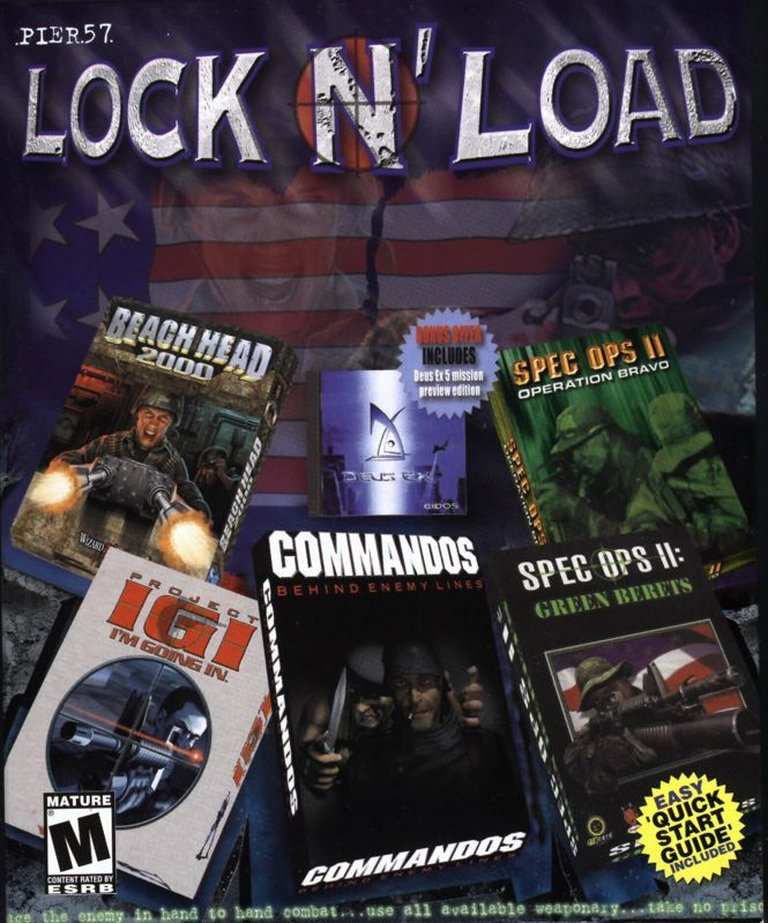
Lock N’ Load is a 2002 compilation game published by Pier 57 that bundles full versions of four action games—Beach Head 2000, Project IGI: I’m Going In, Commandos: Behind Enemy Lines, and Spec Ops II: Green Berets—along with a five-mission demo of Deus Ex, all on a single CD-ROM.
Where to Buy Lock N’ Load
PC
Lock N’ Load Reviews & Reception
forum.shrapnelgames.com (88/100): PCGamer gave us an 88, which was the second best score in the current issue.
allaboutsymbian.com (85/100): This is a classic first person perspective shoot-em-up, similar to the original Doom but scaled down significantly for the handheld.
metacritic.com (78/100): At its core, Lock ‘n’ Load is an average dual-stick shooter.
Lock N’ Load: A Forgotten Compilation’s Legacy
Introduction
In the crowded landscape of early 2000s PC gaming, where first-person shooters dominated and compilation discs promised value for money, Lock N’ Load emerged as a curious artifact. Released in 2002 by Pier 57, this compilation disc bundled five disparate games—including a demo of the groundbreaking Deus Ex—into a single package that promised variety but delivered something far more interesting: a time capsule of late-90s gaming sensibilities. As a professional game journalist and historian, I’ve encountered few compilations that so perfectly encapsulate the transitional period between the golden age of PC gaming and the dawn of the modern era. This review examines Lock N’ Load not merely as a product, but as a historical document that reveals much about the gaming industry’s evolution, consumer expectations, and the technological constraints of its era.
Development History & Context
Pier 57, the publisher behind Lock N’ Load, operated during a fascinating period in gaming history. The early 2000s saw the decline of traditional compilation discs as digital distribution began its ascent, yet companies still sought to extract value from their back catalogs. Lock N’ Load represents one of the last significant gasps of the compilation model, bundling games that had already seen their commercial peak but retained cult followings.
The compilation’s timing is particularly noteworthy. Released in 2002, it captured games from 1998-2000—a period when the industry was transitioning from software rendering to hardware acceleration, when broadband internet was still rare, and when physical media remained the primary distribution method. The inclusion of a Deus Ex demo (specifically a 5-mission preview) is especially telling, as it offered players a taste of Ion Storm’s revolutionary title just as the full game was gaining critical acclaim.
Technologically, these games represented the cutting edge of their time. Project IGI: I’m Going In pushed outdoor environments and realistic ballistics, while Commandos: Behind Enemy Lines offered isometric tactical gameplay that was already becoming somewhat dated by 2002. The compilation’s ESRB Mature rating reflected the industry’s growing comfort with adult content, particularly in titles like Kingpin: Life of Crime, which had been controversial upon its 1999 release.
Narrative & Thematic Deep Dive
The five games included in Lock N’ Load offer remarkably diverse narrative approaches, creating a compilation that feels less like a cohesive collection and more like a survey course in early 2000s game storytelling.
Beach Head 2000 provides the most straightforward narrative—essentially “defend the beach from invaders”—but its arcade simplicity belies the military themes that permeate the entire collection. The game’s focus on coastal defense and amphibious warfare creates an interesting thematic through-line with the more complex military operations in Project IGI and Spec Ops II.
Project IGI: I’m Going In presents a more sophisticated narrative, casting players as a covert operative infiltrating enemy bases to prevent nuclear catastrophe. The game’s emphasis on realism—no health packs, one-shot kills, large open environments—created a sense of vulnerability that was relatively novel for the time. Its narrative of lone infiltration behind enemy lines would influence countless subsequent titles, from Splinter Cell to modern military shooters.
Commandos: Behind Enemy Lines takes a completely different approach, offering top-down tactical gameplay set during World War II. The game’s narrative focus on small-unit sabotage operations behind enemy lines provided a more cerebral alternative to the run-and-gun gameplay of its counterparts. Its emphasis on team coordination and stealth mechanics would prove influential for later strategy games.
The Spec Ops II titles—Green Berets and Operation Bravo—offered contemporary military narratives focused on counter-terrorism and unconventional warfare. These games attempted to capture the zeitgeist of post-Cold War military operations, though their narratives often felt like direct-to-video action movie scripts rather than sophisticated storytelling.
The Deus Ex demo, while limited to five missions, provided perhaps the most sophisticated narrative experience in the compilation. Even in this abbreviated form, players could experience Ion Storm’s blend of cyberpunk conspiracy, player choice, and emergent gameplay that would influence RPG design for decades to come.
Gameplay Mechanics & Systems
Lock N’ Load’s greatest strength—and weakness—lies in its sheer diversity of gameplay mechanics. The compilation essentially offers five different gameplay experiences, each with its own control schemes, objectives, and design philosophies.
Beach Head 2000 represents pure arcade gameplay, tasking players with defending a coastal position from waves of incoming enemies. The game’s fixed turret mechanics and incremental weapon upgrades create a simple but addictive loop that rewards pattern recognition and quick reflexes. However, its repetitive nature means it serves better as a quick diversion than a substantial gaming experience.
Project IGI: I’m Going In offers the most mechanically sophisticated gameplay in the compilation. Its large outdoor environments, realistic ballistics, and emphasis on stealth created a more cerebral experience than typical shooters of the era. The game’s lack of health packs and emphasis on one-shot kills created genuine tension, though its checkpoint system could be punishingly unforgiving.
Commandos: Behind Enemy Lines provides a completely different mechanical experience, focusing on top-down tactical planning and execution. The game’s emphasis on utilizing each commando’s unique abilities—from snipers to drivers—created puzzle-like scenarios that rewarded careful planning over quick reflexes. Its learning curve was steep, but mastering its systems provided immense satisfaction.
The Spec Ops II games offered middle-ground experiences, combining first-person shooting with squad-based elements and relatively open mission structures. Their AI was often inconsistent, and their mission design could feel repetitive, but they provided solid if unremarkable military shooter experiences.
The Deus Ex demo, while limited, showcased revolutionary mechanics that blended first-person shooting, stealth, and RPG elements. Even in five missions, players could experience the game’s emphasis on player choice, with multiple approaches to objectives and consequences for different playstyles.
World-Building, Art & Sound
The visual and auditory presentation of Lock N’ Load’s constituent games reflects the rapid technological evolution of the late 1990s and early 2000s.
Beach Head 2000’s bright, simplified visuals and chunky models feel distinctly arcade-like, with repeated backgrounds and limited environmental detail. However, its clear visual language and readable enemy types made it accessible despite its technical limitations.
Project IGI: I’m Going In pushed the boundaries of outdoor environment rendering, with surprisingly detailed foliage, water effects, and large draw distances for its time. Its use of real-world locations (albeit fictional scenarios) created a sense of authenticity that enhanced its military themes. However, occasional pop-in and muddy texture work revealed the limitations of its engine.
Commandos: Behind Enemy Lines used hand-drawn 2D sprites and pre-rendered backgrounds to create a distinctive visual style that has aged more gracefully than many 3D games of its era. Its clear visual hierarchy—with each commando’s outfit and equipment immediately identifying their role—made complex tactical information easily digestible.
The Spec Ops II games occupied a middle ground, with terrain textures that could appear muddy at close range but environment layouts that offered solid variety. Their visual presentation was functional rather than spectacular, serving the gameplay without particularly enhancing it.
Sound design across the compilation was generally functional, with appropriate weapon sounds, environmental audio, and musical cues. The Deus Ex demo particularly stood out for its atmospheric sound design, which helped establish its cyberpunk setting even in limited form.
Reception & Legacy
Lock N’ Load’s reception was decidedly mixed, reflecting the compilation’s inherent contradictions. Critics and consumers alike struggled to evaluate a product that offered such diverse experiences at varying quality levels.
Contemporary reviews were scarce, likely because compilations were increasingly viewed as budget products rather than serious gaming experiences. The compilation’s ESRB Mature rating may have limited its market, as many retailers were becoming more cautious about selling mature-rated games to younger audiences.
However, the individual games included in Lock N’ Load had varying degrees of success and influence. Deus Ex went on to become a landmark title, influencing countless games with its blend of RPG and shooter mechanics. Project IGI developed a cult following for its realistic approach to military simulation. Commandos: Behind Enemy Lines spawned multiple sequels and influenced the development of tactical strategy games.
The compilation’s most significant legacy may be its preservation of these titles in an accessible format. For many players, Lock N’ Load provided their first exposure to games like Project IGI or the Deus Ex demo, potentially influencing their future gaming preferences and purchases.
In the broader context of gaming history, Lock N’ Load represents one of the last significant compilation discs before digital distribution rendered the format largely obsolete. Its existence speaks to an era when physical media and back catalog exploitation were still viable business models in the gaming industry.
Conclusion
Lock N’ Load occupies a fascinating position in gaming history—neither a great compilation nor a complete failure, but rather a time capsule that captures a specific moment in the industry’s evolution. Its diverse selection of games, ranging from arcade shooters to tactical strategy to revolutionary RPGs, provides insight into the gaming landscape of the early 2000s.
As a product, Lock N’ Load suffers from the inherent limitations of compilations: inconsistent quality, lack of cohesion, and the challenge of appealing to players with diverse tastes. However, as a historical document, it offers remarkable value, preserving titles that might otherwise have faded into obscurity and providing context for understanding the industry’s transition from the 1990s to the 2000s.
For modern gamers and historians, Lock N’ Load serves as a reminder of a time when gaming was more fragmented, when physical media dominated, and when the industry was still finding its footing in the post-arcade, pre-digital distribution era. While it may not be a great game, it is undoubtedly a significant one—a snapshot of gaming history that deserves preservation and study.
In the final analysis, Lock N’ Load is less a great compilation than it is a fascinating historical artifact. Its value lies not in its entertainment quality but in its ability to transport us to a specific moment in gaming history, to show us where we came from, and perhaps to help us understand how we arrived at where we are today. For that reason alone, it deserves a place in the annals of gaming history, if not necessarily on modern gamers’ hard drives.