
- Release Year: 1999
- Platforms: Windows
- Publisher: John R. Bloch
- Developer: John R. Bloch
- Genre: Board game, Strategy, Tactics
- Perspective: Fixed / flip-screen
- Game Mode: Online PVP, Single-player
- Gameplay: Board game
Description
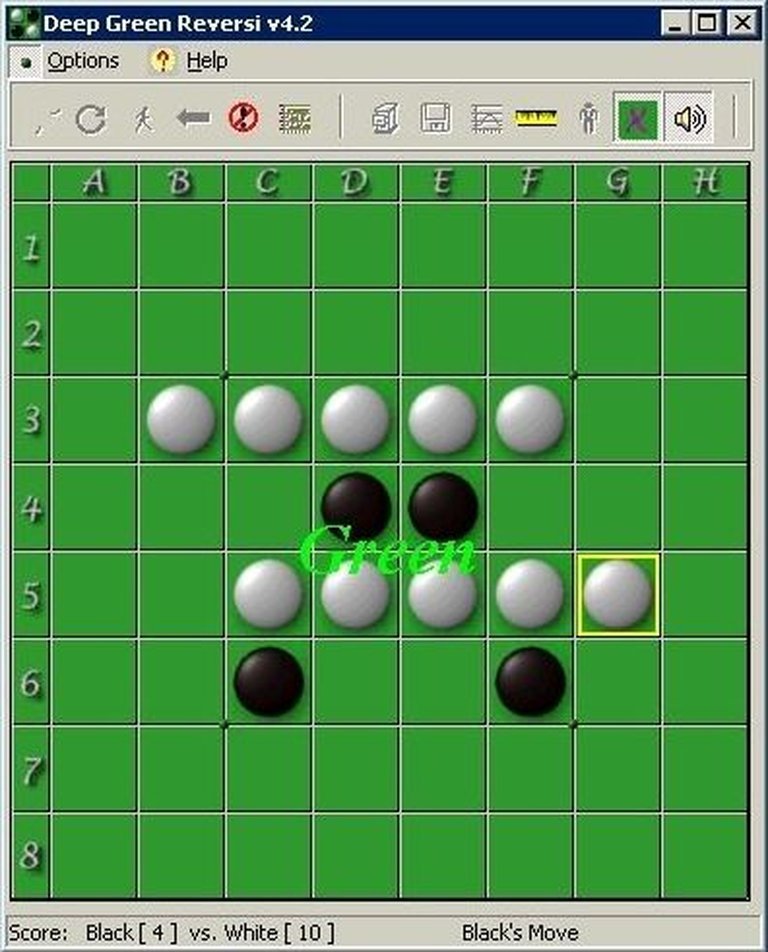
Deep Green Reversi is an award-winning single-player implementation of the classic strategy game also known as Othello. Featuring a resizable 8×8 grid interface, adjustable AI difficulty through search depth settings, and multiple functions including save/load, undo, replay, and internet play options, this shareware game offers a comprehensive digital version of the traditional board game.
Deep Green Reversi Free Download
Deep Green Reversi Cracks & Fixes
Deep Green Reversi Reviews & Reception
reddit.com : How’s the game? How bad is the localization? Is it worth a shot for someone just looking for a quick gacha game to play in my down time?
steamcommunity.com : That depends on what you are looking for in the game.
mobygames.com : Deep Green Reversi is an award winning, single player, implementation of the strategy game that also goes by the name Othello.
Deep Green Reversi: A Retrospective on a Pioneering Digital Board Game
In the late 1990s, as the internet began to reshape how we interacted with games, a quiet revolution was taking place in the world of digital board games. Among the early innovators was Deep Green Reversi, a shareware implementation of the classic strategy game Othello (also known as Reversi) that would set new standards for artificial intelligence, user experience, and online play. Released in 1999 by developer John R. Bloch, this unassuming Windows application represented a significant leap forward in bringing traditional board games into the digital age.
Development History & Context
The mid-to-late 1990s marked a transitional period in gaming history. Personal computers were becoming household staples, internet connectivity was rapidly expanding, and independent developers were beginning to explore the potential of digital distribution. John R. Bloch, working as a solo developer, recognized an opportunity to reimagine Othello for this new technological landscape.
Bloch’s approach was methodical and ambitious. Rather than simply digitizing the physical game, he sought to enhance every aspect of the Othello experience. The development process was notably personal—the game’s credits reveal a touching dedication to “Roberta, my nine-year-old rabbit who sat patiently under my seat licking my feet while I worked.” This intimate detail speaks to the independent nature of the project and the passion driving its creation.
The technological constraints of 1999 presented both challenges and opportunities. With dial-up internet being the norm and processing power limited by today’s standards, Bloch had to optimize his AI algorithms carefully. The game’s ability to adjust search depth—allowing players to modify how many moves ahead the computer would analyze—demonstrated sophisticated programming that could run efficiently even on modest hardware.
Gameplay Mechanics & Systems
At its core, Deep Green Reversi faithfully recreates the Othello experience: two players (one human, one AI) compete on an 8×8 grid, placing black and white pieces with the goal of having the majority of their color showing at the game’s end. However, the implementation goes far beyond simple digitization.
The AI system stands as the game’s most impressive technical achievement. By allowing players to adjust the search depth, Bloch created a scalable difficulty system that could challenge both beginners and experts. This wasn’t merely a matter of making the computer “harder” or “easier”—it fundamentally changed how the AI approached the game, considering more or fewer future moves in its calculations.
The interface deserves special mention for its time. The resizable window was a thoughtful touch that recognized players might want to multitask or adjust their viewing experience. The inclusion of a save/load function, undo capability, and replay feature showed a deep understanding of how players actually engage with strategy games. These weren’t just conveniences; they transformed Othello from a casual pastime into a serious strategic pursuit.
The internet play option was particularly forward-thinking. In 1999, online multiplayer was still in its infancy, and the ability to play Othello against remote opponents was a significant selling point. This feature anticipated the massive growth of online gaming that would follow in the coming years.
World-Building, Art & Sound
While Deep Green Reversi is fundamentally a digital board game without elaborate world-building or narrative, its aesthetic choices deserve recognition. The “Deep Green” name suggests an environmental or natural theme, though the game itself presents a clean, functional interface focused on gameplay clarity.
The visual design prioritizes readability and ease of use. The 8×8 grid is presented clearly, with pieces that are easily distinguishable. The resizeable window demonstrates consideration for different display setups and user preferences. These design choices reflect an understanding that in strategy games, clarity trumps flashiness.
The sound design, while minimal by modern standards, serves its purpose effectively. Audio cues for piece placement and game events provide necessary feedback without becoming distracting. The absence of elaborate soundtracks or effects keeps the focus on the strategic elements of play.
Reception & Legacy
Deep Green Reversi’s reception in 1999 was notably positive, earning recognition as an “award-winning” implementation of Othello. This acclaim came during a period when digital board games were still finding their footing, making the achievement particularly noteworthy.
The game’s influence can be seen in subsequent digital board game implementations. Its sophisticated AI system, particularly the adjustable search depth feature, became a template for how computer opponents in strategy games could offer scalable challenges. The comprehensive feature set—including save/load, undo, replay, and internet play—established expectations for what a complete digital board game experience should offer.
In the broader context of gaming history, Deep Green Reversi represents an important bridge between traditional board games and their digital descendants. It demonstrated that classic games could be enhanced rather than diminished by digital implementation, preserving the strategic depth of Othello while adding new dimensions of accessibility and challenge.
Conclusion
Deep Green Reversi stands as a testament to thoughtful game design and technical innovation. In an era when many digital adaptations of board games were little more than direct translations, John R. Bloch created something genuinely new: a comprehensive, sophisticated, and accessible digital Othello experience that respected the original game while leveraging the unique capabilities of computer technology.
The game’s legacy extends beyond its immediate impact. It helped establish standards for digital board game design that are still relevant today, and its technical achievements—particularly the AI system—influenced how developers approach computer opponents in strategy games. More than just a well-executed digital Othello, Deep Green Reversi represents a pivotal moment in the evolution of how we interact with traditional games in digital spaces.
For modern players, Deep Green Reversi offers more than nostalgia—it provides a window into a formative period of gaming history and demonstrates how even simple games can be transformed through thoughtful digital implementation. It reminds us that sometimes the most significant innovations come not from revolutionary new concepts, but from reimagining and enhancing what already works brilliantly.