
- Release Year: 2016
- Platforms: Windows
- Publisher: Wastebasket Games
- Developer: Wastebasket Games
- Genre: Action
- Perspective: Diagonal-down
- Game Mode: Single-player
- Gameplay: Shooter
- Setting: Fantasy
- Average Score: 81/100
Description
Broken Armor is an arcade-style action game where players control an exiled knight from Slambonia, tasked with finding the Holy Grail to return home. The game features classic pixel graphics, challenging gameplay with traps and creatures, and a rogue-like structure where each playthrough is different.
Where to Buy Broken Armor
PC
Broken Armor Free Download
Broken Armor Patches & Updates
Broken Armor Guides & Walkthroughs
Broken Armor Reviews & Reception
steambase.io (83/100): Broken Armor has achieved a Steambase Player Score of 83 / 100. This score is calculated from 800 total reviews on Steam — giving it a rating of Very Positive.
wasdland.com (78/100): It has received 793 reviews of which 655 were positive and 138 were negative resulting in a rating of 7.8 out of 10.
Broken Armor: Review
In the crowded landscape of indie games, where pixel art and retro aesthetics have become almost ubiquitous, Broken Armor emerges as a peculiar artifact—a game that seems to have materialized from the golden age of shareware, yet arrived in 2016. This diagonal-down shooter, developed by Jonathan Tindell and published by Wastebasket Games, is a curious blend of nostalgia and challenge that deserves a closer examination.
Development History & Context
Broken Armor represents a fascinating case study in the democratization of game development. Created by a single developer using GameMaker Studio, the game embodies the DIY ethos that has come to define indie gaming in the 2010s. Tindell’s vision was clear: to create something that felt like it could have existed on a 5.25″ floppy disk from the 1980s, complete with the punishing difficulty and simple mechanics that defined that era.
The game’s development context is significant. Released in August 2016, it arrived during a period when retro-inspired games were experiencing a renaissance. Titles like Shovel Knight, Axiom Verge, and Celeste had already proven that there was still an appetite for pixel art and challenging gameplay. However, Broken Armor takes a different approach—it doesn’t aim to modernize or refine the retro experience but rather to faithfully recreate it, warts and all.
The technological constraints of the era are evident in every aspect of the game. With minimum requirements as modest as Windows XP, 512 MB RAM, and onboard graphics, Broken Armor is accessible to virtually any system. This accessibility, combined with its $0.99 price point, positions it as the ultimate impulse purchase—a digital equivalent of finding an interesting-looking cartridge in a bargain bin.
Narrative & Thematic Deep Dive
The narrative of Broken Armor is refreshingly simple, almost to the point of parody. You play as an inept knight, exiled from the kingdom of Slambonia for his incompetence, tasked with finding the holy grail to return home. The game doesn’t take itself seriously, and this self-awareness is part of its charm.
Thematically, Broken Armor explores the concept of inadequacy and perseverance. The knight’s broken armor serves as both a literal gameplay mechanic and a metaphor for his flawed nature. He’s not a traditional hero but rather someone who keeps getting back up despite constant failure. This theme resonates throughout the gameplay, where death is frequent and progress is hard-won.
The dialogue and story elements are minimal, which is appropriate for the game’s arcade-style focus. However, this minimalism also means that the narrative doesn’t evolve or deepen as you progress. The knight remains “broken” throughout, and the grail quest never develops beyond its initial premise. For some players, this simplicity will be refreshing; for others, it may feel underdeveloped.
Gameplay Mechanics & Systems
At its core, Broken Armor is a shooter with roguelike elements. You navigate through rooms filled with traps and creatures, using limited weapons to reach the exit. The gameplay loop is straightforward: move, collect weapons, use them strategically, reach the boss, repeat. However, this simplicity belies a surprising depth.
The game offers two playable characters: the knight and the wizard (included as DLC). The knight uses traditional melee weapons—axe, spear, sword, and mace—each with distinct properties. The axe and mace can hit multiple enemies by phasing through them, while the spear and sword disappear after hitting a single target. The wizard, on the other hand, has access to fireball, healing, dagger, and lightning attacks, offering a different strategic approach.
One of the game’s most interesting mechanics is the limitation on weapons. You can only carry one weapon at a time during boss fights, forcing you to make strategic decisions about when to use your limited arsenal. This creates tension and requires careful resource management, especially during the challenging boss encounters.
The roguelike elements add variety and replayability. Each playthrough features randomly generated rooms, enemy placements, and boss orders (with the exception of the final boss, the Black Knight). This randomness means that no two runs are exactly alike, though the finite number of room templates does lead to some repetition over multiple playthroughs.
However, the game’s difficulty can be a double-edged sword. While the challenging gameplay is part of its retro appeal, the lack of progression systems or permanent upgrades means that each death feels particularly punishing. There’s no sense of getting stronger over time, only of getting better at the game’s mechanics. For players seeking a more traditional roguelike experience with persistent progression, this may be disappointing.
World-Building, Art & Sound
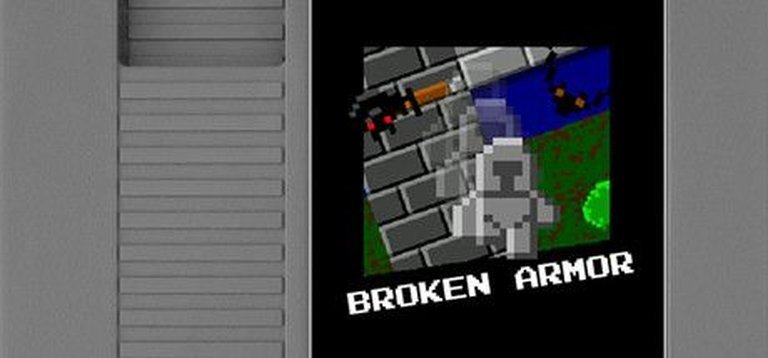
Broken Armor‘s aesthetic is deliberately retro, evoking the look and feel of early computer games. The pixel art is functional rather than impressive, with simple sprites and basic animations. The environments—dungeon, forest, dead forest, and dark dungeon—feature distinct visual themes, though the differences are largely cosmetic.
The game’s sound design follows a similar philosophy. The music has a retro vibe that fits the aesthetic, though it’s described by some players as “forgettable.” Sound effects are basic but effective, providing necessary audio feedback for actions and events.
What’s most impressive about Broken Armor‘s presentation is how cohesive it is. Every element—from the graphics to the sound to the gameplay mechanics—works together to create a unified retro experience. It’s not trying to be a modern game with retro aesthetics; it’s genuinely trying to recreate the feel of a specific era of gaming.
The world-building is minimal but effective. The different biomes provide visual variety and introduce new enemy types, keeping the gameplay fresh. The environmental hazards—water that slows movement, poison lakes that inflict damage, blood lakes with stronger effects—add strategic depth to navigation.
Reception & Legacy
Upon release, Broken Armor received a “Very Positive” rating on Steam, with 83% of over 750 reviews being positive. This reception is particularly impressive given the game’s modest price point and the crowded nature of the indie game market in 2016.
Critics and players praised the game for its authentic retro feel, challenging gameplay, and value for money. Many appreciated that it delivered exactly what it promised—a difficult, arcade-style experience reminiscent of 1980s computer games. The inclusion of the wizard DLC was also well-received, adding replay value without feeling like a cash grab.
However, the game’s reception wasn’t universally positive. Some players found the difficulty frustrating, particularly the lack of progression systems or permanent upgrades. Others felt that the retro aesthetic, while authentic, was too basic and uninspired. The minimal narrative and lack of depth in world-building were also points of criticism.
In terms of legacy, Broken Armor represents an interesting footnote in the evolution of indie gaming. It demonstrates that there’s still an audience for authentic retro experiences, even in an era when many indie games are pushing boundaries and experimenting with new ideas. The game’s success at such a low price point also highlights the importance of value perception in the indie market.
Broken Armor hasn’t spawned a significant franchise or influenced a wave of imitators, but it has found its niche audience. For players seeking a challenging, no-frills arcade experience, it remains a solid option.
Conclusion
Broken Armor is a game that knows exactly what it wants to be and executes that vision with admirable consistency. It’s not trying to revolutionize gaming or push the medium forward; it’s simply trying to recreate the feel of a specific type of game from a specific era. In this, it largely succeeds.
The game’s strengths lie in its authentic retro aesthetic, challenging gameplay, and value for money. The two playable characters offer different strategic approaches, and the roguelike elements provide variety and replayability. The minimalist narrative and world-building, while not particularly deep, fit the arcade-style focus perfectly.
However, Broken Armor also has its limitations. The difficulty, while part of its appeal, can be frustrating due to the lack of progression systems. The retro aesthetic, while authentic, may feel too basic for some players. The minimal narrative and world-building won’t satisfy those seeking a more immersive experience.
Ultimately, Broken Armor is a game that will appeal to a specific type of player—those who appreciate authentic retro experiences and don’t mind a bit of frustration in pursuit of mastery. For this audience, it’s a hidden gem worth the $0.99 asking price. For others, it may feel too basic or too challenging.
In the broader context of video game history, Broken Armor represents an important reminder that there’s still value in simplicity and authenticity. In an industry that often prioritizes innovation and complexity, it’s refreshing to see a game that’s content to be exactly what it is—a challenging, retro-inspired arcade shooter that delivers exactly what it promises.