
- Release Year: 2000
- Platforms: Windows
- Publisher: Shrapnel Games, Inc.
- Developer: Boku Strategy Games
- Genre: Strategy, Tactics
- Perspective: Top-down
- Game Mode: Single-player
- Gameplay: Hex-based wargame, Historical battles, Turn-based strategy, World War II
- Setting: Historical events, World War II
- Average Score: 66/100
Description
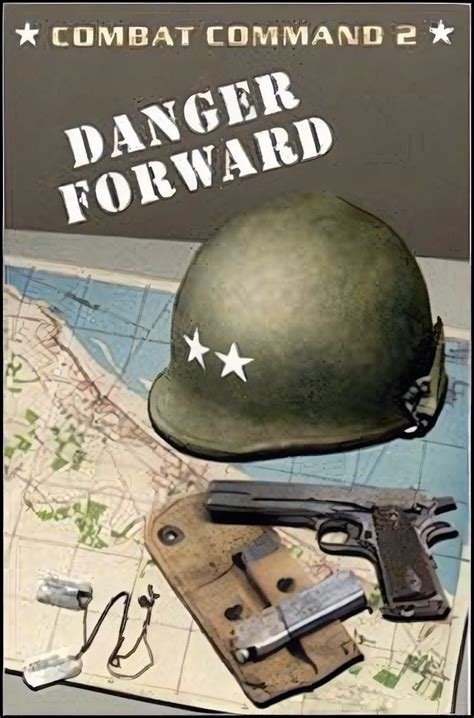
Combat Command 2: Danger Forward is a traditional hex-based wargame set in World War II, recreating lesser-known battles such as Anzio, Salerno, and Bastogne, with a focus on command and control of paradrops, glider landings, and amphibious operations.
Gameplay Videos
Where to Buy Combat Command 2: Danger Forward
PC
Combat Command 2: Danger Forward Cracks & Fixes
Combat Command 2: Danger Forward Patches & Updates
Combat Command 2: Danger Forward Reviews & Reception
metacritic.com (66/100): A terrific challenge on the purely mental level.
Combat Command 2: Danger Forward: Review
Combat Command 2: Danger Forward is a turn-based wargame that dared to venture into the often-overlooked theaters of World War II, focusing on the Mediterranean and Western Front amphibious and airborne operations from 1940-1945. Released in December 2000 by Shrapnel Games and developed by Boku Strategy Games, it aimed to provide a historically accurate and strategically deep experience for hardcore wargamers. This review will delve into the game’s development, gameplay, reception, and lasting legacy, examining whether it succeeded in its ambitious goals or fell short of its potential.
Development History & Context
Boku Strategy Games, a relatively small studio, took on the ambitious task of creating a wargame that focused on lesser-known WWII campaigns. The gaming landscape of 2000 was dominated by real-time strategy games and first-person shooters, with turn-based wargames being a niche market. Combat Command 2: Danger Forward sought to fill a gap in the market by offering a detailed and historically accurate simulation of amphibious and airborne operations, a subject rarely explored in video games.
The developers faced significant technological constraints, as the game was designed to run on relatively modest hardware (Pentium 166, 32MB RAM). This led to a focus on gameplay depth over graphical fidelity, a decision that would prove to be both a strength and a weakness. The game’s manual, a hallmark of traditional wargames, was extensive and detailed, providing players with a wealth of information about the game’s mechanics and historical context.
Narrative & Thematic Deep Dive
While Combat Command 2: Danger Forward doesn’t have a traditional narrative in the sense of a story-driven game, it tells the story of World War II through its scenarios and historical accuracy. The game covers a wide range of battles, from the invasion of Crete to the Battle of the Bulge, each with its own unique challenges and historical significance.
Thematically, the game emphasizes the importance of command and control, supply lines, and the challenges of coordinating large-scale amphibious and airborne operations. It highlights the difficulties faced by commanders in these situations, such as the unpredictability of paratrooper drops, the vulnerability of landing forces, and the importance of maintaining communication with headquarters.
Gameplay Mechanics & Systems
Combat Command 2: Danger Forward is a turn-based wargame that uses a hex-based map system. Each hex represents 500 meters, and turns represent 2 hours during daylight and 4 hours during nightfall. The game features a variety of unit types, including infantry, armor, artillery, and specialized units like paratroopers and commandos.
The game’s core mechanics revolve around command and control, supply, and combat resolution. Units must be within command range of their headquarters to function effectively, and supply lines must be maintained to ensure units have the resources they need to fight. Combat is resolved using a detailed system that takes into account factors such as unit type, terrain, and weather.
One of the game’s most innovative features is its emphasis on amphibious and airborne operations. Players must carefully plan their drops and landings, taking into account factors such as wind, enemy anti-aircraft fire, and the availability of landing zones. The game also features a robust scenario editor, allowing players to create their own custom battles.
However, the game’s interface has been criticized for being clunky and unintuitive. The game uses a modal interface, where players must switch between different phases of the turn, and the controls can be confusing. Additionally, the game’s graphics are dated, even by 2000 standards, and the sound design is minimal.
World-Building, Art & Sound
Combat Command 2: Danger Forward’s world-building is focused on historical accuracy rather than visual spectacle. The game’s maps are detailed and accurate representations of the battlefields of World War II, with terrain features such as rivers, forests, and mountains playing a crucial role in gameplay.
The game’s art style is functional rather than flashy, with unit counters and terrain features rendered in a simple, easy-to-read format. While the graphics may not be impressive by modern standards, they serve their purpose of conveying information to the player.
The sound design is minimal, with basic sound effects for gunfire, explosions, and movement. The game’s music is limited to a few tracks that play during the menu screens. While the lack of sound may be a drawback for some players, it doesn’t detract from the game’s strategic depth.
Reception & Legacy
Combat Command 2: Danger Forward received mixed reviews upon its release. Critics praised the game’s historical accuracy, strategic depth, and innovative focus on amphibious and airborne operations. However, they also criticized the game’s dated graphics, clunky interface, and lack of sound.
The game’s reception was further complicated by the fact that it was released in a market dominated by more mainstream titles. While it found a dedicated following among hardcore wargamers, it failed to attract a wider audience.
Despite its mixed reception, Combat Command 2: Danger Forward has left a lasting legacy in the wargaming community. It is remembered as a game that dared to explore lesser-known aspects of World War II and provided a challenging and rewarding experience for those who were willing to look past its flaws.
Conclusion
Combat Command 2: Danger Forward is a game that is both flawed and fascinating. It is a testament to the dedication of its developers, who sought to create a historically accurate and strategically deep wargame in a market that was increasingly focused on flash over substance. While its dated graphics, clunky interface, and lack of sound may deter some players, those who are willing to look past these flaws will find a rewarding and challenging experience.
The game’s emphasis on command and control, supply, and the challenges of amphibious and airborne operations sets it apart from other wargames of its time. It is a game that rewards careful planning, strategic thinking, and a deep understanding of the historical context of World War II.
In the end, Combat Command 2: Danger Forward is a game that deserves to be remembered for its ambition, its historical accuracy, and its innovative focus on lesser-known aspects of World War II. It may not be a perfect game, but it is a game that has left a lasting impact on the wargaming community and continues to be enjoyed by those who appreciate its unique blend of strategy and history.