
- Release Year: 1979
- Platforms: Android, BlackBerry, Browser, DOS, HP Programmable Calculator, Mainframe, TI Programmable Calculator, Windows, Z-machine
- Developer: James L. Dean
- Genre: Adventure
- Perspective: Text-based
- Game Mode: Single-player
- Gameplay: Exploration, Interactive fiction, Puzzle-solving, Text adventure, Turn-based
- Setting: Adventure, Fantasy
Description
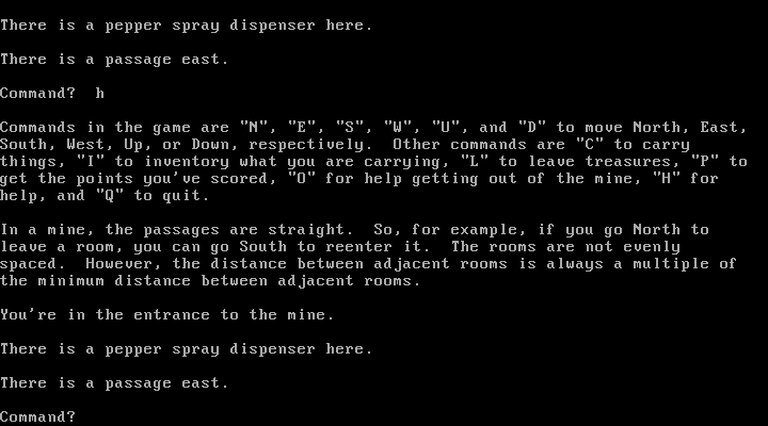
Mines is a classic text adventure game where players navigate randomly generated mine layouts to explore rooms and uncover treasure. The game features a simple text parser that understands only six cardinal directions, ‘drop’, ‘carry’, and ‘way out’ commands, with puzzles automatically resolving when the correct item is carried. Each playthrough offers unique map layouts, item locations, and puzzles for replayability.
Mines Guides & Walkthroughs
Mines Reviews & Reception
bluerenga.blog : Unfortunately, this leads to a sad feeling of Mines being less of an adventure than Treasure Hunt was.
Mines: Review
Introduction
In the nascent decade of video game history, when digital worlds were defined by flickering pixels and rudimentary text, few experiments were as audacious as James L. Dean’s Mines (1979). More than a mere text adventure, it was a pioneering foray into procedural generation—a radical concept that would foreshadow the roguelike renaissance half a century later. Yet, Mines remains a paradox: a game of remarkable historical significance, yet one whose mechanical simplicity and narrative abstraction limit its enduring appeal. This review dissects Mines not as a finished product, but as a pivotal artifact—a crystallization of 1970s computational ambition that dared to randomize entire game worlds, only to reveal both the boundless potential and the inherent pitfalls of such a vision. Its legacy lies not in polish, but in its audacity: a blueprint for infinite replayability that inadvertently exposed the fragile line between procedural ingenuity and player engagement.
Development History & Context
The Visionary and His Constraints
James L. Dean, a solo developer operating on the TANO Corporation Output mainframe, crafted Mines in 1979 with a singular, audacious goal: to generate a unique mine labyrinth every time a player started the game. This was no small feat on hardware limited to 64K of RAM and a 6800 processor. Written in BASIC, the original version was a triumph of resourcefulness, squeezing a randomized world into memory-starved environments. Dean’s vision was mathematical elegance: mine layouts, treasure placements, and puzzle locations were algorithmically derived from a player-selected “mine number,” ensuring repeatability for speedrunners while offering freshness for casual explorers.
Technological Constraints and Adaptations
The game’s minimalist interface was dictated by era-appropriate limitations. Dean designed Mines for text-only terminals, avoiding graphics entirely to maximize compatibility. The DOS port (2006) retained this ethos, running on monochrome MDA/Hercules displays without forcing graphical modes—a deliberate choice that allowed it to function on primitive hardware but left text rendering erratic in 40-column modes. The 2005 rewrite, compiled in Borland Turbo C++, exemplified Dean’s dedication to accessibility, porting the game to modern OSes while preserving its core mechanics. By 2015, Mines had proliferated across calculators (HP, TI), browsers, and mobile platforms—a testament to Dean’s obsession with making his creation universally playable.
The Gaming Landscape of 1979
* Mines emerged from the shadow of giants like Adventure (1976) and Zork (1977), which defined the text-adventure genre with static, handcrafted worlds. While contemporaries focused on narrative and puzzle logic, Mines embraced randomness, aligning it with the “Hunt the Wumpus” tradition of procedurally generated mazes. Yet, it stood apart by integrating item-based puzzles into its randomized framework—a concept so novel that it predated similar systems in Rogue (1980) by years. Dean’s work existed in a liminal space: too simplistic for the narrative-driven adventures of Infocom, yet too structured for the pure randomness of early arcade games. It was a bridge between the wild experimentation of the 1970s and the emerging design principles of the 1980s.
Narrative & Thematic Deep Dive
The Absence of Narrative
Mines offers no traditional plot, characters, or dialogue. Its “story” is a minimalist objective: explore a mine, visit all 100 rooms, and retrieve every treasure. Obstacles—described as a “bear,” “gorgon,” or “vampire”—are static environmental hazards, not entities with agency. The sole narrative moment occurs when a pirate steals a treasure upon using the “Way Out” command, shouting the cryptic clue “WWNUWW.” This is not character interaction but a mechanical prompt, stripping the game of any meaningful storytelling.
Thematic Dissonance Through Randomization
The game’s themes emerge from its procedural chaos. Room descriptions are deliberately incongruous—a “nuclear test site” adjacent to a “hobbit’s room,” or a “hall of dinosaur bones” near the “first circle of hell.” This fragmentation creates a surreal, dreamlike atmosphere, where the mine feels less like a coherent space and more like a collage of subconscious fears. Thematically, it explores the futility of imposing order on randomness: the player’s goal is “completeness,” but the world’s inherent chaos undermines this pursuit. However, the lack of narrative cohesion reduces these moments to novelty rather than profundity. Dean’s randomization prioritizes mechanical possibility over thematic resonance, leaving the player adrift in a world devoid of logic or consequence.
Gameplay Mechanics & Systems
Core Loop: Exploration and Collection
The gameplay is a loop of navigation, item acquisition, and puzzle resolution. Players move through cardinal directions (N, S, E, W, Up, Down), with the parser accepting only six directional commands plus “Carry” (to pick up all items in a room), “Drop” (to discard items), and “Way Out” (to return treasures to the entrance). The objective is twofold: map the entire mine and transport all treasures back to the starting point.
Puzzle Design: Automatic Resolution
Mines’ most innovative and controversial mechanic is its automatic puzzle solving. Obstacles like a “vampire” or “crocodile” are bypassed instantly if the player carries the correct item (e.g., a “silver bullet” or “duct tape”). This eliminates trial-and-error but also agency—the player never solves puzzles so much as triggers solutions. Dean guaranteed that necessary tools were never blocked by procedural generation, ensuring solvability, but this reduced puzzles to mere key-and-lock scenarios. The absence of dynamic elements (e.g., moving threats like the Wumpus) further flattens the experience into a mechanical exercise.
UI and Progression: Minimalism to a Fault
The interface is brutally minimalist. Room descriptions and carried items are listed plainly, with no visual distinction between hazards and treasures. Inventory management is trivialized by the “Carry” command, which scoops all items, and the lack of space constraints. Progression is purely numerical: points are awarded for visiting rooms and retrieving treasures, with an emphasis on efficiency (fewer moves = higher score). There are no stats, upgrades, or skills—only the raw challenge of mapping and optimization. This purity highlights the era’s design philosophy: gameplay as abstract problem-solving, divorced from narrative or character growth.
Innovations and Flaws
Mines’ brilliance lies in its procedural generation, which ensured puzzle solutions were always available—a precursor to modern balanced roguelike design. Yet, its flaws are equally telling: the lack of player agency, the absence of meaningful risk, and the disorienting randomness of room descriptions. As critic Jason Dyer noted, it exemplifies the “problems with excessive random generation and automatic puzzle solving,” reducing adventure to “abstraction.”
World-Building, Art & Sound
The Procedural Labyrinth
Mines’ world is its greatest strength and weakness. With 100 algorithmically generated rooms, the mine is a unique, non-Euclidean space each playthrough. Straight passages ensure logical backtracking (e.g., North leads South), but room spacing is irregular, creating a disorienting maze. Descriptions are randomly assigned, turning exploration into a series of surreal tableaus: “You are in the lair of a giant trapdoor spider” adjacent to “The passage down is guarded by a vampire.” This lack of cohesion evokes the sublime—an awe-inspiring, terrifying void—but also undermines immersion. The mine feels less like a place and more like a machine, its “rooms” placeholders for puzzles.
Visual and Sonic Identity
Visually, Mines is a triumph of austerity. The DOS port’s screenshots reveal a monochrome text interface, with crisp 8×14 EGA fonts or 9×16 VGA glyphs. Art direction is nonexistent; the game relies entirely on text to evoke imagery. Sound design is absent, leaving the player alone with the clatter of a keyboard. This minimalism forces imagination to fill the gaps, but it also amplifies the game’s artificiality. The contrast between evocative descriptions (“a hall of dinosaur bones”) and their nonsensical placement (“next to a nuclear test site”) creates a cognitive dissonance that is more jarring than atmospheric.
Reception & Legacy
Launch and Cult Status
In 1979, Mines left no documented critical footprint. As a mainframe title, it was likely played by academics and hobbyists, its significance lost amid the graphical explosion of the early 1980s. Its true renaissance came with Dean’s 2005 DOS port and subsequent multiplatform releases. Enthusiasts in the retro-computing and interactive fiction communities embraced it as a curio—a “Wumpus/Treasure Hunt hybrid” with procedural DNA. However, reviews were mixed. Dyer’s 2016 analysis praised its innovation but lamented its “mechanical” soul, while speedrunners lauded its replayability. Commercially, it remains a niche product, collected by just four players on MobyGames.
Enduring Influence
Mines’ legacy is two-fold. As a technical achievement, it predates Rogue (1980) in integrating procedural generation with puzzle design, influencing countless indie games that prioritize infinite replayability. Its guarantee of solvability inspired modern systems like Spelunky’s balanced randomization. Conversely, it serves as a cautionary tale. Its lack of player agency and narrative coherence highlights the risks of prioritizing procedural systems over player experience. Games like No Man’s Sky (2016) echoed Mines’ promise of infinite worlds, only to face similar critiques for their emptiness. Today, Mines is studied in game design courses as a foundational text—a “model of problems with excessive randomization” that inadvertently defined a genre.
Conclusion
Mines is not a great game, but it is a vital one. In 1979, James L. Dean dared to build a world that was never the same twice, creating a procedural sandbox that felt both revolutionary and raw. Its brilliance lies in its audacity—a mine of infinite rooms, infinitely randomized, infinitely solvable. Yet, its limitations are equally telling: puzzles reduced to automatic triggers, a world shattered by randomness, and a narrative vacuum where wonder curdles into abstraction.
As a historical artifact, Mines is indispensable. It is the DNA of modern roguelikes, a bridge between the text adventures of the 1970s and the procedurally generated epics of today. Its ports to calculators and browsers are a testament to Dean’s generosity, ensuring this piece of history remains playable. Yet, its gameplay feels like a relic—a reminder of how far game design has evolved from abstract mechanics toward immersive storytelling.
Verdict: Mines deserves a place in the pantheon of video game history not as a masterpiece, but as a blueprint. It is a flawed, fascinating experiment that captures the exhilarating terror and the profound limitations of procedural worlds. To play Mines is to witness the birth of a paradigm—one that would redefine gaming, even as its own simplicity revealed the chasm between mechanical possibility and human connection. In an age of infinite worlds, Mines remains a humble, vital reminder that the greatest adventures often begin not with polish, but with a single, daring idea.