
- Release Year: 1984
- Platforms: 64, BBC Micro, Commodore 64, Dragon 32, Windows, ZX Spectrum
- Publisher: Imagine Software Ltd., Pixel Games UK
- Developer: Imagine Software Ltd.
- Genre: Action
- Perspective: Side view
- Game Mode: Single-player
- Gameplay: Arcade, Shooter
- Setting: Futuristic, Sci-fi
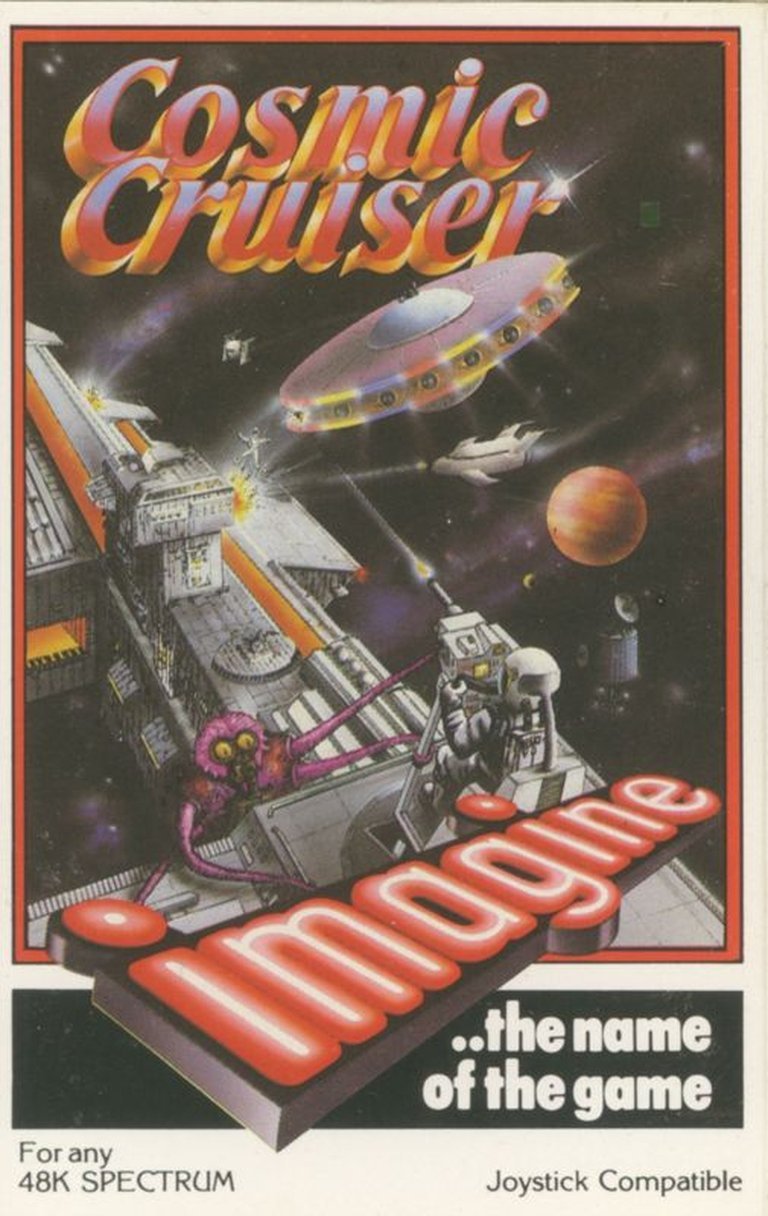
Description
In this side-view sci-fi shooter, players pilot an outdated Cosmic Cruiser on a desperate mission to rescue hostages from a space station overrun by the hostile Rallom Empire. Armed with a roof-mounted cannon, you must blast portals on the spinning station, rescue floating crew members, and transport them to safety while dodging Rallom Fighters and battling Alien Warriors with limited pistol ammo. With one-way momentum controls and constant enemy threats, each level becomes a race against time to rescue as many crew as possible before the timer expires.
Gameplay Videos
Where to Buy Cosmic Cruiser
PC
Cosmic Cruiser Free Download
Cosmic Cruiser Cracks & Fixes
Cosmic Cruiser Guides & Walkthroughs
Cosmic Cruiser Reviews & Reception
everygamegoing.com : The result is unplayable and very soon completely pointless.
Cosmic Cruiser: Review
Introduction
Cosmic Cruiser, released in 1984 by Imagine Software, emerges as a quintessential artifact of the 8-bit home computer era—a title teetering on the precipice of innovation and frustration. Heralded as a unique sci-fi shooter, it tasked players with rescuing hostages from an alien-infested space station using a ship-mounted cannon and a vulnerable astronaut. Its legacy is defined by polarizing critical reception, ambitious technical constraints, and a narrative steeped in pulp sci-fi tropes. This review dissects its development, narrative depth, gameplay systems, artistic execution, and historical significance, arguing that while Cosmic Cruiser ultimately succumbs to its own design flaws, it remains a fascinating, if flawed, specimen of 1980s game design—a bold attempt to merge shooter mechanics with rescue objectives on severely limited hardware.
Development History & Context
Cosmic Cruiser emerged from the tumultuous crucible of early 1980s British software development. Imagine Software, founded by Bruce Everiss, was a studio synonymous with technical ambition and aggressive marketing, known for pushing the boundaries of home computers like the Commodore 64 and ZX Spectrum. The game’s development reflected the era’s fragmented, platform-specific workflow:
– Commodore 64 Version: Programmed by Paul Clansey, with graphics by Mo Lambe and Paul Clansey, music by Fred Gray (a composer for 44 other titles), and illustrations by Brian Wall. The game idea originated from David H. Lawson.
– ZX Spectrum Version: Credited to a separate team—Steve Lavache, Steve Cain, and Abdul Hafiz Ibrahim—highlighting the common practice of parallel development cycles across platforms.
Imagine’s marketing emphasized lavish packaging, including detailed cassette inlays and manuals that framed Cosmic Cruiser as a cinematic sci-fi saga. Released at £5.50 (a premium price), it competed against titles from Ocean and U.S. Gold during the home computer boom. Technologically, the game grappled with severe limitations: the Commodore 64’s superior graphics and sound (via Fred Gray’s chiptunes) contrasted sharply with the ZX Spectrum’s monochrome palette and audio constraints. These limitations forced compromises in gameplay depth, making Cosmic Cruiser a product of its time—ambitious yet constrained by the 8-bit era’s technical ceiling.
Narrative & Thematic Deep Dive
Cosmic Cruiser’s narrative, distilled from its manual and inlays, channels classic B-movie sci-fi tropes:
– Premise: The Rallom Empire, a hostile alien force, seizes an Earth space station, holding its crew hostage. Players pilot the titular “Cosmic Cruiser”—an outdated starship—on a suicidal rescue mission.
– Objectives: Players must blast open portals on the station’s exterior, enter, locate crew members, and ferry them back to the ship while battling alien warriors and Rallom Fighters.
Thematic depth lies in its subversion of shooter norms. Unlike destruction-centric titles, Cosmic Cruiser prioritizes rescue, infusing gameplay with tension—each saved crew member is vulnerable to recapture. The narrative frames technology as a double-edged sword: the ship’s cannon is both a tool for salvation and a stationary vulnerability, while the astronaut’s jetpack is a liability in zero-G. However, execution is sparse. The game offers no in-story exposition beyond the manual, reducing the narrative to a functional backdrop. Alien antagonists lack characterization, and the “Rallom Empire” remains a faceless threat. This minimalism reflects 1980s game design, where story often deferred to packaging, but it underscores the title’s identity as a gameplay-first artifact.
Gameplay Mechanics & Systems
Cosmic Cruiser’s gameplay is a hybrid of turret-based shooting, platforming, and rescue mechanics—a conceptually ambitious fusion that falters in execution:
Core Loops
-
Exterior Phase:
- Players control a cannon turret on their ship (bottom-right screen), targeting rotating station compartments (top screen).
- Portals are blasted open by the turret, but its movement is jerky and imprecise.
- Rallom Fighters bomb the ship; the player is immune while firing the cannon but loses a life if hit while flying.
-
Rescue Phase:
- Players launch an astronaut to enter portals. Inside, they locate floating crew members and escort them to the ship’s hatch (bottom-left screen).
- Alien Warriors attempt to recapture hostages or kill the player. Limited pistol ammo demands strategic shooting.
-
Progression:
- Levels end via timer or rescuing eight crew members. Bonuses are awarded for survivors, and ammo replenishes.
Flaws and Innovations
- Controls: The astronaut moves in one direction at a time, unable to stop—leading to “wobbling” and wall collisions. This makes navigation maddening, especially in cramped station interiors.
- Enemy AI: Alien Warriors aggressively target crew members, creating constant tension but also frustration. Their speed and numbers often overwhelm the player.
- Risk-Reward Balance: Firing while carrying a crew member causes them to float away—a clever mechanic that penalizes recklessness. Yet, limited ammo and sparse health pickups exacerbate difficulty spikes.
- Replay Value: Progressive difficulty (faster enemies, more complex layouts) encourages mastery, but poor controls sap motivation.
Platform-Specific Nuances
The Commodore 64 version features smoother animations and Fred Gray’s iconic title music, while the ZX Spectrum struggles with flickering sprites and basic sound. Both versions suffer from the same core design issues, proving that technical polish couldn’t salvage fundamental flaws.
World-Building, Art & Sound
Cosmic Cruiser’s aesthetic is a product of 1980s sci-fi pulp and hardware constraints:
Visual Design
- Exterior: The station rotates as a wheel of compartments, rendered with parallax effects on the Commodore 64. Its metallic surfaces and glowing portals evoke retro-futurism.
- Interior: Station corridors are claustrophobic, with false-perspective compartments that limit movement. Alien warriors are simplistic humanoid sprites, while the astronaut’s design is functional but stiff.
- Color Palette: The Commodore 64 version uses vibrant blues and greys for the station, contrasting with the ZX Spectrum’s monochrome austerity.
Sound Design
- Commodore 64: Fred Gray’s title theme is a standout—melodic and heroic. In-game effects (cannon fire, pistol shots) are crisp but sparse.
- ZX Spectrum: Limited to beeps and boops, with no memorable musical cues.
Atmosphere
The game’s flip-screen approach breaks immersion, as perspective shifts reset abruptly. Despite this, the art direction successfully conveys isolation and danger—especially during rescue missions, where the emptiness of space amplifies vulnerability. Yet, the lack of environmental storytelling (e.g., no crew animations or station details) prevents deeper world-building.
Reception & Legacy
Cosmic Cruiser’s 1984 reception was a study in contrasts, reflecting the era’s divided gaming press:
Critical Response
- Praise: Home Computing Weekly awarded a rare 5/5, citing “excellent sound, colour and graphics” and labeling it “fast and addictive.”
- Criticism: Crash magazine lambasted it with a 54% score, deeming it “unplayable and completely pointless.” Reviews highlighted unresponsive controls, jerky animation, and frustrating difficulty.
Commercial and Historical Impact
- Sales figures are unrecorded, but the game faded quickly, overshadowed by Imagine’s more polished titles (e.g., Zzoom).
- Legacy: Cosmic Cruiser became a cautionary tale for ambitious game design. Its hybrid mechanics foreshadowed modern “rescue” shooters but were undone by poor execution.
- Re-releases: A 2022 Steam remaster (by Pixel Games UK) added save states and controller support, allowing modern players to experience its flaws firsthand. Its MobyGames and Wikipedia entries preserve its niche status as a historical curiosity.
Influence
The game’s influence is minimal; its blend of shooting and rescue didn’t spawn imitators. Instead, it exemplifies the risks of 8-bit era innovation—where bold ideas collided with technical limitations, yielding experiences more fascinating than enjoyable.
Conclusion
Cosmic Cruiser stands as a monument to the double-edged sword of 1980s game development: ambition without polish. Its narrative of lone heroism against alien invaders is compelling, and its gameplay fusion of turret combat and rescue is admirably ahead of its time. Yet, sluggish controls, punishing difficulty, and technical constraints cripple its potential. For historians, it offers a snapshot of Imagine Software’s creative highs and commercial lows, alongside the era’s hardware struggles. For players, it remains a challenging, uneven experience—one that rewards patience more than pleasure. Ultimately, Cosmic Cruiser is a worthy entry in video game history: not a masterpiece, but a testament to the bold, messy experimentation that defined the medium’s formative years. Its legacy endures not as a classic, but as a flawed, fascinating relic of a bygone era.