
- Release Year: 2015
- Platforms: Windows
- Publisher: Headup Games GmbH & Co. KG
- Developer: Chainsaw Syndicate
- Genre: Action
- Perspective: Side view
- Game Mode: Single-player
- Gameplay: Beat ’em up, brawler
- Setting: Fantasy
- Average Score: 50/100
Description
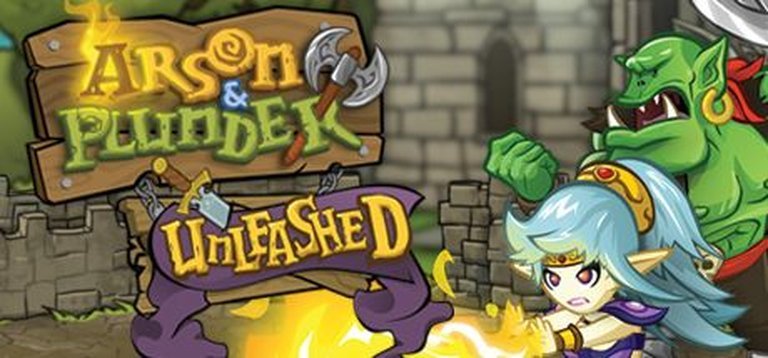
Arson & Plunder: Unleashed is a fantasy-themed beat ’em up brawler set in the Loidar wood, where ancient rivalries between orcs and elves are interrupted by the invasion of humans seeking to plunder their sacred lands. Forcing an unprecedented truce, players unite these warring factions in 2D scrolling combat to defend their homeland from resource-hungry invaders.
Gameplay Videos
Where to Buy Arson & Plunder: Unleashed
PC
Arson & Plunder: Unleashed Guides & Walkthroughs
Arson & Plunder: Unleashed Reviews & Reception
metacritic.com (40/100): Arson and Plunder: Unleashed is just another beat ’em up of no importance. It’s simplistic, it’s repetitive, and, it looks and feels amateurish.
indiegamebundles.com (61/100): Arson and Plunder delivers on the beat-em-up action, and if you’re a fan of the genre this little gem just may be worth a try.
Arson & Plunder: Unleashed: Review
Introduction
In an era dominated by photorealistic epics and sprawling open worlds, Arson & Plunder: Unleashed emerges as a vibrant, pixelated love letter to the golden age of arcade beat ’em ups. Released in 2015 by Spanish developer Chainsaw Syndicate, this game dares to distill the chaotic joy of classics like Final Fight and Teenage Mutant Ninja Turtles into a modern, co-op-friendly package. Its central gimmick—a pyromaniacal elf and a berserk orc fused into a single, bickering body—promises a unique twist on the genre. Yet, as we delve into its history, mechanics, and legacy, a complex picture emerges: a game brimming with charm and ambition, yet hampered by technical quirks and design inconsistencies. This review argues that Arson & Plunder: Unleashed stands as a flawed, endearing curio in the beat ’em up revival—a testament to indie passion that excels in local multiplayer but falters in its solo execution, ultimately securing its place as a niche cult favorite rather than a genre landmark.
Development History & Context
Chainsaw Syndicate, a small Spanish studio with a portfolio focused on action titles, entered the fray in 2015 with a clear reverence for 90s arcade brawlers. Their vision for Arson & Plunder: Unleashed was explicitly nostalgic: “The classic gameplay has been brought up to speed with the latest developments and trends,” as their Steam description proclaims. This meant retaining the genre’s core loop—wading through hordes of enemies—while modernizing it with features like seamless character-switching and 4-player local co-op. Technologically, the game was unassuming. Built with middleware SDL and requiring modest specs (a dual-core 2.0 GHz CPU and 512MB GPU were sufficient), it prioritized accessibility over cutting-edge graphics, aiming for a “beautiful 2D comic art style” rather than high-fidelity visuals.
The 2015 gaming landscape was fertile ground for such a project. The indie scene was booming, with titles like Castle Crashers and Shovel Knight reviving retro genres with contemporary polish. Meanwhile, beat ’em ups were experiencing a quiet renaissance, with Streets of Rage 4 in early development signaling renewed interest. Chainsaw Syndicate positioned Arson & Plunder as an affordable ($4.99) “arcade/beat ’em up adventure,” targeting both nostalgic purists and co-op-seeking friends. However, the studio’s limited resources and ambition created a tension: while the game captured the spirit of its influences, it often struggled to match their technical or design polish, a constraint reflected in its modest sales and mixed reception.
Narrative & Thematic Deep Dive
The narrative premise is gloriously absurd: the eternal war between orcs and elves in the Loidar forest is abruptly halted by a common enemy—humans deforesting their sacred lands. Forced into an uneasy truce, the two races dispatch their champions—Arson, a graceful fire-mage elf, and Plunder, a brutish axe-wielding orc—to infiltrate human territory via a magical teleportation stone. The twist? The stone fuses them into a single, unwilling body, forcing them to share control as a bickering, dual-persona entity. This setup is pure comedic gold, with the constant friction between Arson’s precision and Plunder’s rage driving the dialogue. Lines like “For Great Justice!” and “Tinargey & Vrok” (the characters’ titles, also an achievement name) are delivered with self-aware humor, leaning into 4th-wall breaks and puns (“We Have the possibility to instantly change characters… but we can’t change characters in the middle of a combo”).
Thematically, the game tackles unexpected depth for a brawler. The deforestation plot serves as a blunt environmental allegory, framing humans as faceless exploiters (“Man, a wicked race that wants to take possession of their sacred woodlands”). The orc-elf truce explores forced unity, with characters acknowledging their shared animosity while relying on each other’s skills (“they don’t rely on the others’ abilities”). Most compelling is the “fused body” metaphor—an embodiment of compromise and mutual dependence. The story’s conclusion—where the duo remains fused and journeys to “unnamed lands” seeking powerful wizards—hints at sequels that never materialized, leaving players to imagine further adventures. While the plot is straightforward, the dialogue elevates it, transforming a simple “save the forest” quest into a character-driven farce.
Gameplay Mechanics & Systems
At its core, Arson & Plunder delivers a satisfying beat ’em up experience amplified by its signature gimmick: real-time character-switching. Players seamlessly toggle between Arson (ranged fire attacks) and Plunder (melee berserker fury), adapting to enemy swarms on the fly. This creates dynamic combat: Arson kites distant foes with fireballs while Plunder cleaves through crowds up close. The switch is instant, encouraging tactical flexibility—in theory. As one Steam critic lamented, “the game won’t let you change mid-combo,” forcing players to finish attacks before swapping, which disrupts flow. The controls, praised as “intuitive” by the developer, are divisive. Keyboard controls feel “clunky,” especially during complex combos, while controller support (Xbox 360/One, PS4) is smoother but still lacks the responsiveness of genre classics. Combat itself is weighty, with 20-30 enemies on-screen demanding crowd-control mastery—a refreshing throwback to arcade chaos.
Progression is structured across 25 story missions and 5 difficulty levels, with “challenging boss fights” punctuating each chapter. Character advancement is minimal, relying on skill mastery rather than RPG elements. A “switch anytime” mechanic is highlighted as innovative, but its utility is limited by the inability to interrupt animations. The co-op mode is a standout, allowing up to four players (each choosing between elf, orc, or other characters) to team locally, turning the campaign into a chaotic, cooperative spectacle. For solo players, “Endless mode” offers replayability by pitting them against escalating waves in a dungeon scenario. However, the campaign’s brevity (~1.5 hours) and lack of depth beyond switching and combat leave it feeling underdeveloped. UI is functional but basic, with health bars and mission objectives displayed plainly. Ultimately, the gameplay loop is strong in bursts but undermined by technical hiccups and design oversights.
World-Building, Art & Sound
The game’s fantasy setting—the Loidar forest and surrounding human territories—is rendered with a distinctive 2D comic-book aesthetic. Environments like deforested woodlands and human villages are richly detailed, with parallax scrolling creating depth. The art style leans heavily on bold outlines, exaggerated character designs (Plunder’s hulking frame vs. Arson’s lithe agility), and a muted palette of browns, greens, and earthy tones that reinforce the environmental theme. While described as “beautiful” and “gorgeous” in promotional materials, some reviewers noted “choppy” animations (e.g., Arson’s walk cycle) and limited environmental interactivity beyond background elements.
Sound design is a high point. The soundtrack, a “metalhead’s dream,” features shredding guitars and driving percussion that perfectly match the action, though it lacks standout solos. Sound effects—clangs of axes, fiery whooshes—are crisp and impactful, enhancing the tactile feedback of combat. Voice acting is absent, replaced by text-based dialogue, which allows the humor to shine through. The world-building is minimal but effective; the deforestation plot visually reinforces the stakes, with barren landscapes contrasting the vibrant forest. While not as expansive as Dust: An Elysian Tail, the art direction succeeds in creating a cohesive, stylized world that serves the game’s comedic tone and nostalgic appeal.
Reception & Legacy
Upon release, Arson & Plunder: Unleashed received a mixed reception that reflected its strengths and flaws. On Steam, it holds a “Mixed” score (59% positive from 49 reviews), with praise for its co-op, humor, and art style balanced by criticism of short length and clunky controls. Metacritic aggregated a low score of 40, based on a single negative review from Cubed3, which dismissed it as “simplistic, repetitive, and amateurish.” User reviews echoed this duality: one Steam player lauded the “very high Gameplay in Co-op mode,” while another lamented, “I do not recommend that you buy it loose.”
Commercially, it found modest success as a budget title ($4.99), often purchased in bundles. Its legacy is that of a cult favorite rather than an innovator. It influenced few direct successors but is remembered for its unique fusion premise and local co-op accessibility. In the indie beat ’em up revival, it stands alongside titles like Rampage Knights—quirky, charming, but ultimately overshadowed by more polished efforts like Streets of Rage 4. Chainsaw Syndicate never released a sequel, and the game’s unresolved ending (“unnamed lands”) remains a tantalizing footnote. Today, it’s recommended for genre enthusiasts seeking co-op fun on sale, but its reputation persists as a “flawed gem”—a testament to passion over polish.
Conclusion
Arson & Plunder: Unleashed is a game of delightful contradictions: it’s a loving tribute to 90s brawlers yet hampered by dated mechanics; a humorous tale of unlikely allies undermined by repetitive gameplay; a technical modesty that allows for creative art direction but results in clunky controls. Its core strengths—the seamless elf-orc switching, the chaotic 4-player co-op, and the witty writing—create moments of pure, unadulterated fun. Yet, its short campaign, underdeveloped progression, and inconsistent execution prevent it from reaching the heights of its inspirations.
In the grand tapestry of video game history, Arson & Plunder occupies a niche space: a charming, if flawed, indie experiment that captures the spirit of arcade-era camaraderie. It may not redefine the beat ’em up genre, but it offers a unique, co-op-centric experience that resonates with fans of retro chaos. For those willing to overlook its imperfections, this fused duo’s journey is worth taking—especially with friends. As a historical artifact, it stands as a poignant reminder of the indie scene’s mid-2010s surge, a time when passion and creativity could thrive on a modest budget. In the end, Arson & Plunder: Unleashed is less a masterpiece and more a valiant, entertaining misstep—a brawler that burns bright, even if it doesn’t fully plunder the genre’s potential.