
- Release Year: 2006
- Platforms: Windows
- Publisher: DreamCatcher Interactive Inc., Frogster Interactive Pictures AG, Noviy Disk, Ubisoft Entertainment SA
- Developer: Lexis Numérique SA
- Genre: Adventure, Alternate reality game, Detective, Horror, Mystery
- Perspective: 1st-person
- Game Mode: Single-player
- Gameplay: Email interaction, Mini-games, Puzzle, Web browsing
- Setting: Detective, Europe, Horror, Modern
- Average Score: 68/100
Description
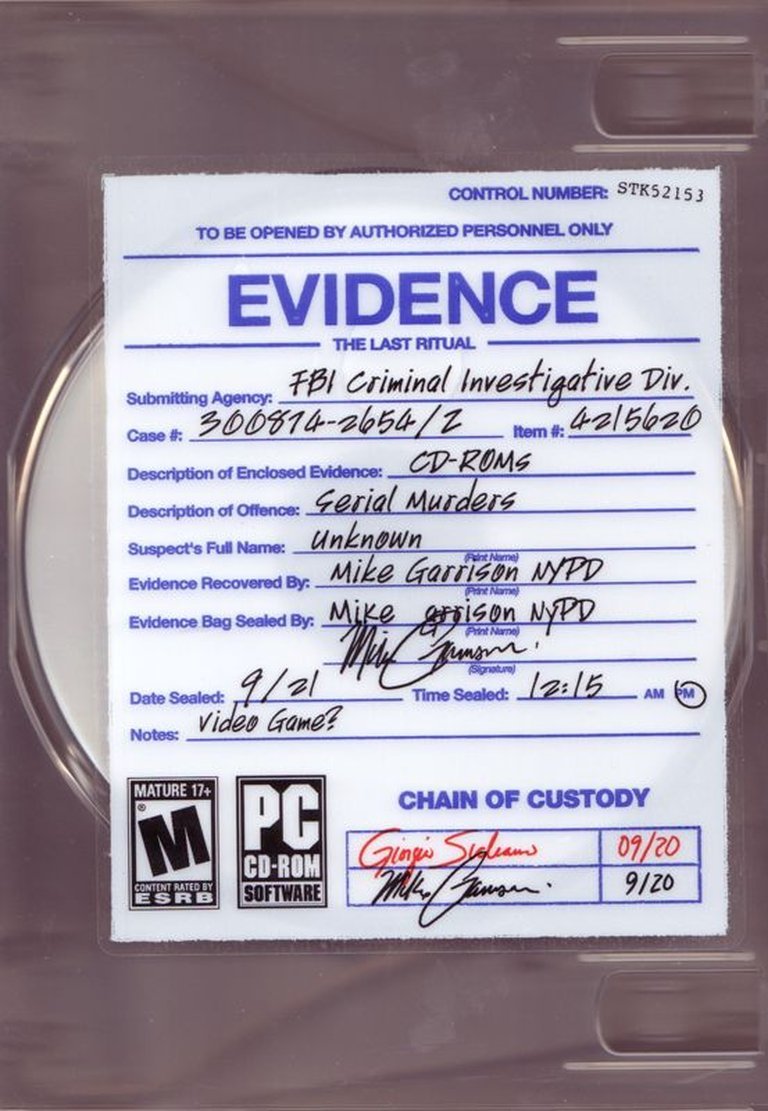
Evidence: The Last Ritual is a first-person adventure puzzle game serving as a sequel to ‘Missing’, where players join the ICPA to hunt the elusive serial killer ‘The Phoenix’ across Europe. The game features eight levels with stylized puzzles, cryptic riddles, and gruesome challenges presented through live-action videos and interactive Flash mini-games, requiring an internet connection to solve clues and receive emails from in-game characters like Officer Manuela and Jessica.
Gameplay Videos
Evidence: The Last Ritual Free Download
Evidence: The Last Ritual Guides & Walkthroughs
Evidence: The Last Ritual Reviews & Reception
metacritic.com (74/100): A truly excellent and innovative adventure game.
ign.com : fun despite bringing little innovation to the table
gamepressure.com (62/100): Spine-tingling and suspense-filled plot that will mesmerize gamers
Evidence: The Last Ritual: Review
1. Introduction
In an era saturated with cookie-cutter adventures, Evidence: The Last Ritual (2006) stands as a haunting, audacious outlier—a digital enigma that blurs the lines between game, interactive film, and cold-case investigation. As the sequel to the cult hit Missing: Since January (In Memoriam in Europe), this French-developed thriller dared players to confront a serial killer not through controller-wielding combat, but through real-world sleuthing. Its legacy lies in its prescient Alternate Reality Game (ARG) mechanics, which predated the viral marketing boom of titles like Halo 2 and Lost. Yet, its true brilliance—and infamy—stems from a design that demands intellectual rigor and emotional fortitude. This review dissects Evidence: The Last Ritual as a landmark of experimental game design, examining its narrative ambition, technological innovations, and the unsettling, often divisive experience it delivered.
2. Development History & Context
2.1 Lexis Numérique’s Vision
Developed by France’s Lexis Numérique, Evidence emerged from a studio obsessed with narrative immersion. Led by creator Éric Viennot, the team expanded on the ARG framework of Missing, treating the game not merely as software but as an evolving dossier. The decision to position it as an “add-on” sequel—rather than a full reimagining—was pragmatic, driven by the “excessive time and financial commitment” required for a standalone product (Wikipedia). Yet, this constraint became a strength. With Ubisoft and DreamCatcher publishing globally, the developers doubled down on what worked: sprawling conspiracies, real-world research, and live-action horror.
2.2 Technological Constraints and Innovations
Released in 2006, the game operated at the intersection of CD-ROMs and nascent web culture. Its core innovation—web-integrated puzzles—required players to scour real and fictional websites (e.g., Google Earth, MapQuest) and receive in-character emails. The French version even offered SMS alerts and phone calls, creating unprecedented player-world symbiosis (Wikipedia). Yet, these ambitions were tempered by technological limits: Shockwave for mini-games, low-resolution 800×600 interfaces, and a dependency on now-obsolete Flash for critical clues. As one review noted, this “opposite of Dead Rising’s infamous issue” forced players to squint or switch resolutions, disrupting immersion (Worth Playing).
2.3 Gaming Landscape of 2006
The mid-2000s were a golden age for experimental PC adventures. Titles like Majestic (2001) had tested ARG waters, but Evidence pushed further, mirroring the Da Vinci Code-obsessed zeitgeist. Critics hailed its “revolutionary” scale, comparing it to “a Da Vinci Code puissance 10” (JeuxActu). Yet, it also faced skepticism. Adventure gamers, weary of point-and-click stagnation, embraced its intellectual rigor, while mainstream audiences struggled with its punishing difficulty. As IGN noted, it was “the same game with a continued story”—a formula that thrilled fans but alienated newcomers seeking novelty.
3. Narrative & Thematic Deep Dive
3.1 Plot: A Web of Betrayal and Ritual
Evidence concludes the saga of “The Phoenix,” a serial killer whose M.O. is psychological torment. The narrative unfolds across parallel investigations:
– Jessica Moses (Sabine Crossen) hunts for her brother Adrian, lured into a cult-like splinter group (OSCS) after cryptic messages lead her to a New England castle.
– Jack Lorski (Olivier Chenevat), the journalist from Missing, aids Portuguese detective Manuela Ortiz (Marta Domingo) in tracking Manus Domini-linked murders.
The plot’s genius lies in its escalating dread. Adrian’s death reveals him as the Phoenix’s disciple, while Jessica’s abduction culminates in a Scottish warehouse confrontation where profiler Gerd Hanke (Stéphane Cornicard) rescues her—only for the Phoenix’s survival to be hinted at via a post-climax email. Themes of obsession, complicity, and digital voyeurism permeate the story. As the Phoenix’s puzzles force players into his perspective, the game asks: What does it mean to become complicit in a killer’s ritual?
3.2 Characters: The Illusion of Control
The cast is a masterclass in unreliable narration. Jessica’s vulnerability humanizes the horror, while Jack’s dogged pursuit mirrors the player’s own frustration. The Phoenix, though rarely seen, dominates through taunting video diaries—his smirking delivery (“How do you know it’s him? Look! It’s an encrypted alphabet he made up just for us when we were kids!“) blurs the line between antagonist and puppeteer. Critics lauded this duality; Gamezine called it a “délire digne d’une groupie raide dingue,” capturing the game’s unsettling intimacy.
3.3 Dialogue and Symbolism
Dialogue is sparse but potent. Jessica’s pleas (““I’m not safe anymore!”“) contrast with the Phoenix’s baroque riddles, steeped in Templar lore and esoteric symbolism. One puzzle involves decoding Book XIV via spyware, framing the player as an unwitting accomplice. As Adventure Europe noted, the game’s “ésotérisme à souhait” and “glauque” atmosphere transform research into a ritualistic act, with the player’s mouse clicks becoming sacrificial offerings.
4. Gameplay Mechanics & Systems
4.1 Core Loop: Research, Decode, Repeat
Evidence eschews traditional inventory management for a “decrypt-discs” structure. Players solve eight levels of puzzles—each unlocking video clues—to progress. The loop is simple yet maddening:
1. Investigate: Scan stylized screens for hidden clues (e.g., zoom tools for micro-text).
2. Research: Use web searches (real and fictional) to find names, dates, or locations.
3. Solve: Input answers via Flash mini-games, which abandon skill-based trials (e.g., knife-dragging) for obfuscation—circling letters, arranging icons via “explosions,” or math-beam number puzzles.
This design, praised for eliminating “troublesome skill games” (Just Games Retro), still drew criticism. PC Action (Germany) lamented that some puzzles were “haarsträubend schwer,” while Just Adventure mocked their “Ha HA! Now tell it to me with one hand behind your back!” absurdity.
4.2 ARG Integration: The Fourth Wall as Weapon
The game’s genius was its ARG layers. Players registered an email address, receiving live “updates” from ICPA agents and even the Phoenix. In France, SMS alerts extended immersion to mobile devices. This created a “pseudo-realistic atmosphere” (Gamepressure), but it was also fragile. When Lexis Numérique shut down servers in 2010, the game’s core experience fractured. Modern players rely on fan-revived servers and archived websites (via Wayback Machine), a “duct-taped experience” that Just Games Retro acknowledges as necessary but “not the full.”
4.3 UI and Technical Flaws
The 800×600 UI remains a point of contention. As Worth Playing noted, it forces players to “squint” or toggle resolutions—a jarring contrast to the expansive web research required. Flash dependencies compounded issues; critical sites (e.g., xineph.org) are now lost, requiring walkthroughs. Yet, minor QoL improvements like video replay addressed predecessor complaints, letting players pause frames for clues.
5. World-Building, Art & Sound
5.1 Atmosphere: Gritty Realism and Gothic Dread
Evidence’s world is a tapestry of decay. Live-action footage, shot in abandoned castles and decaying cities, lends authenticity. Critics praised the “morbide” visuals (Adventurearchiv), with one puzzle featuring Jessica bound and terrified—a stark contrast to the first game’s subtlety. The Phoenix’s lair—a Scottish warehouse with an “Osiris” corpse assembled from victims—epitomizes the game’s grotesque grandeur.
5.2 Visual Direction: Stylized Screens and Cinematic Contrasts
Puzzle interfaces blend utilitarian design with thematic flair. Zoom tools and forensic scanners evoke CSI, while Flash mini-games adopt a sterile, clinical aesthetic. This contrasts sharply with the grainy, handheld feel of videos, mimicking found footage horror. As Game Chronicles noted, the game’s “creepy experience” is amplified by its “standalone” visuals, refusing to sanitize its serial-killer subject matter.
5.3 Sound Design: Dissonance as Narrative Device
Sound is not mere ambiance but a puzzle mechanic. One level requires sequencing audio clues, while others use discordant tones to unsettle. Soundtrack “The Moon Resort” by Lodestar underscores tension, but the true masterstroke is the silence in video cutscenes—heightening the Phoenix’s looming presence. Quandary described it as “always just a little unsettling, like waiting for someone to scrape their nails on the chalk board.”
6. Reception & Legacy
6.1 Launch: Critical Acclaim and Player Polarization
Evidence scored a solid 77% on Metacritic (19 reviews), but reception was polarized. Critics like GamingExcellence (93%) lauded its “innovative” blend of horror and intellect, calling it a “blast to play.” Conversely, Just Adventure (50%) deemed it “unsayably dröge,” mocking its “unfair” difficulty. European outlets embraced its sophistication—JeuxVideoPC.com crowned it “chef d’oeuvre”—while U.S. reviewers (GameSpot, 68%) noted its “frustrating” execution.
6.2 Commercial Performance and Cult Status
Though exact sales figures are elusive, its MobyGames ranking (#2,435 on Windows) and Ubisoft/DreamCatcher distribution suggest moderate success. Its true legacy is cultural. As a precursor to ARG-driven titles like Her Story (2016) and Immortality (2022), it proved games could “raise goose bumps and tempers” (GameSpot) by blurring reality. The In Memoriam Revival Project and fan-restored servers underscore its devoted following—players unwilling to let Phoenix’s “last ritual” fade into oblivion.
6.3 Influence on the Industry
Evidence’s DNA persists in modern interactive narratives. Its use of real-world web research prefigured ARGs like I Love Bees (2004), while its focus on player-as-detector paved the way for games like Return of the Obra Dinn. Yet, its difficulty and reliance on now-dead tech limit its accessibility. As Just Games Retro concluded, it remains “a journey worth taking”—but only for those willing to “make accommodations” for its dated bones.
7. Conclusion
Evidence: The Last Ritual is a flawed masterpiece—an artifact of a bold era when developers dared to treat players as investigators, not avatars. Its narrative twists and ARG innovations were visionary, though its punishing puzzles and technical fragility ensure it remains a niche experience. As a historical document, it’s invaluable: a testament to how games can transcend entertainment to become digital conspiracies. For modern players, it’s a relic requiring patience—revived via fan servers and walkthroughs—but the payoff is unparalleled. The Phoenix may have tormented us, but in solving his riddles, we glimpsed the future of interactive storytelling.
Final Verdict: An essential, albeit challenging, piece of gaming history. For devotees of cerebral horror and ARGs, it’s a haunting echo of a bygone era. For others, it’s a fascinating—but frustrating—curiosity. Evidence: The Last Ritual doesn’t just belong in the canon; it’s a puzzle box demanding to be opened.