
- Release Year: 1997
- Platforms: Windows 16-bit, Windows
- Publisher: Brøderbund Software, Inc.
- Developer: Unknown
- Genre: Extra content, game, Special edition
- Average Score: 74/100
Description
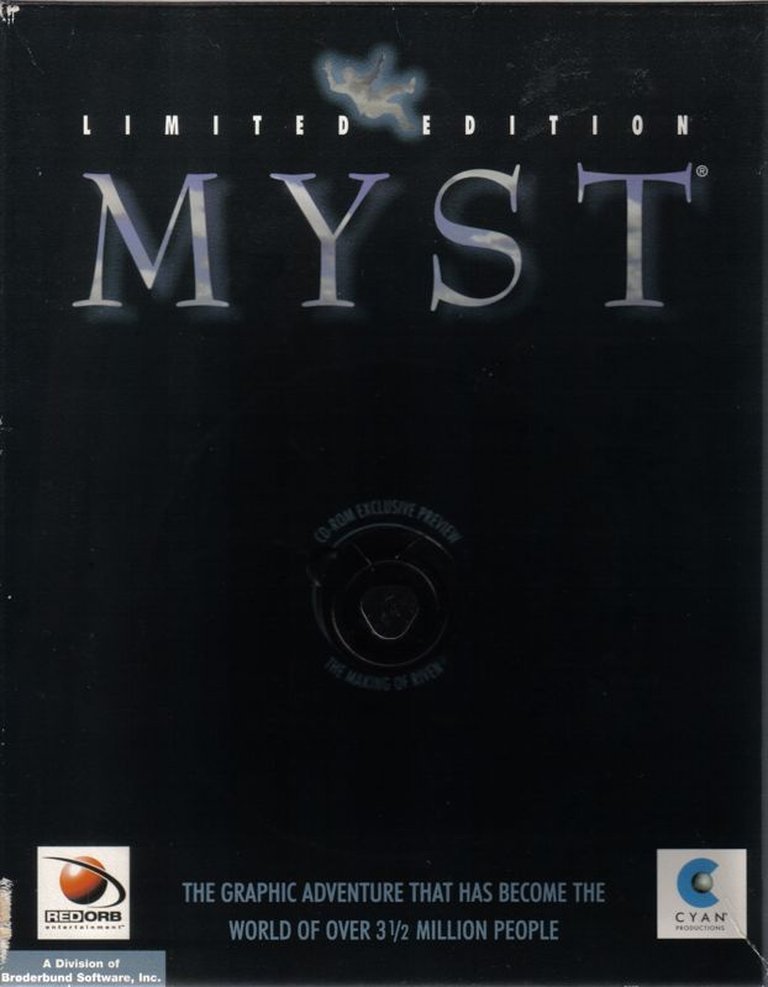
Myst (Limited Edition) is a special re-release of the iconic 1993 adventure game developed by Cyan, where players explore the enigmatic island of Myst via a magical book, solving intricate puzzles across surreal pre-rendered environments to uncover the backstory of its inhabitants and make pivotal choices. This enhanced package includes the original game alongside ‘The Making of Riven’ disc, offering exclusive behind-the-scenes content for the sequel’s development.
Myst (Limited Edition) Reviews & Reception
metacritic.com (78/100): At nearly 30 years old, Myst remains a remarkable experience, made all the more accessible and enthralling in this modern iteration.
pcgamer.com : Our Verdict: This modern remake of the classic puzzle game doesn’t stop it from feeling out of date.
Myst (Limited Edition): Review
Introduction
Few video games have achieved the cultural and commercial impact of Myst. Released in 1993 as a limited edition bundle featuring the original game and The Making of Riven disc, it transcended entertainment to become a cultural phenomenon. More than three decades later, Myst remains a landmark in interactive storytelling, an immersive digital puzzle box that challenged conventions and redefined the possibilities of the medium. This review examines the enduring legacy of Myst (Limited Edition), arguing that its genius lies in its masterful fusion of technological ambition, atmospheric design, and cerebral gameplay—a combination that not only dominated the 1990s gaming landscape but continues to influence modern design. By stripping away traditional game mechanics like combat and time limits, Cyan Worlds created a space for contemplation and discovery that proved video games could be art.
Development History & Context
Myst emerged from the crucible of early 1990s technological transition and creative ambition. The Miller brothers, Rand and Robyn, founded Cyan Worlds in Spokane, Washington, having previously developed children’s games like The Manhole and Cosmic Osmo using HyperCard on Macintosh. Their shift to an adult-oriented vision was born from necessity and inspiration. Pitched to Activision as The Gray Summons (a noir adventure) but rejected for being “too mature,” they later partnered with Japanese developer Sunsoft, seeking to create a non-linear mystery with believable characters and ethical dilemmas—a stark contrast to the black-and-white simplicity of their earlier work^1.
The project was an audacious gamble. Constrained by console memory limitations and single-speed CD-ROM drives, Cyan had to innovate ruthlessly. Development began in 1991 on Macintosh Quadra 700s using HyperCard, but the team soon adopted 3D rendering software (StrataVision 3D, MacroModel) for vibrant, pre-rendered visuals. To overcome CD-ROM bottlenecks, they compressed 66 minutes of QuickTime animation with Cinepak, reducing 500 kB images to 80 kB, and strategically placed files on disc tracks to minimize seek times^3. The budget ballooned to $600,000 (half funded by Sunsoft), and the team spent months designing Ages (islands) before the narrative fully coalesced. Rand Miller noted, “We were place designers… and the maps kind of fueled the story.”[^5] Playtesting via Dungeons & Dragons roleplay sessions and iterative refinement—such as adding an “inciting incident” note after testers reported aimlessness—shaped the final experience[^6]. The result was revolutionary: a game that turned technological limitations into artistic strengths.
Narrative & Thematic Deep Dive
Myst’s narrative unfolds like a digital folktale, told through environmental clues and fragmented testimonies rather than exposition. The player discovers a book titled Myst and is transported to a deserted island, where they find two trap books holding Sirrus and Achenar, the imprisoned sons of Atrus—a “Writer” who creates worlds through linking books[^7]. The brothers plead for rescue, blaming each other for their mother Catherine’s death and the destruction of Atrus’s library. Their messages are corrupted, missing pages scattered across four Ages: Selenitic, Stoneship, Mechanical, and Channelwood.
The narrative brilliance lies in its ambiguity and moral complexity. As players collect red and blue pages, the brothers’ stories clarify, revealing their treacherous natures. Sirrus manipulates with false promises; Achenar threatens violence. The green book they warn against? It leads to D’ni, where Atrus is imprisoned, offering a third path. The endings are haunting: freeing a brother traps the player in their prison; freeing Atrus allows him to resume his work[^8]. Themes of consequence, ambition, and isolation permeate the story. The Millers drew from Jules Verne’s The Mysterious Island and C.S. Lewis’s Narnia, crafting a tale where exploration is the narrative. Robyn Miller admitted the ethical dilemma was not fully realized, but the world’s depth—Atrus’s backstory, the D’ni civilization—invites speculation[^9]. This environmental storytelling, where objects (journals, machinery) speak louder than dialogue, established a template for modern narrative games.
Gameplay Mechanics & Systems
Myst’s gameplay is defined by restraint and immersion. As a first-person point-and-click adventure, it eschews traditional gaming elements: no inventory, no combat, no time limits, and no risk of death. Players navigate 2,500 pre-rendered frames by clicking hotspots, with crossfades between scenes. An optional “Zip” feature (lightning-bolt cursor) allows rapid travel but risks skipping critical clues[^10]. The core loop involves exploration, observation, and puzzle-solving. Puzzles are ingeniously integrated into the world: aligning telescope lenses in the observatory, decoding sound frequencies in Selenitic, or raising a ship in Stoneship. Rand Miller’s design philosophy ensured puzzles felt organic: “Once the player finds the solution, if they blame us, then we haven’t done a good job. But if they blame themselves, then we have.”[^11]
Carrying single pages from journals to their source Ages adds logistical depth. The interface is intentionally invisible—no HUD, minimal cursor changes—fostering uninterrupted immersion. This minimalist design made Myst accessible to non-gamers while challenging veterans with its non-linearity. As one playtester noted, the game demanded “patience, observation, and logical thinking,” a radical departure from reflex-based titles of the era[^12]. The system’s elegance lies in its simplicity: by removing failure states, Cyan transformed frustration into curiosity, making every discovery feel earned.
World-Building, Art & Sound
Myst’s world-building is a masterclass in atmospheric design. Myst Island serves as a haunting hub, with its library, clock tower, and iconic dock, while the four Ages each offer distinct biomes and puzzles. Stoneship’s Victorian-era shipwreck, Channelwood’s treetop villages, and Mechanical’s industrial clockwork feel lived-in, their histories implied through decay and detail[^13]. Inspired by Verne, the Millers prioritized verisimilitude. Rand explained: “A lot can be done with texture… putting screws in things. These are things you don’t necessarily notice, but if they weren’t there, would flag to your subconscious that this is fake.”[^14]
Artistically, Myst pushed Macintosh and CD-ROM boundaries. Grayscale heightmaps were extruded into terrain, wrapped with hand-painted textures, and populated with 3D objects. Frames took hours or days to render, with Photoshop 1.0 refining the final 8-bit images to appear truecolor[^15]. The result was photorealistic for its time—a “stunning” spectacle, as Computer Gaming World noted[^16].
Sound design, led by Chris Brandkamp, was equally meticulous. Ambient sounds were sourced inventively: fire’s crackle came from driving over stones, clock chimes from a wrench, and bubble baths from tubes in a toilet[^17]. Robyn Miller’s synthesizer score, initially omitted for fear of distraction, became integral. The 40-minute soundtrack heightened moods without overwhelming, transforming exploration into a sensory pilgrimage[^18]. Together, art and sound created an unparalleled sense of place, where every creak and texture whispered secrets.
Reception & Legacy
Myst’s reception was a dichotomy of acclaim and criticism. Upon release, it was hailed as a masterpiece. Computer Gaming World declared it “the best [Macintosh] CD-ROM game,” praising its “mesmerizing” graphics and “straightforward” narrative[^19]. Wired and The New York Times saw it as proof games could evolve into art[^20]. It won the 1994 Codie Award for Best Adventure/Fantasy RPG and became the best-selling PC game for nearly a decade, moving 6.3 million copies by 2000[^21]. Yet detractors like Next Generation called it “gaming’s bleakest hour,” criticizing its “static graphics” and trial-and-error puzzles as poor design[^22].
Legacy-wise, Myst reshaped the industry. It drove CD-ROM adoption, becoming the first CD-ROM title to sell over 2 million units[^23]. Its success spawned sequels (Riven, Exile), a multimedia franchise (novels, canceled film/TV adaptations), and countless “Myst clones” like The 7th Guest. It also birthed subgenres: walking simulators (Gone Home), escape rooms, and narrative-driven adventures owe its DNA[^24]. Cyan’s preservation efforts—including 100+ hours of behind-the-scenes footage archived by the Video Game History Foundation—ensure its history is documented[^25]. Added to MoMA’s collection in 2013, Myst remains a cultural touchstone, proving that restraint and atmosphere could define a generation of games.
Conclusion
Myst (Limited Edition) is more than a game; it is a time capsule of 1990s ambition and a testament to the power of interactive art. Its limited-edition bundle, featuring the original game and The Making of Riven disc, offered unparalleled insight into its creation—a rarity in an era of opaque development. By turning technological constraints into aesthetic virtues—pre-rendered frames, compressed sound, non-linear puzzles—Cyan Worlds crafted an experience that was both revolutionary and timeless. The game’s legacy endures not in sales figures (though they were staggering) but in its influence on design, proving that immersion and intellect could trump spectacle and speed.
In an age of instant gratification, Myst’s quiet insistence on patience and discovery feels radical. It broadened gaming’s audience, validated artistic ambition, and left an indelible mark on culture. For all its limitations by modern standards, Myst remains a benchmark—a reminder that the most profound experiences often arise not from what games add, but from what they remove. As Rand Miller mused, “We were exploring the world as we were designing.”[^26] In doing so, they gave players a world worth losing themselves in—a legacy no amount of aging can diminish.