
- Release Year: 2008
- Platforms: Windows
- Publisher: ak tronic Software & Services GmbH, Game Factory Interactive Ltd., JoWooD Productions Software AG, Nordic Games GmbH, Russobit-M
- Developer: Trine Games
- Genre: Role-playing (RPG)
- Perspective: 1st-person, Behind view
- Game Mode: Single-player
- Gameplay: Blacksmithing, Character development – Training, Day, Goldsmithing, Hunting, night cycle, Survival cooking
- Setting: Fantasy
- Average Score: 37/100
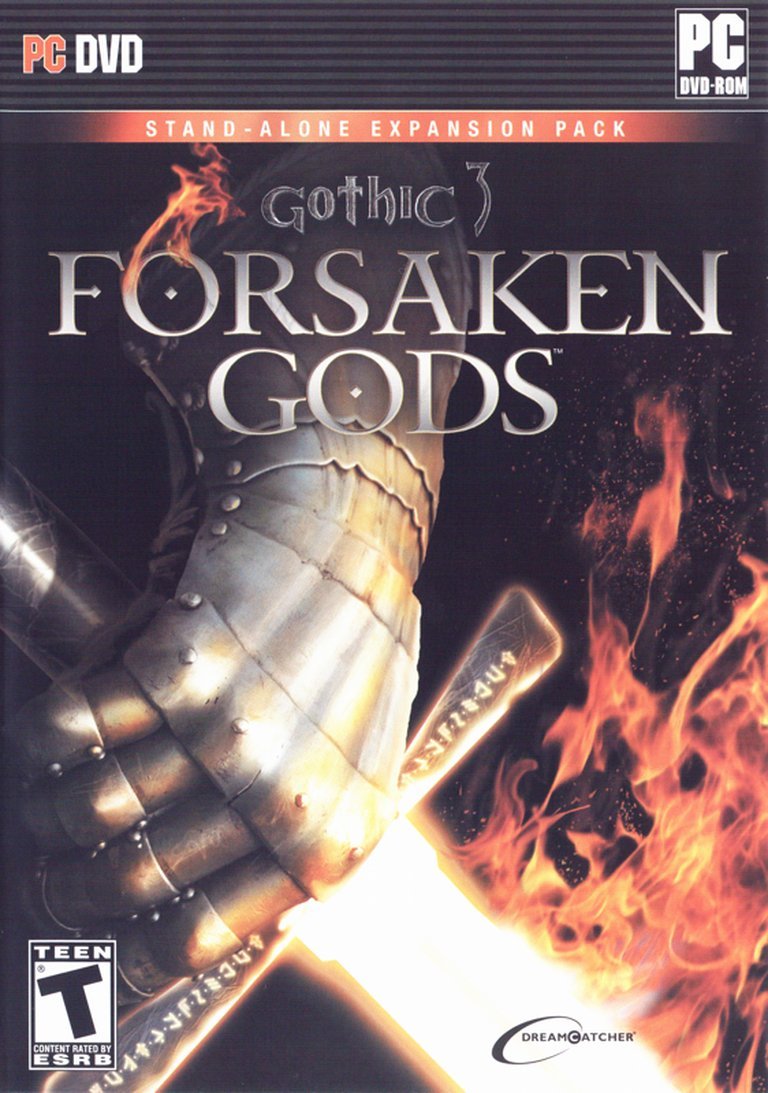
Description
Gothic 3: Forsaken Gods is a standalone expansion continuing the saga from Gothic 3’s ending, where the nameless hero returns to Myrtana after the gods’ destruction to find a fragile peace shattered by rising empires and renewed conflict between human ruler Gorn and orc leader Thorus. Players must navigate a smaller yet evolving world, rebuild their hero’s strength, and choose sides in this fantasy RPG adventure featuring an overhauled combat system with stamina-based parrying and new movement mechanics.
Gameplay Videos
Where to Buy Gothic 3: Forsaken Gods
Gothic 3: Forsaken Gods Cracks & Fixes
Gothic 3: Forsaken Gods Patches & Updates
Gothic 3: Forsaken Gods Mods
Gothic 3: Forsaken Gods Guides & Walkthroughs
Gothic 3: Forsaken Gods Reviews & Reception
ign.com : Bugs and poor execution bring down the latest Gothic.
rpgwatch.com (30/100): Forsaken Gods is a very poor title.
Gothic 3: Forsaken Gods Cheats & Codes
PC
Open the ge3.ini file in the Gothic 3 Forsaken Gods/Ini folder and change TestMode=false to TestMode=true. Press [~] (tilde) while playing to bring up the console and type the cheat codes.
| Code | Effect |
|---|---|
| God | God Mode |
| Invisibility | Invisibility Mode |
| Teach all | Learn All Skills (lowers stats to 0) |
| Kill | Kills Target |
| Give | Give Specified Item |
| Spawn | Spawn Specified Item/Creature |
| idkfa | Gives you all items |
| Help | Show commands |
| fullhealth | Gives you full health |
| give Cat_Armor | All armors |
| give Cat_Weapon | All weapons |
| give Cat_Artefact | All artefacts |
| control | Control character |
| watch | Control camera |
| teach STR x | Set strength |
| teach DEX x | Set dexterity/hunting skill |
| teach INT x | Set intelligence (ancient knowledge) |
| teach ALC x | Set alchemy skills |
| teach SMT x | Set smith skills |
| teach THF x | Set thief skills |
| teach HP x | Set health |
| teach MP x | Set mana |
| teach SP x | Set energy |
| teach LP x | Set learning points |
| Give It_Gold # | Gives specified amount of gold (where # is the amount) |
Gothic 3: Forsaken Gods: Review
Introduction
The Gothic series stands as a cornerstone of German RPG history, lauded for its immersive world-building, morally grey choices, and unflinching difficulty. Yet its legacy is equally defined by turmoil—developer Piranha Bytes’ acrimonious split from publisher JoWooD Productions left Gothic 3 (2006) a buggy masterpiece, its potential overshadowed by technical decay. Into this fraught landscape stepped Gothic 3: Forsaken Gods (2008), a standalone expansion developed by Indian studio Trine Games. Positioned as a bridge between Gothic 3 and the upcoming Arcania: Gothic 4, it promised to resolve dangling plot threads and reignite the saga. Instead, Forsaken Gods emerged as a cautionary tale of rushed development, shattered expectations, and the fragility of a cherished legacy. This review deconstructs the game’s troubled genesis, narrative ambitions, mechanical flaws, and enduring—notoriety, arguing that while it fails as a competent RPG, it remains a vital, if painful, artifact in the *Gothic saga’s history.
Development History & Context
Forsaken Gods was conceived amid the ashes of Gothic 3’s troubled development and release. Piranha Bytes had departed JoWooD in 2007, leaving the publisher to steward the franchise alone. JoWooD tasked Trine Games, a Mumbai-based studio with no prior RPG experience, with creating the expansion. Their vision was ambitious: to craft a canonical sequel that would satisfy fans and set the stage for Arcania by Spellbound Entertainment. However, this ambition collided with harsh reality. Trine Games was simultaneously developing The Guild 2: Venice, stretching resources thin. The studio lacked familiarity with Piranha Bytes’ proprietary Genome Engine, leading to technical mismanagement. JoWooD’s aggressive release timeline—barely two years after Gothic 3—left no room for polish. The gaming landscape of 2008 further complicated matters. Heavyweights like Fallout 3 and The Witcher: Enhanced Edition raised industry standards, exposing Forsaken Gods’ deficiencies. As GameStar (Germany) lamented, “JoWooD didn’t learn from releasing a bug-ridden Gothic 3; the new add-on is full of bugs too.” The result was a game born from compromise, where publisher deadlines superseded creative integrity.
Narrative & Thematic Deep Dive
Forsaken Gods picks up directly after Gothic 3’s “Adanos” ending, where the Nameless Hero and Xardas banish the gods Innos and Beliar, hoping for an era of peace between humans and orcs. Their idyllic vision shatters upon returning to Myrtana: warlord Gorn rebels against orcish ruler Thorus, while mercenary leader Lee observes from the sidelines. The Nameless Hero, stripped of power, must navigate this fractured landscape and choose a side. The narrative framework holds potential, exploring themes of failed utopia, the cyclical nature of conflict, and the burden of legacy. Yet execution falters spectacularly. Characterizations are inconsistent—Gorn, once a noble rebel in Gothic 3, here feels like a caricature warmonger. Dialogue suffers from abysmal translation and voice-acting; as IGN noted, “NPCs suffer from multiple personality disorder, drawing from random sound files.” Quests are nonsensical, with objectives like “wait for an event” or vague directions that break immersion. The story’s central irony—that peace becomes unattainable because the Hero’s absence created a power vacuum—is compelling but buried under glitches and poor pacing. ComputerGames.ro summarized the tragedy: “It hasn’t come up with something useful, it ruined what was good about the series, and it doesn’t have a goal.” The narrative, in essence, becomes a hollow echo of Gothic’s signature depth.
Gameplay Mechanics & Systems
Gameplay in Forsaken Gods mirrors Gothic 3’s real-time action-RPG formula but introduces key, if flawed, revisions. The most significant change is a stamina-dependent combat system, where swings, parries, and the new “shooter-like strife move” deplete endurance, leaving the hero defenseless. This theoretically adds tactical depth but often devolves into frustration, with stamina drain making combat feel sluggish. Character progression remains familiar: players earn talent points to invest in combat, magic, crafting, and survival skills. Yet progression is undermined by a smaller world—Myrtana alone, excluding Nordmar and Varant—and reused assets from Gothic 3. Quest design is a major step backward. Unlike Gothic 3’s faction-driven narratives, Forsaken Gods relies on repetitive fetch quests and broken triggers. As RPGWatch observed, “It’s a ‘game’ where the ultimate goal is becoming rich.” The UI remains unintuitive, lacking quest tracking and clear feedback. Crafting and alchemy systems carry over intact but feel less rewarding in a world stripped of discovery. These mechanics, while not irredeemable, are overshadowed by technical collapse. Gamepressure noted, “Quest NPCs disappear, refuse to speak, and walk behind impassible geometry,” while IGN lamented that loading times and frame rates made cities like Trelis “an absolute slide show.”
World-Building, Art & Sound
Forsaken Gods inherits Gothic 3’s lush, handcrafted world but shrinks it to a single continent, diluting its impact. Myrtana’s forests, mountains, and cities retain a gritty authenticity, yet the absence of Nordmar’s snowscapes and Varant’s deserts makes the world feel monotonous. Population density plagues settlements, with 80% unnamed NPCs and sparse wildlife, reducing immersion. Artistically, the game uses the Genome Engine to render dynamic lighting, SpeedTree foliage, and detailed textures. Antialiasing and HDR lighting in the Enhanced Edition improve visuals, but the engine’s age shows in stiff animations and pop-in. Sound design, however, offers a rare bright spot. Kai Rosenkranz’s return as composer delivers haunting, atmospheric tracks that evoke the series’ soul. Yet audio bugs undermine this—the voice acting, while occasionally competent, suffers from mismatched subtitles and random line triggers. As one Steam user noted, “One minute they sound like a sleepy farmer, next they’re Apu from The Simpsons.” These elements collectively create a world that is visually evocative but sonically and narratively dissonant, a testament to Trine Games’ inability to fully grasp Piranha Bytes’ design philosophy.
Reception & Legacy
Forsaken Gods was met with near-universal derision at launch, epitomizing the franchise’s nadir. Metacritic aggregated a score of 44/100, with IGN infamously branding it “outright disastrous” and “unplayable” due to “design and performance problems.” Critics echoed this sentiment: Absolute Games called it “trash,” while Jeuxvideo.com lamented that the series “didn’t deserve this.” Players fared little better, with Metacritic’s user score averaging 3.5/165. Key complaints included game-breaking bugs (e.g., quest NPC disappearances), performance issues, and anemic storytelling. Yet the game’s legacy evolved post-2011, when Mad Vulture Games—a team of modders—released the Enhanced Edition. Patches fixed critical bugs, optimized performance, and added content, elevating some reviews. GameStar (Germany) noted the patched version was “playable” and praised its “stimmigsten Rollenspiel-Welten” (cohesive RPG world). User reviews on Steam and GOG reflect this shift, with scores rising to 7–8/10 for the Enhanced Edition. Historically, Forsaken Gods remains a symbol of JoWooD’s mismanagement. Piranha Bytes later disavowed its events as non-canon, while the community patching culture it spawned—where fans salvaged broken games—became a hallmark of the Gothic series. As 4Players.de quipped, it earned the “#2 Biggest Insolence of the Year” award, not for the game itself, but for the community’s Herculean efforts to fix it.
Conclusion
Gothic 3: Forsaken Gods stands as one of gaming’s great cautionary tales—a product of hubris, haste, and corporate missteps that squandered a beloved franchise’s potential. As a standalone RPG, it fails on nearly every level: its narrative is incoherent, its mechanics are unpolished, and its world feels like a diminished echo of Gothic 3. Yet its historical significance is undeniable. It represents the tumultuous transition between developers and publishers, the perils of outsourcing a cherished IP, and the transformative power of community-driven modding. For the most ardent Gothic fans, the Enhanced Edition offers a bittersweet return to Myrtana, a chance to witness a saga’s flawed pivot. For everyone else, it serves as a grim reminder that even legendary franchises can be undone by ambition untethered from execution. In the grand tapestry of Gothic, Forsaken Gods is a frayed, stained thread—ugly, yet indispensable for understanding the series’ resilience. Ultimately, it is less a game and more a monument to a moment when hope and disaster walked hand-in-hand.