
- Release Year: 2006
- Platforms: Windows
- Publisher: dtp entertainment AG, hell-tech, Lighthouse Interactive Game Publishing BV
- Developer: Sproing Interactive Media GmbH
- Genre: Adventure
- Perspective: 3rd-person
- Game Mode: Single-player
- Gameplay: Graphic adventure, Point-and-click, Puzzle-solving
- Setting: World War II
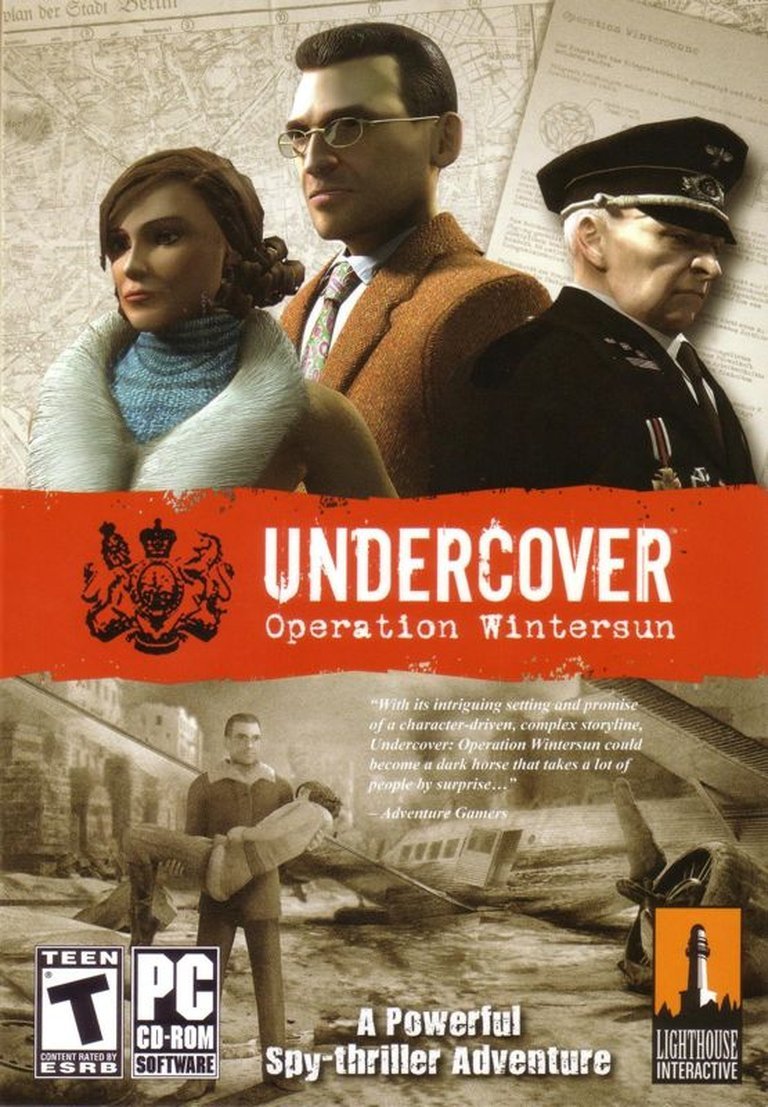
Description
Set in Berlin during World War II, Undercover: Operation Wintersun is a point-and-click graphic adventure that follows physicist Dr. John Russell. Sent on a clandestine mission to investigate the Nazi’s development of an experimental uranium bomb, Russell is aided by British intelligence but must navigate a dangerous web of espionage and question the loyalty of his own companions. The game features 3D characters on pre-rendered backgrounds, offering a classic adventure experience with puzzles ranging from inventory combinations to decrypting secret documents.
Gameplay Videos
Undercover: Operation Wintersun Free Download
Undercover: Operation Wintersun Mods
Undercover: Operation Wintersun Guides & Walkthroughs
Undercover: Operation Wintersun Reviews & Reception
ign.com : The other voices in the game are just as stilted and are hardly sufficient to carry the drama of the story.
gamewatcher.com : Undercover: Operation Wintersun is the perfect example of why Adventure Gaming isn’t as popular as it once was.
Undercover: Operation Wintersun: Review
Introduction
In the shadowed corridors of gaming history, certain titles emerge not as revolutionaries, but as compelling storytellers carving niche spaces in established genres. Undercover: Operation Wintersun (2006), developed by Austrian studio Sproing Interactive Media, stands as a testament to this phenomenon. Set against the chilling backdrop of a “what if” World War II scenario where Nazi Germany nearly achieves nuclear supremacy, the game thrusts players into the trench coat of Dr. John Russell—a brilliant but bumbling British nuclear physicist turned reluctant spy. This premise, blending real historical paranoia with pulp-fiction espionage, offers a fresh lens on the saturated WWII gaming landscape. Yet, the game’s legacy is one of intriguing potential tempered by executional flaws. This review argues that Operation Wintersun succeeds as a atmospheric, puzzle-driven adventure rooted in a unique premise, yet falters under the weight of inconsistent design, stilted performances, and technical hiccups that prevent it from reaching the pantheon of classic point-and-click experiences. It remains a fascinating artifact—a “solid, serious adventure” (Adventure Gamers) that prioritizes cerebral tension over visceral thrills, leaving players with a lingering sense of missed opportunity.
Development History & Context
Undercover: Operation Wintersun emerged from the crucible of mid-2000s European development, spearheaded by Sproing Interactive Media, a studio with a portfolio focused on pragmatic, genre-adherent titles rather than avant-garde experimentation. The project was helmed by Georg Heinz, who served as both game designer and dialog writer, collaborating with executive producer Harald Riegler on the core narrative vision. Their ambition was clear: to craft a historically grounded spy thriller that distinguished itself through its setting—a “horrific What-If scenario” (Worth Playing) exploring Nazi nuclear ambitions—while adhering to the conventions of the classic point-and-click adventure genre. Technologically, the game leveraged the Havok Vision Engine, a pragmatic choice that enabled detailed 3D character animations atop lush, pre-rendered 2D backgrounds. This hybrid approach was common in the era, balancing visual richness with the accessibility limitations of mid-2000s hardware, though it often resulted in jarring juxtapositions of fluid character movement against static environments.
Released in September 2006 (Europe) and September 2007 (North America) by publishers dtp entertainment AG, Lighthouse Interactive, and hell-tech, the game arrived during a transitional period for adventure gaming. The genre was recovering from a post-90s slump, buoyed by titles like The Black Mirror (2003) but still grappling with perceptions of stagnation. Operation Wintersun positioned itself as a “serious adventure” (Adventure Gamers) targeting enthusiasts seeking mature narratives over action-oriented spectacle. Its development context also reflected a European market for narrative-driven games, often more tolerant of slower pacing and complex puzzles than its American counterpart. The inclusion of features like a “novice mode” (highlighting interactive objects) and an optional sepia filter underscored an awareness of accessibility and historical immersion, though these would later become points of contention regarding game design philosophy.
Narrative & Thematic Deep Dive
The narrative unfolds as a gripping, if occasionally convoluted, espionage thriller centered on authenticity and moral ambiguity. Dr. John Russell, a nuclear physicist recruited by MI6 after verifying the authenticity of Nazi uranium bomb plans (“Operation Wintersun”), is thrust into a world far removed from his laboratory. His mission: infiltrate Berlin’s Kaiser Wilhelm Institute and Heereswaffenamt to uncover the project’s progress. This premise, rooted in speculative history—exploring the chilling possibility that Nazi scientists were close to developing an atomic weapon—lends the story immediate gravitas. As Russell traverses war-torn locales, he is accompanied by MI6 agent Peter Graham and later the enigmatic Anne Taylor, whose “own agendas” (MobyGames description) force players to question allegiances. The plot pivots on themes of intellectual responsibility and the ethical compromises of war. Russell’s evolution from detached academic to reluctant hero is compelling, as he witnesses the “human suffering” (Gamepressure.com) wrought by his scientific pursuits.
However, the narrative’s execution is marred by inconsistencies. While the writing is “fairly good” (Adventure Gamers), with period-appropriate dialogue, the voice acting—particularly Russell’s—is universally criticized as “monotonous and calm under stressful circumstances” (Adventure Gamers), failing to convey the tension of his predicaments. Key twists, such as Anne’s true loyalties, feel underdeveloped, and the climax, while tense, suffers from abrupt pacing. The game excels in its atmospheric world-building, using real locations like Berlin and Haigerloch to ground its fiction, yet the “generic streets” (Adventure Gamers) and lack of overt militaristic elements dilute the wartime urgency. Ultimately, the story’s strength lies in its “horror” (Worth Playing) at the intersection of scientific ambition and totalitarian power, even if its characterizations remain superficial.
Gameplay Mechanics & Systems
Operation Wintersun adheres strictly to the point-and-click adventure formula, with its mechanics defined by exploration, puzzle-solving, and inventory management. The interface is intuitive: left-clicking moves Dr. Russell or examines objects, while right-clicking interacts with or collects items. Double-clicking enables running, a welcome feature for navigating larger spaces. Puzzles form the core gameplay loop, ranging from logical item combinations (e.g., creating hydrochloric acid from spirits and rock salt) to complex environmental challenges like reassembling a torn letter or deciphering a safe’s combination using pi (π). Many puzzles are “genuinely challenging” (IGN), rewarding attentive observation and lateral thinking. For instance, the Kaiser Wilhelm Institute’s director’s office requires players to synthesize clues from a journal and scattered paper scraps, a standout moment of cerebral satisfaction.
Yet, the gameplay is also defined by significant frustrations. Pixel hunts are rampant, exacerbated by “inconsistent hotspot handling” (GameWatcher), where critical objects are “hidden in shadow” (IGN) or “colored black against a black background” (IGN). The inventory system, while streamlined, suffers from “cumbersome” (GameWatcher) scrolling mechanics, and puzzle solutions occasionally demand real-world knowledge (e.g., basic German), creating accessibility barriers. Cooperative segments with companions are sporadically effective; Peter and Anne assist in scripted moments, but their “useless” (IGN) advice (“You’re the smart one, you figure it out!”) often feels tokenistic. A unique stealth puzzle, where players must toggle lights to guide Anne through archives without alerting guards, offers brief respite but is undercut by trial-and-error repetition. Technical flaws further blemish the experience, with frequent crashes near the endgame and lip-sync issues that disrupt immersion. The inclusion of a “novice mode” is a double-edged sword: it eases frustration but risks trivializing the game’s challenges.
World-Building, Art & Sound
Visually, Operation Wintersun excels in its environmental detail, leveraging pre-rendered backgrounds to craft period-accurate settings that evoke the tension of occupied Europe. Berlin’s streets, Haigerloch’s rural landscapes, and Stalingrad’s war-torn ruins are rendered with meticulous attention to texture and lighting, from “crumbling brickwork” (Retro Replay) to flickering candles. The sepia filter, an optional aesthetic choice, enhances authenticity, bathing scenes in a “vintage photography” (Retro Replay) hue that aligns with the game’s historical fiction. Character models, however, are less polished; while their animations are functional, close-ups reveal stiff expressions and rudimentary textures, particularly in cutscenes where “lip movements are particularly bad” (IGN). This technical disparity between backgrounds and characters creates a visual disconnect.
Sound design similarly oscillates between strength and weakness. The orchestral score, composed by Henrik Jakoby, effectively underscores tension with brooding strings and subtle percussion, though it is often “too quiet” (GameWatcher) to dominate the soundscape. Voice acting is the game’s Achilles’ heel. Russell’s delivery is flat, lacking the urgency of a man in peril, while supporting performances suffer from “odd accents” (GameWatcher) and wooden line-readings. Sound effects, like the clang of a crowbar or the crackle of radio static, add verisimilitude, but the overall audio landscape fails to elevate the atmosphere beyond functional accompaniment. Together, the art and sound create a world that is visually immersive but emotionally sterile, with the sepia filter doing more to mask character shortcomings than enhance cohesion.
Reception & Legacy
Upon release, Undercover: Operation Wintersun garnered mixed reviews, reflecting its status as a game of intriguing highs and frustrating lows. Aggregator scores underscore this duality: a 67% MobyGames rating and a 57% Metascore position it as a “mixed or average” title. Critics lauded its unique premise and puzzle design, with Adventure Corner praising it as a “top adventure” and IGN calling the puzzles “fairly logical.” Conversely, outlets like GameSpot lambasted its “maddening adventure-game absurdities,” citing potato-distracting-crow puzzles and technical instability. Player reviews were similarly divided, with a 3.5/5 average on MobyGames highlighting its niche appeal. Commercial performance remains undocumented, but its presence in multiple publisher catalogs (dtp, Lighthouse) suggests a modest, regional success.
In the decades since, Operation Wintersun has carved a modest legacy as a cult favorite among adventure enthusiasts. It is remembered for its compelling “what if” scenario and its role in a sparse WWII subgenre for point-and-click adventures. Its influence is more evident in its lessons than its direct impact; its flaws—particularly pixel hunts and voice acting—became cautionary tales for subsequent developers. The game spawned a spin-off, Undercover: Dual Motives (2007) for the Nintendo DS, but this failed to expand its reach. Today, it endures on abandonware sites and retrospectives as a “solid adventure” (Adventure Gamers) that exemplifies the mid-2000s era’s ambition and limitations—a period when studios like Sproing attempted to revitalize classic genres with contemporary sensibilities, often falling short but occasionally striking gold in unexpected places.
Conclusion
Undercover: Operation Wintersun stands as a poignant microcosm of its era: an adventure game of admirable ambition hampered by executional inconsistency. Its greatest strengths lie in its atmospheric world-building, its historically grounded “what if” narrative, and a suite of puzzles that reward intellectual engagement. The sepia-toned visuals, the tension of Russell’s scientific espionage, and the game’s commitment to a cerebral, dialogue-driven experience all contribute to a unique niche in WWII gaming. Yet, these merits are repeatedly undermined by frustrating design choices—pixel hunts, a clunky inventory, and stilted voice acting—that erode immersion. Technical issues and a narrative that fails to fully capitalize on its potential further relegate it to the realm of “decent quality, but not exceptional” (Adventure Gamers).
In the grand tapestry of video game history, Operation Wintersun is not a masterpiece, but it is a fascinating artifact. It deserves recognition for attempting to elevate the adventure genre with mature themes and historical authenticity, even if it stumbles in delivery. For players willing to tolerate its quirks, it offers a rewarding journey into the shadows of alternate-history espionage, one where the terror of Nazi nukes outweighs the terror of finicky hotspots. Verdict: a flawed but compelling mission well worth undertaking for genre devotees, but a cautionary tale for developers aiming to blend historical gravitas with accessible gameplay. Its place in history is assured—not as a landmark, but as a testament to the enduring, if imperfect, allure of the point-and-click adventure.