
- Release Year: 2000
- Platforms: Macintosh, Windows
- Publisher: Masque Publishing, Inc.
- Developer: Masque Publishing, Inc.
- Genre: Casino game, Gambling, Slot machine
- Perspective: 1st-person
- Game Mode: Single-player
- Gameplay: Player tracking, Simulation
- Setting: Casino
Description
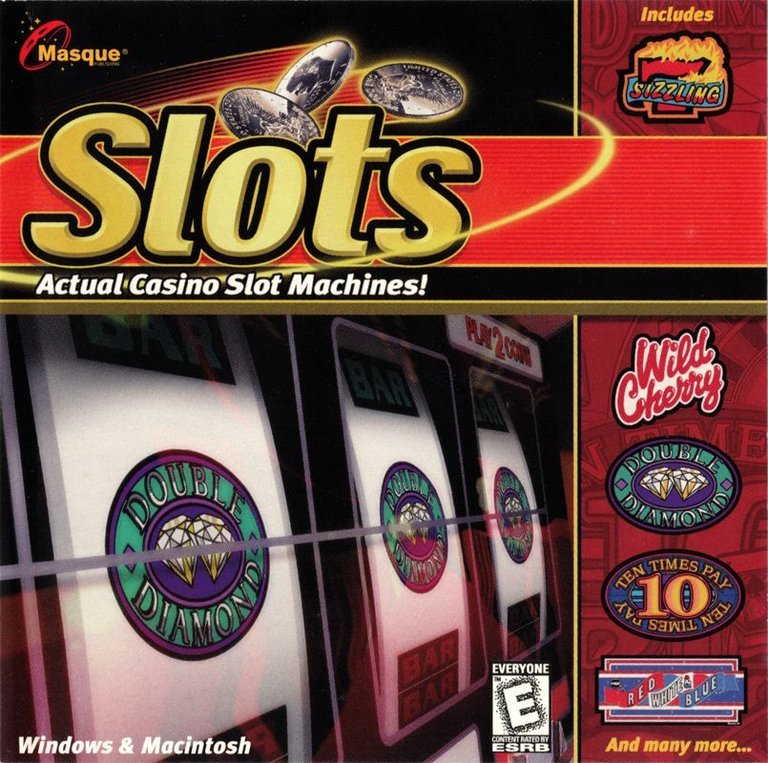
Slots is a commercial slot machine simulator released in 2000 for Windows and Macintosh, featuring licensed IGT slot machines with player tracking, sound effects, and customizable hotlists. The game offers 50 unique slot machines—including popular titles like Double Diamond, Wild Cherry, and Red, White & Blue—through variations in coin and payline configurations, providing a realistic casino experience with extra high payouts and offline solo play.
Where to Buy Slots
PC
Slots Free Download
Slots Reviews & Reception
slotcatalog.com : double fun for your players is guaranteed!
keytocasinos.com : They say that two heads are better than one, but what about two slots?
Slots (2000): Review
Introduction
In the vast, ever-evolving landscape of video games, few titles encapsulate the spirit of a specific technological and cultural moment with such unassuming precision as Slots (2000), developed by Masque Publishing, Inc. Released at the dawn of the new millennium for Windows and Macintosh, this slot machine simulator arrived as a digital artifact bridging the mechanical one-armed bandits of the 20th century and the immersive, feature-rich online casinos that would soon dominate the internet. More than a mere gambling game, Slots is a time capsule—an exploration of how digital technology began to democratize access to casino culture while grappling with the limitations of its era. This review argues that while Slots lacks the narrative depth or innovative mechanics that define landmark games, its meticulous recreation of licensed IGT slot machines, coupled with its candid embrace of repetition and chance, offers a fascinating glimpse into the intersection of gaming, gambling, and technological transition. It stands as a humble yet historically significant footnote in the evolution of interactive entertainment.
Development History & Context
Masque Publishing, Inc., a studio specializing in casino game simulations, spearheaded Slots’ development during a pivotal period in gaming history. The late 1990s and early 2000s saw a surge in licensed gambling titles as personal computers became mainstream entertainment hubs, driven by the growing accessibility of CD-ROM technology and the nascent internet boom. The development team, led by producers Bob Rakosky and James Michael, with programming by Xu Cao, Ted Lappin, and Bob Rakosky, art direction by Brett Mugg, and sound design by Wallace Music and Sound, prioritized authenticity over innovation. Their goal was not to reinvent the slot machine experience but to digitally replicate it with painstaking accuracy, leveraging licensed International Game Technology (IGT) machines to lend credibility.
Technologically, Slots operated within the constraints of 2000-era computing. CD-ROM distribution limited audio-visual fidelity but allowed for a comprehensive library of 50 slot machines—achieved by counting variations (e.g., 3-coin vs. 5-coin, single vs. multi-payline) as distinct titles. This approach maximized content volume without developing entirely new games, a common industry tactic at the time. The gaming landscape of 2000 was dominated by the rise of MMORPGs and real-time strategy games, yet Slots carved a niche by targeting a mature audience seeking low-stakes gambling simulations. Its release alongside titles like Hoyle Slots & Video Poker underscored a growing market for casino experiences on PC, bridging the gap between physical casino floors and digital lounges.
Narrative & Thematic Deep Dive
As a slot machine simulator, Slots intentionally eschews traditional narrative, characters, or dialogue. Instead, its “story” unfolds through the visceral, mechanical language of chance and fortune—a theme executed with hypnotic simplicity. The game’s core narrative is the timeless allure of risk and reward, embodied in the satisfying clink of virtual coins and the anticipation of spinning reels. Each licensed machine functions as a microcosm of a larger casino culture, with thematic motifs reflecting broader cultural touchstones. For instance, “Wild Cherry” evokes nostalgia with classic fruit symbols, “Moolah!” promises opulence through gold imagery, and “Fourth of July” leans into patriotic spectacle.
This thematic purity is both a strength and a limitation. By focusing solely on the mechanics of slot gaming, Slots offers an unadulterated encounter with the genre’s primal appeal, free from the embellishments of modern games. Yet, the absence of narrative depth underscores the game’s functional purpose: it is not a story to be experienced but a ritual to be repeated. The licensed machines—each with unique symbols, sounds, and payout structures—serve as silent protagonists, their designs reflecting the cultural ubiquity of slot machines as symbols of luck and excess in late-20th-century America.
Gameplay Mechanics & Systems
Slots’ gameplay is a study in minimalist design, mirroring the straightforward mechanics of real slot machines. Players select a machine from the library, adjust their bet, and spin the reels. The core loop revolves around repetition and anticipation: spin, wait for the reels to stop, and collect winnings. The game’s primary innovation lies in its “hotlist” feature, allowing players to save favorite machines for quick access, and player tracking, which records statistics like total wins. These additions, though rudimentary by modern standards, enhance the simulation’s authenticity.
However, the gameplay suffers from a lack of depth. There are no bonus rounds, free spins, or progressive jackpots—features that would define future slots. All machines play identically, differing only in visual and payout design, leading to monotony during extended sessions. The UI, while functional, is utilitarian, with clunky navigation between machines. Bet mechanics are limited, and the absence of skill-based elements reduces player agency to pure chance. This mechanical simplicity is true to the source material but highlights the genre’s limitations as a gaming experience. Slots succeeds as a simulation but fails as an engaging game, prioritizing authenticity over innovation.
World-Building, Art & Sound
The “world” of Slots is the casino floor, recreated in digital form with a focus on realism. Each machine is rendered with meticulous attention to detail, from the gleaming chrome of “Double Diamond” to the playful animations of “Cartoon Wild Cherry.” The art style is static and 2D, with no dynamic environments beyond the machines themselves. While this limits immersion, the authenticity of the designs compensates for it—players familiar with real IGT machines will recognize the faithful recreations, reinforcing the game’s commitment to simulation.
Sound design is equally crucial to the experience. The game features digitized sound effects for each machine, including the satisfying clink of coins and celebratory jingles for wins. These sounds are not mere embellishments; they are integral to the game’s feedback loop, amplifying the psychological reward of a win. The absence of a musical score is notable, relying instead on machine-specific audio to create ambiance. This minimalist approach enhances focus on the core gameplay, making the experience feel less like a game and more like a digital casino. The sound design, combined with the visual fidelity, succeeds in transporting players to the sensory world of a casino floor.
Reception & Legacy
At launch, Slots received minimal critical attention, reflected in its sparse coverage on platforms like MobyGames, where it remains largely unreviewed. Commercially, it likely appealed to a niche audience of PC gamers interested in gambling simulations. Its legacy, however, is more nuanced. As a product of its time, Slots represents a transitional phase in the evolution of slot gaming—between mechanical emulation and the fully immersive, feature-rich slots of today. The game’s emphasis on licensed machines and player tracking foreshadowed the trend toward authenticity in casino games.
Over time, Slots has faded into obscurity, overshadowed by online slots and social casino games. Yet, it holds historical value as an artifact of early digital gambling simulation. For historians, it illustrates the technological constraints and design philosophies of the era. In the broader context of slot game history, Slots is a footnote—a reminder of the genre’s roots before it exploded into the multi-billion dollar industry it is today. Its simplicity and authenticity now serve as a contrast to the complex, narrative-driven slots of the 2020s, highlighting how far the genre has evolved.
Conclusion
Slots (2000) is a product of its time—a meticulously crafted but conceptually limited simulation that captures the essence of casino slot machines without reinventing them. While it lacks the depth and innovation of modern slots, its authenticity and attention to detail make it a compelling historical artifact. For players seeking a nostalgic trip back to the era of early PC gambling simulations, Slots offers a charming, if repetitive, experience. For historians, it serves as a valuable snapshot of a transitional moment in gaming history. Ultimately, Slots may not rank among the greatest video games, but its place as a cultural and technological curiosity ensures it a small but significant niche in the annals of digital entertainment. It stands as a humble testament to the enduring allure of chance and the unassuming charm of digital simulation.