
- Release Year: 2012
- Platforms: Windows
- Publisher: Big Fish Games, Inc, HH Games, Intenium GmbH
- Developer: Urchin Games
- Genre: Adventure
- Perspective: 1st-person
- Game Mode: Single-player
- Gameplay: Hidden object, Puzzle elements
- Setting: Detective, Mystery
- Average Score: 84/100
Description
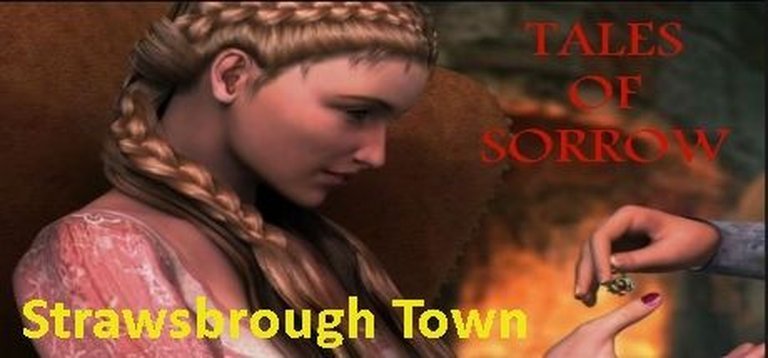
Set in the eerie town of Strawsbrough, ‘Tales of Sorrow: Strawsbrough Town’ follows Alfred as he races to save his fiancée Melissa from a cursed ring that plunges her into an everlasting sleep after a mysterious old woman tricks her during their anniversary celebration. Players must explore the town, interact with quirky residents like the mayor, a sad clown, and a fortune teller, solve hidden object puzzles, and use magical potions and spells to undo the curse.
Where to Buy Tales of Sorrow: Strawsbrough Town
PC
Tales of Sorrow: Strawsbrough Town Guides & Walkthroughs
Tales of Sorrow: Strawsbrough Town: Review
Introduction
On a cold, rain-lashed anniversary night in the isolated hamlet of Strawsbrough, a young couple’s happiness is shattered when a cursed ring plunges Melissa into an eternal slumber. As her fiancé Alfred, players embark on a desperate journey through this enigmatic town in Tales of Sorrow: Strawsbrough Town, a hidden-object adventure that blends fairy-tale melancholy with supernatural mystery. Originally released in 2012 by Urchin Games and later reissued on Steam in 2019, this title occupies a fascinating niche in the casual gaming landscape. While not a revolutionary force, Strawsbrough Town delivers a meticulously crafted experience where atmospheric storytelling, intricate puzzles, and alchemical discovery converge to exemplify the hidden-object genre’s strengths. This review argues that its enduring appeal lies in its masterful fusion of classical narrative tropes with genre gameplay, creating a poignant journey that resonates long after the final puzzle is solved.
Development History & Context
Developed by the Pakistani studio Urchin Games—a team of 17 creatives including programmers Muhammad Ali Khan, Muhammad Hasan Khan, and Muneeb Abdul Aziz, alongside 3D artists Adnan Ali Shah and Fatima Wasif—Strawsbrough Town emerged during a pivotal era for casual games. The early 2010s saw hidden-object adventures (HOAs) dominate platforms like Big Fish Games and WildTangent, appealing to players seeking accessible yet intellectually stimulating experiences. Urchin Games, known for titles like Entwined: Strings of Deception and Greed: The Mad Scientist, specialized in blending supernatural narratives with point-and-click mechanics. Technologically, the game was optimized for modest systems (requiring just a 1.0GHz CPU and 128MB RAM on Windows XP/Vista), reflecting its commercial origins as a downloadable title. Its Steam re-release in 2019 (published by HH-Games) capitalized on the platform’s resurgence of niche indie games, though it arrived amid a saturated market where competition from HOAs like Dark Mysteries: The Soul Keeper demanded standout qualities.
Narrative & Thematic Deep Dive
The plot deconstructs the classic “sleeping curse” trope through a detective-mystery lens. When Melissa accepts a ring from a mysterious crone, her sleep becomes a magical coma, forcing Alfred into an odyssey to uncover the curse’s origins. The narrative unfolds through a series of encounters with Strawsbrough’s eccentric residents: the enigmatic fortune teller Zulaikha, a tormented clown, a pragmatic blacksmith, and a miller guarding ancient secrets. Each character embodies a facet of the town’s collective guilt, their dialogues layered with foreshadowing and emotional weight. For instance, the clown’s sorrow hints at the town’s hidden past, while the mayor’s evasiveness suggests a conspiracy of silence.
Themes permeate every scene: the duality of magic and malice (the ring is both a curse and a key to redemption), the transformative power of love (Alfred’s quest is fueled by devotion), and the cyclical nature of tragedy (Strawsbrough’s history is littered with failed rituals). The cursed ring—explicitly named “Der Ring des Unheils” (Ring of Calamity) in German editions—serves as a metaphor for irreversible consequences, its lore echoing Wagner’s Nibelungenlied but stripping it of grandeur to focus on personal devastation. This thematic depth elevates the genre beyond simple object-finding, creating a narrative tapestry where every hidden object and alchemical ingredient symbolizes a step toward understanding—and ultimately breaking—the curse.
Gameplay Mechanics & Systems
Strawsbrough Town adheres to traditional HOA mechanics but refines them with purpose. The core loop involves two interdependent systems:
1. Hidden Object Scenes: Players scour detailed, cluttered environments for items listed in text or silhouette form. Scenes vary from domestic interiors to mystical locales, with clever contextual clues (e.g., a “broken sword” requiring a smith’s tools) adding thematic cohesion. Difficulty is balanced, with some objects camouflaged but never unfairly obscure.
2. Puzzle & Alchemy Integration: Mini-games (jigsaw puzzles, circuit-logic boards) are seamlessly woven into the narrative, often requiring items found in hidden-object scenes. The alchemy system stands out: Alfred brews potions using gathered components (e.g., “moonlight dew” or “dragon’s breath”), blending inventory management with magical progression. These recipes, documented in a grimoire, serve as both puzzles and lore devices.
The point-and-click interface is intuitive, with a magnifying glass for close inspection. While innovative for its alchemical synthesis, the game occasionally suffers from genre-standard pacing lulls, where backtracking between locations slows momentum. Character progression is narrative-driven rather than RPG-like, with Alfred’s abilities expanding only as the curse’s layers are peeled back.
World-Building, Art & Sound
Strawsbrough itself is a character—a gothic-hued microcosm steeped in regret. Cobblestone streets, fog-shrouded mills, and decaying manors evoke a perpetual twilight, amplified by the constant rain that mirrors Alfred’s sorrow. The town’s design is a triumph of environmental storytelling: a weeping willow near Melissa’s house symbolizes grief, while the mayor’s sterile office hints at suppressed truths.
Artistically, the game merges 3D backgrounds with 2D character sprites, creating a diorama-like depth. Textures are rich and weathered, with chiaroscuro lighting emphasizing the supernatural (e.g., ethereal glows from cursed artifacts). Voice acting is a standout, featuring Zack Taylor’s earnest Alfred and Carol Hendrickson’s chilling crone, while ambient sounds—dripping water, creaking floorboards—heighten immersion. The soundtrack, though not detailed in sources, likely underscores the melancholy with piano melodies and dissonant strings, ensuring Strawsbrough’s atmosphere lingers.
Reception & Legacy
Upon its 2012 release, Strawsbrough Town found modest success via portals like Big Fish Games, praised for its narrative cohesion and polished puzzles. Critical reviews were scarce, but player feedback on Steam (84% “Positive” from 19 reviews) highlights its cult appeal: fans commend its “gloomy charm” and “satisfying alchemy,” while critics note repetitive gameplay. The game’s legacy lies in its influence on subsequent Urchin titles like Scarytales: All Hail King Mongo, which refined its formula but never eclipsed its emotional resonance. Historically, it represents the HOA genre’s maturation—moving beyond simple item-hunting to integrate narrative and mechanics into a cohesive whole. Though not industry-shaping, it remains a benchmark for atmospheric storytelling in casual gaming.
Conclusion
Tales of Sorrow: Strawsbrough Town is a testament to the power of restraint in game design. By marrying a timeless fairy tale with the mechanical rigor of hidden-object puzzles, Urchin Games crafted an experience that is both intellectually engaging and emotionally resonant. Its alchemy system and layered narrative elevate it beyond genre conventions, while Strawsbrough’s unforgettable atmosphere ensures its melancholic beauty endures. Though its gameplay lacks innovation, its synthesis of love, loss, and redemption makes it a hidden gem. For aficionados of point-and-click adventures or Gothic folklore, this is not just a game—it’s a sorrowful symphony worth experiencing. In the annals of casual gaming, Strawsbrough Town stands as a poignant reminder that the most powerful stories are often the simplest: love defying darkness, one hidden object at a time.