
- Release Year: 1996
- Platforms: Macintosh, Windows 16-bit, Windows
- Publisher: Creative Wonders LLC, Learning Company, Inc., The
- Developer: Human Code, Inc.
- Genre: Educational
- Perspective: 3rd-person (Other)
- Game Mode: Single-player
- Gameplay: Board game, Mini-games, Point and select
- Setting: Fantasy
Description
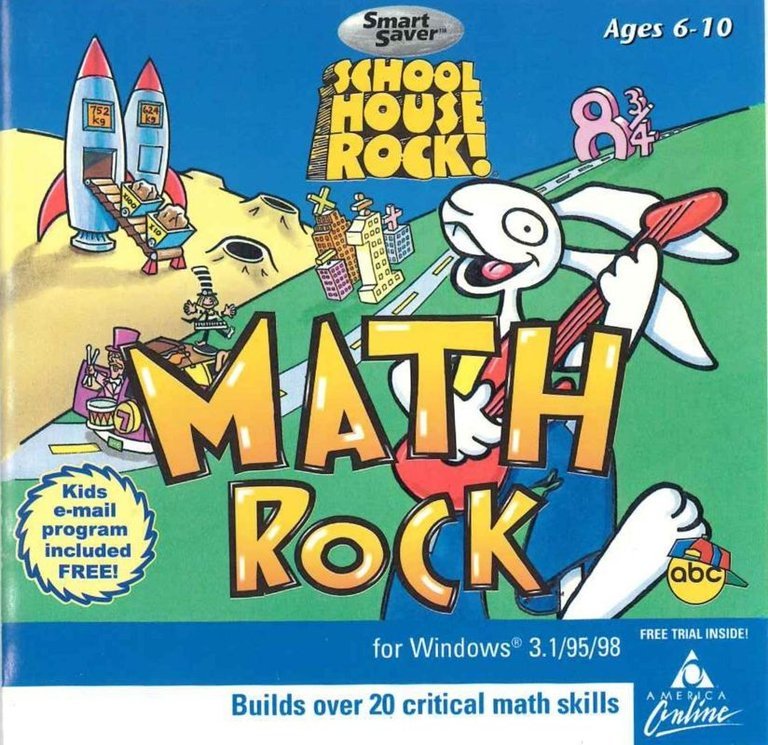
Set in the colorful fantasy world of Funky Numberland, Schoolhouse Rock!: Math Rock follows Lucky Seven Sampson’s quest to form a band by solving math-based challenges across seven themed mini-games. Players guide animals, skate geometric shapes, load moon rocks, and play darts to earn coins and recruit band members, ultimately progressing to a ‘Road to Fame’ board game where math skills unlock concert success. Designed for ages 6-10, the game teaches essential math concepts through engaging activities within the beloved Schoolhouse Rock! universe.
Gameplay Videos
Schoolhouse Rock!: Math Rock Free Download
Schoolhouse Rock!: Math Rock: Review
Introduction
Few educational properties have embedded themselves in the cultural zeitgeist as enduringly as Schoolhouse Rock!. The animated series, which transformed grammar, history, and science into infectious three-minute musical vignettes, became a cornerstone of 1970s and 80s Saturday morning television. By 1996, its educational ethos had expanded into interactive media with Schoolhouse Rock!: Math Rock. This Windows and Macintosh CD-ROM adventure, developed by Human Code, Inc. and published by Creative Wonders, promised to make mathematics as engaging as “Conjunction Junction.” Yet, as the Fecking Bahamas article wryly notes, the game’s legacy is inextricably tangled with the unrelated music genre “math rock,” prompting generations of musicians to sigh in frustration. This review argues that Math Rock stands as a fascinating, if flawed, artifact of edutainment—a game that brilliantly translated the series’ chaotic charm into an interactive format while revealing the limitations of 90s educational design. Its narrative absurdity, mechanical ingenuity, and unintentional cultural misappropriation make it a uniquely compelling relic.
Development History & Context
Schoolhouse Rock!: Math Rock emerged from the golden age of CD-ROM edutainment, an era when multimedia promise outpaced technical execution. Released in 1996 for Windows and Macintosh, it was developed by Human Code, Inc., a studio known for experimental interactive projects, and published by Creative Wonders (a subsidiary of The Learning Company). The game leveraged Adobe Director, a multimedia authoring tool ideal for point-and-click adventures, but faced constraints like limited color palettes, rudimentary animation, and audio compression that often resulted in tinny sound.
The project capitalized on the resurgent popularity of Schoolhouse Rock!, which had returned to ABC in 1993 with new content and was acquired by Disney in 1996. This timing positioned Math Rock as a flagship educational title, competing with contemporaries like Where in the World Is Carmen Sandiego? and Myst. Yet, unlike those games, Math Rock prioritized brand authenticity over innovation. Developers meticulously replicated the series’ hand-drawn aesthetic and upbeat jazz-inflected soundtrack, but the gameplay remained constrained by the era’s hardware limitations and the rigid demands of curriculum-based design. The result was a product that felt both technologically dated and curiously ambitious—a digital encapsulation of the series’ “anything is possible” ethos.
Narrative & Thematic Deep Dive
The game’s narrative is a masterclass in delightful absurdity, framed by the quest of Lucky Seven Sampson, a perpetually relaxed rabbit with a Blink-182-esque vibe, to form a band in Funky Number Land. Guided by the player, Lucky recruits seven eccentric characters—each a walking math problem—who only join if he solves their dilemmas. The story unfolds across seven distinct zones, each a microcosm of mathematical chaos:
- Zookeeper’s Quandary: A dog struggles to manage unruly animals. The player must cage creatures based on numerical criteria (e.g., “greater than 11” or matching shapes), turning zookeeping into a lesson in comparison and classification.
- Carnival Calamity: A slingshot dart game pits players against geometric targets, where trajectory and scoring equations turn carnival fun into a physics puzzle.
- Moon Rock Mayhem: Hero Zero, a saxophone-playing moon-rock dealer, needs precise incremental loading for his rocket—a surrealist take on division and measurement.
- Ice Skating Illusions: A drumming girl challenges players to organize skaters into “impossible 90-degree turns,” blending geometry with spatial reasoning.
- Billiards Blunder: A jazz cat demands a game of pool where each shot requires calculating angles and probabilities.
- Farmyard Fiasco: A farmer with hidden children in hay bales demands sorting by number patterns, merging arithmetic with surrealism.
- Cosmic Connection: Twelve-Tone, an alien keyboardist, requires star-chart matching, introducing set theory and astronomy.
The overarching theme—math as the universal language—resonates through the band’s eclectic lineup (a dog, magician, farmer, alien, etc.), symbolizing the unity of diverse concepts. Yet, as the Fecking Bahamas article notes, the narrative’s quirkiness borders on surrealism: biblical allusions (Noah’s Ark), drug-laden subtext (“moon rocks”), and character backstories (“a complicated history with the magician involving an accident, girls, and sports betting”) create a dissonant tapestry. This isn’t just edutainment; it’s a psychedelic romp through childhood imagination, where math is the glue holding a bizarre, musical universe together.
Gameplay Mechanics & Systems
Math Rock splits gameplay into two phases: a hub-and-spoke exploration of Funky Number Land and a board-game finale, “The Road to Fame.”
Mini-Games:
Each zone hosts a unique activity teaching specific math skills:
– Addition/Subtraction: Guiding animals in the zoo.
– Multiplication/Division: Loading moon rocks by weight.
– Geometry: Ice skating and dartboard targeting.
– Logic/Patterns: Sorting hay bales or connecting stars.
– Fractions/Decimals: Pool and billiards calculations.
– Set Theory: Identifying prime numbers or even/odd groupings.
The mechanics are simple point-and-click interactions, but depth emerges from replayability. Players earn coins for correct answers, which function as currency for the final stage. Critically, the game allows incorrect answers to be selected without penalty—players can “slingshot darts” or “skate in shapes” purely for fun, reinforcing the idea that math need not be intimidating. This accessibility, however, clashes with the game’s ambition; advanced concepts like prime numbers or equations feel shoehorned into simplistic activities, limiting pedagogical depth.
The Road to Fame:
After recruiting all band members, the game transforms into a board game. Players roll dice to advance toward a concert, answering rapid-fire math questions to progress. The twist? At least 30 coins are required to “pay for the concert,” creating a meta-resource-management layer. If coins are insufficient, players must replay mini-games—a brilliant incentive for mastery but a potential frustration loop. This dual structure balances exploration with repetition, though the board-game phase feels abrupt, halting the narrative momentum for rote practice.
World-Building, Art & Sound
Funky Numberland is a triumph of 90s edutainment art direction. Borrowing heavily from the original Schoolhouse Rock! animations, the game features hand-drawn characters and backgrounds bursting with playful anachronisms: wind spinners with four giant “4”s, rocket ships shaped like pencils, and alien thrones modeled after Halo Prophets. The visual style is intentionally busy, cluttering the screen with mathematical motifs (floating equations, number-patterned forests) to immerse players in a world where numbers are tangible. This aesthetic, however, suffers from the era’s technical limits. Colors are washed out, animations are choppy, and static backgrounds lack dynamism, making the world feel less alive than its TV counterpart.
Sound design, by contrast, is a standout. The game retains Schoolhouse Rock!’s signature jazz-pop soundtrack, with upbeat, whistling melodies underscoring each mini-game. Lucky Seven’s voice—provided by a voice actor embodying the series’ laid-back charm—offers constant encouragement, quips, and oddball asides (e.g., his “intense” enunciation of “Funky Number Land”). Sound effects are cartoony and satisfying, from the thwump of a dart hitting a target to the cha-ching of coin collection. Yet, audio compression occasionally yields tinny music, and repetitive voice lines (“Let’s do this!”) grate during prolonged play. Despite these flaws, the audio-visual fusion successfully captures the series’ spirit: a place where math is melodic and learning is a whimsical adventure.
Reception & Legacy
Upon release, Math Rock received little critical attention, reflecting the niche status of educational games in 1996. Contemporary reviews, if any, likely praised its faithful adaptation of the Schoolhouse Rock! brand but criticized its technical limitations and shallow gameplay. The Fecking Bahamas article offers a modern reappraisal, noting its enduring presence in childhood memories—recalled fondly despite its “dullest, most pretentious facets.” Commercially, it occupied a middle ground: not a blockbuster like Carmen Sandiego but a staple in educational software sections of stores like Staples.
Its legacy, however, is twofold. First, it exemplifies the era’s edutainment ambitions, proving that multimedia could make abstract concepts tactile. The game’s structure—mini-games leading to a central goal—would inform later educational titles, though none with its narrative flair. Second, its name became a cultural footnote. The Fecking Bahamas article laments how “math rock” bands are endlessly compared to the game, a testament to its unintended, ironic immortality. Today, it survives on archival sites like the Internet Archive, where it’s played for nostalgia, not education. Its greatest impact? Inspiring countless YouTube playthroughs and a generation of musicians to resent a floppy-eared rabbit.
Conclusion
Schoolhouse Rock!: Math Rock is a time capsule of 90s edutainment—quirky, ambitious, and technically dated. It succeeds in translating the Schoolhouse Rock! ethos into interactivity, using narrative absurdity and accessible gameplay to demystify math. Yet, its repetitive structure, shallow mechanics, and surreal storytelling reveal the constraints of its era. As the Fecking Bahamas article concludes, the game’s true legacy lies in its cultural misappropriation—a symbol of how meaning shifts across time and media. For historians, it’s a fascinating artifact; for educators, a flawed but charming tool; and for math rockers, a source of eternal annoyance. Ultimately, Math Rock earns its place not as a masterpiece, but as a love letter to childhood imagination—a game where even the moon rocks have a beat.