
- Release Year: 2018
- Platforms: Windows
- Publisher: putilin_industries
- Developer: putilin_industries
- Genre: Action
- Perspective: Side view
- Game Mode: Single-player
- Gameplay: Platform, Shooter
- Setting: Zombies
Description
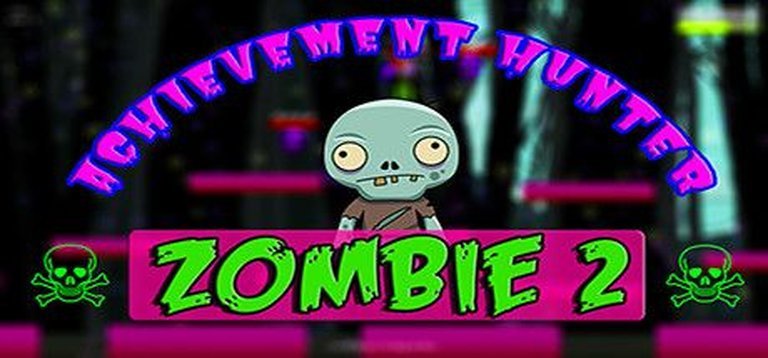
Achievement Hunter: Zombie 2 is a 2D side-scrolling action shooter where players take on the role of a lone hero defending their city against an alien invasion. Armed with real weapons and no allies, players must battle hordes of enemies, upgrade their arsenal, and prevent the aliens from destroying their home while striving to unlock the game’s staggering 5000 achievements.
Achievement Hunter: Zombie 2: A Microcosm of the Steam Direct Era’s Ambition and Absurdity
Introduction
In the sprawling digital bazaar of the Steam Direct era, few phenomena encapsulated both the wild opportunity and the glaring pitfalls of accessible game development like putilin_industries’ Achievement Hunter: Zombie 2. Released on February 18, 2018, this 2D action-platformer arrived amidst a tidal wave of low-budget titles, vying for attention through audacious claims—chief among them a staggering 5,000 achievements—and a price tag set at Steam’s “minimum allowable.” As a historian dissecting the microcosm of Steam’s greenlight-to-direct transition, Achievement Hunter: Zombie 2 emerges not merely as a game, but as a cultural artifact: a testament to developer ambition, community-driven achievement hunting, and the technical fragility of rapid-fire production. This review argues that while Zombie 2 is mechanically and narratively skeletal, its legacy lies in its role as a lightning rod for debates about game value, achievement inflation, and the blurred lines between passion and exploitation in indie gaming.
Development History & Context
putilin_industries, a shadowy collective whose prolific output saw them release over two dozen Achievement Hunter titles between 2017–2019, crafted Zombie 2 amid a seismic shift in the indie landscape. The studio leveraged the Unity engine, enabling rapid development at low cost—reflected in the game’s minuscule 150 MB install size and modest specs (Intel Core Duo 1.83 GHz, 2GB RAM, NVIDIA GeForce 240 GT). This accessibility was both a boon and a constraint: Unity allowed for quick iteration but demanded meticulous optimization to run on aging hardware, a task the studio often struggled with.
The 2018 release window coincided with Steam’s controversial Direct launch, which flooded the platform with over 10,000 new titles annually. In this environment, Achievement Hunter: Zombie 2 positioned itself as a “niche” product for completionists, its ad copy emphasizing “real weapons,” “fearless protagonists,” and no allies—a minimalist design ethos prioritizing replayability over narrative depth. Yet this minimalist approach masked systemic issues: rushed builds (evident in broken achievements) and a reliance on asset reuse common across the Achievement Hunter series (Darkness 2, Punk, Samurai). The studio’s vision was clear: exploit Steam’s achievement economy by creating games with near-endless meta-goals, but this ambition clashed with technical reality, leaving Zombie 2 as a case study in the Steam Direct era’s tension between volume and quality.
Narrative & Thematic Deep Dive
Achievement Hunter: Zombie 2‘s narrative is a hazy, existential paradox: “You’re a zombie and don’t want to die a second time. Kill aliens trying to take over the world.” This premise—equal parts absurdist and apocalyptic—serves as a thin veneer for the action. The protagonist, a “fearless” but unnamed zombie, exists as a blank slate; their motivations are reduced to mechanical imperatives (“stop aliens,” “fight for your home”) with no allies, dialogue, or character arcs. The narrative is not told but implied through gameplay: waves of faceless aliens represent anonymous threats, while the player’s solitary struggle mirrors the isolation of achievement hunting itself.
Thematically, the game reduces survival to a numerical exercise. The zombie protagonist’s “immortality” becomes a metaphor for the completionist’s endless grind, while the alien invasion symbolizes the ceaseless onslaught of Steam’s content library. Yet these themes remain underdeveloped, buried beneath a focus on progression. The narrative’s only memorable moment—achieving “second death”—is left unexplored, reinforcing the game’s core ethos: story is secondary to the pursuit of digital trophies.
Gameplay Mechanics & Systems
Zombie 2’s gameplay is a distilled loop of 2D platforming and shooting, executed with functional but uninspired precision. Players traverse side-scrolling levels, jumping over obstacles and spraying bullets at pixelated aliens. The core systems are built around three pillars:
- Combat & Weaponry: “Real weapons” (pistols, shotguns, etc.) are upgradeable, but upgrades feel cosmetic, altering fire rate or damage without adding tactical depth. Combat is weighty, lacking the fluidity of contemporaries like Hollow Knight, favoring spam attacks over skillful maneuvers.
- Achievement Progression: The game’s defining feature is its 5,000 achievements. These range from trivial (“Kill 1 alien”) to opaque (“ZombieAchievement3604″), often tied to obscure in-game events. The sheer volume transforms gameplay into a scavenger hunt, rewarding persistence rather than mastery.
- Character Progression: Skill upgrades are minimal, emphasizing weapon tweaks over abilities. This flattens the experience, as players quickly hit a skill plateau, relying on achievement-hunting as the sole driver of engagement.
The UI is a stark, utilitarian interface—health bars, ammo counts, and achievement trackers—reflecting the game’s budget constraints. However, the system’s greatest flaw is its technical instability: achievements like “ZombieAchievement1455″ frequently broke, requiring manual registry edits or DLL swaps to unlock. These glitches transformed the “fearless protagonist” into a digital ghost haunting Steam’s infrastructure.
World-Building, Art & Sound
Zombie 2’s world is a void of undetailed environments. Levels are barren backdrops—city streets, alien landscapes—populated by repetitive sprites. The 2D scrolling visuals lack polish, with flat textures and inconsistent animation. Aliens are indistinct blobs, while the zombie protagonist is a generic, tattered figure. The art’s only saving grace is its cohesion; every asset adheres to a minimalist pixel-art style, even if it lacks ambition.
Sound design is equally sparse. Gunshots and explosion effects are functional but unmemorable, while the absence of a musical score amplifies the game’s oppressive quietness. This silence, while atmospheric, inadvertently highlights the world’s emptiness—levels feel like testing grounds rather than lived-in spaces. The “real weapons” boast is undermined by audio that fails to deliver visceral impact, reducing combat to visual feedback alone.
Reception & Legacy
Upon release, Achievement Hunter: Zombie 2 polarized audiences. On Steam, it holds a “Mixed” 53.52% rating, with players divided between completionists praising its achievement density and critics lambasting its technical flaws. Metacritic lists no critic reviews, reflecting its niche status, while community forums buzzed with reports of broken achievements and developer deflection (“reinstall and try again”). The game’s legacy is thus twofold:
- Achievement Infamy: It became a poster child for Steam’s “achievement spam” controversy, alongside titles like The Unemployed Ninja. Kotaku’s Nathan Grayson noted such games “caused controversy” for devaluing achievement systems, turning digital rewards into a grindable commodity.
- Series Context: Zombie 2 is a linchpin in the Achievement Hunter series, sandwiched between Zombie (2017) and Zombie 3 (2018). Its success spawned spin-offs like Achievement Collector: Zombie (2019), but also exposed the model’s limits—by 2019, player fatigue set in, and the series’ release frequency slowed.
Critically, Zombie 2 is a footnote. But culturally, it remains a cautionary tale about the Steam Direct era’s excesses, where a $1 price tag and 5,000 achievements could drive sales despite technical decay. Its influence persists in modern achievement-hunting communities, where debates on “meaningful” versus “grind-based” trophies continue.
Conclusion
Achievement Hunter: Zombie 2 is not a “good” game by traditional metrics. Its narrative is hollow, its gameplay repetitive, and its riddled with technical failures. Yet as a historical document, it is indispensable. It captures the frenetic, unfiltered energy of the Steam Direct revolution—a time when a single developer could flood the market with experimental, if flawed, products. The game’s legacy is not in its design but in its impact: it weaponized achievements, exposed the fragility of rapid development, and forced gamers to confront the question of what constitutes value in a digital marketplace.
For historians, Zombie 2 is a microcosm of ambition colliding with reality. For players, it is a monument to the absurdity of achievement hunting. In the end, its true achievement isn’t 5,000 digital trophies—it’s serving as a time capsule for one of gaming’s most chaotic eras. Verdict: A fascinating, if broken, artifact of a bygone era—essential for studying indie game economics, but unplayable by modern standards.