
- Release Year: 1998
- Platforms: Windows
- Genre: Compilation
- Game Mode: Single-player
- Gameplay: Action, Board game, Card, Puzzle, Racing, Shooter, Simulation, Sports, Strategy
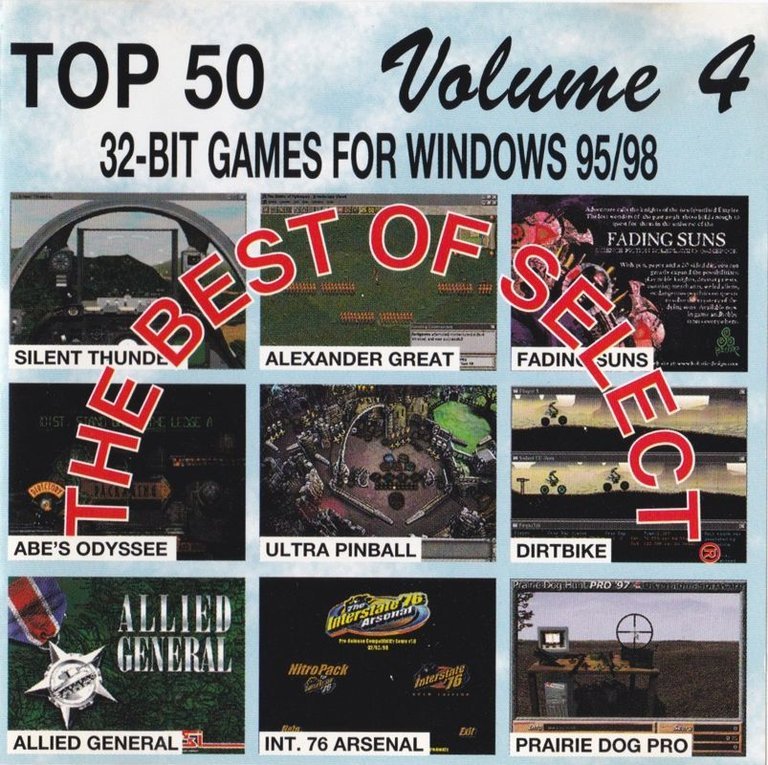
Description
Released in 1998, ‘Top 50 32-Bit Games for Windows 95/98: Volume 4’ is a commercial compilation CD-ROM featuring 50+ shareware, freeware, and demo games designed for Windows 95/98 systems. The diverse collection spans genres like action, strategy, sports, puzzles, and card games—including notable titles such as Oddworld: Abe’s Oddysee, Atomic Bomberman, Heroes of Might and Magic II, and MechWarrior 2: Mercenaries—while also including antivirus utilities like ThunderBYTE Anti-Virus and McAfee VirusScan to enhance system security.
Top 50 32-Bit Games for Windows 95/98: Volume 4: A Curated Time Capsule of the PC Gaming Renaissance
Introduction
In the twilight of the 20th century, as Windows 95/98 solidified Microsoft’s dominance in personal computing, the PC gaming landscape entered a golden age of experimentation and genre-defining innovation. Amid this fertile ground emerged Top 50 32-Bit Games for Windows 95/98: Volume 4, a compilation released in December 1998 by Select CD-Rom. Far more than a mere assortment of titles, this collection served as a digital ark, preserving a snapshot of the era’s gaming zeitgeist—from the burgeoning 3D revolution to the enduring appeal of classic mechanics. This review argues that while “Volume 4” lacks a singular artistic vision, its true legacy lies in its role as a microcosm of late-90s PC gaming: a meticulously curated anthology showcasing the technological ambition, thematic diversity, and cultural impact of an industry in flux. By dissecting its contents, context, and curatorial philosophy, we uncover not just a product, but a portal to formative gaming experiences that shaped the medium’s future.
Development History & Context
The genesis of “Volume 4” is intrinsically tied to the technological and cultural shifts of the mid-to-late 1990s. Published by Select CD-Rom, a company operating in the burgeoning European budget software market, the compilation reflected a practical business model: aggregating shareware, freeware, and demos into a high-value, low-cost package. This approach capitalized on the era’s vibrant shareware culture, where developers distributed stripped-down versions of games freely, relying on player purchases to unlock full experiences. The “Top 50” series positioned itself as a comprehensive guide to the best 32-bit titles available, acting as a discovery engine for gamers navigating the overwhelming DOS-to-Windows transition.
Technologically, the compilation was a product of its constraints. All titles were optimized for Windows 95/98, leveraging 32-bit processing power for smoother multitasking and improved graphics capabilities compared to 16-bit predecessors. However, limitations were palpable: games were designed for modest systems (often requiring as little as a Pentium 133MHz CPU and 16MB RAM), with reliance on software rendering for 3D graphics and MIDI audio for sound. The gaming landscape of 1998 was a dynamic battlefield. While 3D accelerators like the 3dfx Voodoo were revolutionizing visuals, many studios still experimented with isometric perspectives, sprite-based art, and FMV cutscenes. “Volume 4” captured this duality, juxtaposing cutting-edge titles like MechWarrior 2: Mercenaries with timeless classics like Heroes of Might and Magic II. Its inclusion of antivirus software (ThunderBYTE Anti-Virus, McAfee VirusScan) alongside games underscored a pragmatic concern: protecting users from the nascent threats of the early internet.
Narrative & Thematic Deep Dive
As a compilation, “Volume 4” eschews a unified narrative in favor of thematic diversity, offering a kaleidoscope of storytelling approaches emblematic of the era. Its most potent narrative entry is Oddworld: Abe’s Oddysee. This platformer-puzzle hybrid presents a dystopian industrial fable, following Abe, a Mudokon slave, in his quest to free his people from the tyrannical Glukkons. Its narrative strength lies in its environmental storytelling and darkly comedic undertones, critiquing corporate exploitation and ecological devastation—a theme resonant with late-90s anxieties. Abe’s silent, pantomimed communication and the game’s haunting chants created a unique, wordless narrative language that influenced future character-driven games.
Other titles contribute distinct thematic threads:
– Strategy Epics: Allied General and Star General explore alternate-history warfare and galactic conquest, respectively, emphasizing grand strategy and moral ambiguity in conflict.
– Sci-Fi Futures: MechWarrior 2: Mercenaries and Krazy Ivan delve into mecha warfare and spacefaring combat, blending tactical simulation with operatic narratives of duty and betrayal.
– Fantasy Worlds: Heroes of Might and Magic II weaves rich tapestries of lore through its campaigns, embedding players in dynastic struggles and mythic battles.
– Niche Vignettes: Deer Hunter taps into ecological themes, while PBA Bowling and Cricket 97 offer sports narratives focused on skill and competition.
The compilation’s thematic power lies in its breadth. It juxtaposes the epic with the mundane, the dystopian with the whimsical (e.g., Baker’s Dozen vs. Emperor of the Fading Suns), mirroring PC gaming’s expansion beyond core audiences. This eclecticism reflects the era’s willingness to experiment with diverse subjects, from corporate satire to historical reenactment.
Gameplay Mechanics & Systems
“Volume 4” is a masterclass in genre diversity, showcasing a staggering array of gameplay paradigms. Its core strength lies in this variety, offering systems that range from accessible to brutally complex:
- Action & Arcade: Atomic Bomberman delivers frantic, multiplayer-centric bomb-dropping chaos, while Robotron X revitalizes a classic twin-stick shooter for the 32-bit era. Oddworld: Abe’s Oddysee combines stealth, platforming, and environmental puzzles, introducing innovative mechanics like “chanting” to control enemies.
- Strategy & Simulation: Heroes of Might and Magic II stands as a pinnacle of turn-based strategy, blending resource management, army building, and tactical hex-grid combat. Allied General and Star General offer deeper, more complex wargaming simulations with detailed rulesets. Emperor of the Fading Suns merges 4X strategy with political intrigue, featuring a unique council-based diplomacy system.
- Racing & Sports: Interstate ’76 Arsenal provides a unique post-apocalyptic vehicular combat experience, while PBA Bowling and Cricket 97 offer simulations with varying degrees of realism.
- Puzzle & Casual: The compilation is filled with accessible titles like BeeTris (a Tetris clone), Baker’s Dozen, and Drag-n-Drop Solitaire 95, catering to casual players.
- Simulation & Niche: Harpoon Classic ’97 and Su-27 Flanker cater to hardcore simulation enthusiasts with complex controls and realistic physics.
The UI is functional, prioritizing simplicity with a menu-driven launcher. Critically, many entries are demos or shareware versions (e.g., Oddworld, Heroes of Might and Magic II), acting as teasers for full purchases—a deliberate choice reflecting the compilation’s business model. While this reduces playtime for some titles, it encourages exploration of the 51 included “games.” The compilation’s low system requirements ensured broad accessibility, democratizing access to titles that might otherwise have demanded high-end hardware.
World-Building, Art & Sound
Visual and auditory styles in “Volume 4” encapsulate the aesthetic evolution of late-90s PC gaming. The compilation showcases a spectrum of artistic approaches:
– Pre-Rendered 2.5D: Oddworld: Abe’s Oddysee remains a visual landmark, using hand-painted environments and stop-motion-inspired character models to create a unique, tactile world. Its use of lighting and shadow conveyed mood and atmosphere without relying on polygons.
– Isometric Masterpieces: Heroes of Might and Magic II and Allied General employed rich, painterly isometric views, creating dense, information-dense landscapes teeming with detail. The fantasy art of Heroes, in particular, defined the look of the genre.
– Early 3D Experimentation: Titles like Atomic Bomberman, MechWarrior 2: Mercenaries, and Krazy Ivan embraced 3D polygons, though with the blocky textures and limited draw distances of the era. MechWarrior 2 set a benchmark for mecha design, while Interstate ’76 offered a stylized, car-chic aesthetic.
– Sprite-Based Simplicity: Smaller games like BeeTris and Drag-n-Drop Solitaire 95 relied on crisp 2D sprites, proving that pixel art remained viable amid the 3D revolution.
Sound design was equally varied. Oddworld utilized innovative voice acting (Abe’s chants, whistles) and environmental audio to build immersion. Strategy games like Heroes employed orchestral MIDI scores to evoke epic scale, while arcade titles used chiptune-inspired electronic tracks. The inclusion of antivirus software added an unintentional auditory layer—the clunking of floppy drives and modem screeches evoking the era’s digital anxieties. Collectively, the compilation’s audiovisual landscape paints a vivid portrait of an industry grappling with new technologies while honoring artistic traditions.
Reception & Legacy
Upon its 1998 release, “Volume 4” likely served its purpose as a budget-friendly sampler, introducing players to titles they might not have encountered individually. As a compilation of demos and shareware, it didn’t receive widespread critical attention from mainstream outlets, which focused on full-priced AAA releases. Commercially, it thrived in the budget segment, appealing to newcomers seeking affordable entertainment and veterans exploring niche genres. Its legacy, however, transcends initial reception.
Today, “Volume 4” is revered as a historical artifact. It preserves a specific moment in gaming history—before digital storefronts like Steam democratized distribution—when shareware and compilations were vital discovery tools. The inclusion of landmark titles like Oddworld and Heroes of Might and Magic II (even in demo form) ensures its preservation value. Its influence is indirect but profound: by aggregating diverse genres, it inadvertently documented the PC gaming ecosystem’s health and creativity. Modern preservation efforts (e.g., MobyGames) rely on such compilations to catalog lesser-known titles like Chaos Overlords or Iko San. The compilation also reflects a bygone era of physical media—CD-ROMs as tangible archives of digital experiences, complete with antivirus software as a cultural footnote. For retro enthusiasts, it remains a treasure trove, a Rosetta Stone for understanding the technological and thematic DNA of games that defined the late 90s.
Conclusion
Top 50 32-Bit Games for Windows 95/98: Volume 4 is not a game in the traditional sense but a curated time capsule—a sprawling, disjointed, yet indispensable chronicle of PC gaming’s renaissance. Its genius lies in its eclecticism, offering a panoramic view of an industry at the peak of its experimental zeal. From the dystopian narrative of Oddworld to the strategic depth of Heroes of Might and Magic II, the compilation encapsulates the era’s thematic and mechanical diversity. While its curation is uneven—mixing full experiences with demos—it excels as a discovery engine, a low-risk gateway to gaming’s past. Its true legacy endures not in gameplay polish or narrative cohesion, but in its role as a cultural artifact. It preserves the technological constraints, the business models (shareware, compilations), and the artistic ambitions of a time when PC gaming was a wild, uncharted territory. For historians and gamers alike, “Volume 4” remains an invaluable portal—a flawed, fragmented, yet essential window into the soul of late-90s PC gaming. In an age of homogenized digital storefronts, this compilation stands as a testament to the power of curation and the enduring magic of a bygone era’s digital frontier.