
- Release Year: 2007
- Platforms: Macintosh, Windows
- Publisher: Legacy Interactive Inc.
- Developer: Legacy Interactive Inc.
- Genre: Simulation
- Game Mode: Single-player
- Average Score: 46/100
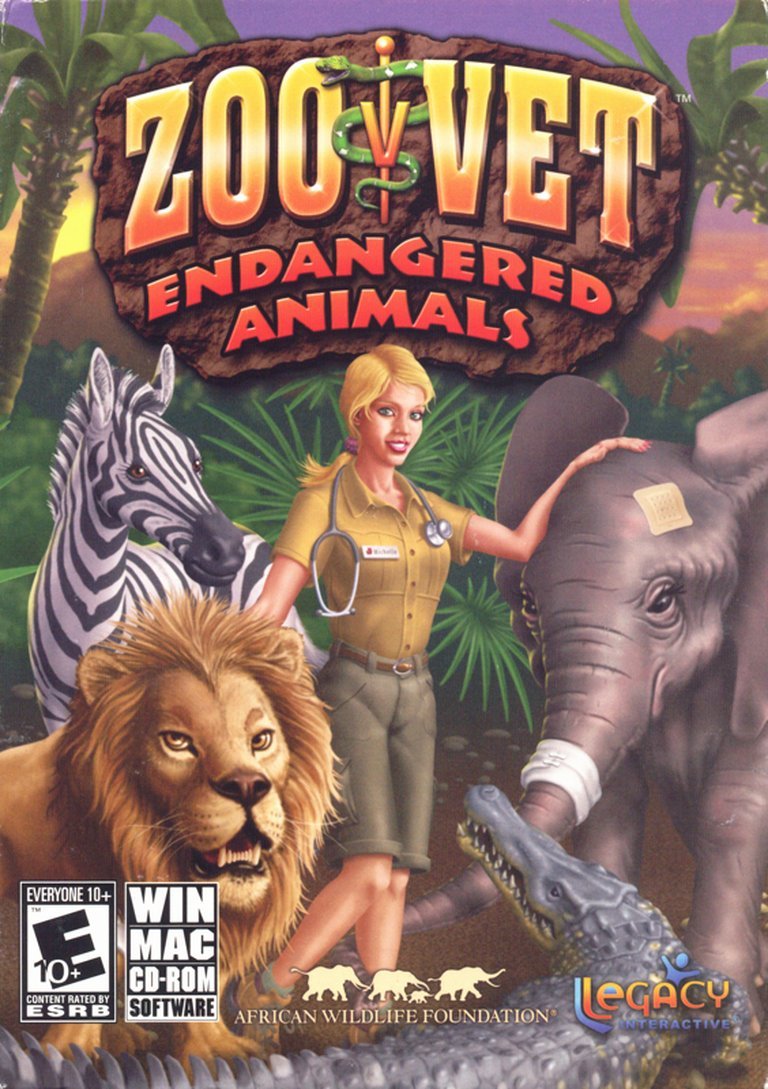
Description
Zoo Vet: Endangered Animals is a veterinary simulation game where players step into the role of a veterinarian at a zoo, diagnosing and treating a variety of endangered animals using realistic medical tools and engaging in educational minigames. The game combines animal care simulation with the mission to save vulnerable species, offering an immersive experience in wildlife conservation through hands-on gameplay.
Gameplay Videos
Zoo Vet: Endangered Animals Reviews & Reception
gamevortex.com (42/100): I wouldn’t call it a horrible experience, but it’s not what I would call fun either.
metacritic.com (40/100): The game isn’t terrible, but it’s definitely bad. Avoid.
Zoo Vet: Endangered Animals: Review
Introduction
In the bustling landscape of simulation games, few niches are as distinctively educational as veterinary simulations. Zoo Vet: Endangered Animals, released in 2007 by Legacy Interactive, promised players an unprecedented opportunity to step into the scrubs of a wildlife veterinarian, tasked with saving imperiled species from extinction. As the sequel to the 2004 title Zoo Vet, it aimed to elevate the genre with its focus on exotic creatures—lions, pandas, elephants, and crocodiles—while leveraging real veterinary expertise. Yet, despite its noble ambitions, the game emerged as a deeply flawed artifact of edutainment, caught between the demands of educational rigor and the constraints of 2000s-era technology. This review dissects Zoo Vet: Endangered Animals not merely as a product of its time, but as a microcosm of the challenges inherent in merging pedagogy with gameplay. While its commitment to conservation is commendable, the game ultimately succumbs to inconsistent mechanics, dated presentation, and a lack of depth, rendering it a curio rather than a classic.
Development History & Context
Developed primarily by Legacy Interactive for Windows and Mac—with a distinct Nintendo DS port handled by FRONTLINE Studios—Zoo Vet: Endangered Animals emerged from a lineage of medical simulations like the Emergency Room series. The studio, led by President & CEO Ariella Lehrer (Ph.D.) and Executive Producer Craig Brannon (Ph.D.), sought authenticity by collaborating with a panel of six real veterinarians (DVMs), including Jackie Gai and Chris Tabaka, and the African Wildlife Foundation. This partnership aimed to infuse the game with credible medical cases and conservation messaging. However, the technological constraints of the era were glaring: the PC version required a mere Pentium II processor, 256MB RAM, and a GeForce 2 graphics card, reflecting a budget-conscious development cycle. The DS port, released a year later, struggled with the handheld’s limited processing power, attempting to translate complex veterinary procedures into stylus-based microgames. The gaming landscape of 2007-2008 was dominated by edutainment titles targeting younger audiences, but competitors like Trauma Center set a higher bar for precision and atmosphere. Legacy Interactive’s vision was clear—to create an “experience similar to the Discovery Channel”—yet the execution was hampered by fragmented development and hardware limitations, leaving the game feeling both ambitious and undercooked.
Narrative & Thematic Deep Dive
The narrative of Zoo Vet: Endangered Animals is functionally minimalist, serving as a framework for its educational mechanics. Players assume the role of a new veterinarian recruited by the Earth Rescue Team (ERT) to rehabilitate wildlife on a pollution-threatened island. There is no overarching story arc; instead, the game unfolds through 30 discrete medical cases, each a vignette of animal suffering or neglect. Characters are reduced to archetypes: the stern head veterinarian who evaluates performance, the perpetually upbeat zookeepers who chirp platitudes (“That’s alright, I know you didn’t mean to” when a panda’s life hangs in the balance), and faceless animal patients. Dialogue is largely inane, prioritizing simplistic encouragement over narrative depth. Thematically, the game tackles conservationism earnestly, emphasizing the fragility of endangered species and the gravity of veterinary work. Yet, its treatment of these themes feels superficial. For instance, cases involve pregnancy complications and fecal tests but lack context about animal habitats or ecological threats beyond a fleeting mention of pollution. The juxtaposition of life-and-death urgency with the game’s casual tone creates cognitive dissonance, undermining its educational goals. Ultimately, the narrative is less a story and more a checklist of procedures, failing to inspire the emotional investment promised by its high-stakes premise.
Gameplay Mechanics & Systems
The core gameplay revolves around six phases of veterinary care: Examine, Monitor, Test, Maintain, Operate, and Medicate. Players must diagnose and treat animals using 15 medical tools—from thermometers to syringes—each tied to a stylus-based microgame. For example, suturing a wound requires tracing a zig-zag pattern on the DS screen, while administering injections involves a pushing motion. This system, in theory, offers tactile engagement, but in practice, it marred by inconsistency. The DS version’s touch-screen recognition is notoriously unreliable, often requiring random prodding to trigger the correct response. On PC, the point-and-click interface relies on ambiguous mouse-over hotspots, making it difficult to distinguish between a “wound” and a “blood vessel” without trial-and-error. Difficulty tiers (Easy, Medium, Hard) alter the availability of hints, but even Easy mode provides a rigid walkthrough that stifles problem-solving, while Hard mode offers no guidance, leaving players adrift. Mini-games, such as tossing fish to penguins or solving word searches, feel tacked on, offering shallow diversions that break the clinical immersion. Educational elements include quizzes on animal diets and anatomy, but these devolve into rote memorization rather than meaningful learning. The game’s failure to balance challenge with clarity results in a frustrating loop of trial-and-error, where the educational value is drowned out by mechanical friction.
World-Building, Art & Sound
The game’s world-building is ambitious yet poorly realized. It spans five habitats—tropical, savanna, desert, arctic, and forest—hosting over 30 species, including the promised lions, pandas, and eagles. However, the environments are rendered with startlingly low fidelity. The PC version features blocky terrain, clipping animals, and textures that look like “horrible excuses for art,” as one critic lamented. Animal models are static portraits with minor animation, such as a lion’s tail swaying, while the DS port fares slightly better with livelier 3D models that still lack detail. Sound design is equally underwhelming: generic jungle loops and upbeat, unmemorable voice lines from staff create a sterile atmosphere. Animal sounds—growls, chirps—are recycled and lack realism, failing to evoke the awe of a real zoo. The game attempts to compensate with rewards like wildlife photos and videos, but these are brief, unexplained snippets that feel like afterthoughts. The overall aesthetic is a jumble of cartoonish animal designs and stiff human avatars, undercutting the intended realism. Despite its focus on endangered species, Zoo Vet fails to build a believable world, leaving players in a limbo of generic environments that neither educate nor enthrall.
Reception & Legacy
At launch, Zoo Vet: Endangered Animals received mixed-to-poor reviews, reflecting its polarizing design choices. IGN awarded the DS version a middling 6.5/10, praising the “solid treatment process” and animal diversity but criticizing the “inconsistent” stylus controls and dated graphics. GameVortex was scathing, noting the PC version’s “linear point-and-click” gameplay and “horrible” graphics, concluding it “helps give educational software the bad rap that it has.” Metacritic aggregated low scores, with My Gamer (40/100) deeming it “terrible” and Worth Playing (35/100) finding “nothing” to recommend. Commercially, the game saw modest sales, with the DS version moving 318 units in its first week in Japan and 318 total in North America, according to VGChartz, while the PC/Mac releases faded into obscurity. Its legacy is similarly muted. The game is remembered as a flawed edutainment footnote—a title that tried to bridge conservation and interactivity but fell short due to technical and design limitations. It did not inspire sequels or influence major franchises, though its emphasis on endangered animals predated the surge in eco-conscious gaming. Today, it stands as a cautionary tale: one where ambition outpaced execution, leaving behind a niche product for aspiring veterinarians rather than a lasting cultural impact.
Conclusion
Zoo Vet: Endangered Animals is a game of two halves: a commendable educational endeavor and a deeply flawed interactive experience. Its strengths lie in its authentic veterinary consultation, diverse roster of exotic species, and earnest conservation messaging. For a young player enamored with wildlife, it could serve as a rudimentary introduction to veterinary care. Yet, these virtues are overshadowed by systemic failures: the unreliable interface, dated visuals, and lack of narrative cohesion transform potential learning opportunities into exercises in frustration. The game’s legacy is one of unfulfilled potential—a reminder that edutainment requires more than good intentions; it demands polished mechanics, immersive design, and respect for its audience’s intelligence. While it occupies a small corner of gaming history, Zoo Vet: Endangered Animals is unlikely to be revisited with nostalgia or admiration. Instead, it endures as a historical artifact—a testament to the challenges of making games that educate, and the fine line between inspiration and frustration. In the pantheon of veterinary simulations, it is a well-meaning patient that ultimately could not be saved.