
- Release Year: 2008
- Platforms: Browser, iPhone, Macintosh, Windows
- Publisher: FreshGames, LLC, Intenium GmbH, MumboJumbo, LLC
- Developer: Aliasworlds Entertainment, FreshGames, LLC
- Genre: Action, Strategy, Tactics
- Perspective: Top-down
- Game Mode: Single-player
- Gameplay: Time management
- Setting: Farm
- Average Score: 83/100
Description
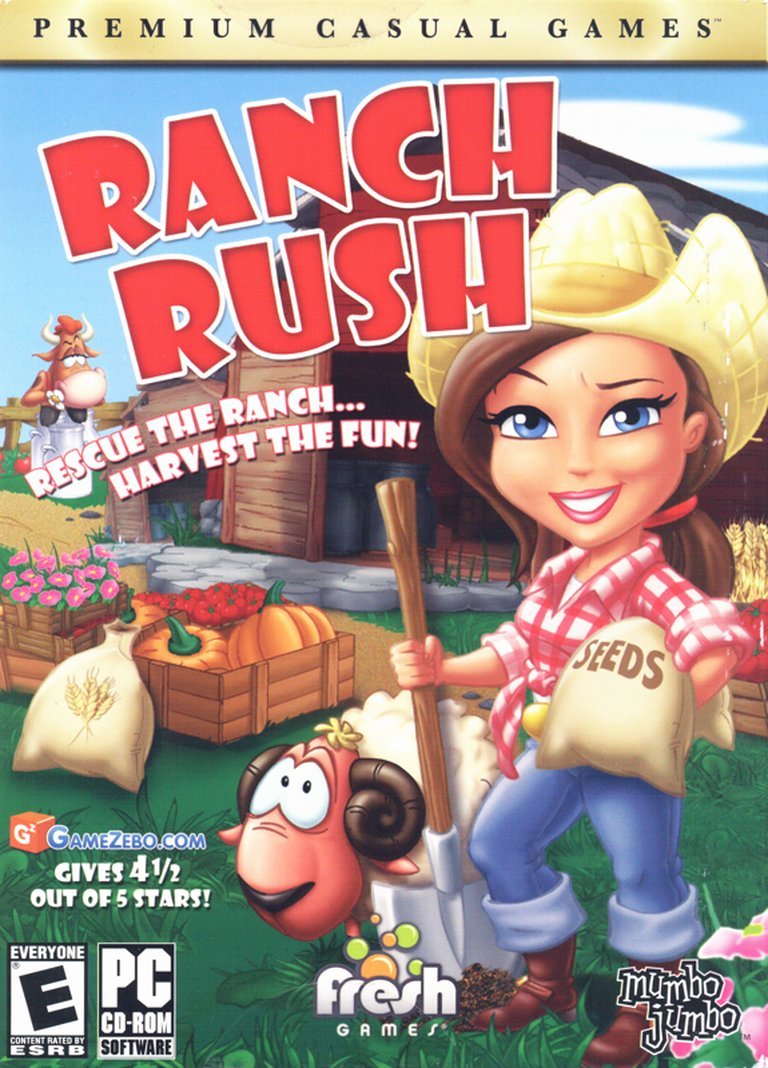
In Ranch Rush, players assume the role of Sara, a greenhouse worker racing to save her failing nursery from being sold to a developer within eight weeks by transforming a vacant three-acre plot into a productive farm. This time-management game requires players to complete daily missions by growing and harvesting crops, processing goods like milk and ketchup, and selling items at a Saturday farmer’s market for bonus cash.
Gameplay Videos
Ranch Rush Free Download
Ranch Rush Guides & Walkthroughs
Ranch Rush Reviews & Reception
cassandra-morgan.com : While I enjoyed the beginning levels of the games, the higher levels felt like they needed something more.
gamezebo.com (90/100): From attractive graphics and superb gameplay balance to healthy doses of creativity, challenge and fun, Ranch Rush is one of those happy instances where almost all aspects of the gameplay come together perfectly.
Ranch Rush: Review
Introduction
In the vibrant world of casual gaming, few genres have captured the hearts of players as consistently as time-management simulations. Released in 2008 during the golden age of downloadable casual games, Ranch Rush emerges as a standout entry that transcends its crowded market. Developed by Aliasworlds Entertainment and published by FreshGames, this title challenges players to save a failing nursery by transforming a barren three-acre plot into a thriving, self-sufficient farm. While its premise echoes classics like Farm Frenzy, Ranch Rush distinguishes itself through unparalleled strategic depth, a charming narrative, and gameplay innovations that redefine the genre’s conventions. This review deconstructs how Ranch Rush balances accessible mechanics with sophisticated design, securing its place as a cult favorite among simulation enthusiasts and a milestone for time-management games.
Development History & Context
Ranch Rush emerged from the creative synergy between Belarus-based developer Aliasworlds Entertainment and U.S. publisher FreshGames. FreshGames President Stephan Smith envisioned a game that would disrupt the time-management status quo, which at the time was dominated by static, counter-based mechanics like those in Diner Dash. As Smith revealed in a 2009 interview with Gamezebo, his team sought a “game where you moved things in the environment around,” a radical departure from the genre’s repetitive patterns. Aliasworlds, already working on a prototype featuring farming and movable assets, provided the technical foundation. The collaboration yielded a game designed explicitly for casual platforms (Windows, Mac, iOS, browser), prioritizing accessibility without sacrificing complexity.
Technologically, Ranch Rush operated within the constraints of 2008’s casual gaming boom. Its top-down perspective and 2D art style optimized for low-spec PCs and early smartphones reflected the era’s hardware limitations. The title launched on Windows on June 30, 2008, with subsequent Mac and iOS releases in 2009, capitalizing on the burgeoning casual market on Apple’s App Store. This multi-platform strategy underscored FreshGames’ ambition to make Ranch Rush a ubiquitous experience, aligning with the industry’s shift toward cross-play accessibility. In a landscape saturated with clones (Pony Ranch, My Pokémon Ranch), Ranch Rush carved its niche through its emphasis on player-driven spatial design and economic planning.
Narrative & Thematic Deep Dive
At its core, Ranch Rush tells a story of resilience and entrepreneurial spirit. Players assume the role of Sara, a passionate nursery worker whose world collapses when her boss, Jim, reveals the nursery will close in eight weeks due to financial distress. Sara’s solution—repurposing vacant land into a farmer’s market—sets the stage for a narrative steeped in hope and ingenuity. The plot unfolds through Sara’s diary entries and customer dialogues, which blend folksy charm with urgency. For instance, her first entry laments: “I’ve been working with you for several years, and I have very sad news… It’s done. If things don’t improve, I’ll sell the farm to the developers in eight weeks!” This immediate threat infuses each day’s labor with purpose.
Character interactions deepen the thematic tapestry. Jim, though initially skeptical, evolves into a mentor figure, symbolizing tradition’s adaptation to innovation. Meanwhile, customers represent diverse community needs: a restaurant owner demands tomatoes for ketchup, while a professor orders honey for research. These interactions subtly explore themes of sustainability (watering crops, pest management) and economic interdependence. The game’s dialogue avoids complexity, prioritizing clarity—Sara’s diary entries (“Looking at the numbers makes me dizzy”) and customer requests (“Your products are selling faster than mine!”) make the stakes visceral. By framing the narrative as an eight-week race against developers, Ranch Rush mirrors real-world anxieties about urbanization and ecological balance, elevating its farming premise beyond mere escapism.
Gameplay Mechanics & Systems
Ranch Rush’s brilliance lies in its layered gameplay systems, which transform the time-management genre into a strategic puzzle. Each of the game’s eight weeks comprises five daily missions (Monday–Friday) and a Saturday farmer’s market, creating a week-long meta-objective. Players must fulfill customer orders—e.g., “10 tomatoes, 4 milk, 2 honey”—by harvesting crops (corn, wheat, grapes), tending animals (cows, sheep, bees), and processing goods via machines (ketchup, bread, jam). This tripartite loop—production, processing, and sale—demands meticulous planning, as items have variable growth times and dependencies (e.g., clover feeds cows for milk).
The game’s defining innovation is its movable infrastructure. Unlike static competitors, players can reposition buildings, crops, and animals, optimizing their farm layout for efficiency. This mechanic introduces unprecedented strategic depth, allowing players to create assembly-line workflows or minimize travel time. For example, placing a ketchup machine near tomato fields reduces crop-hauling delays. State persistence further enhances strategy: unused resources carry over to the next day, encouraging long-term planning, while neglected infrastructure (e.g., unplanted fields) creates morning penalties. Two difficulty modes—Casual and Expert (unlocked after Week 3)—cater to varying skill levels, with Expert mode escalating order quantities and time limits.
Despite these strengths, Ranch Rush exhibits minor flaws. Late-game farms sprawl beyond a single screen, necessitating scrolling that disrupts the frantic pace. Control quirks, such as non-queuable movement commands and an all-or-nothing cancellation system, add frustration. Yet these are overshadowed by the satisfaction of mastering the production chain. The trophy system—rewarding feats like “sell $10,000 in one market” or “collect 40 honey without stings”—adds replayability, turning efficiency into a competitive sport. Ultimately, Ranch Rush elevates time management from reactive clicking to proactive design—a paradigm shift for the genre.
World-Building, Art & Sound
Ranch Rush’s world is a meticulously constructed pastoral idyll, anchored by its three-acre farm. As Sara’s operations expand, the landscape evolves from a barren plot to a bustling hub of greenhouses, pastures, and processing sheds. The setting’s charm lies in its progression: week-by-week, new crops (pumpkins, grapes), animals (ostriches), and machinery (jam makers) unlock, reflecting organic growth. This mirroring of gameplay and world-building reinforces the narrative of revitalization, turning each level into a miniature ecosystem. Environmental storytelling details—pests invading untended crops, withered plants in dry soil—reinforce the game’s core themes of stewardship.
Artistically, Ranch Rush adopts a vibrant, cartoonish style. Top-down perspectives showcase the farm as a living diorama, with exaggerated character animations (Sara’s jaunty stride, cows’ chewing) and lush, saturated colors. The art direction prioritizes clarity: crops and animals are instantly recognizable, and UI elements (harvest indicators, order lists) integrate seamlessly into the scene. Sound design amplifies this immersion. Melissa Hutchison’s warm voice-over narrates Sara’s diary, while Somatone Interactive Audio’s upbeat, folksy soundtrack evokes rural tranquility. Sound cues—bees buzzing, machines whirring—provide critical feedback, alerting players to time-sensitive events like pest infestations. This synergy of visuals and sound transforms gameplay into a sensory delight, making even repetitive tasks feel engaging.
Reception & Legacy
Upon release, Ranch Rush garnered critical acclaim that cemented its reputation as a genre innovator. On Windows, it averaged 77% on MobyGames, with highlights including Gamezebo’s 90% score lauding its “superb gameplay balance” and Den of Geek’s 80% praise for its “difficulty curve.” Reviewers emphasized its strategic depth, with Gamezebo noting it “redefine[d] the genre a bit without breaking it.” The iPhone release scored 60% from App Spy, which, while lower, acknowledged its “freedom” compared to competitors. Commercially, the title thrived across platforms, becoming a staple on casual portals like Big Fish Games and MumboJumbo. Its multi-year porting campaign (Windows, Mac, iOS, browser) underscored broad appeal, particularly among female players—a demographic often underserved in the genre.
Ranch Rush’s legacy extends beyond sales. It directly influenced successors like Ranch Rush 2: Sara’s Island Experiment (2010), which expanded the movable-infrastructure concept to a tropical setting. More broadly, it inspired a wave of strategy-focused time-management games, proving that spatial design could elevate the genre. The game’s community remains active, with modern players praising its “addictive gameplay loop” and “charming protagonist.” While newer titles like Stardew Valley now dominate the farming simulation space, Ranch Rush retains cult status for its elegant synthesis of accessibility and depth—a testament to its design foresight.
Conclusion
Ranch Rush stands as a paragon of 2000s casual game design, proving that innovation can thrive within established frameworks. Its blend of strategic customization, compelling narrative, and polished mechanics created a blueprint for time-management games to follow. Though minor control and UI quirks mar the experience, they are overshadowed by the sheer satisfaction of building an efficient farm empire. More than a game, Ranch Rush is a love letter to rural ingenuity—where each harvested crop and processed good fuels a story of hope against odds. For historians, it represents a pivotal moment when casual games embraced player agency; for players, it remains an enduring delight. In an industry often obsessed with spectacle, Ranch Rush reminds us that the most memorable experiences grow from the seeds of simple, brilliant ideas.