
- Release Year: 2024
- Platforms: Windows
- Genre: Escape room, Puzzle
- Perspective: 1st-person
- Game Mode: Single-player
- Gameplay: Combination, Escape room, logic, Puzzle solving
- Average Score: 91/100
Description
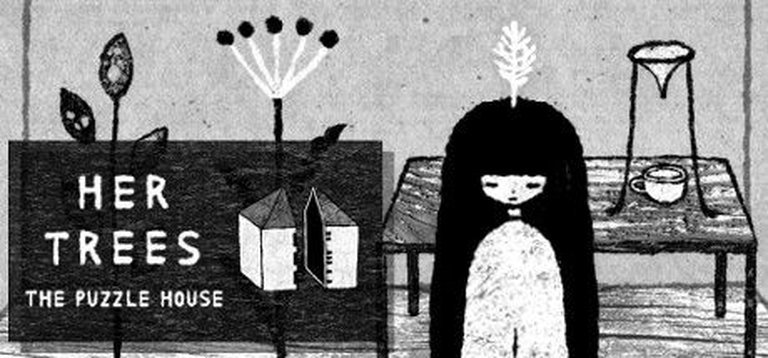
Her Trees: The Puzzle House is a first-person point-and-click puzzle and escape room game set in a peculiar room, where players must combine words, numbers, and objects to solve intricate puzzles and decipher the password that grants freedom. Featuring hand-drawn visuals and an atmospheric noir-inspired style, the game offers a concise yet immersive experience lasting approximately 1.5 hours.
Gameplay Videos
Where to Buy Her Trees: The Puzzle House
PC
Her Trees: The Puzzle House Patches & Updates
Her Trees: The Puzzle House Guides & Walkthroughs
Her Trees: The Puzzle House Reviews & Reception
wasdland.com (87/100): short & fun puzzle game with a cool art style
Her Trees: The Puzzle House: Review
Introduction
In the ever-expanding landscape of indie puzzle games, few manage to carve a niche as distinct as Her Trees: The Puzzle House. Released on February 29, 2024, by the enigmatic developer Stone, this point-and-click escape room eschews conventional tropes to deliver a monochrome, non-verbal labyrinth of abstract logic. As the second entry in the “HER TREES” series, it stands alone as a self-contained enigma—a testament to how constraints breed innovation. This review delves into the game’s legacy, dissecting its minimalist design, surrealist atmosphere, and deceptively complex puzzles to argue that Her Trees is not merely a puzzle game, but a meditative exploration of pattern, perception, and psychological confinement. Its triumph lies in transforming austerity into an immersive, thought-provoking experience that resonates long after the final click.
Development History & Context
Her Trees: The Puzzle House emerged from the solo creative vision of “Stone,” a developer whose previous work, HER TREES: First Puzzle (2023), established the series’ signature aesthetic. Built on Unity, the game navigates modern indie constraints with surgical precision: its monochrome palette eliminates color-related puzzles, while its “serene ambient sound” and absence of verbal cues or sound-based mechanics create an environment where visual logic reigns supreme.
The 2024 gaming landscape was dominated by sprawling open-world titles and narrative-driven epics, making Her Trees a radical counterpoint. Its $1.99 price point and 1.5-hour playtime reflect a deliberate rejection of bloat, aligning with the “cozy game” movement championed by titles like Underground Blossom and Landlord of the Woods. Stone’s development ethos—prioritizing “intuitive” puzzles over tedious calculations—mirrors the minimalist ethos of Japanese art games like Atama Yama, referenced positively by players. This context isn’t incidental; it positions Her Trees as a quiet rebellion against industry trends, proving that profound engagement can thrive in brevity and constraint.
Narrative & Thematic Deep Dive
Devoid of explicit dialogue or plot, Her Trees constructs its narrative through environmental storytelling and thematic symbolism. The game’s premise—a “peculiar room” to be escaped through password decryption—evokes classic escape-room tropes, but Stone subverts them by framing confinement as a psychological state rather than a physical one. The titular “trees” (stylized as abstract, skeletal figures) become central metaphors for growth, entrapment, and cyclical memory. Their monochrome forms, scattered across a “surreal dreamworld,” suggest a liminal space between reality and subconscious.
Themes of isolation and introspection permeate the experience. As players manipulate objects—sticks, letters, symbolic fragments—to uncover a “password,” they engage in a silent dialogue with the room itself. The absence of NPCs or traditional characters shifts focus inward, turning puzzle-solving into a metaphor for self-discovery. The “dark storybook-like ambiance” and “hand-drawn graphics” evoke a gothic fairy tale, where every solved puzzle peels back layers of abstraction, hinting at a fragmented, unresolved past. This non-linear, dreamlike narrative structure resonates with works like Samsara Room, using ambiguity to evoke emotional rather than literal catharsis.
Gameplay Mechanics & Systems
Her Trees revolutionizes the escape-room genre by eschewing inventory-based puzzles in favor of dynamic object manipulation. The core loop involves “moving and combining objects” to form patterns, sequences, or codes—a system that feels both novel and intuitive. Unlike traditional point-and-click games, there are no items to acquire; every solution relies on spatial logic and contextual observation.
- Puzzle Design: Puzzles range from arranging letters to matching symbols, each requiring lateral thinking. For instance, one challenge involves aligning sticks to form constellations, while another combines fragmented words into a cohesive password. The developer’s claim that “no tedious calculations are required” is largely true, though some players (per Steam reviews) found certain puzzles “abstract” or “frustrating” without hints.
- Hint System: Accessible hints and answers mitigate frustration, aligning with the game’s relaxing ethos. This system is praised for being “helpful without giving puzzles away,” balancing challenge with accessibility.
- UI & Controls: The first-person, fixed-screen interface emphasizes environmental immersion. Point-and-select mechanics are crisp, with no extraneous menus—a design choice that reinforces the game’s focus on pure puzzle interaction.
The only significant flaw lies in its steep difficulty curve for some players, as noted in reviews: “I had to click for hints every 10 seconds.” Yet this is mitigated by the game’s brevity, ensuring players never feel irrevocably stuck.
World-Building, Art & Sound
Her Trees’s world is a masterclass in atmospheric minimalism. The “dark storybook-like ambiance” is rendered through stark, hand-drawn graphics that evoke ink-wash illustrations. Every screen—a cluttered desk, a wall of cryptic symbols—feels like a page from a lost grimoire. The monochrome palette, far from limiting, enhances focus; without color distractions, players must rely on texture, line, and negative space to decipher clues.
Sound design is equally deliberate. “Serene ambient sound” (minimalist drones and subtle rustles) creates a hypnotic, almost meditative soundscape. The absence of music or dialogue forces players to engage with the room’s silence, amplifying the sense of isolation. This synergy of visuals and sound elevates the game from a puzzle collection to an immersive psychological space. Notably, the inclusion of “cats” as environmental elements (per Steam tags) adds subtle warmth, contrasting the otherwise oppressive atmosphere.
Reception & Legacy
At launch, Her Trees enjoyed near-universal acclaim. On Steam, it boasts a “Very Positive” rating (95% of 363 reviews), with players praising its “ingenious puzzles,” “gorgeous art,” and “unbeatable value.” The critic review from Gameplay (Benelux lauded it as “mooi, sfeervol en goed voor anderhalf uur intens puzzelen” (beautiful, atmospheric, and perfect for 1.5 hours of intense puzzling). A minority of players found puzzles “too abstract,” but the robust hint system mitigated this.
Commercially, its $1.99 price and niche appeal positioned it as a cult hit. Influential outlets like Kotaku highlighted its uniqueness, while community-driven platforms like Steambase underscored its “psychological” and “experimental” tags. The game’s legacy lies in its demonstration of how constraints—monochrome, non-verbal, short—can foster creativity. It has inspired a wave of minimalist puzzle games, such as Finger Trees and Chopping Trees, but none have replicated its blend of austerity and depth. Stone’s work now stands as a benchmark for “atmospheric puzzle” design, proving that the most profound experiences often emerge from the quietest corners of the industry.
Conclusion
Her Trees: The Puzzle House is a triumph of restraint. In an era of overstuffed AAA titles, Stone’s creation dares to be small, silent, and enigmatic. Its monochrome world, abstract puzzles, and psychological depth coalesce into a singular experience—a puzzle box for the mind. While its brevity may challenge expectations of value, the 1.5-hour journey is dense with reward. The game’s legacy is assured: it redefines the escape-room genre as a medium for introspection, proving that the most compelling stories are often untold. For players seeking a meditative, intellectually stimulating escape, Her Trees is not just recommended—it is essential. In the pantheon of indie puzzle games, it stands as a quiet, unyielding monument to the power of less.