
- Release Year: 2017
- Platforms: Linux, Luna, Macintosh, Nintendo Switch, PlayStation 4, Windows Apps, Windows, Xbox One
- Publisher: Intragames Co., Ltd., Sold Out Sales and Marketing Limited, Team17 Software Limited
- Developer: Playtonic Limited
- Genre: Action
- Perspective: Behind view
- Game Mode: Co-op, Online Co-op, Single-player
- Gameplay: Collect-a-thon, Open World, Platformer
- Setting: Fantasy
- Average Score: 77/100
Description
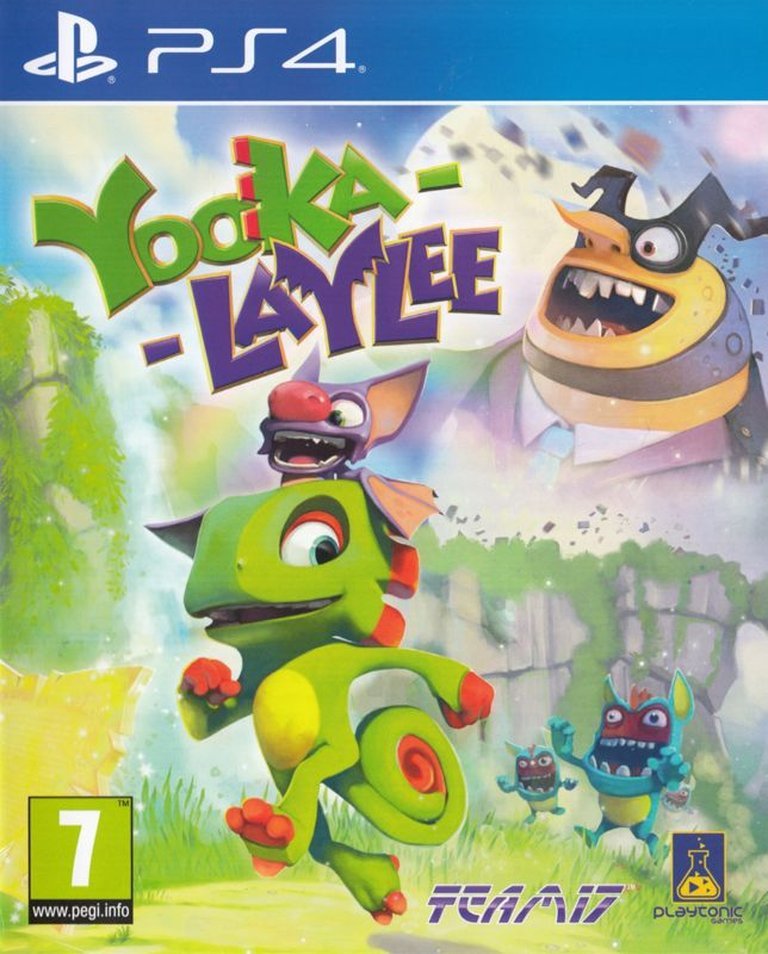
Yooka-Laylee is a 3D platformer set in a vibrant fantasy world where players control Yooka, a bat, and Laylee, a lizard, as they explore colorful environments, collect magical pages, and solve puzzles to progress. Drawing inspiration from classic 90s platformers, the game features a behind-view perspective, cooperative gameplay, and whimsical challenges across diverse realms.
Gameplay Videos
Where to Buy Yooka-Laylee
Yooka-Laylee Free Download
Yooka-Laylee Mods
Yooka-Laylee Guides & Walkthroughs
Yooka-Laylee Reviews & Reception
metacritic.com (77/100): a top-tier platformer experience that’s oozing with heart, charm, joy, fun, and humor.
punishedbacklog.com : Yooka-Replaylee turned a mostly fine game into a really solid one, the game the studio had clearly wanted to make in the first place.
shacknews.com : It’s a fascinating approach that feels great to play, but loses some of its identity in the process.
arstechnica.com : Yooka-Laylee delivers and then some.
gameshub.com : a polished remake that lost some of its soul
Yooka-Laylee: A Nostalgia-Fueled Revival That Trips Over Its Own Past
Introduction: The Ghost of Banjo-Kazooie
In the landscape of modern gaming, few projects arrived with the weight of legacy and expectation as Yooka-Laylee. Conceived not as a mere new intellectual property, but as a deliberate, fan-fueled resurrection of a genre, it stands as a curious and compelling case study in the power—and peril—of nostalgia. Developed by Playtonic Games, a studio composed largely of former Rareware veterans, Yooka-Laylee was marketed explicitly as the spiritual successor to the beloved Banjo-Kazooie series. Its 2017 release was met with a fervent anticipation rarely seen for an indie title, fueled by a record-breaking Kickstarter campaign. Yet, upon arrival, it became one of the most divisive titles of its generation. Critics and players were split: was this a loving, polished homage that recaptured the magic of the N64 era, or a dated, clunky relic prove that some memories are best left undisturbed? This review will argue that Yooka-Laylee is a game of profound contradictions—a technically competent and often charming revival that is simultaneously held back by its unwavering devotion to a design philosophy that has not aged gracefully. It succeeds as a faithful archive of a bygone genre but struggles as a modern game, resulting in an experience that is both warmly familiar and frustratingly anachronistic.
Development History & Context: The Rare-vival Dream
The origins of Yooka-Laylee are inextricably linked to the mythology of Rare. Following the sale of Rare to Microsoft in 2002, many of its iconic talent departed, leaving a void in the “collect-a-thon” 3D platformer genre that Banjo-Kazooie (1998) and Banjo-Tooie (2000) had helped define. In September 2012, several of these former Rare employees, operating under the Twitter handle “Mingy Jongo” (a Banjo-Tooie boss name), began discussing a spiritual successor. This collective formally incorporated as Playtonic Games in August 2014. Their stated mission was clear: to revive the “collectathon” genre with modern sensibilities.
The chosen vehicle for this revival was Kickstarter. Announced in May 2015, the campaign’s goal of £175,000 was met in 38 minutes, and it became the fastest project to reach $1 million at the time, ultimately raising over £2.1 million from 80,000+ backers. This staggering success was a double-edged sword. It validated the market demand for such a game but also created immense pressure to deliver a product that met the heightened, nostalgia-tinged expectations of a core audience that viewed the original Banjo games as sacred texts.
Technologically, the team chose the Unity engine, a significant departure from Rare’s proprietary tools. As noted in development post-mortems, this choice offered flexibility and easier bug-fixing but also presented challenges in achieving the scale and polish of the N64 classics, which ran on custom hardware. The team has stated that increased memory availability allowed for a richer orchestral soundtrack, a collaborative effort from Rare veterans Grant Kirkhope, David Wise, and Steve Burke. The character designs emerged from this legacy: artist Steve Mayles (who worked on Banjo-Kazooie) initially considered Yooka as a lion before settling on a chameleon for its grappling tongue potential; Laylee, a bat, was designed to provide flight and a contrasting personality. The name “Yooka-Laylee” itself is a phonetic play on “ukulele,” with Mayles revealing in an interview that “uku” means “small-brained person” and “lele” “to fly” in Hawaiian—a tongue-in-cheek nod to the duo’s antics.
The development timeline featured notable hurdles. A Wii U version was cancelled in late 2016, with ports shifted to the then-unannounced Nintendo Switch. Playtonic cited “unforeseen technical issues,” though later suggested it was a difficult decision not directly tied to the Wii U’s commercial struggles. The game was delayed from 2016 to April 2017 “to polish,” with Team17 handling publishing duties, including localization, QA, and marketing, while Playtonic focused on the PC and Wii U/Switch versions. A post-launch controversy saw YouTuber Jon “JonTron” Jafari’s voice work removed after racist remarks, demonstrating the heightened scrutiny on a project so connected to its community. A “64-bit mode” was added, a graphical filter mimicking N64-era low-poly aesthetics, serving as both an Easter egg and a statement of intent.
Narrative & Thematic Deep Dive: Corporate Satire and Buddy Comedy
The plot of Yooka-Laylee is a straightforward but serviceable vessel for its gameplay and humor. Capital B, the CEO of the monolithic Hivory Towers Corporation, uses a world-sucking “Blabbotron” to pilfer all literature in search of the magical One Book, intending to rewrite reality to his liking. Our protagonists, Yooka (a laid-back, green chameleon) and Laylee (a sassy, purple bat), reside in Shipwreck Creek with said book. When it’s stolen, they infiltrate Hivory Towers, traversing five fantastical worlds contained within books to reassemble the scattered Pagies (the game’s collectible plot coupons).
The narrative’s strength lies not in complexity but in tone and character dynamics. The game is steeped in a satirical corporate aesthetic. Hivory Towers is a pastiche of soulless modern office culture, complete with motivational posters, dubious HR practices, and a villain whose villainy is expressed in shareholder-friendly jargon (“synergy,” “streamlining”). Capital B is a classic, hammy boss, but his evil is bureaucratized—he’s less a world-conqueror and more a megalomaniacal CEO annoyed by paperwork.
The heart of the experience is the buddy comedy between Yooka and Laylee. Their dynamic is a direct echo of Banjo and Kazooie: the calm, strong one and the loud, sarcastic one. Laylee, in particular, is a Deadpan Snarker, providing much of the game’s humor with her withering remarks at NPCs and situations. Their dialogue is light, often absurd, and filled with meta-commentary (“A tutorial classic!”). However, the voice acting (provided by a small cast, with the protagonists themselves deliberately voiceless to aid player immersion) is a point of contention. Many critics found the NPC voices grating and overly caricatured, a common critique of the original Rare games that Yooka-Laylee replicates without always filtering it through modern sensibilities.
Thematically, the game explores the commodification of imagination (Hivory Towers turning stories into products) and resistance through playfulness. Yooka and Laylee’s journey is one of reclaiming narrative agency from a corporate entity. The ending, where the bumbling cannon Blasto inadvertently defeats the final boss, reinforces a theme of chaotic, uncontrollable joy versus sterile order. The greater-scope threat, V.I.L.E. (a board of directors), is introduced but largely ignored—a potential sequel hook that feels underdeveloped. In the Yooka-Replaylee remake, this subplot is removed entirely, streamlining Capital B into the primary, singular villain.
Gameplay Mechanics & Systems: The Collectathon Crucible
At its core, Yooka-Laylee is a third-person, open-level 3D platformer with a heavy emphasis on non-linear exploration and collection. The progression loop is the classic “collect-a-thon” model: explore expansive, self-contained worlds to gather Pagies (the currency for unlocking/expanding new worlds), Quills (used to purchase moves from the snake merchant Trowzer), and a myriad of other trinkets.
Core Loop & Abilities: The duo begins with a basic moveset: jump, double-jump, butt-bounce, and a basic tongue-grapple. Progression is gated by ability acquisition. Trowzer sells moves like the “Sky Soar” (glide), “Tongue Whip” (ranged attack), and “Sonar Blast” (Laylee’s stun/echo move) for Quills collected in the hub and levels. Additionally, Dr. Puzz, an octopus scientist, provides transformations (like a snowball or piranha) via Mollycools, allowing access to specific areas. This system, while familiar, is often criticized as treadmill progression—you backtrack through worlds repeatedly as new abilities unlock previously inaccessible Pagies. The Yooka-Replaylee remake addresses this by granting all major moves from the start, a significant quality-of-life change.
Collection & Expansion: The key mechanical innovation is the Pagie-driven world expansion. Each of the five main worlds (Tribalstack Tropics, Glitterglaze Glacier, Moodymaze Marsh, Capital Cashino, Galleon Galaxy) and the hub, Hivory Towers, can be “expanded” with extra Pagies, adding new sub-areas, challenges, and collectibles. This creates a compelling “unfolding map” sensation but also contributes to the game’s bloat and backtracking. One critic noted that the worlds become “too large for their own good,” making 100% completion a daunting, sometimes directionless task.
Combat & Challenges: Combat is simplistic—most enemies die in 1-2 hits. The real focus is on puzzle-solving and precise platforming. Challenges include Kartos mine-cart sequences (reminiscent of Donkey Kong Country), “Quills” races with Nimble the snail, Rextro’s arcade minigames (low-poly, intentionally simple), and “I.N.E.P.T.” (a parody of sliding puzzle games). These are a mixed bag: some are delightful homages, others are frustratingly obtuse or brutally difficult. The Ghost Writers (collectible ghosts that must be caught/fought) are a notable highlight, offering unique chase dynamics.
Camera & Control Flaws: This is the most consistent point of criticism. The camera is frequently described as “uncooperative,” “janky,” and “frustratingly dated.” It struggles in tight spaces, has a habit of getting stuck on geometry, and lacks the precision of modern platformers. The controls can feel “slightly träge” or “hackel,” especially on certain ports. The PC version is often praised for snappier response, while the console versions, particularly PS4, suffer more. The post-launch patches did improve these systems, but the core issue—a design philosophy built for an era of tank controls and fixed cameras—remains palpable. The final boss fight, a long sequence with no checkpoints and cutscene interruptions, is a notorious Kaizo Trap that epitomizes the game’s sometimes punishing old-school sensibility.
Multiplayer & Extras: Local co-op is included, allowing a second player to control Laylee. Competitive minigames (8 total) are available but shallow. The “64-bit mode” is a fun visual novelty. The Play Tonics system (purchased from a sentient vending machine, Vendi) offers RPG-like stat modifiers (e.g., reduced power consumption, fall damage immunity), adding a layer of customization but feeling somewhat inconsequential.
World-Building, Art & Sound: A Vibrant, Quirky Universe
Visually, Yooka-Laylee is a masterclass in stylized, vibrant art direction that directly channels the Rareware aesthetic. The worlds are bursting with color and personality:
* Tribalstack Tropics: A lush, sunny jungle with Mayan-inspired architecture, floating islands, and a vibrant, percussive soundtrack.
* Glitterglaze Glacier: A crystalline ice palace and snowy peaks, featuring the infamous “Icymetric Palace” puzzle segment with its faux-isometric design.
* Moodymaze Marsh: A dark, toxic swamp (the direct Bubblegloop Swamp expy), complete with piranha transformations and murky water.
* Capital Cashino: A garish, neon-drenched casino with slot machines, roulette wheels, and a chaotic, jazz-infused score.
* Galleon Galaxy: A surreal, Raygun Gothic space-pirate lagoon with asteroid fields and a literal “Hailfire Peaks” mix of sea and cosmos.
The character designs, by Kevin Bayliss (Donkey Kong Country Returns) and Ed Bryan (Banjo-Kazooie), are expressive and full of personality, even if some critics found them “uninspired.” The environments, led by Steven Hurst (Banjo-Kazooie, Viva Piñata), are densely packed with secrets, quirky NPCs (sentient shopping carts, melancholy moons), and visual gags. The art style successfully avoids being a mere clone, carving its own identity through a slightly more exaggerated, cartoonish flair.
The sound design and music are arguably the game’s most universally praised elements. The return of Grant Kirkhope was a major selling point, and his work, alongside David Wise and Steve Burke, delivers a dynamic, melodic, and incredibly memorable orchestral score. Each world has a distinct, thematically rich suite that enhances the atmosphere—from the tropical rhythms of Tribalstack to the noir-ish casino jazz. The sound effects are punchy and cartoonish, perfectly complementing the visuals. This auditory landscape is the strongest bridge to the N64 era’s beloved soundtracks and a key factor in the game’s nostalgic power.
Reception & Legacy: The Love-Hate Phenomenon
Upon release in April 2017 (with a Switch port following in December 2017), Yooka-Laylee garnered a “mixed or average” reception on Metacritic (PC/PS4/XBO: 68-76/100; Switch: 75/100). This split was palpable in the critical discourse, which can be broadly categorized:
The Praise: Critics who grew up with Banjo-Kazooie often welcomed it as a “Banjo-Threeie” (The Escapist). They lauded its expansive worlds, charming humor, fantastic soundtrack, and sheer volume of content. For them, its flaws were the charming “warts” of a bygone era. As one review noted, it was “the best 3D platformer since Super Mario Galaxy” in terms of pure exploration joy. Its success on the Switch, where it ran particularly smoothly, was cited as evidence of its underlying quality, with ports addressing some initial control/camera issues.
The Criticism: Detractors argued it was nostalgia gone wrong, a “game out of time” that clung to outdated mechanics while failing to innovate. Common complaints included: frustrating camera, clunky controls, ambiguous puzzles with poor signposting (the “Guide Dang It!” trope run amok), repetitive and bloated level design, and annoying NPC voices. Some felt the corporate satire was toothless, and the game couldn’t decide on its audience—childish or adolescent. Polygon’s stark verdict—”proof that sometimes our fondest memories should stay in the past”—became a touchstone for the negative camp.
Commercial Performance & Evolving Legacy: Despite the critical schism, the game was a commercial success, selling over 1 million copies by late 2018. Its Kickstarter backers were largely satisfied, having received their promised physical goods and DLC. It won awards like “Game in a Small Studio” at the TIGA Awards.
Its legacy is complex:
1. It Proved a Market: It demonstrated there was still a viable audience for traditional 3D collectathons, paving the way for later revivals and influencing indie platformer design.
2. It Highlighted the Genre’s Fragility: Its divisiveness showed how tightly this genre’s appeal is bound to specific, now-dated, design conventions. The camera and feel issues were not just bugs but symptoms of a gameplay loop that modern game design has largely moved past.
3. It Led to Iteration: The development of Yooka-Laylee and the Impossible Lair (2019), a superb 2.5D side-scroller in the vein of Donkey Kong Country, demonstrated Playtonic’s ability to learn and adapt. By shedding the problematic 3D camera and focusing on tight, modern 2D platforming, they created a game widely seen as superior.
4. The Replaylee Redemption: The 2025 announcement of Yooka-Replaylee is the ultimate verdict on the original’s legacy. This remake/remodel directly addresses nearly every major criticism: all moves unlocked from the start, a redesigned navigation map, a fixed 3D camera, rebalanced puzzles, fast travel, and quality-of-life additions. It represents Playtonic’s matured vision, stripping away the dated scaffolding to preserve the heart—the worlds, the collectibles, the charm—while modernizing the experience. Early reviews for Replaylee are significantly more positive, suggesting the game’s core concept was sound but its initial execution flawed.
Conclusion: A Flawed Relic That Forged a Path
Yooka-Laylee is not a great game by many modern standards, but it is an undeniably important and fascinating one. It is a meticulously crafted time capsule, bursting with the spirit, humor, and structural idiosyncrasies of the late-90s Rareware golden age. Its strengths—a cohesive, vibrant world, an outstanding soundtrack, and a deep well of collectibles—are potent. Its weaknesses—a stubborn camera, occasionally byzantine puzzles, and a sense of bloat—are the very things that defined its inspirations and ultimately feel archaic.
The game’s true significance lies not in its critical scores but in its cultural and developmental impact. It was the catalyst that reignited conversation about the 3D collect-a-thon, proved its commercial viability via a historic crowdfunding run, and forced both fans and developers to confront what made those classic games beloved and what held them back. Playtonic learned from the experience, channeling its lessons into the excellent Impossible Lair and the corrective Yooka-Replaylee.
Therefore, on its own merits from 2017, Yooka-Laylee earns a conditional recommendation. For the player with a high tolerance for jank and a deep reservoir of nostalgia for Banjo-Kazooie, it offers dozens of hours of familiar, often joyful exploration. For the modern gamer expecting the tight controls and clarity of a Mario or modern indie platformer, it will likely feel like a frustrating museum piece. Historically, it stands as a passionate, imperfect love letter that successfully resurrected a genre, learned from its mistakes, and ensured its legacy would be refined, not just repeated. It is the bridge between a beloved past and a cautiously optimistic future for the 3D platformer.