
- Release Year: 1997
- Platforms: Windows
- Publisher: Sybex France
- Genre: Action
- Perspective: Side view
- Game Mode: Single-player
- Gameplay: Bosses, Breakout, Level editor, Paddle, Pong, Shoot ’em up
- Setting: Futuristic, Sci-fi, Space
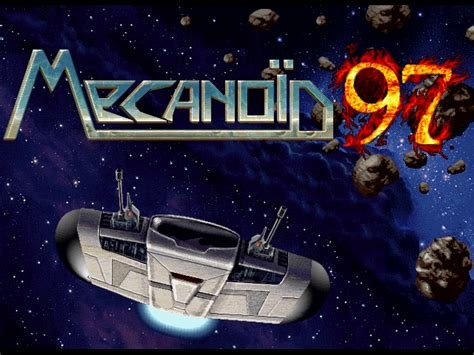
Description
Mécanoïd is a 1997 action game set in a sci-fi space environment, blending classic Breakout gameplay with paddle-based mechanics. Players navigate 48 levels, utilize a built-in level editor, face boss encounters, and experience shoot’em up segments, all presented in a fixed side-view with direct controls.
Mécanoïd Patches & Updates
Mécanoïd: Review
Introduction: A Flicker in the Cosmic Dust
In the vast, star-choked expanse of video game history, certain titles achieve supernova status—illuminating entire genres and etching themselves into collective memory. Others, however, are mere distant pulsars: faint, persistent, and known only to a cadre of dedicated archivists and nostalgic players. Mécanoïd, released in 1997 for Windows by Sybex France, is unmistakably one of these latter curiosities. A Breakout-style game cloaked in a veneer of sci-fi spectacle, it emerges not from the creative vanguard but from the twilight of a genre’s dominance. Its legacy is a trifecta of obscurity: barely documented, critically unnoticed, and commercially negligible, yet its existence is tethered to a fascinating, if failed, cross-media experiment. My thesis is this: Mécanoïd is a poignant artifact of transitional gaming—a competent but unexceptional mechanics-driven experience that epitomizes the struggle of 2D arcade traditions to assert relevance amid the 3D revolution, all while serving as a promotional vessel for an equally forgotten novel. It is a testament to developer Eric Zmiro’s versatility, yet a cautionary tale about the perils of artistic ambition without cohesive execution.
Development History & Context: Veterans at a Crossroads
The Studio and Creators: From Titus to Obscurity
Mécanoïd was developed by Sybex France, the French branch of Sybex Inc., a publisher more renowned for its strategy and simulation software than for original games. The creative force behind the project was Eric Zmiro, supported by Laurent Fournier—a duo with deep roots in the European game scene. Both had cut their teeth at Titus Interactive, contributing to cult classics like Prehistorik (1991) and Les Aventures de Moktar, la Zoubida (1989). By 1997, their résumés already spanned nearly two dozen titles, blending programming and graphic design in an era when such hybrid roles were common. However, Mécanoïd arrived as the industry was hurtling toward 3D acceleration. Zmiro and Fournier were veterans of the 8-bit and 16-bit golden ages, yet here they were crafting a 2D, flip-screen Breakout clone for Windows 95—a platform increasingly associated with multimedia edutainment and transitional indie projects rather than cutting-edge gaming.
The Vision: Novel Ambitions and Genre Stagnation
The game’s development was inextricably linked to Zmiro’s parallel venture: a science-fiction novel titled Mecanoïd, published in 1997. Mécanoïd the game reads as an interactive advertisement for the book, a “publicité in vivo” as Abandonware France astutely notes. The narrative framing—Earth under siege by the enigmatic “Maître de la Galaxie” (Master of the Galaxy)—is lifted directly from the novel’s premise, yet the game offers no substantive storytelling. This cross-media synergy was not uncommon (consider Doom or Wing Commander), but here it feels inverted: the game exists to sell the book, not vice versa. Vision-wise, Zmiro sought to inject a sci-fi epic into the rigid Breakout formula, perhaps hoping the novel’s lore would elevate what is essentially a mechanics-driven puzzle-action game. The result is a disjointed experience where narrative is an afterthought, relegated to the manual.
Technological Constraints and the 1997 Gaming Landscape
Technologically, Mécanoïd was constrained by the specifications of its time: a requirement for a 486 CPU, 8MB RAM, 20MB hard drive space, a sound card, CD-ROM drive, and DirectX 3.0 or higher. These were modest demands, but the game’s fixed/flip-screen visuals and 2D sprite-based graphics stood in stark contrast to the 3D revolution unfolding in 1997. That year witnessed landmark releases like Final Fantasy VII, GoldenEye 007, Fallout, and Myth: The Fallen Lords—titles leveraging polygons, open worlds, and immersive sim design. Mécanoïd, with its side-view, paddle-control mechanics, belongs to an earlier arcade paradigm that was rapidly becoming niche. The gaming press and public attention were fixated on 3D; Mécanoïd arrived as a relic, albeit one with a level editor—a feature that catered to the lingering DIY spirit of the shareware era but did little to secure mainstream relevance.
Narrative & Thematic Deep Dive: The Novel’s Ghost in the Machine
Plot and Characters: Skeleton of a Saga
The narrative of Mécanoïd is skeletal, delivered exclusively through the game’s manual in a paragraph-sized blurb: “Nous sommes au septième millénaire, et la Terre replonge dans une terrible guerre contre le Maître de la Galaxie. Ce dernier, dont on ne connaît ni le nom ni l’origine, ni les desseins, a envoyé une armada de vaisseaux et de murs énergisants pour abattre la résistance des humains. À bord de votre Mecanoid, un vaisseau bourré de munitions, vous allez affronter cette armée au cours de 48 niveaux de base.” Translated, this sets the stage for a galactic conflict in the seventh millennium, pitting humanity against a faceless, omnipotent adversary. The player is a nameless pilot of the titular Mecanoid vessel, a lone warrior in a war of attrition. There are no characters beyond this archetype—no dialogue, no cutscenes, no textual backstories within the game itself. The 48 levels are abstracted into brick-breaking stages, with “bosses” mentioned but unspecified, suggesting climactic encounters that likely deviate from standard Breakout play.
Themes: Epic Scope, Miniature Expression
Thematically, the game touches on classic sci-fi tropes: humanity’s resistance against an overwhelming alien force, the symbolism of walls (both literal energy barriers and metaphorical obstacles), and the heroism of the lone pilot. However, these themes are purely cosmetic, inherited from Zmiro’s novel without integration. The “Mecanoid” itself—a ship “bourré de munitions” (packed with ammunition)—implies a fusion of machine and warrior, but the gameplay reduces this to a paddle bouncing a ball. There is a dissonance between the epic scale suggested by the manual and the iterative, repetitive act of destroying bricks. This gap highlights a fundamental flaw: the narrative is not told through gameplay but imposed upon it, creating a thematic void. Any deeper exploration of war, technology, or identity from the novel is absent; Mécanoïd the game is pure abstraction. It reflects a 1990s trend where genre games (especially Breakout variants) adopted sci-fi or fantasy skins without meaningful systemic storytelling—a practice that would be scrutinized as games matured narratively.
Literary Tie-In: A Novel’s Unfulfilled Potential
Eric Zmiro’s novel Mecanoïd (1997) is the key to understanding the game’s narrative aspirations. Unfortunately, the novel is obscure, out of print, and rarely discussed, leaving the game’s lore tantalizingly incomplete. One can speculate that the novel delved into the origins of the “Maître de la Galaxie,” the psychology of the Mecanoid pilots, or the ethics of mechanized warfare. But the game offers no such depth. The 48 levels could have been framed as missions in a interstellar campaign, but they function merely as progression gates. The level editor’s inclusion hints at a desire for user-generated narratives, but without story tools or scenario builders, it remains a sandbox for mechanics, not tales. Thus, Mécanoïd’s narrative is a ghost—a promising outline that never materializes into interactive substance, underscoring the challenges of cross-media adaptations when the interactive medium is not given primacy.
Gameplay Mechanics & Systems: The Addiction of Iteration
Core Gameplay Loops: Breakout with a Sci-Fi Sheen
At its heart, Mécanoïd is a Breakout clone: the player controls a paddle (the “Mecanoid” ship) at the bottom of the screen, bouncing a ball to destroy bricks arranged in patterns across the top. The twist is the sci-fi setting and the integration of shoot ’em up elements, as noted in the MobyGames description. The core loop is simple—destroy all bricks to advance to the next level—but it is enriched by a suite of power-ups and hazards. The game spans 48 main levels, increasing in difficulty, with a level editor allowing players to create custom stages, a feature that extends its replayability significantly.
Power-Ups and Arsenal: Variety in Velocity
The power-up system is where Mécanoïd attempts innovation. As detailed on Abandonware France, bricks release various bonuses:
– Armored Balls: These destroy “bunker” bricks—invulnerable standard bricks—in a single hit, adding strategic depth to brick types.
– Slow Ball: Reduces ball speed, giving players more control in complex layouts.
– Explosive Weapons: Likely area-of-effect blasts that damage multiple bricks.
– Fire Ball: A single-pass destructive ball that clears a path but is temporary.
– Multi-Cannons: The paddle can mount one, two, or three cannons, allowing simultaneous multi-ball or shooting capabilities.
– Magnetic Mines: Adjustable via mouse clicks (right-click to reposition, left-click to detonate), these can clear large sections of reinforced brick walls.
This variety introduces tactical choices: when to use a slow ball for precision, when to deploy mines for bunker bricks, or when to activate multi-cannons for rapid clearance. The shoot ’em up elements manifest in these offensive power-ups and possibly in “boss” encounters, where the player might shoot at larger enemies rather than just bricks. However, the integration is tepid; the core remains brick-breaking, with shooter mechanics as supplementary.
User Interface and Controls: Direct but Spartan
The interface is minimalist and functional. The screen displays the score, level number, energy bar (in green), shield bar (to the right), and total level count at the bottom. Input is entirely mouse-driven for paddle movement, embodying “direct control” as per MobyGames specs. Keyboard shortcuts are mapped to function keys:
– F1: In-game help (crucial for identifying power-ups).
– F2: Pause (with a ball loss penalty, a harsh but arcade-typical penalty).
– F3: Toggle music.
– F4: Toggle sound effects.
– F5: Select level (standard or custom).
– F12: Access level editor.
– ESC: Quit game.
The level editor is a standout feature: players can design and save custom levels (press S to save), fostering a community of content creation—rare for a Breakout title of this era. However, the editor’s usability is unknown; likely text-based or simple drag-and-drop given 1997 tools.
Innovations and Flaws: A Formula in Need of Evolution
Innovations: The power-up diversity, especially adjustable magnetic mines, adds a layer of strategy uncommon in simple Breakout clones. The inclusion of a full level editor empowers players, aligning with the burgeoning modding scene. The sci-fi aesthetic, while superficial, differentiates it from colorful, abstract predecessors like Arkanoid.
Flaws: The game suffers from genre fatigue. Breakout mechanics are inherently repetitive; without evolving core systems (e.g., physics changes, narrative integration), 48 levels can feel like a grind. The shoot ’em up elements are vestigial—paddles don’t shoot by default, only with power-ups, so the shift in gameplay is minimal. Bosses, if any, are likely just larger brick formations or simple enemy sprites, lacking Health or pattern complexity. The UI is informative but sparse; no options for difficulty or ball speed customization are mentioned in the readme. Moreover, the reliance on manual for power-up identification is archaic; an in-game icon system would have been more intuitive. Finally, the mouse-only control, while precise, may not appeal to keyboard purists.
World-Building, Art & Sound: Aesthetic of the Forgotten Frontier
Setting and Atmosphere: Seventh Millennium Clichés
The game’s setting is a generic space opera: the seventh millennium, Earth at war, with the player piloting a Mecanoid ship against the Master of the Galaxy’s forces. The atmosphere is one of urgent, solo combat—a lone vessel against endless waves. However, the world-building is non-existent beyond brick patterns. Levels are abstract grids; no environmental storytelling, no alien architecture, no sense of a galaxy in conflict. The “space” theme is skin-deep, with brick colors and background visuals likely using starfields or simple geometric shapes. This misses an opportunity to use the Breakout grid as a metaphor for, say, energy shields or asteroid fields—a narrative mechanic fusion that games like Space Invaders occasionally hinted at.
Visual Direction: Fixed Views and Pixelated Promise
Visually, Mécanoïd employs a fixed/flip-screen perspective, common in arcade ports and 2D action games. The graphics are 2D sprites, probably rendered in a 256-color palette typical of early Windows gaming. From screenshots available on abandonware sites (though not embedded here), one can infer a design language of neon hues against dark space—bricks in reds, blues, greens; the paddle as a ship silhouette; the ball as a glowing orb. The flip-screen may mean each level loads a new screen, avoiding scrolling but breaking continuity. This visual choice is pragmatic for performance but feels dated even in 1997, when parallax scrolling and layered backgrounds were norms in action games. The art direction lacks cohesion; there’s no consistent iconography for the Master of the Galaxy or human resistance, making the sci-fi veneer feel tacked-on.
Sound Design: Beeps and Boops in the Void
Sound design is minimal, as indicated by the readme’s music and sound toggles (F3, F4). Likely, the game uses basic digital samples for brick collisions, power-up catches, and perhaps a looping MIDI track for ambiance. There are no voiceovers or cinematic stings. The audio serves a functional purpose—feedback for actions—but does not enhance atmosphere. In a year where Fallout’s ambient tracks and Star Fox 64’s iconic score were defining experiences, Mécanoïd’s soundscape is an afterthought. This aligns with its budget status; audio programming was often outsourced or simplified in lesser-known titles.
Cohesion: Where Aesthetics and Mechanics Diverge
The art and sound do little to elevate the gameplay. The sci-fi setting is not reflected in mechanics: bricks aren’t “energy barriers” with distinct properties beyond “bunker” vs. standard; enemies in shoot ’em up segments are not integrated into the brick grid. The disconnect is palpable—a missed chance to make the Breakout formula feel fresh. Compare to Arkanoid’s power-ups, which had clearer thematic ties (e.g., “catcher” extending the paddle), Mécanoïd’s arsenal feels generic. The visual style, while competent for its scope, lacks the polish of contemporaries like DX-Ball 2 (1998), which refined the genre with smooth animations and particle effects. Mécanoïd feels like a prototype that reached production without the refinement needed to transcend its arcade roots.
Reception & Legacy: Echoes in the Abandonware Void
Critical and Commercial Reception at Launch
Upon its 1997 release, Mécanoïd landed with a thud that was barely audible. MobyGames records no critic reviews for either the 1997 or 1999 entries (the latter likely a re-release by Sybex-Verlag GmbH for German markets). The “Moby Score” is listed as “n/a,” and it has been collected by only one player on the site—a stark indicator of its obscurity. Commercial performance is inferred from its absence from sales charts and its rapid transition to abandonware. In Metacritic’s 1997 rankings, which highlight games with seven or more critic reviews, Mécanoïd is nonexistent, underscoring its failure to penetrate the critical consciousness. Reviews on platforms like My Abandonware and Abandonware France are non-existent or user-submitted only, with no professional coverage from era magazines like PC Gamer or Gen4. This silence suggests Sybex France’s limited marketing reach and the game’s inability to stand out in a year dominated by 3D blockbusters.
Evolution of Reputation: From Obscurity to Archive Piece
Over time, Mécanoïd has solidified its status as a forgotten piece of software. Its availability on abandonware sites (My Abandonware, Old Games Download, Abandonware France) and the provision of patches (e.g., “WinXP Fix”) indicate a cult following among retro archivists, but no substantial reappraisal. On My Abandonware, it holds a 5/5 rating from two votes—a tiny sample that likely reflects nostalgia rather than objective quality. Its Wikidata entry (Q38795151) categorizes it simply as a “Breakout clone” with minimal links, reinforcing its marginalization. Unlike obscure gems that gain retrospective appreciation (e.g., Pathologic), Mécanoïd lacks the design ingenuity or narrative depth to spark reevaluation. It is remembered, if at all, for its level editor and its connection to Eric Zmiro’s later work.
Influence on Subsequent Games and the Industry
Mécanoïd’s influence is negligible. It resides in the “Breakout variants” group on MobyGames alongside titles like DX-Ball 2 and Arkanoid Returns, but these peers similarlyFailed to leave a lasting mark on the genre. The Breakout formula saw iterative refinements (e.g., Shatter in 2009 introduced physics puzzles), but Mécanoïd is not cited as an inspiration. Its level editor predates widespread modding tools but was not innovative enough to set trends. The shoot ’em up hybrid element was explored more successfully in games like Puzzle Bobble (1994), which merged Bust-a-Move with shooting mechanics. Mécanoïd’s attempt feels half-hearted.
However, its legacy is more personal than industrial. Eric Zmiro and Laurent Fournier’s careers evolved beyond this footnote. Zmiro notably founded Magic Pockets in 1999-2000, transitioning to Game Boy Advance, DS, and 3DS development with titles like Shrek: Swamp Kart Speedway and Rayman DS. This pivot from PC 2D to handheld 3D showcases adaptability, albeit unrelated to Mécanoïd. Fournier’s path is less documented but likely similar. Thus, Mécanoïd represents a dead end in their portfolios—a project that did not catalyze further innovation in the Breakout space or in cross-media storytelling. It stands as a monument to the era’s cross-pollination attempts (games as book ads) that lacked the synergy to succeed.
Conclusion: A Competent Curiosity, Not a Lost Classic
In the final analysis, Mécanoïd is a game of contrasts: ambitious in scope yet shallow in execution; tied to a novel yet narratively barren; technically sound for its time yet artistically uninspired. It demonstrates the enduring appeal of Breakout-style gameplay—that addictive loop of risk and reward—while highlighting the genre’s creative stagnation. The power-ups and level editor are commendable features, especially for a budget title, but they cannot compensate for the repetitive core or the disjointed sci-fi theme. As a historical artifact, it is valuable for illustrating the last gasps of pure 2D arcade design on PC before the industry’s full embrace of 3D. It also serves as a case study in cross-media misalignment, where a game becomes a promotional tool rather than a standalone narrative experience.
My definitive verdict is that Mécanoïd deserves preservation as a curious footnote, not celebration as a classic. It will never rank alongside the titans of 1997, nor will it be rediscovered as a hidden gem. Its place in video game history is that of a well-crafted but unremarkable specimen from an era of transition—a reminder that even in the shadow of giants, small studios persisted in making the games they loved, even if few were paying attention. For the dedicated player, it offers a nostalgic hour of brick-breaking with a touch of space opera; for the historian, it’s a data point in the evolution of genre fatigue and cross-media experiments. Ultimately, Mécanoïd is exactly what its MobyGames entry suggests: a Breakout variant, and little more—but in that simplicity lies a certain purity, a testament to the era when gameplay alone could sustain a title, even if it could not make it immortal.