
- Release Year: 2008
- Platforms: Windows
- Publisher: 1C Company
- Genre: Adventure
- Perspective: 3rd-person
- Gameplay: Puzzle elements
Description
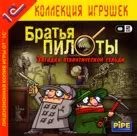
Kollekciya klassiki: Brat’ya Piloty 3D is a 2008 Windows compilation that bundles two 3D adventure games from the Pilot Brothers series, developed by K-D Lab and published by 1C Company. Featuring third-person perspectives and puzzle elements, the games immerse players in humorous mystery scenarios, including ‘Brat’ya Piloty 3D. Delo ob Ogorodnyh vreditelyah’ and ‘Brat’ya Piloty 3D-2. Tajny kluba sobakovodov’, focusing on comedic detective-style adventures.
Kollekciya klassiki: Brat’ya Piloty 3D: Review
Introduction: A Quirkily Timeless Relic from Russia’s Gaming Periphery
In the vast and often homogenized landscape of video game history, certain titles exist not as mainstream milestones but as cherished artifacts of a specific time, place, and cultural sensibility. Kollekciya klassiki: Brat’ya Piloty 3D (translated as Classic Collection: Pilot Brothers 3D) is precisely such an artifact. Released in December 2008 by the prolific Russian publisher 1C Company and developed by K-D Lab Game Development, this compilation represents a curious transitional phase for one of Russia’s most beloved homegrown adventure franchises: the Pilot Brothers series. Its thesis is a study in contrasts: a game that faithfully preserves the absurdist narrative charm and character-driven humor of its 2D predecessors while stumbling under the weight of a premature and technically challenged leap into three dimensions. This review will argue that while Brat’ya Piloty 3D is a flawed vehicle for its source material, its very existence offers a crucial window into the ambitions and limitations of mid-2000s Russian game development, where creative spirit often battled against scarce resources and an evolving technological tide.
Development History & Context: From Hand-Drawn Charm to Janky 3D
The Pilot Brothers series originated in the late 1990s as a series of 2D point-and-click adventures and platformers, celebrated for their distinctly Russian cartoon aesthetic and slapstick detective stories set in the fictionalized Ukrainian town of Berdichev. By the mid-2000s, under studios like PIPE studio and Gamos Ltd., the series had cemented its cult status with entries like Brat’ja Piloty: Zagadka atlanticheskoj sel’di (2006), which innovatively blended cooperative puzzle-platforming with hand-drawn art.
The development of the Brat’ya Piloty 3D titles was a response to the industry’s seismic shift toward 3D graphics. K-D Lab Game Development, a studio with a portfolio spanning various genres, undertook the challenge of translating the series’ iconic characters and humor into three dimensions. This was no small feat in the Russian development context of the era. Resources were limited compared to Western AAA studios, and the team was working within the technological constraints of mainstream Windows PCs of 2008—machines that could handle 3D but often at the cost of visual fidelity or smooth performance. The vision was likely ambitious: to modernize the franchise, attract a new audience accustomed to 3D exploration, and prove that Russian comedic adventure could thrive in a new dimension. However, this translation came at a cost. The series’ soul resided in its expressive, hand-drawn 2D animations and meticulously crafted static backgrounds. Moving to 3D meant modeling, texturing, and lighting, areas where budget and expertise were undoubtedly stretched thin. This compilation, released as a value-priced “collector’s edition” in jewel case packaging on December 19, 2008, was thus a testament to perseverance but also a product of its technical and financial realities.
Narrative & Thematic Deep Dive: Absurdism in Two Acts
The compilation comprises two standalone, full investigations featuring the iconic duo: Шеф (Shef, or “Chief”) and Коллега (Kollegа, or “Colleague”). Their dynamic is the absolute bedrock of the series’ identity. Shef is the cerebral, verbose, and oft-frustrated leader who prefers analysis, deduction, and rhetorical questions. Colleague is the man of action—impetuous, physically capable, and driven by instinct rather than intellect. This Laurel-and-Hardy-esque pairing generates comedy from their constant friction and ultimate reliance on one another.
1. Brat’ya Piloty 3D. Delo ob Ogorodnyh vreditelyah (The Case of the Garden Pests)
The plot begins with a devastatingly mundane crime: Shef and Colleague discover their vegetable garden has been ransacked and the produce stolen. This petty burglary, however, is merely the inciting incident for a wildly improbable globe-trotting (or at least city-hopping) conspiracy. The investigation leads them from the outskirts of Berdichev to an Egyptian tomb, a journey fueled by absurd clues and increasingly surreal encounters. The central thematic question—”Who is the villain and what really happened?”—becomes a metatextual joke. The narrative gleefully subverts expectations, transforming a local nuisance into an international mystery, satirizing both detective genre tropes and the Soviet/post-Soviet tendency to inflate minor issues into grand, state-level concerns. The garden, a symbol of personal toil and humble sustenance, is violated, and the response is disproportionate, epic adventure, highlighting the characters’ (and by extension, their society’s) inability to handle the mundane without melodrama.
2. Brat’ya Piloty 3D-2. Tajny kluba sobakovodov (Secrets of the Dog Breeders’ Club)
Fresh from solving one case, the duo is immediately handed another by Историк-Любитель (Istorik-Lyubitel, or “History Enthusiast”), a prominent citizen of Berdichev. The quest is to locate a priceless relic: the diving suit of the legendary pre-revolutionary explorer Фоки Малдырин (Foki Maldyrin). Maldyrin’s mysterious retirement after a single dive into a local body of water is a perfect MacGuffin—a historical puzzle wrapped in local legend. This case delves deeper into Berdichev’s invented history, blending urban folklore with historical parody. The theme here is one of nostalgia and obscured truth. The diving suit represents a lost era of adventure and fame, and its recovery is less about the object itself and more about reconstructing a fragmented civic identity. The Dog Breeders’ Club itself is a quintessential piece of absurdist world-building—an organization of such obscure importance that its secrets must be guarded by the town’s best (and only) detectives.
Across both stories, the writing is saturated with a specific brand of Slavic absurdism. Dialogue is rapid-fire, laden with puns, non-sequiturs, and cyclical arguments that highlight the characters’ fundamental incompatibility yet deep-seated partnership. The humor is less about laugh-out-loud jokes and more about the relentless, slightly unhinged logic of the world itself. The underlying theme remains consistent: the universe of the Pilot Brothers is one where the ordinary and the extraordinary are indistinguishable, and “detective work” is often a series of escalating misunderstandings and physical comedy.
Gameplay Mechanics & Systems: The Clunk of a Transitional Era
Gameplay in both titles follows a standard late-2000s third-person adventure template, but one straining under the weight of its ambitions. The core loop involves exploring semi-open environments, interacting with objects and NPCs, and solving puzzles that typically require the unique skills of both Shef and Colleague.
-
Character Abilities & Puzzle Design: The puzzles are built entirely around the duo’s dichotomy. Shef, the thinker, might be required to examine clues, decipher codes, or engage in dialogue trees to gather information. Colleague, the doer, handles brute-force tasks: breaking down doors, moving heavy objects, or engaging in simplistic combat. The challenge comes from switching between them to progress. For instance, Colleague might need to clear a path by smashing a wall, but only after Shef has found the right tool or distracted a guard. This system, while conceptually sound, often falters in execution. The puzzle logic can be obtuse, relying on “ adventure game logic ” where items are used in counter-intuitive ways. The lack of clear feedback or hints can lead to frustrating dead ends, a common criticism of the genre that is exacerbated here by sometimes finicky 3D controls and camera angles.
-
Combat & Interaction: Combat is rudimentary and usually optional. Colleague handles any brawls with basic punches or improvised weapons. Shef avoids direct conflict, reinforcing his role. The interaction system uses a context-sensitive button, but the 3D environment can make it difficult to judge what is interactable, leading to missed clicks and unnecessary backtracking.
-
UI and Progression: The user interface is functional but spartan. An inventory screen holds collected items, and a dialogue log is often absent, forcing players to remember lengthy conversations. Progression is largely linear within each case, with new areas unlocking as puzzles are solved. There is no traditional RPG-style character progression; abilities are fixed from the start.
-
Innovations and Flaws: The primary innovation is the franchise’s awkward first step into 3D navigation. Previously, 2D plane movement was precise. Here, movement in a 3D space with tank-like controls (common for the era) feels imprecise. Camera control is often manual and problematic in tight spaces, a significant source of frustration. The puzzles that leverage 3D space (e.g., climbing specific ledges, viewing objects from high angles) are the most troublesome. The game’s greatest flaw is this persistent clunkiness—the feeling that the medium is fighting the player at every turn. What should be a charming detective romp becomes a test of patience with the interface.
World-Building, Art & Sound: Aesthetic Sacrifices for Technological Aspirations
The world of the Pilot Brothers is the star, and in this 3D iteration, it receives a mixed treatment.
-
Setting & Atmosphere: The fictionalized Berdichev remains the anchor—a town where historical societies, surreal clubs, and bizarre crimes are everyday occurrences. The transition to 3D allows for larger, more immersive environments: the cluttered backyard, the echoing corridors of an Egyptian tomb (in the first case), and the opulent, strange halls of the Dog Breeders’ Club. The ambition is to make the world feel more “real” and explorable. However, the atmosphere is often undermined by the technical execution. The scale can feel off, and the lack of atmospheric effects (like dynamic lighting or particle systems) makes these spaces feel hollow rather than alive.
-
Visual Direction: The hand-drawn, cartoonish charm of the 2D classics is replaced by low-polygon 3D models with simplistic textures. Character models capture the essence of Shef and Colleague’s designs—Shef tall and lanky, Colleague short and stout—but their animations are stiff and repetitive. Facial expressions are minimal, robbing dialogue of much of its comedic punch. Environments are blocky and lack the intricate detail of their 2D counterparts. The color palette attempts to mimic the vibrant, slightly garish style of the originals, but the result often looks dated and generically “low-budget 3D” rather than a deliberate stylistic choice. This is the core trade-off: gaining dimensional freedom at the cost of the artistic clarity and expressiveness that defined the series.
-
Sound Design: This is one of the compilation’s stronger aspects. The musical score, presumably composed by the series’ veteran Alexey Ushakov or a successor, retains the playful, melodic themes that underscore the comedic and adventurous tones. Sound effects are cartoony and effective—the thwack of Colleague’s punches, the quirky click of puzzle solutions. The voice acting, a hallmark of the series, is present and likely delivered by the original Russian cast (including Alexey Kolgan). The vocal performances are energetic and perfectly pitched to the characters’ personalities, providing a vital link to the series’ legacy and saving the experience from complete audio-visual dissonance.
Reception & Legacy: A Curio in the Catalogue
Upon its release, Kollekciya klassiki: Brat’ya Piloty 3D received little to no coverage from Western or major Russian gaming press, as indicated by the dearth of critic reviews on MobyGames. Its commercial performance was likely modest, serving primarily as a budget title for fans and completists. The user ratings aggregated on sites like VGTimes hover around a mediocre 5.5/10, reflecting a consensus of “interesting idea, poor execution.”
Its legacy is therefore twofold. First, as a cautionary tale about the perils of technological transition for a niche franchise. The move to 3D stripped away the very artistic identity that made the Pilot Brothers unique. Where the 2D games were compared to animated cartoons, the 3D entries were compared to sub-par generic adventure games, and the comparison was unfavorable. Second, and more importantly, it served to preserve and repackage the franchise’s history. This compilation, alongside its 2D-focused sibling Kollekciya klassiki: Brat’ya Piloty (which collected five classic 2D titles), ensured that these games were not lost to obsolescence. It introduced the series, however imperfectly, to a new generation of PC gamers in the late 2000s.
In the broader context of the industry, Brat’ya Piloty 3D represents a dead-end branch on the evolutionary tree. Its influence on Western development was negligible. Within Russia, it may have dissuaded other small studios from attempting similar 3D transitions for their 2D-based series without significant technical horsepower. The franchise itself would not see another major release for years, with later attempts like Pilot Brothers 3 (2004, also 2D) and sporadic mobile ports finding more success by staying true to their roots. The true legacy of the Pilot Brothers is rooted in their 2D era—a testament to the power of strong writing, character, and hand-crafted art in adventure gaming.
Conclusion: A Flawed but Fascinating Artifact
Kollekciya klassiki: Brat’ya Piloty 3D is not a good game by any conventional metric. Its controls are unwieldy, its 3D visuals are unattractive and technically deficient, and its puzzle design often lapses into obscurity. Yet, to dismiss it entirely would be to overlook its cultural and historical significance. It is a passionate, if misguided, attempt to carry a beloved piece of Russian interactive comedy into a new era. The core DNA—the hilarious, contradictory relationship between Shef and Colleague, the absurdist plots that treat Berdichev as a nexus of the bizarre—is unmistakable and occasionally shines through the technical grime.
For the historian, this compilation is invaluable documentation of a franchise at a crossroads. For the player, it is a painful glimpse at what might have been had the transition been handled with more resources or a more clever design philosophy that embraced 3D as a complement to, rather than a replacement for, the series’ 2D strengths. Its place in history is secure not as a masterpiece, but as a poignant footnote: a reminder that in game development, artistic vision must be matched by technical execution, and that sometimes, the most classic collections are those that preserve the originals untouched, rather than trying to forcibly modernize them. The 2D Pilot Brothers games remain the classics; this 3D collection is merely the well-intentioned, awkwardly assembled box they came in.