
- Release Year: 2007
- Platforms: Windows
- Publisher: eGames, Inc.
- Genre: Puzzle
- Perspective: 1st-person / Top-down
- Game Mode: Single-player
- Gameplay: Cards, Tiles
Description
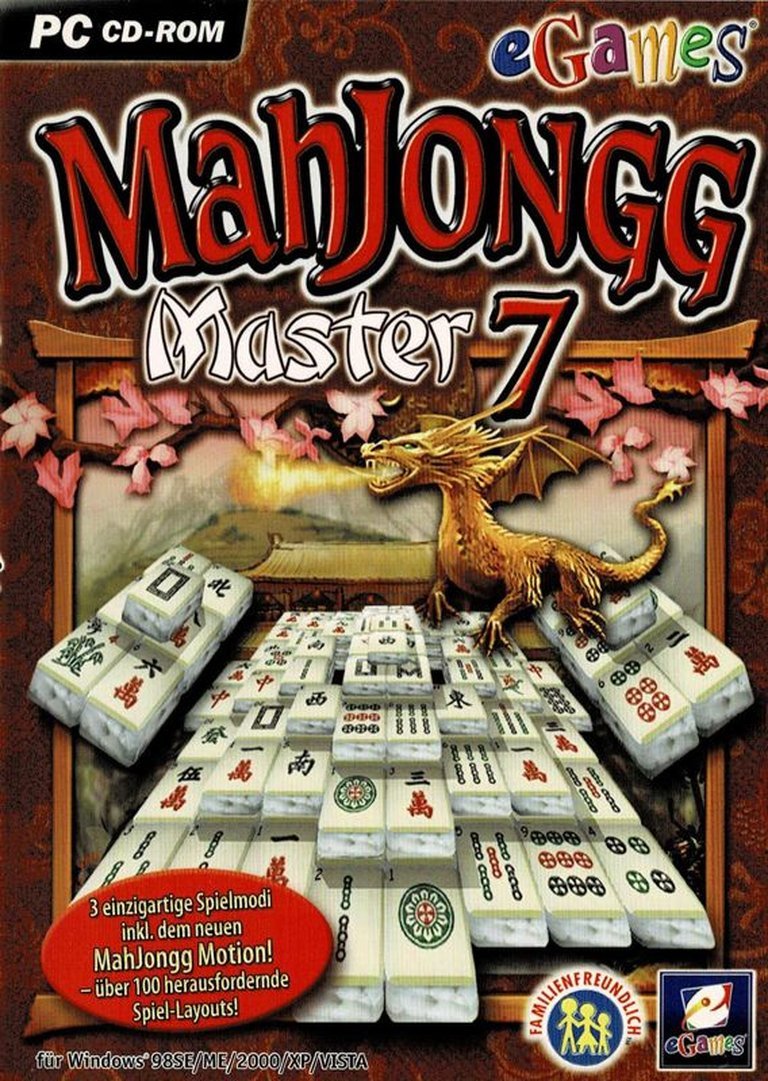
MahJongg Master 7 is a Windows-based puzzle game that focuses on Mahjong solitaire, offering players over 100 diverse tile layouts to solve. It includes a built-in editor for creating custom challenges and introduces the ‘MahJongg Motion’ mode for a dynamic twist. Released in 2007 by eGames, Inc., it features top-down and first-person perspectives with a point-and-select interface, blending classic tile-matching with digital innovation.
MahJongg Master 7: A Definitive Review of a Digital Tile-Matching Staple
Introduction: The Sparrows’ Digital Nest
In the sprawling ecosystem of puzzle games, few subgenres are as deceptively simple yet profoundly enduring as Mahjong solitaire. For decades, the gentle clack of virtual tiles has been a constant presence on personal computers, a digital pacifier for the mind. Nestled within this long lineage is the Mahjongg Master series from German publisher eGames, Inc., a quiet but persistent franchise that has iterated on the Shanghai formula since the late 1990s. MahJongg Master 7 (2007) represents a culmination of that iterative approach: a no-frills, feature-rich, and functionally timeless entry that prioritizes breadth and player creativity over flashy presentation. This review will argue that while MahJongg Master 7 is not a landmark of innovation, it is a masterclass in pragmatic game design and a crucial artifact in the history of digital Mahjong solitaire. It embodies the shift from proprietary, closed puzzle experiences to user-customizable platforms, serving both as a competent casual game and a powerful tool for the dedicated enthusiast. Its legacy is not in rewriting rules but in democratizing their creation.
Development History & Context: The Long Tail of a Simple Idea
The Mahjongg Master series emerged not from a single visionary auteur but from the commercial logic of the late-’90s/early-2000s casual and “classics” software market. eGames, Inc., operating from the United States but with a strong European presence (the game’s primary language on the Internet Archive is German), identified a reliable niche: the evergreen audience for computer adaptations of classic tile games. The series’ progenitor, MahJongg Master (1998), arrived as the solitaire variant was cementing its place in the computing mainstream, largely thanks to the bundled Mahjong Titans in Windows XP (2001) and the enduring popularity of Activision’s Shanghai series.
The development of MahJongg Master 7 in 2007 must be understood against the backdrop of mid-2000s PC gaming. This was an era of waning dominance for full-price retail boxed software and the rising tide of digital distribution and casual web games (e.g., PopCap’s Bejeweled, Microsoft’s Solitaire Collection). For a publisher like eGames, survival meant producing low-cost, high-value products for a specific audience. The technological constraints were modest: the game’s listed specs (800 MHz Pentium, 128 MB RAM, 32 MB 3D graphics card) are testament to its lightweight, 2D-focused engine. The “3D-Grafikkarte” requirement was a standard boilerplate for games of the period that used even basic hardware acceleration for UI effects, not for any meaningful 3D rendering.
The gaming landscape for puzzle titles was bifurcating. On one side were the minimalist, free-to-play web incarnations (often Flash-based). On the other were the premium, feature-laden “deluxe” editions like MahJongg Master 7. This title’s primary innovation—the “MahJongg Motion” mode and the included layout editor—wasn’t a response to AAA competition but to the dedicated community. It acknowledged a truth long understood by Mahjong solitaire aficionados: the joy is as much in crafting the puzzle as in solving it. The release, a commercial CD-ROM product in 2007, was almost anachronistic, targeting the holdouts who preferred a permanent, offline, ad-free installation over browser-based ephemera. It is a game built for the enthusiast’s desktop, not the casual browser’s homepage.
Narrative & Thematic Deep Dive: The Story in the Stones
As a pure solitaire tile-matching game, MahJongg Master 7 possesses no traditional narrative, characters, or dialogue. Its “story” is entirely emergent and player-driven, rooted in the profound cultural heritage of the tiles it employs. This is where the game’s thematic depth, inherited from the centuries-old game it simulates, becomes its most powerful narrative device.
The tiles themselves are not mere graphical assets; they are a lexicon of Chinese iconography. Each set—Dots (Circles), Bamboo (Sticks/Chows), Characters (Craks)—represents a suit from the original money-suited card games, with their numeric progression (1-9) creating mathematical harmony. The Winds (East, South, West, North) and Dragons (Red, Green, White) are honor tiles that carry elemental and mythical weight. The optional Flower and Season tiles add a layer of poetic seasonal reference and auspiciousness. When a player surveys the pyramid (or turtle, or spider, or any of the 100+ layouts), they are not just looking at a puzzle grid; they are engaging with a fragmented, mandala-like representation of a cosmological order. The act of matching and removing pairs is a subtle metaphor for restoring balance, clearing chaos, and revealing a hidden, complete structure beneath the surface complexity.
The “MahJongg Motion” mode introduces a subtle but themically resonant twist. While the source material does not detail its exact mechanics, the name suggests animated tile removal or environmental dynamics (perhaps falling tiles or shifting structures). This moves the experience from a static pattern-matching task toward a more kinetic, almost meditative flow. It mirrors the real-life act of shuffling and handling the tangible, weighted tiles, introducing a sense of process and time that the static, click-to-remove model lacks. Here, the theme is impermanence and flow—the board is not a fixed sculpture but a dynamic system, and the player’s intervention causes a chain reaction, a small cascade of order.
Ultimately, the game’s narrative is one of focus and cognitive restoration. In an era of information overload, the dense, patterned field of tiles demands singular attention. The thematic goal is not to “save the princess” but to achieve a state of wu wei (effortless action) where the player’s perception syncs with the board’s geometry, and removal becomes intuitive. The game’s vast layout library and editor ensure this narrative of restoration never grows stale, offering endlessly new “worlds” to bring into order.
Gameplay Mechanics & Systems: Architecture of Engagement
At its core, MahJongg Master 7 is a faithful implementation of Mahjong solitaire (often called “Shanghai”). The rules are immutable: tiles are stacked in specific, pre-determined formations. A tile is “exposed” and selectable only if it is not covered by another tile and has at least one adjacent side (left or right) free. The player removes exposed, matching pairs (identical tiles, with the notable exception of most Flower/Season tiles, which typically match any other flower/season). The game is won when all tiles are removed; lost when no exposed matches remain, creating a deadlock.
Core Gameplay Loop:
1. Survey: Assess the entire board topology from a top-down or isometric perspective.
2. Identify: Scan for exposed, matching pairs, prioritizing tiles that are “blocking” others (often deeper in the structure).
3. Execute: Click a pair to remove them, causing the tiles above to “fall” down, potentially exposing new matches.
4. Re-assess: The board state has changed. Repeat until victory or deadlock.
The genius of this loop lies in its perfect balance of observation (pattern recognition), strategy (risk assessment—do I remove this pair now or save it to unblock a critical tile later?), and short-term memory. It is a puzzle of spatial reasoning and forward planning, not luck.
Innovative & Flawed Systems:
- The Layout Library (>100 Pre-Set Layouts): This is the game’s primary strength. It moves beyond the standard “turtle,” “dragon,” or “spider” to include hundreds of named patterns. This provides immense variety in board topology—from small, tight screens to vast, sprawling landscapes. The sheer volume ensures players can constantly find new challenges, adjusting to different spatial “grammars.”
- The Integrated Layout Editor: This is the game’s killer feature and its most historically significant contribution. In 2007, such a tool was not ubiquitous in casual puzzle games. It transforms the player from a consumer into a creator. The editor likely uses a simple tile-placing grid interface, allowing users to design their own puzzles, set specific tile distributions, and save them as new playable layouts. This fostered a community (though not officially supported here) of sharing custom puzzles, extending the game’s lifespan indefinitely. It acknowledges that the puzzle’s architecture is as important as its solution.
- “MahJongg Motion” Mode: As noted, this is the new addition. In the absence of a physical review, one can infer its function is to add visual dynamism—perhaps animating tile removal with a satisfying slide or fade, or introducing subtle environmental motion (like a slow camera pan or background animation). It serves a purely aesthetic and experiential purpose, aiming to enhance the “zen” quality of play, reducing the static, click-heavy feel.
- Flaws & Omissions: By modern standards, the game is minimalist to a fault. There is no hinted “undo” function mentioned, a critical tool for learning and experimentation in modern solitaire Mahjong. There is no hint system to assist when a player is stuck, nor a progressive difficulty curve or “story mode.” The scoring is likely purely based on time and/or number of moves, with no elaborate point system for special combos. The UI is functional but dated by 2007 standards. It offers no social or online features (the “Internet-Zugang für Internet-Features” is noted as nicht länger verfügbar—no longer available), isolating the experience to the single player. This is both a strength (no distractions) and a limitation.
World-Building, Art & Sound: The Aesthetic of Calm
The “world” of MahJongg Master 7 is the abstract, topological space of the tile layout itself. The atmosphere is one of quiet concentration, a digital extension of the traditional Mahjong parlor’s focused silence.
Visual Direction: The game uses the standard, crisp, and colorful tile set typical of Western digital Mahjong. Tiles are 2D sprites, clearly differentiating the three suits (Dots as circles, Bamboo as sticks, Characters as Chinese numerals) and the honors. The backgrounds are often simple, solid colors or subtle patterns to avoid visual noise that would interfere with tile recognition. The perspectives toggle between a straight-down “god view” and a slight 3/4 isometric “perspective,” as listed in its MobyGames attributes (“1st-person, Top-down”). This limited camerawork was standard for the era, allowing the player to see depth in the stacks without complex 3D rendering. The art is utilitarian, prioritizing clarity and instant tile identification above all else—a fundamental requirement for a puzzle game’s UI.
Sound Design: The source material provides no specifics, but the genre convention is clear. The soundscape is sparse and functional:
* Tile Sounds: A distinctive, satisfying clack when tiles are placed at the start, and a sharper click or thump upon removal. A cascading shuffle sound when a layer clears. These sounds are the primary auditory feedback, crucial for confirming player actions.
* Ambient/Background: Likely a choice of a few loops of quiet, contemplative music—often new-age, ambient, or soft Eastern-inspired melodies—or the option for silence. The goal is to be calming, not intrusive.
* UI Sounds: Subtle beeps or chimes for errors (trying to select an invalid tile) or victories.
These elements combine to create a sensory environment designed for cognitive flow. The visuals are high-contrast and clear, the sounds provide rhythmic, non-startling feedback. It’s an anti-stimulus package, deliberately engineered to lower heart rate and focus attention. It doesn’t build a “world” in a narrative sense but cultivates a headspace, making the act of solving the puzzle the sole and singular reality.
Reception & Legacy: The Quiet Workhorse
MahJongg Master 7 exists in a curious critical void. On aggregators like MobyGames and Metacritic, it has no critic or user reviews (“n/a” score). This is not an indictment of its quality but a reflection of its positioning. It was not a mainstream release covered by gaming press. It was a budget or mid-priced utility title sold in software bundles, through online retailers like Amazon, or in the “games” sections of computer stores. Its audience was not “gamers” in the conventional sense but puzzle enthusiasts, retirees, and people seeking a non-violent, mentally engaging way to pass time.
Its commercial success is therefore inferred from the longevity of the series. The fact that eGames released MahJongg Master 8 and a Jubiläumsausgabe (Anniversary Edition) after this 2007 title indicates it found a sustainable market. Its true reception is measured in its functional reliability and feature set compared to its peers (e.g., Moraff’s MahJongg, World Mahjong, Shanghai sequels). In that context, the inclusion of 100+ layouts and a user editor was a significant value proposition.
Its legacy is twofold:
- As a Steward of the Format: In the mid-2000s, it stood as a competent, full-featured representative of the digital Mahjong solitaire genre. It preserved the core ruleset with fidelity while offering substantial content.
- As an Early Advocate for User-Generated Content: The layout editor is its most historically important feature. Long before “UGC” (User-Generated Content) became a buzzword in major franchises, a small PC puzzle game was giving players the tools to become designers. This aligns with a broader trend in mid-2000s casual and indie gaming (think TrackMania‘s track editor, Spore‘s Creature Creator) that empowered players to extend a game’s life infinitely. For the Mahjong solitaire community, this feature is everything. It turns a static game into a creative platform.
Conclusion: Verdict and Historical Position
MahJongg Master 7 is not a game to be judged by the metrics of cinematic storytelling or mechanical innovation. Its cousins are not The Legend of Zelda or Portal, but Microsoft Mahjong Solitaire, Mahjongg Dimensions, and Shanghai. Within this family, it is the pragmatic, well-equipped, middle child.
Its strengths are its immense layout variety, the unparalleled power of its included level editor, its clean and functional UI, and its unwavering focus on the singular pleasure of tile-matching. It is a game that understands its purpose completely and executes it without bloat.
Its weaknesses are its dated presentation (even for 2007), its lack of modern amenities like robust undo/hint systems, its complete absence of online play or community integration, and its thematic anonymity beyond the tile set itself.
Final Verdict: MahJongg Master 7 is a curator’s game. It is the definitive digital toolbox for the Mahjong solitaire purist. Its historical significance lies in its role as a bridge—carrying the simple, contemplative joy of the genre from the early shareware era into the modern age of user-generated content. While it was likely overlooked by the games press and remains critically undocumented, it holds a revered place for those who find endless solace in its stacks of tiles. It is not a masterpiece of game design, but it is a perfectly serviceable, generous, and enduringly useful artifact from the golden age of desktop puzzle games. For the historian, it marks a moment where digital Mahjong solitaire matured into a customizable platform. For the player, it offers hundreds of hours of quiet, cerebral engagement with one of humanity’s oldest game forms, faithfully rendered for the PC.